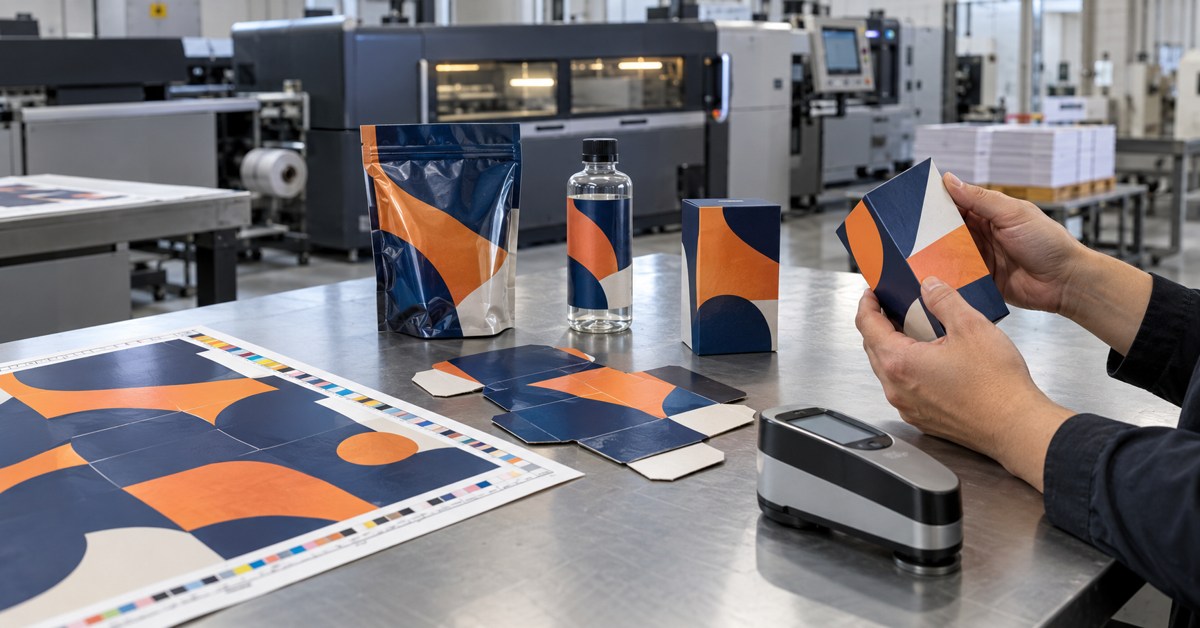
A new substrate runs through the press. The image is clean, transfer appears complete, and the first adhesion check passes. A convincing sample is placed on the table. Production appears ready to proceed.
Yet the sample has not experienced the process that will turn it into the product the customer receives.
Consider three illustrative situations. A printed carton develops a pale line when folded. A film prints consistently but separates within the laminated structure. A label passes initial adhesion screening, yet its printed surface scuffs during handling after application to the bottle. These outcomes differ and may involve different mechanisms. What they share is an approval decision that did not cover everything the product needed to do.
My starting point is simple: qualification must state what has been demonstrated, under which conditions, and for which application. A successful print trial is valuable evidence. It may justify the next converting trial. It does not automatically authorize commercial release of a finished package.
Equally, a downstream failure does not automatically prove that the substrate is unsuitable. Conditioning, mechanical contact, coating application, or another process condition may have changed. The investigation must establish the cause before rejecting a material or replacing a familiar chemistry.
This distinction matters particularly in digital printing. Short preparation times make it easier to produce new versions and persuasive samples quickly. They do not necessarily shorten the time needed for a bond to develop, a laminate to become ready for conversion, or a carton to demonstrate acceptable folding performance. Fast sample production and fast qualification are separate achievements.
For production managers, material specialists, and quality teams, the practical challenge is to qualify the complete construction without testing everything indiscriminately. That means identifying the important interfaces, choosing relevant tests, and understanding which decisions the results actually support.
The question is not simply whether we can print the next sample. It is whether we know enough to release the next product with confidence.
Define what is actually being qualified
In a pressroom, a material may be described as "approved for digital." The statement sounds complete until we ask a few more questions. Approved for which ink system? Which side? With what primer, protective coating, and converting route? For what end use?
An approval without boundaries can gradually become broader than the evidence behind it.
The useful unit of qualification is the combination of material, process, and product. A surface-printed flexible film protected by varnish is not the same construction as a reverse-printed film buried inside a laminate. Even when the base polymer is identical, the interfaces and exposures differ. A label applied to a dry bottle is not automatically qualified for condensation or immersion.
For folding cartons, grammage and caliper alone do not describe coating integrity, fiber direction, moisture, or ply strength. Two commercially similar boards can behave differently during creasing and gluing. For films, a polymer name does not fully describe the additives, topcoat, treatment history, or storage conditions that determine the surface when it reaches the press.
I would therefore begin with the application and work backward. Will the package encounter refrigeration, heat, repeated rubbing, or flexing? Will it be filled before shipment? Which areas will contact adhesive? Which printed surfaces will remain exposed? Those answers should shape the test plan.
It is also worth separating supplier qualification from the converter's production qualification. Supplier evidence can reduce uncertainty and guide testing. Its relevance depends on whether it covers the proposed construction and process. A certificate is useful when its scope is understood.
Qualification establishes tested conditions; it does not guarantee that every future unit will be acceptable. Routine production control must show that the job remains within those conditions. A change in material, supplier, coating, or drying requires an impact review. Sometimes a focused check is sufficient. Sometimes a broader trial is justified.
Finally, keep development approval, controlled production trials, and commercial release distinct. A promising sample may deserve further investment while still lacking evidence for final use. Recording that distinction allows progress without presenting unfinished work as a completed qualification.
In digital printing, a correct image is only the beginning
Digital printing is a family of technologies, not a single physical mechanism. In liquid electrophotography, charged particles form an image that is transferred through an intermediate surface to the substrate. Inkjet forms the image through droplets, with drying or curing requirements that depend on the ink system. Process instructions should not move between technologies merely because both are digital.
In a blanket-transfer process, a correctly formed image does not prove that the resulting bond to the substrate is adequate. The receptive surface, transfer conditions, and material compatibility still need evaluation. Temperature and pressure can influence transfer and the interface, but they are not substitutes for diagnosis. Raising either outside a validated range can introduce another problem, particularly with heat-sensitive or dimensionally unstable materials.
Primer performance also depends on more than formulation identity. The dry functional layer reflects solids content, application, local coverage, and drying. An apparently continuous coating may vary across a rough or absorbent surface. Adding primer without measuring the effect can increase drying demand or alter winding and stacking behavior.
When a failure appears, I would first separate image formation, transfer, and anchorage. Is part of the image missing? Has the image transferred but can be detached? Does the printed layer remain intact while lifting with the substrate coating? These observations lead to different investigations.
A useful trial includes a control material with a known production history alongside the new substrate, under recorded conditions. If both fail, investigate process conditions and the test method as well. If only the new material fails, the comparison helps narrow the investigation, but it does not yet identify the responsible component.
Artwork also belongs in the trial definition. A lightly printed test image may not represent solid areas, white-ink coverage, fine text, or heavy ink combinations in the commercial job. Include representative features where they could affect performance, and retain the file version used.
Digital printing makes focused trials practical. To learn from them, preserve sample identity and keep track of the variables. Ten undocumented samples may reveal less than two properly designed comparisons. Speed becomes useful when it shortens the path to a defensible decision.
Choose tests that answer the right question
Wetting, adhesion, and durability are related, but they are not measured in the same way. A wetting test describes how a test liquid behaves on a surface at the time of testing. It does not directly measure the bond that develops after the primer dries or after printing. A strong initial bond, in turn, does not establish durability throughout use.
A tape test can provide practical screening for ink or coating adhesion. However, tape identity, application, and removal affect the result. ASTM F2252/F2252M addresses evaluation on flexible packaging materials and emphasizes control of test conditions. It does not establish universal acceptance criteria; the relevant parties must agree on them. Its scope is also limited to surfaces that are not damaged by applying and removing the tape. [1]
After a peel or tape evaluation, examine both sides of the separation. Ink on the tape does not by itself explain whether ink separated from primer, primer separated from substrate, or a weak substrate coating was removed. You may need magnification or analytical examination to locate the fracture plane. Separation at an interface and failure within a layer are different mechanisms.
Rub resistance is another question. A pale mark can result from material loss, but also from a change in gloss or local surface texture. Controlled rub testing compares performance under specified contact conditions. ASTM D5264 provides one such approach for printed materials. A favorable result does not establish resistance to every form of handling, moisture, or cleaning chemistry. [2]
A useful report records the specimen condition, applied stress, method, and observed failure. "Passed" without method details is incomplete information. A peel-force value without a failure description can also mislead: a result involving substrate tear is not necessarily equivalent to clean separation between layers.
Define acceptance before the comparison. Is a visible gloss change acceptable? Is damage near a fold treated differently from damage across a display panel? Does the evaluation include code readability? The answers depend on the product, not on which sample looks best after the test.
The laboratory reduces uncertainty through repeatable testing. A production trial checks whether that conclusion remains valid along the actual route. Both are needed where the risk warrants them. A controlled test is most useful when we understand what it represents and what it leaves untested.
Time and conditioning belong in the specification
A specimen tested immediately after printing and one tested the following day may be in different physical states. Temperature, moisture, liquid removal, and the development of layer properties can change with time. The implications depend on the chemistry and construction. No single waiting period applies to every ink, primer, varnish, and adhesive.
Drying, cooling, and curing also differ. The surface can feel dry while still not ready for the next stress. Conversely, not every system relies on chemical curing. Where curing does occur, touch alone cannot establish that the required state has been reached. Instructions should follow material data and validation under the actual process conditions.
On a largely nonabsorbent film, removing water from an aqueous primer depends mainly on evaporation. Paperboard may absorb part of the applied liquid, affecting its moisture balance. Do not carry the same drying assumptions across both materials. Even equal line speeds do not prove equal thermal histories.
Conditions inside a roll or stack can also differ from those measured in the room. Winding pressure, stack height, and material temperature affect surface contact. A single sheet cooling on a table may not represent one held in the center of a warm stack.
"Wait until tomorrow" is therefore weaker than a defined conditioning instruction that states the conditions and the point from which elapsed time is counted. During qualification, compare relevant time points against the requirements and establish a workable production window. One early result cannot prove that every shorter interval is unacceptable or that every longer interval is safe.
The handover between departments should carry this information. A roll delivered to lamination needs more than a job number. The receiving team needs to know its production status, relevant preparation history, and whether the required conditioning is complete. Otherwise, an assumption can become a process setting.
Conditioning must also appear in production planning. If a construction requires a validated interval before lamination, slitting, or filling, that interval is part of the real lead time. Removing it to save hours can transfer the cost to rejects and complaints. Efficiency begins with understanding how long the product needs and how long the press spends printing it.
Follow the actual converting route
In laminated flexible packaging, the printed image becomes part of a multilayer construction. The laminating adhesive may contact printed areas, white ink, or unprinted film. Evaluation should cover representative areas, not merely a convenient strip cut from the web. Ink adhesion before lamination matters, but does not establish the strength of the completed laminate.
Define the adhesive condition, lamination settings, conditioning, and observed separation plane. ASTM F904-22 addresses ply separation for bond-strength testing of laminated flexible materials. Specimen preparation is not a substitute for an appropriate measurement method and acceptance limit. [3] Laminate bond strength, seal strength, and package leak integrity are separate characteristics and require evidence appropriate to each requirement.
For folding cartons, the printed structure experiences changing geometry. During folding, the outside stretches while the inside compresses. Creasing, caliper, fiber direction, and moisture influence the response. A pale fold line may reflect cracking in a coating or substrate; it does not automatically indicate poor ink adhesion on a flat surface.
Evaluate the glue joint where it will actually be made. If the glue flap is covered by ink or varnish, the adhesive encounters that surface rather than the one originally intended. An uncoated glue area, a compatible coating, or a process adjustment is a design decision to validate, not a universal remedy.
Label qualification continues through die cutting, matrix stripping, dispensing, and application. Bottle radius, surface condition, application temperature, and subsequent exposure can reveal weaknesses that a flat sample may not show. Ink adhesion to the facestock and label adhesion to the bottle are different systems.
Test the relevant sequence as well as individual stresses. For example, a product may encounter condensation before rubbing, or folding before shipment. Where that sequence is part of intended use, isolated tests may not represent the combined exposure. Define the sequence from the real application rather than inventing an unnecessarily severe test.
No product needs every available test. The task is to match testing to plausible failure mechanisms. An irrelevant test adds cost without necessarily adding confidence. An omitted test at a genuine risk point can leave the customer to perform the experiment on our behalf.
Turn a successful trial into repeatable production.
Consider an illustrative carton trial. Printing and tape screening are satisfactory, but the surface scuffs in the folding machine. Replacing the primer may seem reasonable. First, however, determine whether the mark involves ink removal, gloss change, varnish damage, or lifting of the board coating. Compare specimens before and after folding and check whether the mark follows a guide, belt, or roller position.
If the ink remains anchored and concentrated contact creates the mark, the investigation shifts toward protection and contact conditions. The protective coating or varnish may be unsuitable, conditioning may be insufficient, or a mechanical component may be worn. Changing several factors at once may produce a good sample while leaving the team unsure what to maintain to reproduce it.
Begin with focused comparisons against a control. Where interactions are suspected, a designed experiment can examine multiple variables systematically. Record results that contradict the initial hypothesis. Evidence that a primer change does not affect the failure can prevent another unnecessary production trial.
Once you find a solution, check whether it works throughout a run. Samples from the start, middle, and end, and, where relevant, after a stop and restart, help reveal time-dependent changes. Sampling scope depends on requirements and variability. No universal sample count validates every process.
Include the intended operating window in the decision. A setting that works only at a narrowly controlled point may be unsuitable for routine production. Evaluate relevant, realistic variation within proposed limits rather than deliberately pushing materials beyond their qualified range. The aim is to understand available margin, not to discover the maximum punishment a sample can survive.
Release needs a named decision owner. Production confirms execution conditions, quality reviews the evidence, and the authorized person approves conformity. Any accepted deviation should be explicit, limited, and documented. Silence between departments is not approval.
Define what reopens the decision: changes in substrate, coating formulation, ink system, application components, converting route, or end-use requirements. Starting from zero is not always necessary. An impact review should identify which evidence remains applicable and which must be renewed. Qualification then remains a working production tool, not a file forgotten after launch.
Measure success at the finished product.
A fast press run that stops in converting is not necessarily an operational success. To understand performance, examine how many acceptable products were completed, what was required to finish them, and which resources were lost. Higher printing speed has value, but that value falls if it increases waste, rework, or stock waiting for a release decision.
The same reasoning applies to sustainability. A lighter structure or a recycled-content grade may be desirable, but you must evaluate its effect on finished-product performance. If it requires more coating, additional drying energy, or causes more rejects, those effects belong in the assessment. Waste prevention alone does not prove an overall environmental advantage; that comparison requires data and consistent assessment boundaries.
Efficient qualification is staged. Check basic suitability first and stop unpromising trials early. Then validate critical interfaces, complete the relevant converting route, and evaluate the finished product. Scale up when the evidence supports it. This uses digital printing's flexibility to learn quickly without turning a customer order into an uncontrolled experiment.
Alongside results, retain material identity, setting versions, and test conditions. Such records help teams compare cases and recognize patterns. Prediction, however, does not replace validation when a new combination enters production. A useful information system should reveal missing evidence as clearly as it displays a successful result.
Before commercial release, I would want the team to answer a short set of questions: What exact construction was tested? Did it use representative artwork and production conditions? Did it complete the relevant conditioning and converting sequence? Were failure mechanisms and acceptance criteria defined? Who approved release, and what changes require a new review?
These questions connect materials, digital workflow, operational efficiency, and sustainability. A local success becomes an industrial success when the rest of the process can rely on it.
The printed sample is an important milestone, but our responsibility continues beyond it. A product is ready for release when evidence supports its defined appearance, function, and durability under known production and use conditions. That is not a promise that it will never fail. It is a clear account of what has been demonstrated and what remains outside the qualification.
I believe the next advance in industrial printing will be a better ability to predict and preserve finished-product performance, not merely to produce an acceptable sample. Shared knowledge across materials, printing, and converting teams will make that ambition useful in everyday production decisions.
At what stage does your team give final approval to a new substrate, and which test most recently changed your release decision?
Technical references
The references below support the distinctions between adhesion testing, abrasion resistance, and preparation of laminate specimens. References to standards use their publicly available scope and significance statements. They do not replace the complete applicable edition when implementing a method. Acceptance criteria, test conditions, and sampling plans must suit the product and its requirements.
[1] ASTM F2252/F2252M-25. Standard Practice for Evaluating Ink or Coating Adhesion to Flexible Packaging Materials Using Tape. Relevant to test control and agreed acceptance criteria.
[2] ASTM D5264-98(2019). Standard Practice for Abrasion Resistance of Printed Materials by the Sutherland Rub Tester. Relevant to comparison under controlled contact conditions.
ASTM abrasion resistance practice
[3] ASTM F904-22. Standard Practice for Separation of Plies for Bond Strength of Laminated Flexible Materials. Distinguish specimen preparation from measurement and acceptance.
For more on substrate surfaces and primers, see my articles "Dyne Level Is Not Adhesion" and "Primer Is the Interface."
Further reading
For readers who would like to explore these topics further, I have written books on industrial printing and packaging. You can find my books on my Amazon author page.