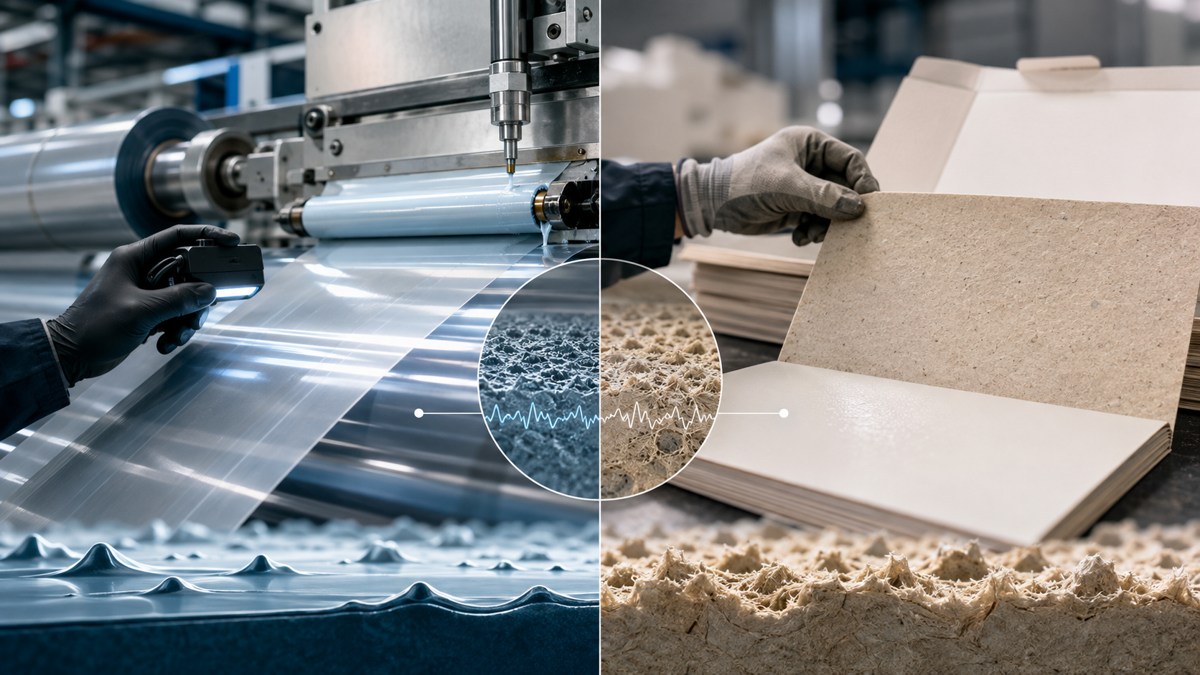
One of the biggest changes in industrial printing is not happening inside the press. It is happening in the material portfolio.
Printers are being asked to run more substrates, constructions, and grades than before. Customers want lighter materials, recyclable structures, recycled content, fewer layers, and commercial grades that are readily available rather than developed specifically for one printing process.
For the pressroom, this creates a practical problem. A new substrate may carry a familiar commercial description and still behave very differently at the press. One polypropylene film is not qualified because another polypropylene film printed well. A folding-carton board is not qualified because its grammage and caliper resemble the previous grade. A material described as digitally printable is not automatically suitable for every printing, coating, and converting route.
This is why primer matters far more than its modest position in the production sequence may suggest. Primer is not simply there to help the ink stick. Its real job is to create a controlled interface between a variable substrate and a printing process that requires a repeatable surface. As the material portfolio expands, that interface becomes increasingly important.
New substrates are arriving faster than qualification habits.
New materials enter production for many reasons: cost pressure, supply disruption, customer requests, sustainability targets, or the need to replace a specially developed grade with a standard commercial product. Recycled-content paperboard deserves particular attention. It can be an excellent printing material, but changes in fiber composition and base-sheet uniformity can place greater demands on coating, surface strength, smoothness, porosity, and moisture control.
This does not mean that every recycled board is rougher or less printable than every virgin-fiber board. A well-manufactured and well-coated recycled board can provide an excellent printing surface. The more useful conclusion is that recycled-content grades may introduce a different level or type of surface variability, depending on how they are manufactured. The primer meets the surface that actually arrives in production, not the sustainability statement on the specification sheet.
Film and paperboard present different primer problems
Synthetic films such as PE, PP, BOPP, and PET often begin with a surface-chemistry challenge. Many untreated polymers have relatively low surface energy and may not allow a liquid to wet the surface sufficiently. Corona or another suitable surface-preparation process may therefore be required before priming or printing. Treatment improves wettability, but it does not by itself prove final adhesion.
Folding-carton board starts from a different physical structure. It is a layered fibrous material whose behavior depends on fiber composition, pigments, coating binder, surface sizing, porosity, surface strength, moisture, smoothness, caliper, and fiber direction. You must also consider the mechanical demands of die cutting, creasing, folding, and gluing. Board qualification therefore cannot be reduced to a dyne target.
On film, the task may be to make a chemically reluctant surface receptive. On board, it may be to make a porous, irregular, or chemically incompatible coating behave as a consistent printing surface. Primer can support both objectives, but it solves a different problem in each case.
Primer expands a qualified window.
Without a suitable primer, every new substrate must present the surface chemistry required by the printing process. A properly qualified primer creates a functional layer between the base material and the printed image. On film, it can bridge the difference between polymer-surface chemistry and ink chemistry. On board, it can reduce the process's dependence on the original coating's exact behavior and provide a more consistent receptive surface.
That makes primer a valuable enabler when you need to introduce commercial off-the-shelf materials quickly. But primer must not hide a bad substrate. Contamination, weak board coating, excessive Roughness, physical instability, or an unsuitable topcoat cannot be corrected simply by applying more primer. Primer can expand a qualified process window; it cannot remove the need for qualification.
Water based does not describe one chemistry.
Many primers used in industrial digital printing are water based. That description identifies the carrier before drying, not the functional layer that remains on the substrate. Once drying is complete, most of the water has left the coating. Performance depends on the remaining polymeric layer and how it was applied and dried.
Different aqueous primers may use acrylic, ethylene-acrylic, polyurethane, or other functional polymer systems. They can differ substantially in solids, viscosity, rheology, coat-weight requirement, drying demand, storage stability, and intended production route. Water based is therefore not a sufficient primer specification. Never treat two water-based primers as interchangeable without qualification.
Surface roughness must become part of the discussion.
Pressrooms often describe a substrate as smooth, rough, glossy, or matte. Those descriptions are useful, but qualifying a new surface requires objective data. One useful parameter is Ra, the arithmetic mean height of the roughness profile. In practical terms, Ra describes the average magnitude of microscopic height deviations from the mean line over the defined evaluation length. It is commonly expressed in micrometers.
Use Ra for the question it answers. It describes physical topography. It does not show whether a surface is chemically receptive, whether the liquid will wet it, whether the ink will remain attached, or whether a board coating has sufficient internal strength. A low Ra is not proof of adhesion, and a higher Ra is not proof of failure.
Ra and wetting are not the same measurement.
This distinction matters most on synthetic film. A film can have a very low Ra and still wet poorly because its surface energy is too low. Another film may have a higher Ra and still wet acceptably. Ra describes geometry; a wetting or dyne evaluation provides information about liquid behavior on the surface. Neither measurement alone proves adhesion.
Dyne methods also require discipline. Results depend on the defined method, the condition of the test fluid or pen, operator technique, elapsed time, contamination, and the age of the treated surface. A dyne value is useful process evidence, but it should not be promoted into a universal pass-fail statement for the final printed construction.
Why Roughness changes primer coverage
Primer is usually applied as a thin functional layer, so surface geometry matters. On a relatively flat surface, the liquid can form a more uniform film. On a surface with deeper microscopic valleys and higher peaks, the same average coat weight may produce a very different local distribution. Lower areas may retain more liquid while peak areas receive less effective coverage.
The actual result also depends on wetting, solid-surface energy, liquid surface tension, rheology, leveling, absorption, application dynamics, and drying rate. Roughness alone cannot predict coverage, but it helps explain why a coat weight that worked on one grade may not create the same functional interface on another. The answer is not automatically to increase coat weight: excess primer can create drying, blocking, optical, winding, or downstream-converting problems.
Recycled board needs evidence, not assumptions.
A recycled-content folding-carton grade may present a different topography or greater local variation than the board it replaces. The base fiber structure may be less uniform, the coating may interact differently with the base sheet, and porosity or smoothness may change. The board may still meet its commercial specification while presenting a meaningfully different surface to a very thin primer layer.
Primer can provide a more controlled receptive layer where the original surface does not meet the needs of the printing process. However, if roughness or porosity changes significantly and the application volume stays the same, nominal coat weight may not tell the full story. The correct response is investigation and testing, not automatic correction.
Ra is not the only roughness method for board.
Paper and paperboard suppliers commonly report air-leak methods such as Parker Print-Surf, Bendtsen, or Sheffield. Parker Print-Surf, or PPS, evaluates air leakage between the sheet and a reference surface under defined clamping pressure intended to represent printing contact. It is a different physical method from profile measurement.
A PPS result and an Ra result must therefore not be compared as if they were interchangeable. If the supplier specifies PPS, record the PPS value and its test conditions. If you use profilometry for development or troubleshooting, Ra may provide additional information. A roughness number without its method, settings, and sampling condition is incomplete data.
Roughness is not surface strength.
A smooth board can still fail mechanically. The primer may coat well and the printed image may initially show excellent adhesion, yet the printed layer may later lift together with part of the board coating. In that case, the primer may have bonded successfully to the coating while the weak interface remained underneath it.
This is why the fracture plane matters. Did the ink separate from the primer? Did the primer separate from the substrate coating? Did the coating detach from the board? Was there fiber tear? Did failure appear only after creasing? Did the glue seam contact ink or varnish instead of an intended bonding surface? Poor adhesion is not a diagnosis. Identifying the fracture plane is the starting point of the diagnosis.
Inline and offline priming create different material histories
An inline route may include surface preparation, primer application, drying, and printing. The interval between creating the interface and using it is short. The primed surface normally does not need to survive extended storage before printing.
An offline route adds cooling, rewinding or stacking, handling, storage, and later printing. Time now becomes part of the material specification. The coating must remain stable, resist blocking, tolerate handling, and retain the intended print receptivity until it reaches the press. Offline systems may therefore use a different formulation and coat-weight strategy from an inline system. Solids content and viscosity are formulation-specific values, not universal inline or offline targets.
There are two shelf lives to control
The first shelf life belongs to the liquid primer. It depends on the formulation, packaging, storage temperature, contamination control, and whether the container is unopened, opened, or connected to a circulating system. The applicable period must come from the current technical data for that formulation.
The second shelf life is the qualified interval between priming the substrate and printing it. For an inline route, that interval may be minutes. For an offline route, it may be much longer when the chemistry, coat weight, handling, packaging, and storage conditions have been validated. Never confuse these two shelf lives. A liquid primer may still be within its storage period while a previously primed roll is outside its qualified printability window, or vice versa.
Viscosity, solids and the anilox form one process
Water can evaporate while an aqueous primer circulates. The nonvolatile material remains, so viscosity and solids concentration may increase over time. That can change transfer even when the anilox has not changed. An operator may truthfully report that no setting changed while the coating process gradually shifted.
Therefore, record viscosity using a defined method. When using a flow cup, record the cup, temperature, and time. When using a rotational instrument, follow the defined spindle, speed, temperature, and procedure. Viscosity OK is not a measurement.
Do not add water just because a primer looks thick. Some formulations permit controlled adjustment with deionized water; others are supplied ready for use. Dilution changes viscosity and solids, and solids determine how much functional material remains after drying. Measure any permitted correction, mix thoroughly, recheck, and confirm against coat weight and final performance.
Primer chemistry cannot be separated from the coating system. Anilox volume and cell geometry, transfer efficiency, primer rheology, speed, pressure, drying, and substrate behavior all contribute to the final dry layer. Changing the primer can change the coating process window even if the hardware settings remain unchanged. The application and drying conditions must therefore be requalified.
Drying film and drying board are different jobs.
A synthetic film is essentially nonabsorbent, so most of the water must leave by evaporation. Incomplete drying can leave the interface unready for printing and may create blocking when a warm or insufficiently dried web is rewound.
Paperboard can absorb part of the applied liquid, depending on its coating and porosity. That introduces moisture into a structure whose dimensional stability and converting behavior depend on moisture balance. Excess application or inadequate drying can affect curl, stack behavior, creasing, and later converting. Film and board should not share drying assumptions just because the primer is water-based.
The finished product is the final qualification.
Do not qualify a primer only at the press. A flexible package may still pass through lamination, adhesive curing, slitting, pouch making, and sealing. Once an image has been printed, the laminating adhesive may contact the printed layer, white ink, or another functional surface rather than the original film. A raw-film dyne result does not prove the strength of that final interface.
For folding cartons, qualification continues through coating or varnishing, die cutting, creasing, folding, and gluing. Evaluate rub resistance, surface lift, fiber tear, crease cracking, glue performance, and the requirements of the intended end use where relevant. A beautiful sheet at press delivery is not the final product. If the construction fails during converting or use, the material and process qualification is incomplete.
A practical sequence for a new substrate
When an unfamiliar commercial grade enters the pressroom, I would build evidence in a controlled sequence rather than begin with a full production order:
Identify the material precisely. Record supplier, grade, lot, side, construction, caliper, and applicable certificate or specification. For film, include polymer, treatment side, and any topcoat. For board, include recycled content, coating construction, moisture, fiber direction, and available surface data.
Measure the incoming surface with the appropriate method. For film, this may include a controlled wetting or dyne evaluation and, when relevant, surface topography. For board, record the specified smoothness or roughness method, such as PPS, and use profilometry only as a clearly identified additional method.
Define the primer condition. Record formulation or approved primer family, batch, solids, viscosity, storage condition, permitted adjustment, and the qualified interval between priming and printing.
Verify application and coverage. Record anilox or application configuration, wet application volume where available, dry coat weight, speed, pressure, and evidence of uniform coverage. Do not rely on average coat weight alone when surface structure has changed.
Dry according to the substrate. Confirm the primer is functionally dry without overheating the film or disturbing the board's moisture balance and dimensional behavior.
Print under controlled conditions. Keep the test condition traceable and include a suitable control material so you can distinguish substrate effects from normal press variation.
Locate the fracture plane. Use appropriate adhesion, rub, peel, or bond-strength tests for the construction. Document whether failure occurs at the ink-primer, primer-substrate, coating-board, fiber, adhesive, or other interface.
Complete the real converting route. Test lamination and sealing for flexible packaging, and coating, die cutting, creasing, folding, and gluing for cartons. Include end-use requirements that are relevant to the product.
This sequence takes longer than loading the material and judging the first printed image. It takes far less time than discovering the weakness during a customer order.
The material name is no longer enough.
Pressrooms will continue to receive materials that are close to a qualified grade but not identical: a different BOPP grade, a new PET construction, a recycled-content folding-carton board, a revised coating formulation, or a print-ready commercial stock introduced because the usual material is unavailable. The temptation is to classify the material by name and move on.
The press does not print the commercial name. It prints the surface. On synthetic film, that surface is defined by polymer chemistry, additives, treatment, coating, contamination, aging, and topography. On paperboard, it is defined by fibers, coating, porosity, moisture, surface strength, Roughness, and manufacturing history.
Primer gives us a powerful way to make those surfaces more predictable, but it doesn't eliminate the surface underneath. The better we understand the incoming material, the more reliably we can use primer to create the interface that the printing process requires.
Know the material, not only its name.
Measure the surface you actually received.
Treat Roughness as geometry and wetting as surface behavior.
Use primer to build the required interface, not to hide a bad substrate.
Control viscosity, solids, coat weight, application, and drying as one process.
Follow the product through converting before calling the material qualified.
That is how a new substrate becomes a production material rather than a production experiment.
When a new substrate enters your pressroom, which parameter do you verify first, and which failure is most often discovered only during converting?
Technical references
TAPPI/ANSI T 555, Roughness of paper and paperboard, Print-surf method
Evaluation of Recycled Paperboard Properties and Characteristics
Further reading
For readers who would like to explore these topics further, I have written books on industrial printing and packaging. You can find my books on my Amazon author page.