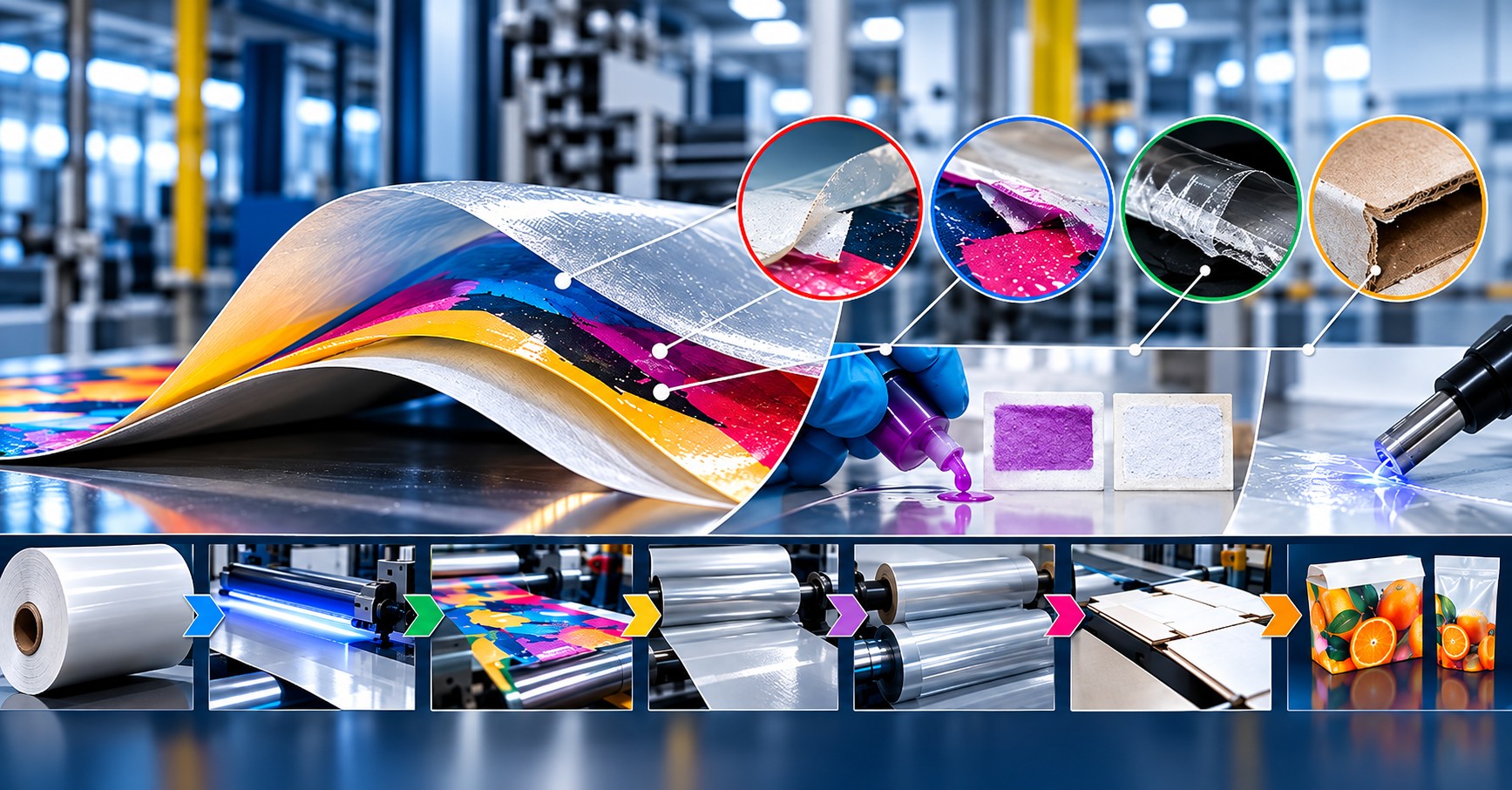
A food package can look flawless. Color is accurate, the ink film is stable, rub and adhesion tests pass, and the laminate appears ready for the filling line. Yet small chemical constituents can sometimes move from ink, coating, adhesive, or substrate into the food. This type of transfer is normally invisible during routine print-quality inspection.
Printing on the outside of a package does not automatically eliminate the risk. Compounds may permeate packaging layers, transfer by set-off when rolls or sheets are stacked, or move through the headspace. Risk depends on the chemistry of the complete structure, the type of food, contact time, temperature, and how the package is manufactured and used.
This guide focuses on decisions that printing and packaging teams can make: identify potential migration routes, select qualified systems, control the process, recognize warning signs, and commission appropriate verification of the finished package.
1. Direct food contact versus indirect food contact
Direct Food Contact (DFC) means the relevant surface physically contacts the food—for example, a tray surface on which food rests. If a printed ink layer itself is on that food-contact surface, the system needs explicit qualification for that contact and the intended conditions. An ink marketed as suitable for printing food packaging is not automatically suitable for direct contact.
Indirect Food Contact (IFC) means that ink is separated from food, often printed on the outside or trapped between layers. A reverse-printed polyethylene terephthalate (PET) film laminated to polyethylene (PE) may place the PE layer next to the food, but PE does not automatically prevent all low-molecular-weight compounds from passing through.
The same concern applies to paperboard: an exterior print can be physically distant from food, yet substances may pass through a porous board, contact the food-side surface via set-off, or enter the headspace.
Production rule: identify where the ink, adhesive, and coatings sit in the actual final layer stack; never infer safety solely from which face of the web is printed.
2. What migrates—and what does not?
Migration is the transfer of chemicals from packaging materials into food. It usually concerns mobile chemical molecules rather than intact pigment particles crossing an unbroken package wall. Ink formulations contain pigments, binders, oils or carrier liquids, additives, and sometimes curing materials. Even after the ink looks dry, certain small molecules may remain mobile.
Four mechanisms must be distinguished:
- Diffusion through the substrate: substances pass through one or more packaging layers until they may reach the food.
- Set-off during winding or stacking: the printed face touches a surface that later becomes the food-contact side, allowing transfer before the final package is formed.
- Gas-phase transfer: volatile and semi-volatile constituents move through air spaces and are absorbed by food, particularly relevant to some dry foods in paper and board packaging.
- Physical transfer: flakes of ink, coating debris, or particles reach the food because of scuffing, peeling, abrasion, or process contamination. This failure mechanism differs from molecular migration.
Odor is not the same as migration. An odor can signal a need for investigation without proving hazardous exposure, and the absence of odor does not prove the absence of migration.
3. Which substances have a greater tendency to migrate?
Migration potential often rises with molecular mobility, but migration potential and toxicological hazard are different questions. A relatively mobile compound may have low toxicological concern at the measured exposure; another compound may be tightly restricted at much smaller concentrations.
Constituent group | Typical concern | Practical verification |
|---|---|---|
Residual solvents | May remain mobile or volatile after drying | Residual analysis, drying control, intended storage conditions |
Unreacted monomers | Potentially mobile constituents | Chemical identity, curing, applicable substance limits |
Photoinitiators and breakdown products | Relevant to some ultraviolet (UV) systems | Substance-specific migration and curing verification |
Mobile oils and hydrocarbons | Potential transfer, particularly into certain fatty foods | Hydrocarbon composition, barrier, contact time |
Plasticizers and low-mass additives | Behavior varies by formulation | Compatibility, concentration and toxicological assessment |
Small oligomers | May be non-intentionally added substances | Screening and identification of relevant substances |
Stable insoluble pigments | Often lower molecular migration, but not a blanket exemption | Impurities, soluble constituents and physical transfer |
High-molecular-weight binders | Typically less mobile than low-mass constituents | Residual monomers, oligomers and degradation products |
Non-Intentionally Added Substances (NIAS) include impurities, reaction products and degradation products. They may not be individually named in the ink sales specification; suitable analytical screening and risk assessment may therefore be needed.
4. Vegetable-oil-based offset ink: is it inherently safer?
Some offset inks use vegetable oils, including soybean or linseed oil, as part of their ink vehicle and binder systems. Their renewable origin may offer certain sourcing advantages, but "vegetable-based" is not a food-contact approval. Formulations may also contain pigments, resins, and additives; some systems can produce small oxidation products as they set and dry.
Conventional sheetfed offset can set partly through absorption and oxidative reactions. The remaining low-mass fractions and oxidation products depend on formulation and conditions. Therefore, distinguish ordinary vegetable-oil-based offset ink from a food-packaging-specific offset system engineered to control migration and set-off.
Operator and materials checks
- Verify that the exact ink series is designated by the supplier for the specified food-packaging structure and application.
- Confirm approved drying or setting conditions, and control stack height and set-off risk during finishing and storage.
- Do not approve a package simply because the supplier calls the ink "soy-based" or "mineral-oil-free."
5. UV and UV-LED inks: fast curing is not the same as low migration
Many UV printing systems use reactive monomers and oligomers, together with photoinitiators, to build a polymerized ink film under radiation. Their rapid curing supports high-speed converting, but under-cured material or certain reaction by-products can remain mobile.
A UV print can feel dry, be non-tacky, and pass a rub test without meeting migration requirements. Pigment coverage, ink-film thickness, press speed, lamp output, wavelength, and formulation can all affect the chemistry remaining in the finished layer.
UV light-emitting diode (UV-LED) printing must use ink chemistry matched to the emission spectrum. Replacing a conventional UV source with UV-LED does not automatically lower migration potential.
Practical prevention
- Select a low-migration UV system specifically intended for the packaging structure, not a standard industrial UV ink by default.
- Use supplier-approved curing settings; monitor UV delivery and equipment condition rather than relying on visual dryness alone.
- Evaluate the relevant photoinitiators, unreacted species, and degradation compounds in the finished package.
Low-migration ink does not mean zero migration; it is one component of a qualified packaging system.
6. Liquid Electrophotography (LEP): polymeric ink films and carrier fluid
In Liquid Electrophotography (LEP), pigmented polymer particles are dispersed in a carrier liquid. During printing, the ink forms a polymeric film on a heated blanket before being transferred to the substrate. Unlike conventional ultraviolet (UV) inks, this process does not rely on UV-initiated polymerization, and it differs from the oxidative drying mechanisms commonly used in conventional offset printing.
Certain packaging-grade LEP ink formulations use high-purity synthetic isoparaffinic carrier fluids, including hydrocarbon mixtures in the C11–C13 range, rather than intentionally added mineral white oils. However, carrier-fluid composition varies between formulations. The absence of a particular mineral oil does not guarantee the complete absence of residual hydrocarbons or other potentially migrating substances. Food-packaging suitability must therefore be established through formulation-specific assessment, evaluation of the complete packaging structure, and appropriate migration testing under the intended conditions of use.
What about Marcol?
Marcol is a trade name associated with refined white mineral oils made from saturated petroleum hydrocarbons. "Does not contain Marcol," "contains no intentionally added mineral oil," "contains no mobile hydrocarbon residues," and "complies with final-package migration limits" are different statements. Only the last addresses the finished application—and it still depends on the food and conditions of use.
LEP checks before approving a food package
- Verify the exact ink formulation, substrate, surface preparation, and any primer, varnish, or laminate used.
- Map the contact-side layer and assess the functional barrier, if present.
- Evaluate the possible set-off path during printing, winding, stacking, storage, and converting.
- Obtain supplier information for substances of concern and verify the final package as required for its intended use.
7. Practical comparison of the three ink families
Criterion | Vegetable-oil offset | UV / UV-LED | LEP packaging ink |
|---|---|---|---|
Film formation | Absorption and/or oxidation; depends on series | Radiation-induced polymerization/crosslinking | Polymeric film formation and transfer |
Components to assess | Mobile oil fractions, resin components, oxidation by-products | Monomers, photoinitiators and reaction by-products | Carrier-related constituents, residuals and other low-mass compounds |
Critical process control | Setting, drying, stack and set-off | Effective cure dose, spectrum and coverage | Qualified materials, process window and transfer |
Direct food contact by default? | No | No | No |
Can be suitable for food packaging? | Yes, with a qualified system | Yes, with a qualified system | Yes, for qualified structures and conditions |
No defensible universal ranking places "vegetable," "UV," or "LEP" from safest to least safe. A more useful question is whether the chosen chemistry, process, barrier, and verification suit the exact food package.
8. MOSH and MOAH: not all mineral oil fractions carry the same risk
Mineral Oil Saturated Hydrocarbons (MOSH) and Mineral Oil Aromatic Hydrocarbons (MOAH) are distinct categories. European Food Safety Authority (EFSA) assessments have distinguished their potential health concerns. In EFSA's 2023 reassessment, available data did not indicate that current dietary exposure to MOSH is a health concern for the population overall, while certain MOAH fractions—especially those with three or more aromatic rings—remain of greater concern because of possible genotoxic and carcinogenic effects.
Refined white mineral oil, unrefined mineral oil, and synthetic isoparaffinic carrier mixtures are not chemically identical; hazard and migration assessment requires constituent-level evidence rather than a broad label.
Recycled paperboard is another potential source. Hydrocarbon residues may already be present in recovered fibers or from older inks and processing aids. When a MOSH/MOAH screening result is elevated, compare unprinted board, inked board, and finished packaging before assigning the source to the newly printed ink.
9. Functional barriers: will any plastic layer stop migration?
A functional barrier is a layer or structure intended to prevent or sufficiently limit transfer of relevant compounds under defined use conditions. A barrier against oxygen is not automatically a barrier against ink constituents. Protection depends on the specific molecule, film thickness, temperature, moisture, and contact time.
Packaging material | Practical migration interpretation |
|---|---|
Uncoated paper/paperboard | Usually not a dependable barrier against a broad range of mobile organic compounds. |
Polyethylene (PE) | Can allow transfer of some organics; behavior depends on polymer grade, thickness, and use. |
Polypropylene (PP) / biaxially oriented PP (BOPP) | Permeability depends on the compound and structure; it is not absolute. |
Polyethylene terephthalate (PET) | May provide stronger resistance than some polyolefins for certain compounds, but is not universal. |
Ethylene-vinyl alcohol (EVOH) | Excellent oxygen barrier in appropriate conditions; assess chemical permeability and moisture effects separately. |
Metallized film | Thin metallization may help, but pinholes and coating defects can compromise performance. |
Continuous aluminum foil | Strong barrier through intact foil; does not undo prior set-off or eliminate edge/seal paths. |
Glass | Excellent wall barrier; closures, gaskets and coatings still require assessment. |
Metalized polymer film and continuous aluminum foil should not be treated as interchangeable. Likewise, a good final barrier cannot reverse contamination transferred to the food-contact surface earlier in winding or stacking.
10. What do the regulations and standards require?
In the European Union, no single harmonized printing-ink regulation qualifies every printing-ink formulation for every food-contact use. The general framework, good manufacturing practice (GMP), specific material measures, and relevant national rules must be evaluated together.
Framework | Practical meaning for packaging teams |
|---|---|
Regulation (EC) No 1935/2004 | Food-contact materials must not transfer constituents in amounts that endanger health or unacceptably change food composition or sensory properties. |
Regulation (EC) No 2023/2006 (GMP) | Control transfer from non-food-contact-side inks through the substrate and by set-off during winding and stacking; maintain documented controls. |
Regulation (EU) No 10/2011 and amendments | Harmonized requirements for plastic food-contact materials, including overall and substance-specific migration limits where applicable. |
Regulation (EU) 2025/351 | Updates relevant plastic food-contact requirements, quality controls, and documentation. |
Swiss Ordinance SR 817.023.21, Annex 10 | National requirements, positive lists, and restrictions relevant to printing-ink constituents. |
German Printing Ink Ordinance | National provisions for printing inks and substance restrictions, with transition rules to verify against the current effective date. |
U.S. FDA — 21 CFR and other applicable pathways | Compliance depends on the specific substances, uses, and exposure conditions; a generic "FDA-approved ink" claim is inadequate. |
Overall versus specific migration
Overall Migration Limit (OML) concerns the total amount transferred under the applicable regulatory test; for plastics in scope of EU 10/2011, the general value is normally 10 mg/dm² of food-contact area, with relevant special provisions. A Specific Migration Limit (SML) is a limit for an individual substance, often expressed in mg/kg food. Passing OML does not guarantee compliance with each SML.
The 10 mg/dm² value should not be indiscriminately applied as the limit for every ink, paperboard, or non-plastic coating. Appropriate limits depend on the material and legal scope.
What does "10 ppb" really mean?
In some national schemes and circumstances, certain non-listed substances may be subject to non-detectability requirements at a defined analytical level such as 0.01 mg/kg (10 µg/kg, or 10 ppb by mass), with further toxicological exclusions and conditions. This is not a universal safe threshold for every possible ink constituent.
The original article also notes the extension of the German printing-ink transition period until 31 December 2026; packaging destined for the German market should be checked against the legally effective requirements when the product is placed on the market.
United States
For U.S. applications, the Food and Drug Administration (FDA) framework evaluates the identity of food-contact substances, intended use, conditions, and exposure through applicable regulations, Food Contact Notifications, or other appropriate legal pathways. "FDA approved" without identifying a specific substance and use is not an adequate release criterion.
11. How migration testing works in practice
Testing must reflect the finished packaging structure and the real intended food and use. A dry snack kept at room temperature for months may require a different test strategy from a fatty food pouch intended for microwave heating. Food simulants, contact temperature, contact time, and surface-area-to-food-mass ratio are selected under the applicable rules.
Relevant food simulants under the European plastic framework can include aqueous ethanol solutions, acetic acid solutions, vegetable oil, and simulant E for certain dry-food applications. A technical laboratory must select the correct test scheme for the actual structure and food category.
Laboratory investigation | Why it matters |
|---|---|
Overall migration | Quantifies total transferred constituents under defined conditions. |
Specific migration | Measures individual regulated or risk-relevant chemicals. |
Residual solvents | Identifies volatile compounds remaining after manufacturing. |
NIAS screening | Finds and assesses unintended substances and transformation products. |
MOSH / MOAH analysis | Characterizes relevant mineral-oil hydrocarbon fractions. |
Set-off assessment | Checks possible transfer to the future food-contact side. |
Sensory/organoleptic assessment | Checks possible food odor or taste effects using suitable methods. |
Methods may involve gas chromatography–mass spectrometry (GC-MS), liquid chromatography–mass spectrometry (LC-MS/MS), gas chromatography with flame ionization detection (GC-FID), or other validated techniques suited to the analyte. No single analytical method covers all possible migrating substances.
A test run at an overly aggressive temperature may alter thin polymer films and produce misleading barrier behavior. Accelerated test conditions must be justified against the intended use and applicable standard.
12. Troubleshooting: what should the plant do when migration is suspected?
Case A — Odor develops in a printed paperboard package
Print quality has passed, but the package develops an unusual odor after storage. Quarantine suspect lots under the site quality procedure. Compare unprinted paperboard, printed sheets, coated sheets, and the finished pack. If the odor is present in unprinted board, investigate the substrate; if it is introduced after printing or finishing, assess ink, varnish, adhesive, drying, and volatile residues. Odor alone neither proves a regulatory exceedance nor establishes safety.
Case B — UV printing passes rub testing, but migration testing fails
Identify the exact migrating compound and the point at which it could arise. If linked to the UV system, investigate the ink series, cure chemistry, emission spectrum, lamp condition, print thickness, and verified process settings. More radiation is not automatically the remedy; if process parameters are correct, a different qualified ink or barrier structure may be required.
Case C — An LEP-printed flexible package is used for fatty food
The ink is outside the food-contact surface. Confirm the full layer stack, barrier performance, possible set-off before lamination, carrier-related compounds that warrant investigation, and substances contributed by laminating adhesive and films. "No Marcol" or "no conventional UV photoinitiators" is not sufficient release evidence.
Case D — Hydrocarbons are detected in a recycled-paperboard food pack
Test the unprinted paperboard and compare it with the printed and finished product. Historic inks, recycled-fiber contamination, and processing aids may contribute, not just the current press ink. Consider substrate substitution or a validated barrier when the source is the board.
13. Preventing migration during package development
Prevention should begin before the first production sheet or reel is printed. Packaging development must define the food type, shelf life, storage temperature, potential freezing or heating, and the realistic contact scenario. The material structure should then be designed for both its usual packaging functions and the control of relevant chemical transfer.
Minimum release specification
- Food category and anticipated contact time, temperature and processing conditions.
- Complete layer stack, print orientation, location of the food-contact surface and possible set-off routes.
- Exact ink system and supplier-defined food-packaging scope or restrictions.
- All primers, overprint varnishes (OPVs), adhesives, and coating systems.
- Drying, curing, winding, and storage controls required by the chosen system.
- Material supplier documentation and substance-risk information.
- Migration test plan for the final package and its target sales markets.
This specification belongs in the production and quality workflow, not solely in a packaging-development file.
14. Who is responsible across the production chain?
The ink supplier provides formulation-specific information, intended-use restrictions, and relevant risk information as part of its obligations. The printer controls the qualified process and documents drying, curing, set-off prevention, and material changes. The converter must ensure lamination, coating, die-cutting, and other finishing steps do not invalidate the qualified structure.
The packaging developer and quality team own the full package design and verification plan; the food packer must confirm compatibility with the actual food, filling process, shelf life, and market. A supplier ink statement is important evidence but is not, on its own, proof of finished-package compliance.
15. When must a package be reassessed?
Changes that may affect migration include a different PE grade or film supplier, a different adhesive, replacement varnish, a revised ink formula, altered color coverage, a changed UV curing profile, a new substrate, a new printing orientation, or changed end-use conditions. Even a change marketed as "equivalent" may affect transport or set-off.
Not every modification automatically requires repeating every analytical test, but every relevant modification requires a documented change-impact review. Acceptance should be risk-based and traceable to the previously qualified structure and conditions.
16. The engineering lesson: safer ink alone is not enough
A specialized low-migration ink used with an unsuitable barrier or under uncontrolled converting conditions can still produce an unacceptable package. Conversely, a different ink system behind a properly demonstrated functional barrier may suit the intended use, provided all other migration routes—including set-off—are controlled.
Therefore, the decision is not simply "Which ink technology is safest?" A more useful evaluation has three pillars: the chemistry of every relevant material, the package's physical architecture, and the actual manufacturing process.
Conclusion — Safety lies in what the eye cannot see
Food-packaging printing demands more than attractive graphics and a mechanically durable ink film. Chemical transfer may take place without direct contact, without visible deterioration, and without any signal from routine rub or adhesion tests. Vegetable-oil offset, UV, and LEP have different chemistries and different process controls, yet none provides automatic freedom from migration.
Reliable approval is based on identified mobile constituents, the actual contact pathway, barrier performance, intended storage and use, and an appropriate verification program for the finished package.
A safer food package is not defined by one ink name. It results from materials, processing, and validation designed to work together without transferring substances to food at unacceptable levels.
Professional references
- European Parliament and Council — Regulation (EC) No 1935/2004 on materials and articles intended to come into contact with food.
- European Commission — Regulation (EC) No 2023/2006 on good manufacturing practice for food-contact materials.
- European Commission — Regulation (EU) No 10/2011 on plastic materials and articles intended to come into contact with food, as amended.
- European Commission — Regulation (EU) 2025/351 on amendments to relevant food-contact rules.
- European Printing Ink Association (EuPIA) — Guidance for food-contact printing inks, migration testing, risk assessment, and NIAS.
- European Food Safety Authority (EFSA) — Update of the Risk Assessment of Mineral Oil Hydrocarbons in Food (2023).
- Swiss Federal Food Safety and Veterinary Office — Food-contact materials legislation and Printing Ink Annex 10.
- German Printing Ink Ordinance — National rules applicable to printing inks in food packaging.
- U.S. Food and Drug Administration — Food-contact substances, regulatory pathways, and 21 CFR framework.
- ExxonMobil — Marcol white mineral-oil technical documentation.
Scope note: This document is a practical technical guide, not a compliance certificate or legal opinion. Approval requires review of the actual materials, markets and conditions of use.
Acronyms and technical terms
Acronym | Meaning |
|---|---|
BOPP | Biaxially Oriented Polypropylene |
DFC | Direct Food Contact |
EFSA | European Food Safety Authority |
EVOH | Ethylene-Vinyl Alcohol |
FDA | Food and Drug Administration |
GC-FID | Gas Chromatography with Flame Ionization Detection |
GC-MS | Gas Chromatography–Mass Spectrometry |
GMP | Good Manufacturing Practice |
IFC | Indirect Food Contact |
LC-MS/MS | Liquid Chromatography–Tandem Mass Spectrometry |
LEP | Liquid Electrophotography |
MOAH | Mineral Oil Aromatic Hydrocarbons |
MOSH | Mineral Oil Saturated Hydrocarbons |
NIAS | Non-Intentionally Added Substances |
OML | Overall Migration Limit |
OPV | Overprint Varnish |
PE | Polyethylene |
PET | Polyethylene Terephthalate |
PP | Polypropylene |
SML | Specific Migration Limit |
UV | Ultraviolet |
UV-LED | Ultraviolet Light-Emitting Diode |