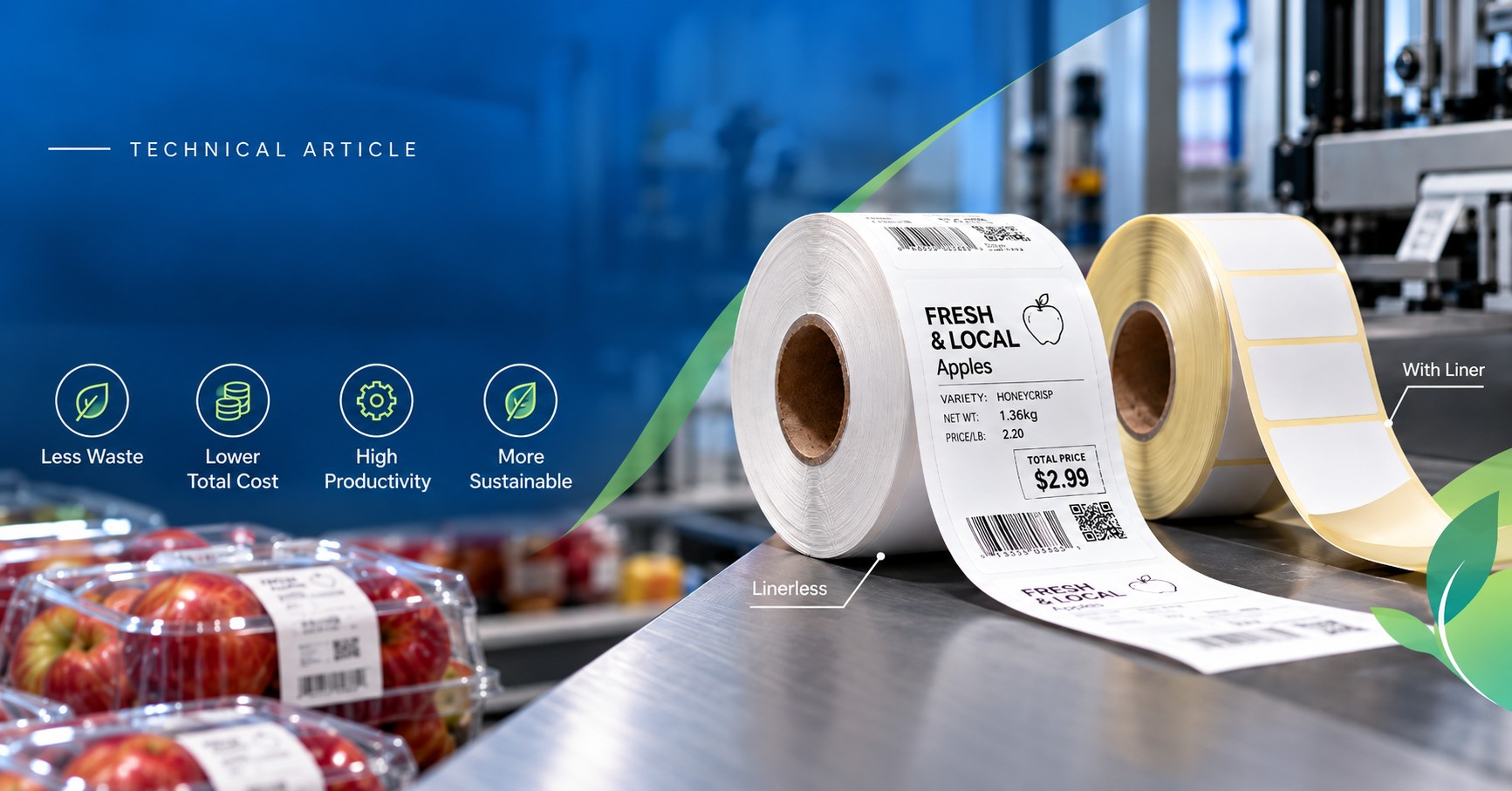
In the label industry, the release liner is one of the most important components of a pressure-sensitive construction, even though the end user rarely sees it. The liner protects the adhesive, carries the Label through printing and converting, supports die-cutting and matrix stripping, and allows precise dispensing at the application line. Once the liner is applied, it usually becomes a separate waste stream or a candidate for dedicated recovery.
Linerless technology removes this separate carrier. The adhesive on the back of one turn in the roll contacts a release-treated surface on the next turn, and these two surfaces must separate predictably when the roll is unwound. This sounds like a simple material reduction, but it transfers functions formerly performed by the liner to the label construction, adhesive chemistry, release coating, cutting equipment, and applicator.
The implications extend beyond sustainability. Without a liner, the printing process, winding pressure, storage conditions, coating anchorage, adhesive ooze, cutting design, printhead contact, and label application must all be considered together. Liquid Electrophotography (LEP) and flexographic printing can both be part of this architecture, but their resulting ink films form differently and require appropriately qualified release-coating systems.
The central engineering question is not merely whether a liner can be removed. It is whether the new construction still prints, unwinds, cuts, dispenses, adheres, survives use, and meets the actual end-of-life requirements.
- What Is a Release Liner, and Why Is It So Important?
A conventional pressure-sensitive label uses a Pressure-Sensitive Adhesive (PSA): an adhesive that forms a bond when sufficient contact and pressure are applied, usually without heating or chemical activation during application. Because the adhesive remains tacky, it needs protection during conversion, transport, storage, and dispensing. The release liner serves this role.
The liner is commonly made from glassine paper, another suitably treated paper, or a polymer film such as Polyethylene Terephthalate (PET). One side carries a controlled-release coating, often silicone-based. The coating enables the PSA to stay supported during manufacturing but separate from the liner at the dispensing stage.
The liner is therefore more than a disposable protective sheet. During die-cutting, the cutting tool normally penetrates the label face and adhesive while leaving the liner sufficiently intact to act as a web carrier. Surrounding material can then be removed in a process known as matrix stripping. Individual labels remain precisely positioned for winding and later dispensing. At the applicator, the liner bends sharply around a peel plate while the Label continues toward the product; the stripped liner is collected separately.
This mechanical support explains why a change to linerless technology may require redesigning the entire production and application route, even when the printed Label looks almost identical.
- Label Architecture: With a Liner Versus Without One
A typical conventional pressure-sensitive structure, shown from the visible side to the supporting carrier, can be represented as:
VARNISH / INK / FACESTOCK / PSA ADHESIVE / RELEASE COATING / LINER
The face stock provides appearance and mechanical behavior; printing and varnish provide graphics and protection; PSA bonds to the object; and the release-coated liner carries the construction through conversion and application.
A representative linerless construction, from the exposed surface to the adhesive side, is:
RELEASE COATING / PRINTED OR PRINTABLE FACE / FACESTOCK / PSA ADHESIVE
The separate carrier has disappeared. When wound into a roll, the PSA faces the release coating on the adjacent turn. The critical release interface is now part of the finished Label itself. The layer order and coatings depend on the chosen print process and label grade. Some architectures pattern-coat the adhesive, release layer, or both rather than using continuous coverage.
Engineering characteristic | Conventional Label with liner | Linerless Label |
|---|---|---|
Separate supporting carrier | Present | Absent |
Location of release coating | On the liner | Usually on the exposed label face |
Adhesive protection in the roll | Separate release-coated liner | Contact with adjacent release-treated label turn |
Die-cutting | Face stock cut while liner supports web | Continuous cutting or specialized linerless converting |
Matrix stripping | Normally required for shaped labels | Avoided in simple continuous formats; may be needed for shaped formats |
Separation during application | Peel plate separates Label from liner | Dedicated cutting or separation mechanism |
Label shape flexibility | Broad range | Depends strongly on equipment and format |
Waste at the applicator | Spent liner | No spent release liner |
Main machine-related risk | Liner damage, breaks, die strikes | Adhesive contact, buildup, release and cutting stability |
Recycling outcome | Label and liner require separate assessments | Finished Label and its coatings still require assessment |
The significant difference is functional, not simply numerical. A linerless label has fewer material components in the final roll, but the engineering roles of the omitted carrier must be reassigned.
- Two Important Linerless Families
Direct Thermal Linerless
Direct Thermal Linerless is widely used for shipping, logistics, retail weighing, identification, and print-on-demand labeling. Its face material contains a heat-sensitive imaging layer; the back has a suitable adhesive; and the exposed face has a release treatment. A thermal printhead creates the image by controlled local heating, without a liquid ink or a thermal-transfer ribbon.
Many systems use a continuous roll. The printer or applicator generates the required label length and cuts it when needed. A common roll may therefore serve more than one label size, within the equipment's limits. The engineering complication is that the thermal-sensitive coating and release layer must work together. The printhead must deliver enough energy to develop a legible image without damaging the coating or contaminating the printhead.
A conventional direct-thermal stock does not become a qualified linerless stock merely by removing the liner. Thermal response, surface protection, release force, adhesive behavior, and machine compatibility all require verification.
Preprinted Linerless
In preprinted linerless products, graphics are printed before the finished adhesive-and-release construction is supplied. The graphic layer can be created by flexography, offset, or a compatible digital printing route. Release coating is applied to the outer face, and PSA is placed on the back; in some formats these coatings are patterned rather than continuous.
These constructions serve printed retail labels, food packaging labels, banding applications, and other packaging formats where preprinted color and branding are important. Their main challenge is interaction among the print layer, release coating, adhesive, winding conditions, cutting method, and applicator. A label that prints perfectly before coating is not necessarily a successful finished linerless material.
- PSA Adhesive Chemistry in Linerless Constructions
The adhesive must develop adequate bonding to the product while avoiding undesirable bonding inside the roll and onto application machinery. Its performance depends on the target surface, application temperature, dwell time, contact pressure, and expected end-use conditions.
Three common adhesive families illustrate the design choices.
Water-based acrylic PSA. Acrylic copolymers dispersed in water can be formulated for permanent, removable, and low-temperature applications. Performance depends on monomer composition, additives, coat weight, drying, aging, and compatibility with the release surface.
Hot-melt PSA. These adhesives may use thermoplastic elastomers, tackifying resins, and functional additives. They can be coated without evaporating a water or solvent carrier during application, but demand qualified heated processing and control of adhesive flow, edge ooze, and temperature response after winding.
Radiation-curable and specialized systems. Some constructions use adhesives developed through controlled radiation curing or other targeted chemistries. The formulation and curing window must be qualified for the linerless release interface and production equipment.
Three performance terms are often confused. Tack is the ability to form an initial bond rapidly; Peel Adhesion is the force required to remove an applied label under a defined geometry and test condition; and Shear Resistance describes the bond's ability to withstand loading parallel to the bonded surface. A high initial tack does not necessarily mean high shear resistance, and a high peel value does not guarantee clean winding or cutting.
In linerless systems, the adhesive must be selected for both sides of its life: it must release correctly from the neighboring turn during unwinding and adhere reliably to the final product afterward.
- The Release Coating: A Function Moved From the Liner to the Label
In conventional labels, the release chemistry resides on a carrier that is eventually removed. In linerless constructions, it remains on the exposed label face. This changes the coating's functional demands. It must release from the PSA, anchor to the underlying face or printed surface, tolerate processing and storage, and sometimes provide scuff protection or a compatible surface for direct-thermal printing.
Silicone-based release coatings are widely used because their surface interactions with selected adhesives can be tailored. Depending on the system, silicone chemistry may be thermally cured or cured using Ultraviolet (UV) radiation. An incomplete cure or poor anchorage can create release instability or unwanted transfer; cure and anchorage are separate questions.
Silicone is not the only possible release chemistry. Some systems employ other coatings or engineered surfaces, but suitability must be demonstrated for the exact adhesive and manufacturing route. A general statement that one surface has low surface energy does not establish a predictable release result.
Coefficient of Friction (COF) measures resistance to sliding contact, while Release Force measures the force needed to separate adhesive from the release-treated face after a specified pressure, temperature, and contact history. They are not interchangeable. A roll may move satisfactorily over guide components yet still block after warehouse storage. Conversely, satisfactory release can coexist with poor web transport if friction is unsuitable.
Any qualification should therefore record both properties wherever they are relevant, together with the conditions under which each was measured.
- Printing and Converting: Why the Workflow Changes
Conventional Labels With Liner
The liner supports the continuous web through printing, overprint coating, die-cutting, and waste-matrix removal. A cutting die ideally penetrates the face and adhesive without damaging the liner enough to cause breaks or dispensing problems. After the matrix is removed, the individually shaped labels remain at fixed pitches on the carrier. Registration and dispensing can therefore be controlled using the continuous liner.
Linerless Labels
In simple continuous linerless designs, no carrier holds pre-cut label shapes at known intervals. Instead, the material is fed as a continuous strip and cut into the required lengths at or near application. This can remove the need for conventional matrix stripping and provide variable label length, but exposes the cutting and transport equipment to new adhesive-related challenges.
The basic continuous format commonly favors straight-edged labels, but it is incorrect to claim that every linerless Label must be rectangular. Specialized converting and applicator systems can create contours or other shapes, sometimes with their own cutting waste and handling requirements. Their existence does not imply that a standard linerless printer can process every geometry.
A knife cutting PSA-coated stock may accumulate adhesive, pull material, or create irregular edges. Winding tension, registration, adhesive coat pattern, and cutter surface all influence reliability. The right performance question is whether the complete system runs at production speed without residue buildup or loss of cut accuracy.
- LEP Printing: Opportunities and Interface Risks
In Liquid Electrophotography (LEP), charged pigment-and-polymer ink particles are transferred electrophotographically and consolidate into a polymeric film on a heated intermediate blanket before transfer to the substrate. This differs from applying conventional liquid flexographic ink and forming its film mainly by drying on the web.
The LEP route offers fine graphics, variable information, short runs, and the ability to change versions without manufacturing new flexographic plates. These benefits can help with preprinted linerless labels with multiple stock-keeping variants, seasonal designs, or frequent artwork changes, provided the substrate and downstream coating route are appropriate.
The key interface challenge arises when the release coating is applied over an LEP-printed surface. The silicone or other release formulation encounters an already-formed polymeric ink film. Wetting, adhesion, ink-film thickness, coverage, surface condition, and the approved primer or treatment system can affect coating performance.
A release lacquer that performs well on unprinted PET, Polyethylene (PE), or Polypropylene (PP) cannot automatically be assumed to anchor equally well on the printed LEP ink. Testing should include unprinted areas, moderate image coverage, dense solids, and opaque white where present. These areas may respond differently to the same coating.
Some low-energy films require an approved print-receptive primer or surface treatment before printing. Corona treatment can help prepare suitable polymer surfaces, but it is not a universal remedy for chemical incompatibility. Post-print corona applied to the LEP ink surface must not be prescribed generically: it needs process approval and evidence that the printed surface remains fit for coating.
The ink film's thermoplastic nature is an input to qualification, not evidence of inevitable failure at normal storage temperatures. Coating, winding, contact pressure, and thermal history should be tested under realistic conditions. Direct printing onto an already cured silicone release layer is generally an adhesion challenge and should not be assumed viable without a specifically engineered route.
- Flexography Versus LEP for Preprinted Linerless Labels
Flexography supports a wide range of packaging and label inks and can integrate graphic printing and functional coating on suitably configured continuous lines. Ink binders and additives can be selected for scuff resistance, drying, surface energy, and overprint-coating compatibility. Some formulations have established histories with release systems. Others contain slip additives or waxes that may interfere with coating anchorage or adhesion.
In solvent- or water-based flexographic inks, adequate drying before release coating is essential. Heavy coverage or opaque white may change the drying demand. In LEP, the transferred polymeric ink film poses a different set of surface-compatibility questions. Neither technology is automatically suitable for every release-coating chemistry.
Qualification variable | LEP print route | Flexographic print route |
|---|---|---|
Ink-film formation | Polymer-containing film consolidates on heated blanket before transfer | Liquid ink dries on web or cures, depending on chemistry |
Short-run and versioned graphics | Strong digital production capability | Depends on plate preparation and changeovers |
Release-coating anchorage | Test against formed polymeric ink film | Test against ink binder, additives, and drying state |
Heavy image coverage | Evaluate ink-film build and coating uniformity | Evaluate drying, additives, and coating uniformity |
Integrated continuous coating | Depends on the chosen production line | Possible on appropriately configured lines |
Final linerless qualification | Whole printed, coated, and adhesive construction | Whole printed, coated and adhesive construction |
The choice is not a universal ranking of ink durability or chemical compatibility. Print economics and full-material qualification must be evaluated separately.
- What Changes at the Label Applicator?
In a conventional pressure-sensitive labeling machine, the liner remains the continuous, load-bearing carrier until the dispensing station. A peel plate redirects the liner sharply, enabling the Label to continue toward the product. The empty liner is collected on a waste roll. The label die-cut shape and pitch were established earlier during converting.
Without the liner, there is no separate carrier to redirect around the peel plate. A linerless machine must use a compatible cutter or another separation mechanism, control web position and length, and place the resulting Label onto the product at the intended point in the cycle. Depending on the applicator, this may require dedicated non-stick rollers, controlled adhesive contact surfaces, revised web tension, and a different registration strategy.
The cutter must remain clean and produce repeatable edges. Drive rollers have to transport the strip without unintended adhesive pickup. The applicator must apply appropriate pressure to the real product surface, which may be curved, rough, textured, or temperature-sensitive. For a print-and-apply system, the printhead and the linerless transport hardware must also be compatible with the actual stock.
A conventional applicator intended for linered labels should not be assumed to handle linerless stock simply by disabling liner take-up. Equipment suitability is part of construction approval, not a last-minute installation detail.
- Blocking, Adhesive Bleeding, and Cutting Residue
Blocking occurs when the adhesive bonds too strongly to the release-treated face of the neighboring roll turn. Symptoms include high unwind force, tearing, transferred adhesive, visible print damage, and machine stops. Potential causes include incompatible adhesive/release chemistry, inadequate coating cure, excessive winding hardness, high storage temperature, or prolonged pressure contact.
Adhesive bleeding or ooze occurs when PSA flows beyond the intended coated area, particularly at roll edges and cut boundaries. Its occurrence depends on viscoelastic behavior, coat weight, storage temperature, winding pressure, and coating geometry. Without a separate liner, edge ooze may directly contaminate feed components and create increased friction or transport resistance.
Adhesive buildup on cutters is another common risk. If a blade cuts directly through a tacky layer, residues can collect on the cutting edge, pull fibers or film, disturb cut length, and eventually create jams. Remedies may involve selecting another approved adhesive, changing pattern-coating margins, optimizing knife geometry, or using equipment designed for linerless materials. The cause should be confirmed before making multiple uncontrolled adjustments.
Cleaning requires particular care. Guide rollers and cutting mechanisms may have specialty surface coatings, and aggressive solvents can damage them. Maintenance materials and frequencies should follow the equipment supplier's approved instructions, rather than a generic cleaning recipe.
- Print Durability and Image Stability
The exposed face of a linerless label may have to perform several jobs at once. It carries the graphics, withstands abrasion and handling, releases predictably from the PSA, and interacts with the machine's transport surfaces. Its performance must therefore be assessed after release coating, not only after printing.
For preprinted materials, evaluate rub resistance, color appearance, scuffing, coating transfer, release-coating anchorage, and legibility after winding and aging. The surface response can differ between unprinted areas and heavy ink builds, so the test image should reproduce production artwork as well as generic control patches.
In Direct Thermal Linerless, the release layer sits above a heat-reactive imaging system. The printhead must transfer sufficient energy for clear imaging through that layer without depositing residues or exceeding approved hardware settings. Inadequate thermal response or printhead contamination can cause weak print, poor barcode edge definition, and scan failures.
Direct thermal labels may also be sensitive to heat, light, and certain chemicals during service. An application requiring long-life identification needs a qualified combination of material, protective treatment, print process, and exposure conditions. Printing a label clearly on day one does not guarantee lifetime readability.
- Testing a Linerless Construction
A meaningful test plan must evaluate both adhesive function on the product and controlled release within the roll. Neither result alone establishes suitability.
Release force. Measure the force needed to unwind or separate PSA from the release-treated face after specified pressure, temperature, humidity, and contact time. FINAT (the European self-adhesive label industry association) publishes standardized FINAT Test Methods (FTM), including FTM 3 and FTM 4 for defined release-liner configurations. Those methods are useful references for test principles, but their normal liner-based geometries should not automatically be claimed as validated linerless methods. Select or qualify a suitable, documented linerless test procedure.
Peel adhesion. FINAT Test Method 1 (FTM 1) and FINAT Test Method 2 (FTM 2) describe peel tests using specified geometries and conditions. Results depend on the test plate or product substrate, application pressure, dwell time, removal rate, and temperature. A value obtained on a standard steel panel does not guarantee equal performance on low-energy or textured packaging.
Loop tack. FINAT Test Method 9 (FTM 9) assesses rapid initial adhesion. This matters for high-speed application where contact time may be short, and bonding must initiate promptly.
Shear resistance. FINAT Test Method 8 (FTM 8) is used for defined shear-holding behavior. It helps reveal weaknesses that might be missed by a peel measurement alone.
Adhesive and release coat weight. Measure deposited adhesive mass and coating uniformity using methods appropriate to the formulation and substrate. Where silicone is used, evaluate coat weight, continuity, cure, and anchorage as distinct characteristics: a satisfactory coat weight does not prove complete cure or acceptable release stability.
Printing and machine trials. Verify image quality, registration, cut length, roll release, printhead cleanliness where applicable, label placement, rejected labels, downtime, and buildup at several representative production speeds and during a run long enough to expose accumulation effects.
Aging. Test after storage conditions representative of real supply chains. Accelerated conditioning can identify risks but must not be treated as a validated predictor of shelf life without an appropriate correlation study.
- Troubleshooting Matrix: Linerless Label Failure Modes
Observation | Possible mechanism | Evidence to collect | Controlled engineering response |
|---|---|---|---|
Roll is difficult to unwind. | Blocking or excessive release force | Release testing after documented storage; inspect both faces | Adjust qualified adhesive/release pairing, curing, or winding conditions |
Adhesive transfers onto print surface | Loss of PSA anchorage or unsuitable release | Identify transferred material and failure interface | Correct the demonstrated interfacial failure |
Adhesive builds up on cutter. | Adhesive ooze, unsuitable blade contact | Observe accumulation and cutting edges over time | Qualify adhesive, pattern margins, cutter geometry, and approved cleaning |
Label fails to attach to product. | Insufficient initial tack or substrate mismatch | Loop tack and peel on actual product surface | Select suitable adhesive or application pressure and conditions |
Edges lift after application. | Film stiffness, curvature, adhesive balance | Inspect curvature, dwell, storage, and peel failure | Adjust face stock, dimensions, adhesive, or application conditions |
Thermal image is weak. | Release layer alters thermal imaging, or the printhead is contaminated | Verify stock, head condition, approved energy range | Adjust qualified stock and printer configuration |
Release coating lifts from LEP ink | Ink-to-coating anchorage failure | Peel/adhesion assessment at multiple ink coverages | Qualify coating, primer, or approved process change |
Release coating lifts from flexo ink | Binder/additive/coating incompatibility | Compare known ink and release combinations | Correct the proven ink/coating interaction |
Label length varies during operation. | Feed slip, tension, or cutting control | Cut-length trend across running speeds | Stabilize transport and cutter synchronization |
Frequent print-and-apply stops | Adhesive buildup or hardware incompatibility | Inspect media path, rollers and cutter | Apply supplier-approved maintenance and configuration |
Performance changes after storage | Aging, release drift, or adhesive flow | Controlled storage experiment with retained samples | Address the material or process variable linked to change |
A photograph of a jam or a single peel-force value rarely identifies the root cause. The investigation must establish which interface or process first changed, and reproduce that change under controlled conditions.
- Root Cause Analysis: Why Does a Roll Begin Jamming After Storage?
Consider an illustrative engineering case, not a claim about a particular documented production incident. A freshly made linerless label roll runs successfully during an initial acceptance test, but after several weeks of storage the stock begins sticking and causing repeated stops on the same applicator.
Instead of changing the adhesive immediately, retain samples from one manufacturing lot and divide them into comparable groups. Test one group soon after production, condition another under defined warehouse conditions, and expose a third to a deliberately selected pressure-and-temperature combination designed to probe sensitivity. Record the conditions explicitly; do not assume that accelerated treatment reproduces real-time aging on a one-to-one basis.
Measure release force, inspect the released surfaces, record adhesive transfer or coating damage, and perform a sufficiently long machine trial. If release force rises strongly only after storage, investigate adhesive-release interactions, coating cure, and winding pressure. If release force remains normal but jams still occur, inspect transport components for localized adhesive accumulation, misfeed, or cutting faults. If material transfers between faces, identify the material and determine whether the failure occurred in adhesive anchorage, within a coating, or at the intended release interface.
The useful output is not a general statement that the silicone is 'wrong.' It is a confirmed failure path with a controlled change that restores reliability without introducing a new print, adhesive, or durability problem.
- Sustainability: Does Linerless Really Reduce Environmental Impact?
Eliminating a separate liner can reduce material consumption, roll weight, warehouse volume, shipping requirements, roll-change frequency, and used-liner waste at the applicator. These benefits can be substantial in certain high-volume applications. Some commercial product comparisons have reported approximately 32% thinner constructions or up to roughly 50% more labels per roll relative to their named reference products. Such figures are not universal performance claims: they depend on the original liner thickness, face-stock grade, roll diameter, label length, and equipment conditions.
Conventional release liners are not necessarily landfilled. Dedicated recycling pathways exist for some silicone-coated paper and polyester liners. Consequently, a defensible sustainability comparison must consider what actually happens to the original liner in the relevant market, not assume it has no recovery route.
The linerless Label itself still contains face material, PSA, release chemistry, ink, and possibly primer or protective coating. It is not automatically recyclable because the separate liner was removed. Once applied to a PET, High-Density Polyethylene (HDPE), Polypropylene (PP), or fiber-based package, its impact on sorting, washing, separation, and recyclate quality must be evaluated in the complete package context.
For some bottle-recycling routes, the adhesive may need to release under controlled washing conditions. For fiber-based labels, silicone or other functional coatings may influence repulping and recovered-fiber yield. Suitability cannot be inferred from the word 'paper' or from the absence of a release liner alone.
A total-cost comparison must also include the price of linerless stock, printing and coating, adhesive use, applicator investment, cut waste, roll handling, changeover time, downtime, maintenance, and waste processing. A high-volume operation may benefit from reduced consumables and fewer roll changes, while a smaller operation with diverse, complex shapes may find the necessary machinery and development work outweigh the savings.
- When a Conventional Liner Is Still the Better Choice
Linerless technology is not always the right solution. Conventional linered constructions can be preferable for highly intricate shapes, internal cutouts, demanding waste-matrix removal, very thin and delicate films, and applications where the liner provides essential stability during conversion and dispensing.
Premium clear labels, unusual container geometries, and specialty adhesives can create additional development demands. Existing high-speed dispensing machinery may also be optimized for liner-based labels and may not support linerless material without substantial modification.
The right choice meets real application requirements at an acceptable cost and reliability. Sustainability benefits do not justify reducing application quality, product identification, code readability, or process robustness.
- A Practical Linerless Development and Qualification Plan
Start with the product and application, not with a liner-removal target. Define container material and surface energy, surface roughness, curvature, application temperature, expected moisture exposure, application speed, intended life, and end-of-life market.
Select the face stock, PSA, and release coating together. Their individual datasheets do not prove that the combined structure will run reliably. Then define the printing and coating sequence. For LEP or flexography, confirm release-coating adhesion over actual printed graphics, including heavy ink solids. For direct thermal, verify that the release coating allows suitable thermal imaging without unacceptable printhead buildup.
Build a qualification matrix that includes release force, adhesion, tack, shear, adhesive coat weight, release coat cure and anchorage, roll aging, cut performance, and production-speed trials. Test on the real applicator long enough to characterize buildup and stop rates, not just a few successful labels.
Finally, evaluate recovery and recycling compatibility for the actual package and destination market, plus the total economics of material, waste, transport, production, maintenance, and capital equipment. A design should not be commercially released solely because the new roll contains no liner.
- Engineering Perspective: Removing the Liner Moves the Risk
In conventional pressure-sensitive labels, the liner silently performs several operational functions. It shields the adhesive, supports die-cutting, holds label pitch, carries web tension, and permits predictable dispensing. Linerless technology doesn't eliminate all those tasks; it redistributes them.
The release-treated label face replaces the liner as the controlled separation surface. The cutting and feeding system absorbs much of the work the liner once supported. The PSA must cooperate with the winding and cutting process as well as with the final product. Ink and topcoats must remain functional after repeated contact against the adhesive in the roll.
This is why material reduction can increase engineering complexity. Success requires coordination among substrate and adhesive producers, release-coating formulators, printers, converters, applicator designers, and quality engineers. The finished construction is a system, not merely a simplified stack of materials.
Conclusion: Less Carrier Material, More Integrated Engineering
Linerless labels can reduce release-carrier material consumption and improve roll efficiency and logistics in suitable applications. Yet removing the liner changes the construction, not just the bill of materials.
A conventional linered label benefits from a dedicated carrier that protects adhesive, supports precise converting, and enables predictable dispensing. Linerless products require engineered release behavior on the exposed label face, a compatible adhesive, controlled winding and cutting, and equipment designed to handle the adhesive-coated web directly.
Preprinted products add a critical ink-release interface. LEP offers strong digital flexibility, but its polymeric film must be qualified for adhesion to the release coating. Flexography offers mature ink-and-coating workflows, but drying, additives, and the specific binder chemistry still matter. Direct Thermal Linerless adds another interface between release chemistry, heat-sensitive imaging, and printhead behavior.
The final decision should be based on print performance, release and adhesion tests, applicator reliability, total operating cost, and the recycling behavior of the finished package—not simply on the absence of a discarded liner.
The liner may disappear from the construction, but its engineering responsibilities do not disappear. They are redistributed across the Label and the machines that make and apply it.
Abbreviations and Technical Acronyms
Abbreviation | Full English term | Context in this article |
|---|---|---|
PSA | Pressure-Sensitive Adhesive | Adhesive that bonds under application pressure |
COF | Coefficient of Friction | Sliding resistance between contacting surfaces |
LEP | Liquid Electrophotography | Digital print process transferring a formed polymer ink film |
PET | Polyethylene Terephthalate | Polyester substrate or container polymer |
PE | Polyethylene | Low-surface-energy polymer film family |
PP | Polypropylene | Polymer film and container family |
HDPE | High-Density Polyethylene | Bottle and rigid-container polymer |
UV | Ultraviolet | Radiation used to cure certain coatings |
FINAT | European self-adhesive label industry association | Publisher of established label test methods |
FTM | FINAT Test Method | Test-method identifier, such as FTM 1 or FTM 9 |
Technical References and Further Reading
- FINAT. *Technical Handbook and FINAT Test Methods* (including FTM 1, FTM 2, FTM 3, FTM 4, FTM 8 and FTM 9). Consult the current method and its defined substrate geometry and test conditions.
- Label Academy. Technical educational material on linerless labels, release liners, adhesive constructions, converting, and application technology.
- Industry technical documentation on Direct Thermal Linerless systems, silicone release over thermal-sensitive imaging layers, compatible printers, and dedicated applicators.
- Technical resources on preprinted linerless materials, patterned adhesive and release coatings, cutting arrangements, and application machinery.
- Printer and applicator maintenance guidance on PSA buildup, cutter cleaning, transport rollers and approved cleaning agents for linerless equipment.
- Recycling design guidance relevant to pressure-sensitive labels on plastic packaging and to repulpability of coated paper constructions.
- Technical literature on Liquid Electrophotography (LEP) and flexographic printing, ink-film formation, primer and release-coating anchorage.
Engineering qualification note. Layer-stack examples, potential benefits, test approaches, and troubleshooting recommendations in this article are general technical guidance. They are not universal material specifications, equipment approvals, performance guarantees, or regulatory certifications. The complete construction must be qualified for the intended product, production line, and end-use conditions.