Ronen Dolev | 2026
When the press gets the color right, but the finished label does not
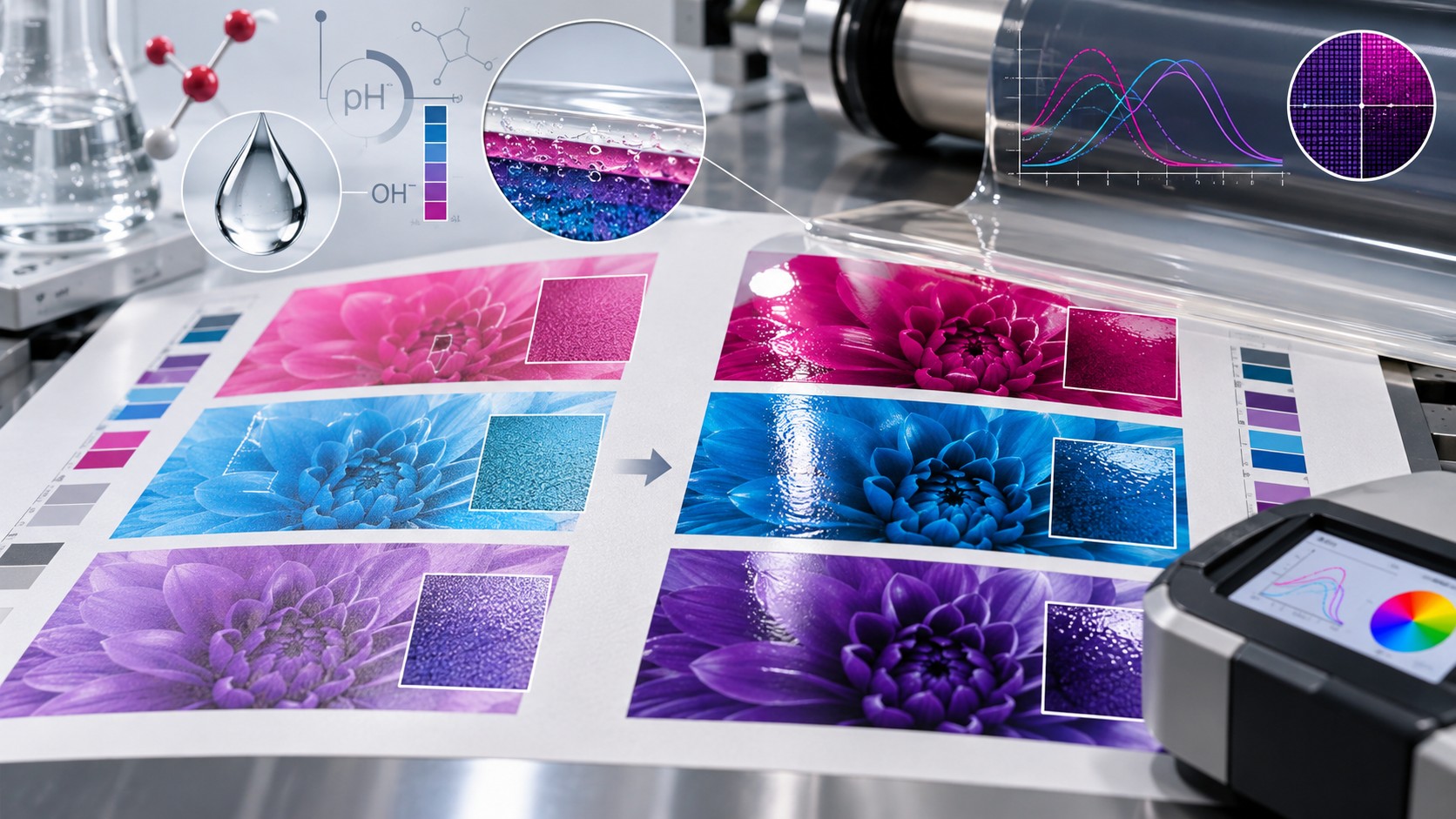
At a pressure-sensitive label production facility, the team was confronting a recurring problem. Printing was stable, color control approved the result, and the specified shade fell within the customer's acceptance criteria. Yet after a water-based overprint varnish was applied, the hue shifted.
The behavior was particularly revealing because the change was not always immediate. In some samples, the difference became more noticeable after the coating had dried. Subsequent measurements showed that the hue could continue to move with time.
The natural response to a color deviation is often to return to the press: check calibration, adjust the color recipe, or introduce a correction intended to offset the change caused by the varnish. Here, however, one fact mattered more than anything else: the press had already delivered the required color. The unacceptable change occurred only after the printed image encountered another material.
An applications expert from the printing press manufacturer, visiting the facility as part of a broader technical assignment, focused on that transition. Rather than modifying a printing process that was performing correctly, he asked what was happening at the interface between the ink and the coating.
The central question was deceptively simple: How can a nominally transparent varnish change the color of an ink that has already been printed correctly?
Answering it requires separating ordinary optical effects from chemical and physicochemical interactions that can alter a colorant's behavior.
Beyond spot colors: process CMYK, extended gamut and pigment chemistry
Coating-related color movement is not limited to a custom spot formulation. It can also affect process colors, extended-gamut inks and composite shades. Cyan, Magenta and Violet are useful examples, but the investigation must include Yellow and Black as well: the hue name is not a chemical identity, and historical published LEP resistance testing found a particularly large alkaline-response difference between Yellow and the other process colors.
The labels Magenta, Cyan, Yellow and Violet do not identify unique pigments. Two inks matching the same target may use different pigment families, polymer binders and functional additives. Even a seemingly familiar process color may change formulation across generations or product lines. Its actual ingredient list cannot be inferred from a patent, a color name, or a historical test.
Quinacridone pigments used for some magenta formulations, including PR122 and PV19, can show strong alkali resistance. Copper-phthalocyanine pigments such as PB15:3, commonly used for Cyan, are generally chemically robust. Dioxazine violet grades such as PV23 can also exhibit high resistance. These are useful chemistry examples, not confirmation that any particular currently marketed LEP ink uses a specific pigment.
Other colorant systems—including certain Rhodamine-derived, Methyl Violet, Reflex/Alkali Blue and lake-based formulations—may be sensitive to aqueous-coating chemistry. Yellow also requires attention, not because every yellow pigment is chemically weak, but because publicly reported alkaline-exposure results for one historical LEP process-ink set showed a much more severe response in its regular Yellow ink than in its M, C and K inks. That observation is relevant to risk assessment, not proof of a specific pigment degradation pathway.
Even when a principal pigment is stable, another component of the ink, a secondary colorant, the binder, or an ingredient of the overprint varnish may respond differently to chemical exposure. This is particularly important in mixed violet, blue, orange or green shades, where selective change in one constituent can move the entire spectral balance.
The correct question is therefore not "Which color is vulnerable to pH?" but "Which exact ink formulation, coating chemistry and exposure conditions are involved, and what evidence explains the observed shift?"
What pH really means in an aqueous coating
pH describes hydrogen-ion activity in an aqueous environment. It is a useful indicator of acidity or alkalinity, but it does not fully describe a coating's chemistry. Many water-based overprint varnishes contain polymer dispersions, resins, surfactants, wetting agents, and other additives. Some operate under alkaline conditions because alkalinity is integral to the stability or behavior of their resin and dispersion systems.
An alkaline aqueous varnish is not, by definition, defective. The issue is compatibility with the printed layer beneath it.
When a coating is applied, the ink comes into contact with a wet mixture containing water and dissolved or dispersed chemical components. Depending on the formulation, these components can interact with the ink's binder, colorants, dispersion system, or other constituents. The relevant exposure depends on more than the pH number printed on a technical data sheet. It also depends on the varnish's buffering or alkaline reserve, wet-coating weight, available water, contact time, the printed layer's permeability, temperature, and drying conditions.
Furthermore, a pH reading taken from a liquid coating should not be assumed to describe the exact microscopic chemical environment inside the dried coating film. The wet and dried states are different systems.
Measuring pH is therefore an important diagnostic step, but it cannot, by itself, prove the molecular mechanism of a color change.
In fact, a supplier publishes an acrylic-based waterborne overprint coating intended for use on compatible digitally printed substrates with a typical pH of 8.5–9.0. That specification is a practical reminder that "alkaline" is not synonymous with "unsuitable": the question is whether the exact varnish and the exact LEP ink qualify as a system. A nominal pH window does not, on its own, establish pigment stability.
Mechanism 1: acid-base changes in a pH-sensitive chromophore
A colorant's appearance depends on which wavelengths of visible light it absorbs and which are reflected or transmitted. In many organic colorants, the absorbing portion of the molecule—the chromophore—contains an electronic system in which electrons are delocalized over conjugated bonds. Its electronic structure helps determine the wavelengths of light that can be absorbed.
In some pH-sensitive molecules, an acidic or alkaline environment changes their protonation state. Protonation means gaining a proton; deprotonation means losing one. Either change can modify the distribution of electrons in or near the chromophore, producing a different absorption spectrum.
The observed result may be a shift in hue, a change in chroma, or a change in apparent color strength. Spectroscopically, the position or intensity of an absorption band may change. Depending on the molecule, the change may be reversible under suitable conditions or accompanied by less readily reversible chemistry.
This mechanism is well established in some molecular dyes and indicators. It must not, however, be automatically assigned to every industrial printing pigment. Many commercial pigments are essentially insoluble particles with high chemical resistance, and their behavior can differ markedly from that of dissolved dye molecules.
A measured hue shift alone does not demonstrate that protonation or deprotonation occurred. Evidence about the actual colorant and its chemistry is needed.
Mechanism 2: chemical instability, migration or bleeding
Industrial inks are complex formulations. Their colorants are held within a resin or binder system and may be accompanied by dispersants and other functional ingredients. Some formulations use stable insoluble organic pigments. Others may contain colorants or derived pigment systems that respond differently to moisture, alkaline exposure, or solvents and additives present in a varnish.
Under incompatible conditions, the colorant or an associated component may undergo a chemical change, lose stability, or redistribute within the printed layer. Some components can migrate into the wet coating, leading to bleeding or a local change in optical density and hue.
Not all such effects require destruction of the chromophore. Changes in solubility, ionic environment, mobility, or interaction with surrounding polymers may affect the apparent color. Conversely, some chemical reactions can change the chromophore itself.
The distinction matters because the corrective action depends on what has actually failed. Replacing a sensitive colorant addresses one class of problem; improving compatibility at the ink–varnish interface or controlling wet exposure may address another. Neither should be selected based on hue alone.
Mechanism 3: pigment dispersion and the microstructure of the ink film
In a pigmented ink, the particles are embedded in a polymeric environment. Their optical performance depends not only on intrinsic absorption but also on particle size, dispersion, local aggregation, and how light travels through the printed film.
In some systems, an aqueous coating can change the physical environment at the ink surface. Interactions with surfactants, dispersants, or binder components may alter local microstructure or scattering without chemically transforming the pigment molecule.
Such changes can modify measured or perceived color even when the colorant's underlying chemistry remains stable. They are plausible diagnostic alternatives that should be considered—not a mechanism that can be declared proven without appropriate evidence.
Mechanism 4: the normal optical effect of transparent varnish
Before attributing every color difference to alkaline chemistry, the investigator must consider what a transparent surface layer does to light.
Overprint varnish changes gloss, roughness, refractive-index boundaries, and the balance between specular and diffuse reflection. Depending on the substrate, ink, and coating, the finished print may look darker, richer, or more saturated even when no pigment has reacted chemically.
These physical optical changes can also alter measured L*, a* and b* values, depending on measurement geometry and the conditions used to compare samples. A nonzero ΔE00 between unvarnished and varnished prints is therefore not, by itself, evidence of an alkaline chemical reaction.
An immediate, reproducible difference that stabilizes as the film dries may be predominantly optical. A progressive change occurring after the apparent completion of drying deserves additional investigation, particularly if it is associated with particular pigment formulations or coating chemistries. Even then, continued physical film formation, residual moisture, or incomplete drying must be ruled out before assigning a chemical cause.
Why the pigment family matters—but does not tell the whole story
Pigment identifiers indicate potentially relevant chemistry; they do not establish the composition or coating compatibility of a commercial LEP ink. The table below summarizes illustrative material families and the engineering questions they raise. Treat a historical alkaline-immersion result for a finished LEP print separately from pigment-grade fastness values.
Hue family | Illustrative colorants or pigment chemistry | Technical significance |
|---|---|---|
Magenta | Quinacridone pigments, e.g. PR122 | Some grades have high alkali resistance; magenta hue alone does not imply pH sensitivity. |
Magenta / Red | Some Rhodamine-derived or other sensitive formulations | Certain formulations may show coating-related color movement and require specific compatibility tests. |
Cyan | Copper phthalocyanine, e.g. PB15:3 | Generally good alkali resistance; investigate additional causes when cyan shifts. |
Violet | Dioxazine violet, e.g. PV23 | Some grades can show strong chemical resistance; supplier-specific confirmation remains necessary. |
Violet / Blue | Some Methyl Violet and Reflex/Alkali Blue formulations | Can include components vulnerable under particular aqueous-coating exposures; not equivalent to process Cyan. |
Mixed colors | Two or more primary or extended-gamut inks | A shift in one constituent can change the spectral balance even when other components remain stable. |
Yellow | Ink-specific organic yellow pigments; exact commercial LEP chemistry unverified | Historical LEP direct-contact data found a very large shift in regular Yellow in the tested ink set; this is not a general claim for all yellow pigment grades or OPVs. |
Black | Often carbon black; exact ink grade varies | Historical M/C/K LEP test group exhibited smaller shifts than the tested regular Yellow; no separate Black reading was published in that result. |
Supplier alkali-fastness data are valuable screening inputs, but the actual object to qualify is the full printed system: substrate, receptive primer (if used), particular ink generation, overprint varnish, and drying conditions. Laboratory pigment rankings cannot be directly substituted for a final-print compatibility trial.
Published LEP alkaline-resistance results: important but easy to misread
A manufacturer-published ElectroInk technical FAQ describes testing finished CMYK prints in static contact with various chemical agents under defined conditions, including water, bases, acids, oils, detergents and solvents. The reported results were based on changes in color coordinates and optical density, using relevant print-resistance test frameworks. This provides direct evidence about printed ink systems—not merely the isolated pigment powder.
In the basic-solution comparison, the report groups Magenta, Cyan, and Black together as "MCK" and gives a visible color-difference range of approximately 1–5 ΔE. Regular Yellow showed a much larger reported difference of at least 30 ΔE. An alternative Fade Resistant Yellow formulation was reported to be considerably more stable under the same broad exposure category. The source does not supply independent M, C, and K values in this passage, and it does not label the metric as ΔE00.
These figures must not be read as expected shifts from an ordinary water-based overprint varnish. Direct contact with an alkaline test solution is not equivalent to a thin wet aqueous coating that subsequently dries. Exposure time, chemical concentration, alkalinity reserve, contact geometry, substrate, and ink generation may differ substantially. The data demonstrate that some historical LEP ink formulations respond very differently to chemical challenge; they cannot certify or disqualify a current OPV.
Public patent literature provides examples of electrostatic Magenta inks using colorants such as PR122 and PV19, as well as other LEP-related formulations involving PB15:3 or PV23. Patents disclose possible formulations, not bills of material for current proprietary production inks. Confirm colorant identity with the ink supplier when a formulation-specific conclusion is required.
This distinction matters particularly when comparing legacy inks, updated ink sets, fade-resistant variants, and new-generation CMYK+. The chemical-resistance evidence available here should be treated as historical risk evidence, not as a published alkali-qualification result for all modern inks.
The case investigation: moving the question downstream
The application described in the source narrative was a pressure-sensitive label printed on coated paper. The qualified preparation route applied a primer to the coated paper before printing. In a separate comparison involving this paper construction, an unnecessary corona-treatment step was removed, and primer anchorage improved. That issue and its resolution were distinct from the subsequent color shift.
For the color case, the printed spot color met the target before the web was sent to a separate coating machine. The change appeared only after the protective aqueous varnish was applied.
The applications expert first preserved the printing condition rather than changing it. The same paper labelstock, primer, printing condition, and spot-color formulation would be used in a controlled comparison. The team documented the varnish's actual operating pH instead of relying only on a general supplier range.
A printed control remained unvarnished. Matched printed sections were coated under different aqueous-varnish conditions while coat weight, drying, line speed, handling, and sample identification were controlled. Measurements were taken before varnishing, after complete drying, and again after approximately 24 hours.
The first varnish condition reproduced the unacceptable shift. A second condition produced a smaller change. A third condition, selected for better chemical compatibility with the sensitive spot-color formulation while maintaining required protective performance, produced mainly the optical change expected from the finished varnished label.
The next day's measurements supplied a critical distinction: the color exposed to the original, more alkaline condition had continued moving in a consistent direction, whereas the more compatible coating remained substantially more stable.
The colorant supplier then confirmed that the spot formulation contained a component with limited resistance to the alkaline exposure associated with the original varnish condition. Together, the controlled comparisons, time-dependent measurements, pH records and formulation information supported an ink–coating incompatibility mechanism.
The book does not identify the exact pigment number or demonstrate a particular molecular reaction pathway. It would therefore be incorrect to claim that the case proved protonation of PR122, chemical degradation of a particular violet pigment, or an issue exclusive to LEP. The source establishes a narrower—but technically meaningful—conclusion: a component in that spot-color formulation was insufficiently resistant to that specific alkaline coating environment.
Why changing press calibration would have been the wrong correction
One tempting response was to print an intentionally shifted shade so that the coating would move it back toward the customer target. This type of compensation can be valid when the finishing-induced optical change is stable, repeatable, and properly characterized as part of a qualified process.
It is not a sound first response to chemistry that continues to evolve. If the reaction rate or magnitude depends on varnish chemistry, alkalinity, residual moisture, contact history, or elapsed time, a press-side correction simply moves the starting point of an uncontrolled process. A sample might pass immediately after coating and fail a day later.
The correct sequence is to stabilize the material system first and only then, if needed, make final color adjustments for the approved finished construction. A stable varnish-related appearance shift can be incorporated into normal finished-product color management. A color recipe alone cannot reliably correct an unstable chemical interaction.
A practical diagnostic experiment: controlled, comparative and time-dependent
For an aqueous-coating color shift, print a controlled matrix that includes process Cyan, Magenta, Yellow and Black; extended-gamut Violet, Orange and Green where available; the affected spot or brand color; and relevant mixed shades. Hold the press condition and print recipe constant. The test must answer whether the issue is confined to a particular ink or mixed shade, whether it is reproduced by one coating condition, and whether the color continues moving after the coating has dried.
Use the same qualified media, primer, ink lot, press state, and pre-varnishing interval for each comparison. Include an unvarnished control, the original coating, and at least one supplier-approved alternative with a chemistry potentially more compatible with the printed ink. An alternative should not be called "compatible" until color stability, application quality, and protective performance have all passed.
Set | Condition | What the comparison reveals |
|---|---|---|
A | Unvarnished printed control | Baseline color and any time-dependent change without a coating. |
B | Original varnish, original qualified operating state | Reproduces the production problem under documented conditions. |
C | Qualified alternative coating with more compatible chemistry | Tests whether a different coating environment suppresses the defect without sacrificing protection. |
Measure coating pH using a calibrated instrument and record its actual production value, approved operating range, wet coat weight, solids, line speed, drying profile and sample history. Measure spectral reflectance and L*a*b* before coating, after complete drying, after approximately 24 hours and, if indicated, after approximately 72 hours or longer end-use-relevant conditioning. The historical source reports ΔE, not specifically ΔE00; never combine them as identical metrics.
Use consistent illuminant, measurement condition, and instrument geometry. Review changes in hue angle and chroma and compare full reflectance curves, not only a scalar ΔE value. Check gloss and haze, assess bleeding or local lift where suspected, and inspect the coated layer for uneven wetting, thickness, or drying. An apparent spectral difference is evidence of changed optical behavior—not, by itself, evidence that a pigment molecule decomposed.
The purpose is to separate the response of the printed colorant from the ordinary optical contribution of a clear coating, while still testing the actual production stack.
A defensible qualification plan for production
First, confirm the exact ink set, ink generation, press/application platform, substrate, primer, and varnish identities. Record the ink and coating batches. Confirm whether the customer approves color after coating, and define measurement tolerances and a realistic storage interval before running the trial.
Second, compare three controlled coating conditions: unvarnished print, existing production varnish, and a supplier-selected candidate intended to provide better compatibility. Record wet coat weight, solids, pH, drying energy, production speed, and time between printing and coating. Keep the press settings and the print sample constant. Use full-tone Cyan, Magenta, Yellow, and Black patches, extended-gamut colors if present, and the actual job's composite color.
Third, examine the finished spectral reflectance and any color drift after complete drying and approximately 24 hours. Extend to 72 hours or application-specific aging when the defect is time-dependent. Control measurement conditions and distinguish pre- and post-coat optical shift from subsequent chemical movement. Include representative production restarts, storage conditions, and at least a second lot or run before final qualification.
Fourth, verify the practical consequences of the changed varnish: rub and scuff resistance, coating adhesion, blocking, drying, converting, handling, appearance, and any use-specific safety or compliance requirements. Release the varnish/ink combination only when both stable finished color and functional coating performance pass. Do not impose a "zero ΔE relative to unvarnished stock" criterion unless the application genuinely requires it; the acceptance target concerns the approved final product.
Solution 1: qualify a chemically compatible protective varnish
If a reproduced chemical incompatibility exists, the preferred first corrective route is to qualify an aqueous protective varnish whose chemistry and approved operating pH are demonstrably compatible with the exact printed ink. "Lower pH" by itself is not a specification or a solution: aqueous coatings have legitimate alkaline operating windows, and many are developed for LEP print systems.
Do not acidify a commercial coating on the production floor to chase a numeric pH target. The dispersion, resin neutralization, viscosity, drying behavior, film formation, and mechanical protection may be disrupted. Require the coating supplier to identify an appropriate grade and define its specified operating window, application conditions, and relevant compliance requirements.
The comparison must verify the finished shade and its time stability alongside adhesion, scuff and rub performance, blocking resistance when relevant, gloss/appearance, production handling and any end-use requirements. One properly qualified varnish grade is preferable to a press-side color correction that merely disguises evolving chemistry.
A color-stable label with inadequate surface protection is not a successful finished product.
Solution 2: qualify more alkali-resistant colorant chemistry
Sometimes the protective varnish cannot reasonably be replaced because it is needed for a particular mechanical property, production window, or end-use requirement. In that situation, the ink or colorant system may need to change.
The alternative route is to request an approved formulation with colorants and binder constituents proven to be more resistant to the required alkaline environment. Public patent examples of PR122/PV19 for magenta or PB15:3/PV23 in electrostatic ink formulations do not specify which pigments are in a particular production cartridge. For proprietary LEP systems, the manufacturer must support and qualify any ink replacement.
A supplier may offer an ink marketed for a distinct functional purpose, such as lightfastness. However, resistance to ultraviolet exposure and resistance to alkaline chemicals are different properties. A published historical case in which an alternative Yellow formulation performed better in an alkali test must not be generalized to every currently available fade-resistant or new-generation ink, or used as proof of present press compatibility.
With digital presses that rely on proprietary or otherwise controlled ink systems, do not modify ink constituents independently on the production floor. Any formulation change should be developed and validated through the approved ink supplier and appropriate technical process.
Solution 3: control wet-coating exposure and drying
After chemistry compatibility is established, verify whether coating process conditions unnecessarily extend wet exposure. Excessive coat weight, long wet dwell, local pooling, or inadequate drying may increase exposure of a sensitive ink layer to the wet coating, but none should be treated as the sole cause without controlled evidence.
Review the specified coating weight, coating uniformity, dryer performance, and line speed. A controlled process should form the required protective film without unnecessarily exposing vulnerable printed components to water and other active ingredients.
The answer is not automatically to raise the dryer temperature or accelerate the machine. Excessive heat or aggressive drying may introduce new coating or substrate defects. The objective is to remain inside the coating supplier's qualified window and the end product's performance requirements.
Better process control can reduce an exposure-driven problem, but it cannot make fundamentally incompatible chemistries reliably compatible.
The corrective-action decision: which variable should actually change?
If the apparent shift stabilizes as the varnish dries and is reproduced consistently with no subsequent movement, investigate normal gloss and optical effects first. Color characterization of the approved finished construction may be appropriate after optical stability has been confirmed.
If the shift is time-dependent and tracks one particular aqueous-coating chemistry, qualify a different supplier-approved protective varnish as the primary route. Only if necessary, ask the ink manufacturer for an approved, more chemically resistant ink system. Maintain coat weight and drying within the qualified range rather than using them as an uncontrolled workaround.
If several coatings reproduce the same time-dependent shift, or if Yellow is disproportionately affected, request ink-specific alkaline-resistance and compatibility evidence from the ink supplier; avoid inferring pigment identity from hue. If coating replacement is not possible, escalate a joint ink/coating/substrate qualification. Never use an arbitrary pH adjustment, an unapproved ink reformulation, or a DFE correction as the first-line fix.
How to distinguish chemical color movement from an optical finish change
A single before-and-after color measurement cannot answer this question. The decision should combine controlled coating comparisons, measurements over time, actual pH data, complete spectral information, and material-specific chemical resistance evidence.
A change that appears immediately after coating and becomes stable after proper drying may be predominantly optical. A change that continues over time, occurs selectively in particular colors, and repeatedly tracks particular varnish conditions is more suspicious of chemical or physicochemical incompatibility. Neither pattern is conclusive by itself.
The strongest practical conclusion comes when the original process consistently reproduces the defect, a chemically compatible alternative suppresses it under otherwise matched conditions, and supplier information identifies a relevant vulnerability in the colorant system. That is the level of evidence described in the source case.
For deeper investigations, distinguishing a chemically altered chromophore, colorant migration, and changes in dispersion may require analytical work beyond ordinary color measurement. Claims about a specific molecular reaction must be limited to what that analytical evidence actually establishes.
Finished-color approval belongs after finishing
For a varnished label, the customer buys a varnished label. Color approval must therefore consider the final construction, not just the uncoated image coming off the press.
The approved measurement condition should reflect the finished product, with consistent viewing and instrument geometry. Where the ink–varnish system contains a known or suspected sensitive component, qualification should include stability after coating. The 24-hour measurement in the source investigation effectively separated two coating behaviors; it is not a universal holding period for all formulations.
Other applications may need additional exposure, storage, or aging tests relevant to their actual use. Methods such as ISO 2836:2021 can provide a framework for assessing printed material resistance to selected agents, but they do not replace testing the actual ink and varnish together under the facility's real production conditions.
What the findings mean for liquid electrophotographic printing
The book's case describes a web-fed digital press and a spot-color formulation that changed after aqueous varnishing, without explicitly identifying the press technology as LEP. A separate, published manufacturer technical FAQ now supports the broader relevance to LEP by reporting direct chemical-contact tests of printed process inks. These are two independent evidence streams: one is a narrated production case; the other is a historical controlled chemical-resistance study.
LEP image layers contain pigments embedded in a polymeric ink film. The precise formulation, including a binder and other ingredients, varies by product and may be proprietary. Possible alkaline exposure effects include a genuinely vulnerable colorant, binder–coating interactions, migration or film microstructure changes, as well as harmless optical changes caused by an overprint finish. The published chemical-resistance results demonstrate formulation-dependent color differences but do not, by themselves, identify the molecular mechanism.
Therefore, qualify the exact substrate–primer–ink-generation–varnish construction. Do not assume data from a legacy ink applies to the latest ink, to CMYK+ or to another press family. Document chemical resistance, the varnish operating window, and finished-color stability for the particular job.
Thinking beyond the usual troubleshooting boundaries
The most important step was not measuring an alkaline pH; aqueous coatings commonly operate under alkaline conditions. The important step was refusing to treat a downstream color shift as evidence that the press was printing incorrectly.
The applications expert followed the defect's chronology. Printing passed. Varnishing introduced the change. In the original coating condition, the change continued over time. The investigation therefore moved from calibration toward chemical compatibility.
By holding printing constant and comparing finishing chemistries, the team isolated the relevant variable. Supplier formulation information then explained why the sensitive color could behave differently from others. The corrective action became qualifying a compatible ink–varnish system, not deliberately misadjusting a press that had already met its color target.
This is the essence of effective out-of-the-box troubleshooting: identify which part of the complete product caused the failure, and intervene at that mechanism rather than at the most familiar control panel.
Engineering conclusion
Water-based protective varnishes are valuable because they provide the surface durability and appearance many industrial printed products require. Yet a visually transparent coating is neither optically nor chemically invisible.
A specific colorant may be sensitive to alkaline exposure, while a pigment of similar hue may be very robust. Other changes can arise from binder/coating interactions, migration, wet-film effects, or standard gloss optics. A historic LEP chemical-contact comparison highlighted ordinary Yellow as a special vulnerability within its tested formulation, whereas M, C and K showed smaller reported changes. The conclusion is not that all yellow inks fail in aqueous varnish; it is that the response can be strongly formulation-dependent.
In the original application narrative, the printed spot color met target before finishing. The reproduced shift, time-dependent measurements, and supplier information supported incompatibility between one sensitive formulation constituent and the original alkaline varnish condition. Separate LEP manufacturer tests further show why the exact colorant/ink generation matters, while an application trial must prove the behavior of a specific modern aqueous OPV.
The engineering rule is to stabilize ink–coating chemistry before applying color compensation. Approve the finished, varnished construction, and verify that the color remains stable through realistic processing and storage. The correct solution may be a qualified compatible varnish, a manufacturer-approved more resistant ink, or a controlled exposure window—but not an unvalidated press adjustment that masks an unstable system.
Source and technical notes
Case narrative: Ronen Dolev, The Personal Journey of an Industrial Printing Expert (2026), Chapter 35, "The Visit That Was Supposed to Be Training." A reconstructed professional narrative. Its sensitive spot color is not chemically identified, and its web-fed digital press is not explicitly identified as LEP.
Technical background: Cork Industries, "Color Shift & Aqueous Coatings." Describes coatings-associated shifts and examples of potentially sensitive colorants. https://corkindustries.net/color-shift-aqueous-coatings/
Resistance test method: ISO 2836:2021, Graphic technology - Prints and printing inks - Assessment of resistance of prints to various agents. This does not replace process qualification of a finished, varnished package or label. https://www.iso.org/standard/76452.html
Pigment chemistry: representative published electrostatic-ink formulations, including HP Indigo BV patent EP3152265A1 (PR122, PV19 and other candidate pigments); illustrative only, not proof of the composition of commercially sold inks. https://patents.google.com/patent/EP3152265A1/en
Manufacturer technical evidence: HP Indigo ElectroInk, technical FAQ, "What is the chemical stability of HP Indigo ElectroInk on print?" Reports static-agent-contact data for CMYK, including a grouped MCK ΔE range of about 1–5 and a ≥30 ΔE result for regular Yellow under basic-solution exposure, with improved resistance for the historical Fade Resistant Yellow version. These results do not specify the effect of a particular OPV on current inks. https://digitalprinting.hp.com/content/dam/sites/possibility-city/indigo-printers/25k/why-hp/5efb356381d09254254844.pdf
Coating supplier technical example: Michelman, "DigiGuard Toner Imprintable 6000," an acrylic-based aqueous coating marketed for compatible HP Indigo printing on paper/paperboard; published typical pH 8.5–9.0. Illustrates that alkaline OPVs can be designed for LEP, not that they are universally compatible. https://www.michelman.com/solutions/digiguard/digiguard-r-toner-imprintable-6000