Industrial Printing | Color Science | Ink and Substrate Engineering | Troubleshooting
By Ronen Dolev
In industrial printing, some of the most frustrating color problems appear precisely when process-control measurements indicate that the press is operating correctly. The optical densities of the primary colors are within the approved range. The L*a*b* measurements of cyan, magenta, and yellow meet their targets, the press is calibrated, and the substrate matches the approved specification. Yet secondary and brand colors made with two or more inks show an obvious deviation.
A red area intended to look deep appears too orange. Cyan printed with yellow produces a green that lacks saturation. A purple obtained from cyan and magenta does not match its reference, even though each component color is individually within tolerance.
The first reaction may be to change calibration, the ICC profile, or color separation values. Before changing the digital color workflow, however, the engineer must investigate what is happening between the ink layers. When one color is printed over another, the result depends not only on the amount of each ink. It also depends on how the second layer transfers, how it adheres, its effective film thickness, pigment transparency, and the sequence in which the layers are formed.
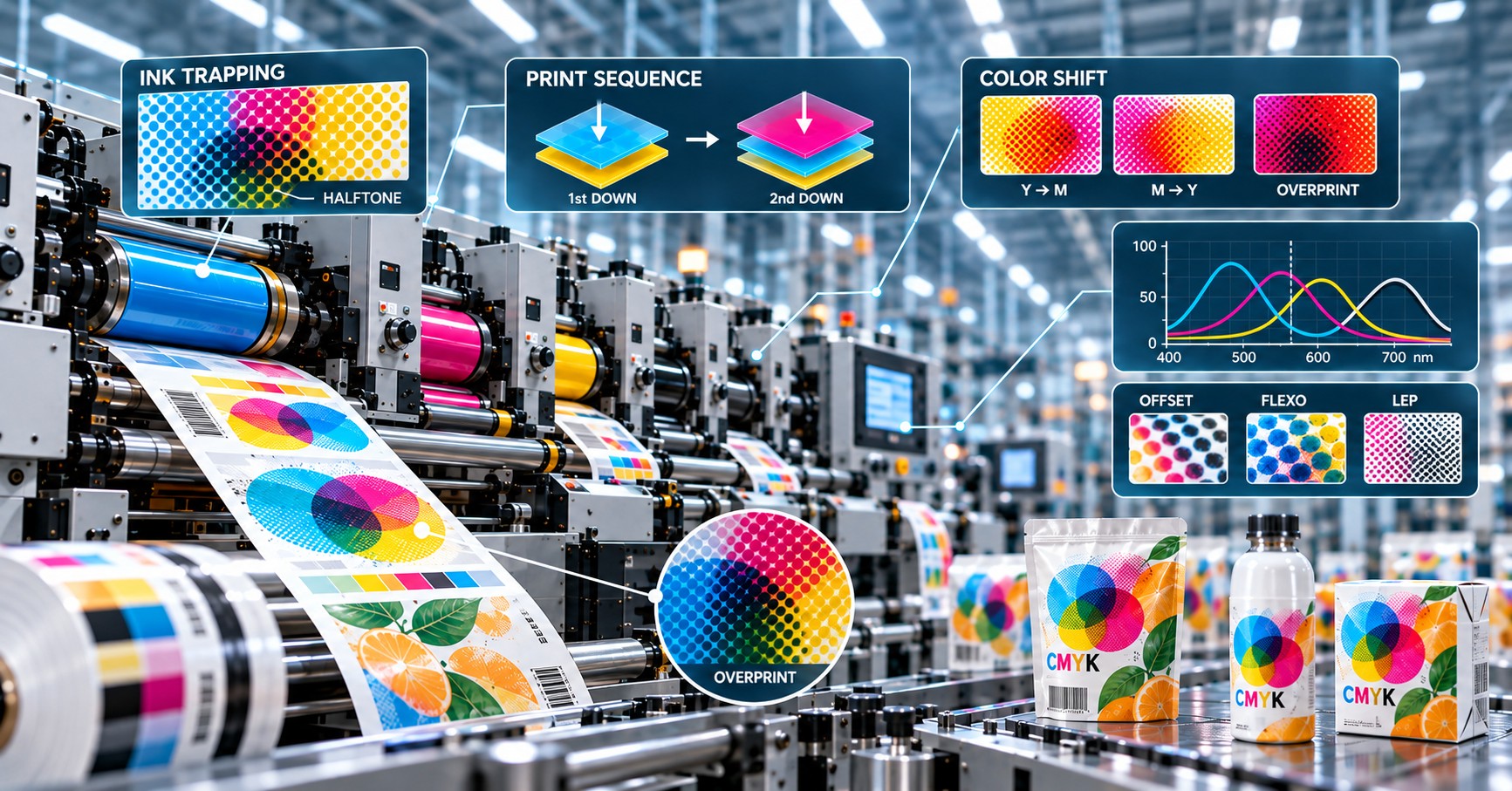
These interactions are often grouped under the term ink trapping. That term requires care: it can refer to the physical efficiency of placing a second ink on an existing ink film, or to an optical index calculated from the appearance of a two-color overprint. Those are related but not identical concepts. Distinguishing them separates a mechanical or chemical ink-transfer defect from an optical change in an otherwise well-printed stack.
1. What Does Ink Trapping Mean in Engineering Terms?
Printing a first ink layer on a substrate establishes an ink–substrate interface. Printing a second layer establishes a different interface: the incoming ink may contact an already printed ink film rather than the original paper, board, or plastic surface. Its transfer behavior therefore depends on the condition of the first layer, the chemistry of the next ink, and the transfer technology used.
Three mechanisms should be distinguished:
Physical ink trapping concerns how effectively a second ink is deposited on a surface that already contains ink. In wet-on-wet offset, for example, ink tack and the rheological state of the earlier layer influence this transfer.
Optical trapping concerns the measured appearance of the overprint. Light is absorbed and scattered by ink films, transmitted between layers, reflected by the substrate or backing, and returned toward the observer or measurement instrument. Transparency and layer order can change that response even if both inks were deposited successfully.
Halftone overprint interaction concerns the geometry of overlapping halftone patterns. Dot overlap, register variation, and changes in tonal value affect both the area covered by ink and how the printed region reflects light.
Each mechanism suggests a different corrective action. When the second ink fails to transfer, changing an ICC profile cannot repair the physical transfer mechanism. When the ink transfers correctly but the layer sequence produces a different spectral response, there may be no mechanical defect; the new condition may instead require characterization. When only halftone combinations fail while two-color solids behave normally, dot interactions and register deserve attention before blaming the ink's trapping ability.
2. Why Does Printing Sequence Change the Result?
Consider cyan and magenta. Printing cyan first with magenta on top creates one layer order; printing magenta first with cyan on top creates another. The total pigment combination may be similar, but the optical structure is not necessarily equivalent.
Commercial inks are not perfectly transparent. Their pigments and resins absorb and scatter light, while interfaces between layers and the substrate also influence reflection. If a relatively opaque ink is placed above another color, it may partially mask the lower film. Placing the same ink beneath a more transparent film can produce a different visible response.
In an idealized optical model involving perfectly transparent, nonscattering layers with unchanged thickness, sequence effects might be very small. Actual printing systems are not ideal. Pigment characteristics, effective coating weight, local coverage, and ink–surface interactions all contribute. Exchanging the printing order can therefore change L*a*b*, chroma C*, and hue angle h° without intentionally changing the nominal ink recipes.
Imagine a print in which cyan alone passes its target and magenta alone passes its target, but their purple overprint fails. Rather than immediately increasing the cyan or magenta density, ask whether the second layer transferred differently, whether the relative optical position of the layers changed, whether the pigments have different transparency, or whether halftone interaction is involved. The symptom can look the same even when the mechanisms differ.
3. Ink Trapping in Offset: The Role of Wet-on-Wet Printing
In multicolor sheetfed offset, successive inks are commonly applied within a short interval, before earlier films have fully set or dried. This is a wet-on-wet process. Ink tack is therefore a fundamental control variable.
Tack represents an ink film's resistance to rapid separation under defined testing conditions. It reflects a combination of rheological and interfacial properties as ink splits and transfers. Tack and viscosity are related, but they are not interchangeable measurements; a viscosity reading alone does not define tack behavior on press.
Tack balance across printing units
Many wet-on-wet offset ink sets are designed around a controlled tack sequence, commonly with tack decreasing through successive units, subject to the specific ink system and printing conditions. The objective is stable deposition of each incoming ink onto the previously applied film and reduced unwanted ink pick-back.
An unsuitable tack relationship may reduce second-ink transfer or contribute to back-trapping, in which previously printed ink is picked up by a subsequent printing unit. The consequences can include contamination, shifts in combined colors, and poor consistency during the run.
A trapping deviation does not, by itself, prove that tack order is incorrect. First-ink film thickness, substrate behavior, press speed, and dampening conditions can also affect transfer.
Ink-film thickness and print density
If the first ink layer is excessively thick, it can change the way the next ink is received. Increasing the second ink's supply to compensate for a weak overprint may temporarily move the composite color closer to target, but it changes the entire film build and can introduce further variation. If the first layer is confirmed as the cause, consider a suitable ink strength and controlled film thickness rather than treating higher ink consumption as the universal fix.
Substrate and dampening conditions
On a low-absorbency surface, the first ink film may remain wetter between units. An unsuitable ink–water balance can also change ink behavior during transfer. If a trapping deviation appears only on one paper grade or after a dampening change, investigate those physical conditions before changing color separation or the ICC profile.
4. Ink Trapping in Flexography: A Different Mechanism
Conventional flexography transfers comparatively low-viscosity ink from an anilox through a plate to the substrate. Solvent- and water-based systems commonly use drying between units to stabilize each film before the next color is applied. In that sense, many flexographic applications operate predominantly under dry-on-dry or dry-trapping conditions rather than the wet-on-wet mechanism typical of sheetfed offset.
The next color is printed onto an ink film dried sufficiently for the intended process. In radiation-curable applications, the timing and degree of curing between units must be considered separately; not every press configuration has identical interstation curing.
Variables affecting flexographic overprints
Important factors include the binder chemistry of both inks, surface energy of the first printed layer, wetting by the second ink, drying effectiveness, pigment transparency, and deposited ink mass. Inadequate drying may cause the next layer to interact with a film that has not stabilized as intended. Conversely, even a properly dried film may have surface properties that inhibit uniform wetting by the next ink.
These mechanisms require different responses. Better drying will not necessarily correct a fundamentally incompatible ink–ink surface interaction; more aggressive surface treatment will not automatically correct under-drying or the optical effects of pigment opacity.
Anilox and doctor-blade contribution
In flexography, the amount of ink transferred is influenced by anilox cell volume, release efficiency, ink rheology, doctor-blade conditions, and the plate-to-substrate transfer path. Variations in deposited film weight can change the optical appearance of overprints.
Before attributing an overprint shift to trapping, verify that the second ink deposits the required amount when printed alone. If its solid patch is unstable on a clean substrate, this is primarily a base transfer problem, not yet evidence of a specific ink-on-ink trapping defect.
Why order still matters in a dry-on-dry process
Even when both inks are applied and dried correctly, their sequence can alter the appearance. Yellow-over-cyan and cyan-over-yellow need not deliver identical greens because the optical structure differs. A sequence effect therefore does not necessarily mean the press has a physical ink-transfer problem.
5. What Research Tells Us About Printing Sequence
Studies in the flexographic printing literature show that changing color order in expanded-gamut printing can alter the printable color gamut and the appearance of selected overprints. In a 2016 Flexographic Technical Association study, four sequences were examined for a CMYK system expanded with orange, green, and violet. The work considered placing expanded-gamut colors before, between, and after neighboring process colors.
The reported results showed that print sequence affected gamut volume and the hue of some combined colors, but the effect was not uniform across color regions. Some pairs associated with orange and green showed stronger sequence sensitivity than other combinations. The work also cautioned against using opacity alone to predict which sequence would produce the largest gamut.
A follow-up study reported in 2017 described gamut-volume differences of about 6% between evaluated sequences. That numerical difference did not imply that every color improved or that all observers consistently preferred the sequence with the larger measured gamut. These observations relate to the tested inks, substrate, setup, and conditions; they do not define a universally superior sequence.
The practical conclusion is that print order is a measurable engineering variable. You can optimize it for a particular process, but you should not assume a sequence copied from another ink system is optimal without testing.
6. What Happens When LEP Prints One Color over Another?
Liquid Electrophotography (LEP) forms its ink image differently from conventional offset and flexography. Electrically charged ink particles containing pigment and polymer resin are transferred by an electrophotographic process to a heated intermediate blanket. On that blanket, the particles consolidate into a polymeric ink film, which is subsequently transferred to the substrate.
Consequently, LEP should not be described simply by the wet-on-wet tack model used for conventional offset. Its color-film interactions and transfer path are different.
One-Shot and Multi-Shot configurations
In a One-Shot configuration, color separations build up on the intermediate blanket before the composite multicolor image is transferred to the substrate in one combined transfer event. In a Multi-Shot configuration, separations can be transferred to the substrate in successive events.
This distinction matters for understanding the finished ink stack. When layers accumulate on an intermediate blanket and are subsequently transferred, you must analyze the relationship between their build-up order and their optical position relative to the viewer rather than assume it. Press architecture and specific transfer configuration are part of the print condition.
Is there ink trapping in LEP?
LEP overprints can exhibit color differences, but those should not automatically be attributed to the same physical wet-trapping mechanism as in offset. Ink-film formation already takes place on the intermediate blanket, so the relevant interactions include deposition/transfer efficiency, the resulting ink-film structure, coverage, and color separation behavior.
When a combined color shifts, inspect the press's actual print state and transfer configuration, as well as the spectrally measured output. Changing an offset or flexographic print order is not mechanically equivalent to changing a layer arrangement in LEP.
7. Surface Printing versus Reverse Printing
For flexible packaging, printing order must be distinguished from the optical order in which a consumer sees the layers.
With surface printing, the observer sees the inks from the side on which they were deposited. With reverse printing on transparent film, the image is viewed through the film. The first printed ink may therefore be closest to the viewer, even though subsequent colors were laid over it during production.
An opaque white backing layer further changes the optical response by altering the light returned through the colored inks. Two structures containing nominally the same colors and ink quantities can thus look different when one is surface printed and the other reverse printed.
It is equally important to distinguish the appearance before and after lamination. Lamination adhesive, film thickness, film haze and refractive effects, backing whiteness, and the surface gloss of the finished pack can all influence the measured result. A color deviation appearing only after lamination is not automatically evidence of poor trapping during printing. First identify the production stage at which the appearance changed.
8. How Is Ink Trapping Measured?
A traditional approach is a densitometric index generally associated with the Preucil formula. It compares the density contribution of the second ink when it is printed over the first with the measured density of the second ink on its own.
Apparent Trap (%) = [(D₁₂ − D₁) / D₂] × 100
For this expression:
- D₁₂ is the density of the two-color overprint measured through the channel/filter appropriate to the second ink.
- D₁ is the density of the first ink alone, measured through that same channel/filter.
- D₂ is the density of the second ink alone, measured through that channel/filter.
Worked calculation
Measurement | Optical density |
|---|---|
First ink alone, in the second ink's channel | 0.15 |
Second ink alone | 1.20 |
Two-color overprint | 0.99 |
Substituting these hypothetical readings gives:
Apparent Trap = [(0.99 − 0.15) / 1.20] × 100 = 70%
The result is an apparent optical trapping value of 70% under the stated measurement conditions. It does not establish that only 70% of the second ink's physical quantity reached the substrate. The index is influenced by ink transparency, spectral absorption, selected density channel, and sequence. This number alone does not mean 30% of the ink failed to transfer.
No universal trapping percentage can be adopted as the passing threshold for every pair of inks, substrate, and print technology. This index is most useful for comparing a defined production condition with its approved reference.
Limits of the Preucil approach
The method assumes a workable relationship between optical density and the contribution of deposited ink films. Real commercial inks and substrates do not satisfy those assumptions perfectly. Research comparing densitometric and physical approaches has shown that the measured apparent trapping index does not directly determine transfer mass. Use it as one process-control indicator, not as sole proof of the failure mechanism.
9. Spectral Measurements: Beyond a Single Density Number
A spectrophotometer provides more information about combined color than a single OD measurement. By measuring reflectance across wavelengths, it enables calculation of L*a*b*, L*C*h°, and color differences. Measuring the solids and their overprints lets the engineer determine whether the sequence primarily changes lightness, chroma, or hue angle.
Two sequences can produce similar chroma yet noticeably different hue angles. A single density figure cannot explain that distinction.
Why retain spectral data?
L*a*b* coordinates are derived from a specified illuminant, observer, and measurement configuration. Retaining the underlying spectral data lets you revisit the analysis and compare reflectance-curve shapes, even when computed color differences appear modest.
Optical models can also compare predicted overprint appearance with measured output. Research reported in Color Research & Application in August 2026 described assessing ink trapping using overprint reflectance spectra and comparing it with established densitometric methods. The approach was presented as a way to obtain more sensitive diagnostic information in the studied context; it should not be treated as an automatic replacement for all production measurement procedures.
For reliable comparisons, keep instrument conditions, substrate backing, reference data, and measurement mode consistent, including M0/M1/M2/M3 where relevant under ISO 13655. A measurement-condition mismatch can be mistaken for a printing or trapping deviation.
10. Distinguishing Trapping from Calibration Problems
The first diagnostic question is whether a deviation occurs in individual primary colors or only in combinations.
If both the first and second inks are already outside their approved single-color targets, there is no reason to begin with an ink-trapping investigation. Verify the basic printing condition first.
If the primary solids pass but only selected two-color combinations fail, examine second-layer transfer, printing order, and optical properties. A practical control strip should contain full solids of each color, full-solid overprints of relevant color pairs, and halftone overprints.
The full-solid overprints are particularly useful because they reduce—but do not eliminate—the influence of dot gain and register. If two-color solids pass but halftone combinations fail, investigate tonal value increase (TVI), screening, dot overlap, and register. If full-solid overprints fail, ink-film transfer, chemistry, order, and optical appearance become more prominent candidates.
Why not change the ICC profile first?
An ICC profile describes a printing system in a defined physical state. When the physical state drifts, the profile may no longer represent the press accurately. Changing the profile before stabilizing the process can create a digital compensation for a condition that is still moving.
The result may match briefly after recalibration, only to drift when the original transfer mechanism returns. The engineering sequence should be: stabilize materials and printing conditions; verify single-color and combined-color performance; and only then decide whether new characterization is required.
11. Substrate Effects on Combined-Color Printing
The same ink order can produce different results on different substrates. Absorbent paper, coated paperboard, PET film, and PP film present different surface energy, absorbency, optical properties, and interfacial behavior.
On absorbent stock, some ink components can penetrate and change the condition of the first film before the next ink is applied. On nonabsorbent films, the ink remains primarily at the surface, and drying or curing depends strongly on the ink chemistry and the press configuration.
Primers and receptive coatings can also change wetting, anchorage, optical scattering, and ink transfer. A primer that improves ink adhesion does not automatically improve trapping: it must be qualified as part of the complete substrate–ink system. Replacing a primer may improve a mechanical interface while changing the resulting overprint color. Both effects must be measured.
12. Expanded Gamut: Seven Colors Make Sequence an Engineering Variable
Expanded-gamut workflows using CMYK plus orange, violet, and green (CMYKOVG) extend the range of colors that can be built from a fixed ink set. Adding channels does not remove the influence of print sequence; it adds more possible overprints and color-pair interactions.
Orange can contribute to hues in the yellow–magenta region; green supports hues between cyan and yellow; and violet contributes to regions associated with cyan and magenta. This does not mean all seven inks are deposited in every image area. Separations should use the channels required for the target color and the approved process strategy.
Why one sequence cannot be optimal for every ink set
Flexographic expanded-gamut research shows that changing the sequence affects different color regions to different degrees. One sequence may increase saturation in oranges without producing comparable improvement in violets. The response depends on pigment transparency, film properties, printed overprints, and spectral behavior.
The most useful sequence must therefore be established on the actual substrate and ink set. Copying an order from another press or supplier is not an engineering substitute for qualification.
Define the objective before optimizing
Is the purpose to maximize total gamut volume, improve a small set of brand colors, reduce ink consumption, or achieve more stable matching between production runs? These objectives can compete with one another.
Once the objective is defined, measure singles and overprints, compare hue and chroma, and evaluate viable sequences. Consider drying, curing, register, press configuration, and production repeatability. A sequence that delivers a larger gamut in a laboratory trial but is unstable during commercial production is not necessarily the better choice.
13. Troubleshooting: Finding the True Source of the Deviation
Observation | Plausible mechanism | Diagnostic evidence | Controlled engineering response |
|---|---|---|---|
Primary solids pass, secondary color fails. | Ink-layer transfer or optical interaction | Measure single and two-color solid overprints | Isolate order and layer effects |
Second ink appears weak in offset. | Tack balance or excessive first-film thickness | Trapping index, tack evaluation, ink-film condition | Qualify ink and transfer conditions |
Problem occurs on only one substrate. | Absorbency, primer, or surface-property change | Controlled cross-substrate comparison | Correct qualified substrate/surface-preparation route |
Hue shifts after flexographic unit-order change. | Layer-order and transparency effects | Spectral comparison of sequences | Characterize the approved sequence |
Only halftones deviate | TVI, register, dot overlap | Compare full solids with halftones | Investigate screening, register, and tonal behavior |
Deviation follows an ink change. | Pigment, binder, or opacity difference | Spectra and overprint patches | Characterize the new ink combination |
Color changes after lamination | New optical viewing stack | Before/after laminate measurements | Approve color on finished construction |
New ICC profile fixes color only temporarily | Digital compensation for process drift | Repeat before/after process-state measurements | Stabilize physical cause before profiling |
LEP overprints deviate from reference | Separation, transfer, or ink-stack changes | Verify print configuration and spectral output | Validate press condition and matching profile |
Expanded-gamut region lacks chroma. | Order or optical interaction of O/G/V with CMY | Overprint-pair evaluation | Controlled sequence experiment |
This table is a diagnostic map, not a list of automatic root-cause assignments. Similar visual symptoms can result from different mechanisms, so each proposed explanation requires a controlled test.
14. Engineering Illustration: The Primaries Pass, but the Green Is Wrong
The following scenario is an educational illustration based on established printing mechanisms; it is not presented as a documented event from a specific factory.
A flexographic packaging converter reverse prints on transparent polymer film. The customer has approved the cyan and yellow primaries when measured separately, yet their green overprint does not match the reference.
The operator first increases cyan to improve the green. The combined hue moves closer to target, but cyan alone now falls outside its approved tolerance. One symptom has been improved by creating a second problem.
A controlled investigation begins instead. Cyan and yellow solids are measured separately and remain within limits. A full-solid green overprint is measured, confirming the discrepancy. Halftone patches also differ, but the deviation is already evident in the solid overprint; dot gain and registration therefore cannot account for the entire problem.
Next, inspect the physical conditions: first-ink drying, second-ink wetting, delivered film weight, and transfer settings. If these are stable and satisfactory, compare the two viable print sequences under controlled conditions. Spectral measurements can reveal whether the main change is in hue angle or chroma.
If another sequence improves accuracy and stability, it may be qualified for the job. But changing the sequence changes the printing condition. The plant should not keep using an ICC characterization built for the former layer order without verification or recharacterization.
The purpose of the illustration is not to declare the original sequence universally wrong. It is to show how to distinguish a failure in ink deposition from optical behavior that does not match the approved color reference.
15. Designing a Professional Print-Sequence Trial
A useful experiment must separate sequence effects from unrelated process changes.
Where practical, use substrate material from the same lot and verify uniform surface condition. Keep pigment/binder systems consistent within the trial. In flexography, control anilox specification, plate condition, doctoring, drying, and print pressure. In offset, confirm ink tack, ink-film thickness, blanket state, and dampening conditions. In LEP, define the transfer architecture, print state, substrate, and color separation settings; do not assume that layer order can be rearranged exactly as on a flexographic press.
Test target design
The target should include primary-color solids, selected two-color solid overprints, halftone combinations at several tone values, and relevant brand-color builds. Include opaque white or other backing colors when they are part of the final package.
Run each valid sequence at defined settings, collecting samples only after the process has stabilized. Do not compare a single patch from each condition. Gather enough replicates to assess repeatability, including variation across the web and along production length where relevant.
Measurements and what they reveal
Measurement | Engineering value |
|---|---|
Primary-color OD | Base print strength and deposition stability |
Primary-color L*a*b* | Conformance of individual colors to references |
Overprint L*a*b* | Final appearance of combined ink layers |
ΔE00 | Color difference relative to the agreed reference |
C* and h° | Chroma and hue-angle changes |
Apparent trapping index | Relative densitometric process indication |
TVI | Tonal response and dot-area-related behavior |
Spectral reflectance | Wavelength-dependent changes in optical response |
Drying/curing condition | State of the layer receiving the next ink |
Sample-to-sample variation | Production repeatability, not just a single good proof |
Choosing a winning sequence
Do not automatically select the sequence with the highest apparent trapping percentage. Success must be evaluated against predefined outcomes: brand-color accuracy, process stability, required gamut, and the finished product's appearance.
If one sequence improves one gamut region but weakens another, choose according to the actual work mix and customer requirements. A plant printing a restricted palette of demanding brand colors may value stable performance in those colors more than the largest possible total gamut volume.
16. When Should Sequence Change, and When Should Calibration Change?
Changing ink order is a substantial change to the print condition, not a first response to every color deviation.
If a problem stems from unstable ink transfer, incorrect drying, excessive ink-film thickness, or uncontrolled process settings, correct those mechanisms first. When the physical process is stable, and measurements show that an optical sequence effect is preventing target matching, evaluate whether another sequence provides a durable improvement.
After a validated order change, update the color characterization as needed. In expanded-gamut workflows, sequence can influence color separation and achievable gamut. In LEP, the permitted order of layer accumulation and transfer depends on the press architecture and qualified workflow; use approved platform-specific settings rather than borrowing a change method from offset or flexography.
The principle is consistent across technologies: calibration controls describe a defined physical process. It is not a substitute for stabilizing that process.
17. Looking Ahead: Can Overprint Behavior Be Predicted?
Traditional print-order selection has relied heavily on experience, accepted rules, and successive press trials. Spectral measurement and computational modeling can now help predict the appearance of combined inks before committing to every possible full-scale production trial.
Models of color mixing and spectral reflectance may estimate overprint behavior based on ink properties and substrate response. Their usefulness is limited when the model does not capture actual transfer, effective ink-film thickness, dot interactions, or process variability.
A model calibrated only to laboratory drawdowns cannot be expected to predict a full-speed commercial press perfectly. The strongest development approach combines laboratory and spectral measurement, controlled production experiments, and a model adjusted against real press results. This reduces unnecessary trials while retaining on-press verification.
Conclusion: Correct Primaries Do Not Guarantee Correct Overprints
A press can reproduce primary colors within approved tolerances and still show significant deviations when those colors are printed together. The final appearance depends not only on each ink in isolation but also on the transfer mechanism, layer sequence, substrate, and the way light travels through the printed structure.
In offset wet-on-wet printing, ink tack balance and film thickness can directly influence deposition of successive inks. In flexography, ink chemistry, drying or curing, interfacial wetting, and layer order can change the result even when each ink is deposited correctly. LEP forms and transfers polymeric ink films by a different mechanism, so its layer accumulation and transfer configuration must be considered on its own terms.
Distinguishing physical trapping from optical trapping prevents unnecessary corrections. Physical transfer faults require stabilization of the deposition process. Optical differences require understanding the layer stack and, when appropriate, the color characterization. Deviations restricted to halftones call for examination of screening, registration, and tonal response.
The engineering lesson is simple: measuring every ink separately is not enough. We must understand what happens when inks meet—and how that encounter changes the light the customer ultimately sees.
The correct final color is not the product of an ink recipe, ICC profile, or density target alone. It results from a complete physical and optical process that must be stable, measurable, and repeatable.
Technical References and Further Reading
- Flexographic Technical Association. Liam O'Hara, Bobby Congdon, and Brad Gasque. Printing in Color: Optimizing the Print Sequence for Expanded Gamut (2016).
- Flexographic Technical Association. Nina Davis. Print Sequence in Expanded Gamut Printing and Its Effect on Color Gamut (2017).
- Jui-lin Hsu. A Study of Ink Trapping Comparing Gravimetric and Densitometric Methods of Measurement. Rochester Institute of Technology (1989).
- Nguyen Thanh Phuong. Ink Trapping Assessment Based on Reflectance Spectra Analysis of Overprint. Color Research & Application (2026). DOI: 10.1002/col.70117.
- ISO 12647-2:2013. Process control for the production of halftone color separations, proof and production prints—Part 2: Offset lithographic processes.
- ISO 12647-6:2020. Process control for the production of halftone color separations, proof and production prints—Part 6: Flexographic printing.
- ISO 13655:2017. Spectral measurement and colorimetric computation for graphic arts images.
- Industry technical guidance on ink tack sequencing, back-trapping, ink–water balance, and wet-on-wet offset printing.
- Technical literature on liquid electrophotography, intermediate-blanket transfer, and One-Shot/Multi-Shot image formation.
Engineering note: The article combines published research findings with technical explanation and proposed diagnostic methods. The illustration in Section 14 is a teaching scenario and is not represented as a documented factory incident. Press configuration, ink chemistry, and accepted process limits must always be confirmed for the actual application.