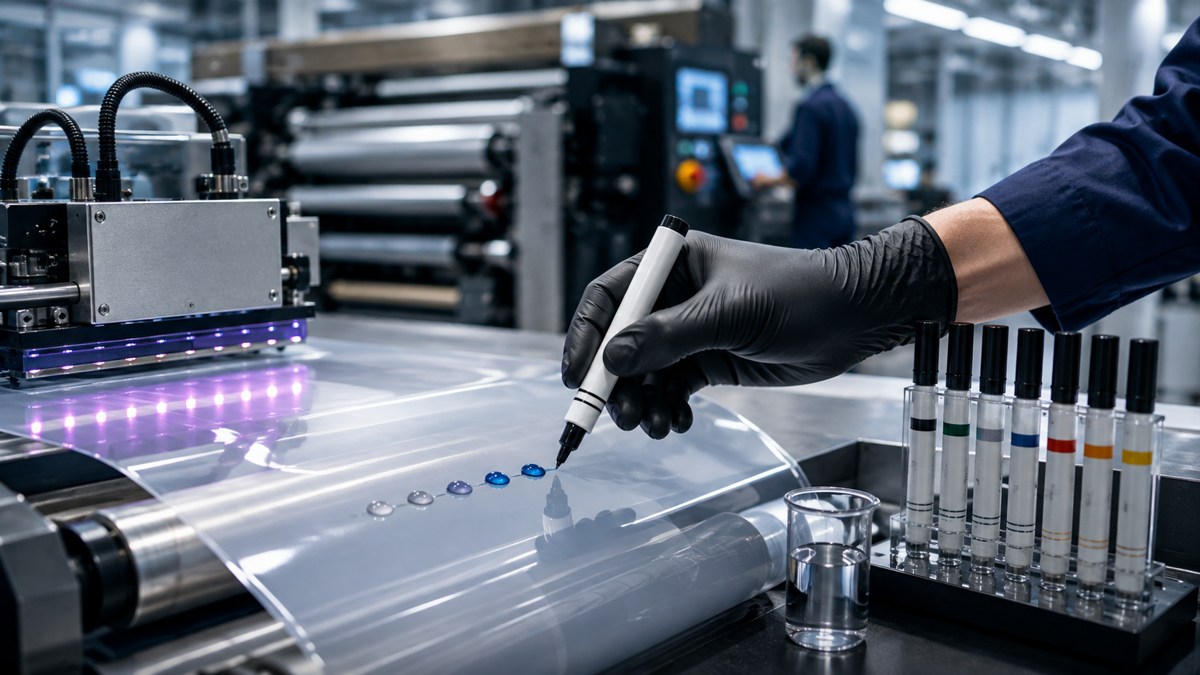
Anyone who works with synthetic substrates in printing eventually becomes familiar with dyne levels.
A roll of film arrives. The surface is checked. The number is compared with a specification. If it is low, the film may be corona treated. If the reading moves into the expected range, production often feels more comfortable proceeding.
That sequence is useful.
The problem begins when the dyne number is asked to prove something it was never designed to prove.
A dyne test provides insight into wetting. It does not, by itself, prove ink adhesion, primer compatibility, coating durability, laminate bond strength, or finished-product performance.
For printers working with PE, PP, BOPP, PET, and other synthetic films, that distinction matters.
First, dyne is not a universal substrate specification
This discussion applies primarily to synthetic, non-porous polymeric substrates, particularly films used in labels and flexible packaging.
The same logic should not automatically apply to paper and paperboard. Their printability and converting behavior depend on other properties such as coating chemistry, porosity, surface strength, smoothness, moisture content, caliper, fiber direction, and the mechanical demands of creasing, folding, and gluing.
With polymer films, surface energy is a particularly important factor at the printing interface because many untreated polymers naturally present surfaces that are difficult for primers, inks, coatings, or adhesives to wet adequately.
But even here, there is no single “correct dyne level” for all synthetic materials.
Polyethylene does not behave like polypropylene. Polypropylene does not behave like polyester. BOPP and CPP may both belong to the polypropylene family yet still have very different film histories, coatings, treatment levels, and intended applications.
Even two rolls described by the supplier as belonging to the same polymer family can exhibit different surfaces at the press.
The polymer is the starting point. It is not the complete surface specification.
The grade matters as much as the family name.
One of the mistakes I have seen repeatedly in production is allowing a broad material description to become the qualification.
“BOPP” is not enough.
“PET” is not enough.
“PE” is certainly not enough.
Within each family, the grade, manufacturing route, additives, orientation, coatings, slip package, treatment history, and intended use can change how the surface behaves.
Two BOPP grades may have different treatment levels, coefficients of friction, coatings, and heat response. A PE family can contain a wide range of densities, additive packages, mechanical behavior, and seal characteristics.
The same principle applies at the printing surface.
Each material/application combination needs its own qualified surface window.
That window should be based on the actual film grade and the subsequent process — not on a universal number copied from another substrate.
What the dyne test really tells us
A dyne solution or dyne pen gives practical information about how a test liquid behaves on the surface at the time of the test.
If the liquid wets the surface as expected, we have evidence that the surface energy is within a range that may allow the next liquid layer to spread properly.
That next layer may be a primer, an ink, a coating, or an adhesive.
This is important because poor wetting can prevent a process from ever developing a reliable interface.
But wetting is only the first question.
A surface can wet well and still fail later.
The primer may be chemically incompatible with the surface.
The primer itself may not be properly dried or crosslinked.
The ink may transfer correctly but anchor poorly.
A printed layer may survive the press but fail during varnishing, lamination, die-cutting, matrix stripping, or application.
A lamination adhesive may wet the printed surface and still develop an unacceptable final bond.
The dyne result cannot answer all of those questions.
It tells us how the test liquid behaves.
It does not tell us the complete chemistry of the interface.
Treatment history changes the surface.
Another reason not to treat dyne as a permanent material property is that polymer surfaces change over time.
Corona treatment modifies the upper molecular layer of the film, increasing its surface energy and improving wetting.
That condition is not necessarily permanent.
Treatment can decay with time. Additives and slip agents can migrate toward the surface. Storage temperature, handling, contamination, contact with the opposite side of the wound roll, and aging can all change the practical surface that reaches production.
This is why a supplier's treatment value and the value measured months later at the press can both be correct — and still describe different moments in the material's life.
The label on the roll tells us what material was supplied.
The surface test tells us something about what we have now.
Neither one alone tells us whether the complete printing construction will work.
More corona is not automatically better.
Corona treatment is an extremely useful process tool, but it is sometimes used with the wrong objective.
The goal should not be to generate the highest dyne value the treater can produce.
The goal is to establish the required qualified surface condition.
That may sound like a small difference, but operationally it is a major one.
If the incoming film is below the required wetting condition, a controlled corona refresh may restore the surface to the operating window needed for the primer or other chemistry that follows.
Once that condition is achieved, more treatment is not automatically more useful.
Excessive or poorly controlled treatment can damage a sensitive surface or coating, change appearance, reduce process stability, or create a new problem while trying to solve the original one.
A useful production approach is therefore:
Measure the incoming condition.
Treat only when required.
Measure again.
Then continue through the real process and validate the interface.
The dyne number is a process control point, not a competition.
Pre-primed does not mean pre-qualified
This distinction becomes particularly important with so-called pre-primed or print-ready materials.
A supplier may have applied an excellent receptive coating. The material may have been successfully validated in a particular printing system.
That does not automatically mean it is qualified for every ink generation, press condition, protection system, converting route, or final application.
The correct question is not:
“Is this film pre-primed?”
The better question is:
“Pre-primed and validated for what?”
For printers, this is an important difference.
A supplier specification tells us what the supplier has prepared or tested.
Our production qualification must tell us whether the evidence covers the construction we are actually producing.
Always identify the surface the next process will meet
This is where many investigations become unnecessarily complicated.
Imagine a flexible-packaging structure.
Before printing, we measure the film surface.
We corona treat if required.
We prime.
We print.
Later, the web goes to lamination.
At that point, what does the laminating adhesive actually meet?
In a printed area, it may no longer meet the original film at all.
It may meet a polymeric ink layer, white ink, a protective coating, or another prepared surface created during printing.
A dyne value measured on the raw film before printing does not automatically describe that new interface.
This is one of the most useful questions I use when looking at a failure:
What surface is the next process actually touching?
If the failure occurs during lamination, examine the actual lamination interface.
If the failure occurs during gluing, inspect the surfaces involved in the glue joint.
If the ink fails during conversion, examine the printed construction and the failure mode rather than automatically returning to the incoming substrate specification.
The location where the failure becomes visible is not always the place where it began.
Separate wetting, adhesion, and durability
For practical troubleshooting, I prefer to keep three questions separate:
Wetting - can the liquid spread properly on the surface?
Adhesion- does the resulting layer bond adequately to the surface beneath it?
Durability - does that interface survive the stresses required by the real product?
One test should not be asked to answer all three.
A dyne test supports the first question.
Adhesion needs adhesion evidence.
Durability needs application-relevant evidence.
Depending on the product, that may involve tape testing, rub or scratch testing, lamination and peel evaluation, coating tests, die-cutting, matrix stripping, folding, gluing, dispensing, application, or other finished-product simulations.
The test should follow the failure mechanism and the actual product requirement.
A practical production sequence
When a synthetic substrate is being qualified or when an adhesion problem appears, I would keep the investigation disciplined:
- Confirm the exact material and grade. Do not stop at PE, PET, or BOPP.
- Confirm the side. Treatment, coating, and print-receptive layers may not be identical on both sides.
- Review the surface history. Please review the supplier treatment, age, storage, contamination risk, additives, coatings, and previous preparation.
- Measure the actual surface condition. Use the dyne result as wetting information.
- Treat only if the material and qualified route require it.
- Measure again after treatment.
- Apply the real primer, ink, coating, or adhesive.
- Test the actual interface.
- Continue the evaluation through the downstream process that matters.
That last step is often the one that separates a good laboratory result from a reliable production result.
A printed film is not qualified merely because it looked good on the press.
A laminate is not qualified because the adhesive initially held the webs together.
A label is not qualified until it withstands the converting and application conditions for which it was designed.
The evidence has to travel with the product.
The number is useful - as long as we let it remain a number
I am not arguing against dyne testing. Quite the opposite.
It is a simple, practical, and valuable production tool when used for the question it can actually answer.
The trouble begins when a wetting indicator is mistaken for an adhesion certificate.
For synthetic substrates, surface energy is part of a chain:
Polymer and grade → surface history → treatment → wetting → primer or ink interface → converting or finishing → final performance.
Every link matters.
The most useful rule I know is also one of the simplest:
Use dyne to understand wetting. Use the real interface to prove adhesion. Use the finished application to prove durability.