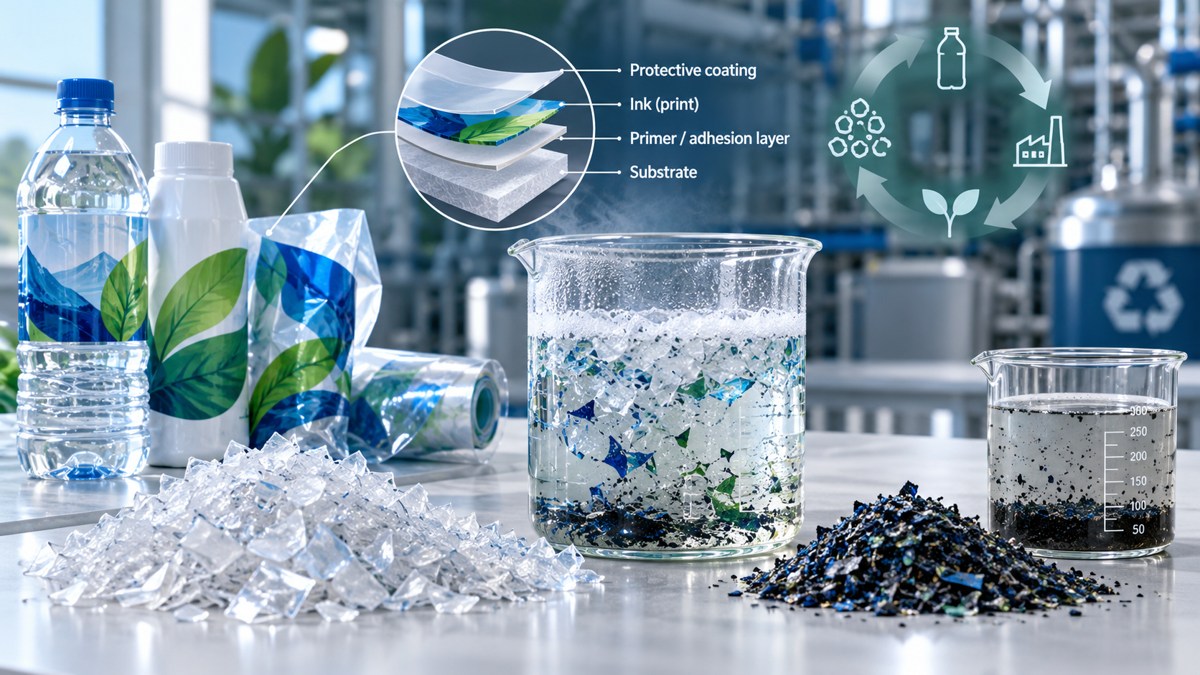
At first glance, deinking sounds like a simple end-of-life requirement: when the package reaches recycling, remove the printed image from the plastic. In practice, that sentence hides one of packaging's most difficult interface problems. The image that must disappear at the end of life is the same image that had to survive printing, varnishing, converting, filling, transport, refrigeration, rubbing, flexing, and months of handling before the package ever reached a recycling plant.
That is why deinking should not be treated as an ink-selection exercise. It is a property of the complete construction. The substrate, surface treatment, primer, ink, white layer, overprint coating, adhesive, curing history, and recycling wash all shape the final result. Change one of them and the same printed image may behave very differently.
Another complication is that not every recycling route wants the printed layer to behave the same way. In one application, the best result is for the label to leave the container while the ink remains strongly attached to the label. In another, the label or sleeve may remain with the polymer stream and the decoration must be removed from it. Both routes can use a hot alkaline wash, yet they ask the printed structure to do almost opposite things.
The right question is not "Is the ink deinkable?" It is "Does the complete printed construction behave correctly in the intended recycling process?"
Deinking and wash-off are not the same requirement
A pressure-sensitive label on a PET bottle provides a good example. A common recycling strategy is to release the label during washing and then separate it from the PET by density. In that route, ink retention can be more important than ink removal. If the label releases cleanly but the ink bleeds into the wash water, the bottle may be mechanically separated while the color and fine solids remain in the process. The label has washed off, but the decoration has not behaved well for recycling.
A compatible shrink-sleeve construction can create a different requirement. If the sleeve is intended to remain with the main polymer fraction, the printed layers may need to release from the sleeve so that the polymer entering reprocessing is clean enough for the intended recycled application. Here the success condition is not ink retention; it is controlled deinking.
These examples explain why the phrase recyclable label is incomplete without the recycling route. A construction can be excellent for one collection and recycling system and inappropriate for another. Regional infrastructure, polymer stream, density separation, wash conditions, and end-market quality all influence the preferred design. A single recipe cannot represent every market.
This is also why a technical team should define the target behavior before starting a trial. Does the decoration need to stay on a removable component, leave a compatible component, or remain compatible with the recyclate at the specified loading? Until you answer that question, a deinking test has no clear pass condition.
The printed image is a multilayer interface
The printed layer is often discussed as if the ink sits directly on the base polymer. In industrial production, the situation is usually more complex. The surface may be treated, coated, primed, printed with multiple colors and white, then protected with a varnish or another functional coating. Each interface has its own adhesion and chemical resistance.
For normal production, we want that stack to behave as one system. The primer should wet the substrate and provide a stable receptive layer. The ink should anchor to the primer or treated surface. The protective coating should withstand the product's mechanical and chemical demands. Converting should not introduce cracking, abrasion, or delamination. These same properties can make end-of-life release more difficult if the construction was never designed to change state during recycling.
The useful way to think about deinking is therefore not 'strong adhesion versus weak adhesion.' A successful construction needs selective adhesion. It must be strong enough throughout the product life and then respond predictably when the recycling process applies a different combination of temperature, alkalinity, surfactant, water, and mechanical energy.
That transition is the engineering challenge. A structure that fails too early is not a commercial product. A structure that never releases may protect the print perfectly but prevent the polymer from reaching the required recyclate quality.
The recycling wash is a process, not a bucket of hot water.
Hot alkaline washing is widely used in plastic recycling, particularly where labels, adhesives, dirt, and other surface contaminants must be removed. But temperature alone does not define the process. Alkalinity, surfactant chemistry, residence time, agitation, solids loading, flake size, and the history of the printed construction all influence what happens at the interface.
A small laboratory sample can also behave differently from material in a production recycler. In the laboratory, every fragment may see similar chemistry and agitation. In an industrial line, wash liquor ages, solids load changes, contaminants accumulate, friction occurs between flakes, and separation equipment has finite efficiency. The laboratory should therefore be used to understand mechanisms and screen constructions, not to create an artificial confidence that one successful beaker test guarantees industrial recycling performance.
The wash has to do several jobs at once: release unwanted components, avoid re-deposition, maintain polymer cleanliness, allow effective solid-liquid separation, and protect the quality of the recovered material. Deinking that succeeds visually but overloads the wash water with fine pigment can simply move the problem from the plastic surface into the recycling loop.
Where the removed ink goes matters as much as whether it comes off
This is one of the most important points in deinking. Complete removal from the film is not automatically a successful result. The removed material has to go somewhere, and its form determines whether the recycling process can handle it.
At one extreme, color can bleed or dissolve into the wash liquor. The printed surface may look clean while the water becomes visibly coloured. At another extreme, the coating can fragment into particles so small that they remain suspended and pass through normal separation steps. A third result is the release of larger, filterable fragments. Whether those fragments are desirable depends on the recycling process, but they are at least easier to observe and separate than dissolved color or extremely fine solids.
This is why serious deinking work should examine both the cleaned polymer and the wash stream. Visual inspection of the substrate answers only half the question. The test should also assess wash-water color, turbidity, filtered solids, and the size range of released material. Some laboratory protocols use staged filtration specifically to reveal whether the decoration has broken into particles that remain in the water rather than being captured as solids.
The practical lesson is simple: a clean-looking film can still be a poor deinking result, and dirty wash water can be more important than the photograph of the deinked sample.
Primer can decide the fracture plane
Primer is often treated as a printing aid, but in a deinking study it becomes part of the recycling architecture. Its dry polymer layer determines how the substrate and ink interact, and it can become the fracture plane during the wash.
A very thin primer layer may be enough to provide initial print adhesion, yet local coverage can vary over a rough, porous, or chemically heterogeneous surface. During recycling, those local differences can produce partial release: some areas cleanly deink, some remain printed, and some break into small fragments. Increasing primer coat weight may improve uniformity, but it can also change the chemistry and mass of material that the recycling process must remove.
The opposite mistake is assuming the strongest primer is the most robust sustainable choice. If the recycling route requires deinking, an interface engineered only for maximum permanent adhesion may work against the end-of-life objective. If the route requires ink retention on a detached label, the same high resistance may be beneficial. You cannot select the primer independently of the intended recycling behavior.
For this reason, primer qualification for recyclable packaging should include dry coat weight, solids, coverage, drying, and aging - not only the primer name or the result of a tape test. The recycling response belongs in the process window.
The overprint coating can protect the image or lock it in place
Protective coatings create a similar trade-off. In a wash-off label route where the objective is to keep the decoration on the label, a durable, well-cured overprint layer can reduce pigment release and protect the image while the label separates from the container. In that case, resistance to the recycling wash is a feature.
In a deinkable sleeve route, the same logic can be reversed. A highly crosslinked coating may prevent the wash from reaching the interfaces beneath it, or it may hold the ink stack together so effectively that the sleeve remains decorated. On the other hand, a coating designed to release together with the ink in controlled fragments can help remove the entire printed stack. The result depends on chemistry, film formation, coat weight, cure, and the layers underneath.
This is why varnish should never be treated as a cosmetic final step in a recycling trial. It changes surface energy, friction, chemical resistance, mechanical toughness, and the path the wash takes to reach the printed layer. Test a deinking construction with the actual protective coating, at the actual coat weight and cure level used in production.
The same is true for heavily printed areas. A low-coverage graphic can appear easy to deink, while a high-density black, a heavy white layer, or multiple overlapping colors produce a very different film thickness and fracture behavior. Artwork is part of the material construction.
Don't judge digital and conventional printing by the process name.
It is tempting to make broad statements such as 'water-based inks deink better' or 'digital inks are harder to recycle.' Those statements are too simple to be useful. Water-based describes the carrier before drying, not necessarily the behavior of the final polymer film. A waterborne system can still crosslink strongly after drying, and a pigment or dye that disperses too easily can create a wash-water problem rather than a recycling advantage.
The same caution applies to radiation-cured systems and to different digital ink technologies. The recycling plant does not see the press's marketing category. It sees the dried or cured layer that arrives on the substrate. Film cohesion, particle size after release, solubility, surface chemistry, primer interaction, coating interaction, and the recycling process determine the result.
Paper recycling has demonstrated the same principle for years. Successful deinking requires the printed material to detach from the fiber, fragment into a useful size range, and then be removed by the available separation process. Different print technologies can perform very differently because the ink film and the recycling method interact. Plastic packaging is not identical to paper, but the system's lesson is the same: release is only useful when the released material can be separated.
The practical approach is therefore to qualify the construction, not the technology label. If two printing systems create different ink films, test them separately. If the primer, coating, or substrate changes, assume the recycling response may change until evidence shows otherwise.
A useful qualification plan starts with the failure mode.
A good deinking study does not begin by printing ten random samples and placing them in the same wash. It begins by defining the intended recycling route and the most damaging plausible failure modes. For a wash-off label, those may include adhesive residue on the bottle, ink bleeding into the wash, and label fragments following the PET fraction. For a deinkable sleeve, the risks may be incomplete ink removal, decoration fragments remaining with the polymer, or particles becoming too fine to separate effectively.
From there, build a small, designed experiment around the variables you can realistically control in production. The goal is not to find one perfect laboratory sample. It is to identify a process window wide enough to survive normal variation.
A practical qualification framework
For every deinking trial, I would document six groups of variables:
Substrate - Polymer type, surface treatment, coating, recycled content (where relevant), and lot and storage history.
Primer - Chemistry, coat weight, solids, viscosity, application method, and drying condition.
Printing - Ink coverage, white ink where used, image build, and representative production conditions.
Protective coating - Coating chemistry, coat weight, cure or drying condition, and the level of protection required during use.
Recycling test conditions - Wash chemistry, temperature, time, agitation, filtration, and separation method.
Evaluation - Residual ink on the substrate, contamination of the wash water, particle size, filter residue, and final material cleanliness.
For development work, I prefer to compare a limited number of deliberately different constructions rather than many poorly documented samples. A baseline, a controlled change in primer coat weight, a controlled change in protective coating, and a high-coverage artwork condition can reveal more than many unrelated trials. If the first screen identifies a promising window, then repeat it after aging and after the real converting route.
Do not separate recycling qualification from production qualification
A construction that looks beautiful but cannot survive filling, transport, or customer use is not sustainable. Neither is a construction that performs perfectly in the market but contaminates the recycling stream. The engineering target is the overlap between those two windows.
Verify that overlap after the real production sequence. Heat used for shrinking can increase film cohesion or change orientation. Extended storage can strengthen or weaken an interface. A protective coating may continue to develop after application. Adhesives can migrate or age. A sample tested immediately after printing may not represent the package entering recycling months later.
The same reasoning applies to scale-up. Laboratory screening is useful because it is controlled and economical. Final qualification should still include the relevant converting route and, where the risk justifies it, testing against the recognized recycling protocol for the target market. Design-for-recycling guidance changes as recycling technology and end-market requirements evolve, so qualification is not a permanent property of a material name.
It is also important to distinguish recyclability from recycled quality. A package may technically enter a recycling stream yet reduce the recyclate's color, clarity, odor, mechanical performance, or food-contact suitability. High-value circularity depends on what the recovered material can become, not only on whether it passed through the recycling plant.
The end-of-life requirement should be written into the print specification
Today, the print specification usually includes color targets, adhesion, rub resistance, coating appearance, coefficient of friction, and converting requirements. For packaging intended to support high-quality recycling, the end-of-life behavior should sit alongside those properties rather than being treated as a separate sustainability document.
That does not mean adding a vague line saying 'recyclable.' It means defining the expected behavior of the complete construction in the applicable recycling route. Should the label be released? Should the ink remain on it? Should the decoration leave the sleeve? What must happen to the adhesive? Which polymer fraction should the component follow? What evidence is required before the construction is released commercially?
Once those questions are explicit, the technical work becomes much clearer. Primer, ink, and varnish can be optimized as a system. The converter can test realistic artwork instead of laboratory patches alone. Quality can control the relevant variables. Sustainability teams can discuss actual process evidence rather than material claims. And the recycler's needs become part of product design before the package enters production.
This is the point where deinking becomes more than an environmental test. It becomes another controlled industrial interface - one that connects print quality, material science, converting, and the value of the recycled polymer.
The package has to work twice.
Printed packaging has two lives. In the first, the decoration must be stable, attractive, and durable. In the second, the same construction must enter a recycling process and behave in a way that protects the value of the recovered material.
Designing only for the first life is no longer enough. But designing only for easy wash-off is not enough either. The best solution is a controlled transition between the two: strong during use, predictable at end of life, and compatible with the separation technology that actually exists.
That is why deinking is not an ink problem. It is an interface problem, a process problem, and ultimately a product-design problem. The most reliable path is to start with the intended recycling route, work backward through the printed construction, and qualify the complete system under conditions that represent both production and end of life.
When a new recyclable construction is proposed, the question I would ask first is not 'Which ink are we using?' It is: 'What exactly do we want this package to do when it reaches the recycler - and have we designed every layer to support that behavior?'
Technical note: Recycling compatibility is route-specific. Laboratory screening is useful for development, but commercial claims and final qualification should be based on the applicable design-for-recycling guidance and recognized test protocol for the target market and packaging construction.
Technical references and further reading
European Design for Recycling guidance for plastic packaging - 2026 Design Book
European recyclability evaluation protocol for inks used on PET bottle decorations - 2026
Deinkability principles for printed paper - ink detachment, particle formation and removal