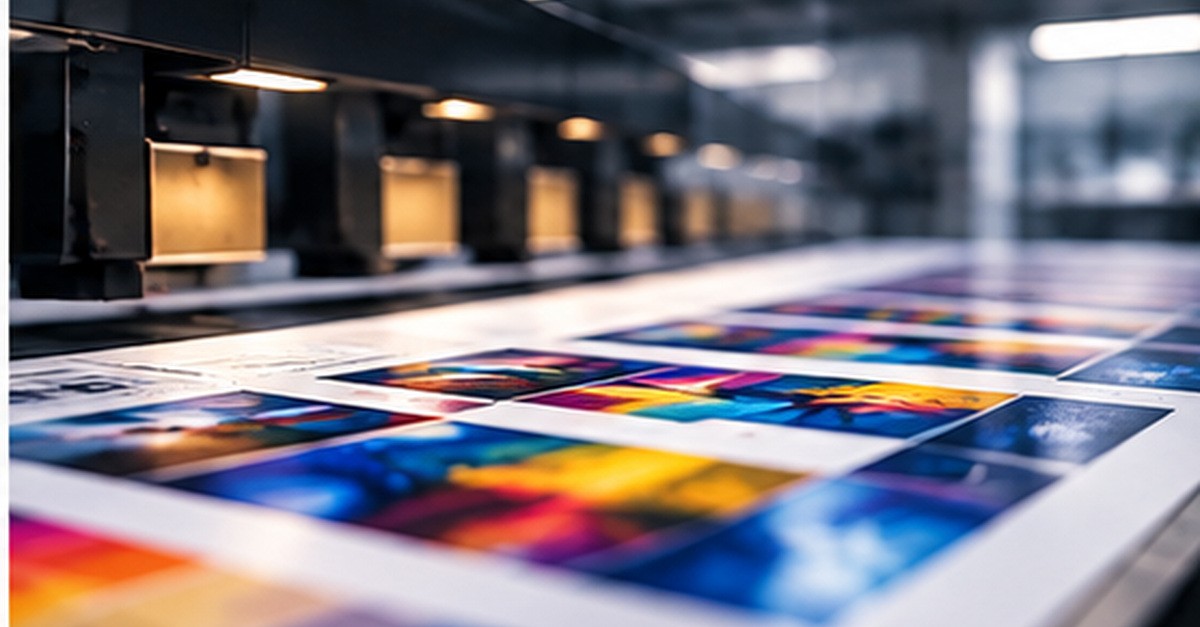
Understand the physical causes of color variation, prepare the press for stable production, and maintain consistent color through calibration, continuous monitoring, and systematic troubleshooting.
Ronen Dolev | Industrial Color Engineering Series | October 2026
The first sample passes. The last reel does not.
A digital packaging converter begins a long production run with a carefully calibrated press. The first printed samples are measured, the critical brand colors are approved, and the production team confirms that the job meets its color specifications.
Several hours later, however, the printed output begins to change. A deep blue appears slightly weaker, a neutral gray develops an unwanted color cast, or a saturated brand color gradually moves away from its approved reference. By the end of the run, samples taken from different production reels may no longer appear identical, even though the artwork, substrate definition, and color profile have remained unchanged.
This situation reveals one of the most important distinctions in industrial digital printing: achieving accurate color at the beginning of production does not automatically guarantee stable color throughout the run.
Color calibration establishes an initial printing condition, but that condition depends on a physical manufacturing process. Ink properties, imaging components, transfer surfaces, temperature, electrical behavior, and substrate characteristics can change while the press operates. Even small variations may influence printed color when they accumulate over thousands of impressions.
The engineering challenge is therefore not simply to calibrate the press correctly. It is to establish stable operating conditions, preserve the colorimetric reference, detect changes before they become unacceptable, and apply the appropriate correction without introducing further instability.
Understanding the different forms of color variation
Before investigating color drift, you must distinguish between color accuracy, color consistency, and print uniformity. Although closely related, these characteristics describe different aspects of print quality.
Color accuracy expresses how closely the printed output matches an established reference, normally evaluated through colorimetric measurements such as CIELAB and ΔE00. A press may achieve excellent accuracy immediately after calibration but gradually drift from the approved target as production continues.
Color consistency describes the ability to reproduce the same color over time, across production runs, and following normal operating events such as substrate replacement, maintenance, or production interruptions.
Print uniformity describes how consistently color is reproduced across the width of a web or the area of a printed sheet. A press may maintain a stable average color value while producing visible differences between the center and edges of the substrate.
These distinctions are important because each type of variation requires a different investigation. A uniform change across the entire printed area may indicate a change in overall process response. A deviation restricted to one side of the sheet suggests a spatial problem, while a sudden change between two reels may indicate a substrate or production-condition transition.
An effective quality-control system must therefore measure not only whether the printed color matches its target, but also how consistently that color is reproduced across both time and position.
The physical mechanisms behind color drift
In liquid electrophotographic (LEP) printing, image formation relies on the controlled development and transfer of electrically charged colorant particles. The resulting ink image is transferred through an intermediate surface before reaching the substrate.
This process involves multiple interacting variables. The condition of the photoconductive imaging surface, ink development assemblies, intermediate transfer blanket, electrical charging system, temperature regulation, and substrate-transfer conditions can all influence the final printed result.
Changes in ink concentration, conductivity, temperature, or development behavior may affect the amount and distribution of colorant transferred during printing. These variations can influence solid optical density, tonal reproduction, and ultimately the measured color coordinates.
The transfer stage introduces another important source of variation. Changes in blanket condition, temperature, pressure, contamination, or accumulated image memory can affect the consistency of the deposited ink film. Such problems may initially resemble color-calibration errors, even though their origin is mechanical or material-related.
Consumable aging can also produce gradual changes. Imaging and transfer components may remain operational while their performance gradually drifts from the condition under which the press was originally calibrated.
However, not every color deviation originates inside the press. Substrate properties can change between manufacturing batches or even between reels from the same supply. Variations in surface finish, coating, optical brighteners, whiteness, and surface treatment may alter the optical response of the printed image.
For this reason, do not automatically attribute color drift to an incorrect LUT or calibration setting. First, identify whether the measured change reflects a genuine alteration in the printing process, a substrate difference, or a measurement inconsistency.
Preparing the press for stable production
Long-run color consistency begins before the first production impression. A mechanically unstable press cannot maintain a reliable color reference, regardless of how sophisticated its calibration software is.
Before starting a critical production run, the press should be brought to a qualified maintenance condition. Preventive maintenance activities should be completed, and components directly involved in imaging, ink development, and image transfer should be inspected.
Particular attention should be given to consumables approaching their replacement limits. A component that is still operational may nevertheless exhibit characteristics that reduce color stability, especially during an extended production period.
Where practical, consumables with insufficient remaining service life should be replaced before beginning the run. However, newly installed components should not automatically be considered ready for color characterization. Certain imaging and transfer materials require conditioning, stabilization, or additional calibration procedures before reaching a repeatable operating state.
The objective is to establish the press under its best-qualified, representative production conditions, not merely with the newest possible consumables.
The ink system should also be verified for stable operating conditions. Depending on the press architecture, relevant parameters may include ink temperature, concentration, electrical conductivity, circulation, and development behavior.
Blanket cleanliness, imaging-surface condition, and transfer performance should be confirmed before color calibration. Solid printed patches should be examined for missing dots, streaks, uneven coverage, or repeating defects. These abnormalities must be corrected before the press is characterized.
Where supported, the appropriate imaging, development, transfer, and sensor-calibration procedures should be completed following maintenance or consumable replacement.
Temperature stabilization is equally important. Calibrating a press before it has reached its normal operating state may establish a reference that is no longer representative once sustained production begins.
The correct substrate must then be defined, including its material classification, surface finish, optical properties, and any required treatment or priming conditions. Inaccurate substrate definitions can lead to inappropriate optical-density targets or operating parameters.
A reliable calibration begins only after the combined conditions of the press, ink system, and substrate have been verified.
Establishing a reliable color reference
Once the printing system is stable, color calibration can establish the intended starting condition.
The first objective is to achieve the appropriate solid optical-density targets for the selected substrate. Different substrate finishes may require different density aims because their optical characteristics influence the measured response of printed ink.
Solid-density control must then be complemented by tonal verification. Matching cyan, magenta, yellow, and black solids does not guarantee that highlights, midtones, shadows, or neutral gray combinations will reproduce correctly.
The calibration process should therefore establish both the required solid response and the appropriate tonal behavior for the installed screening configuration.
On systems that offer high-accuracy calibration modes, additional measurement positions or sampling procedures may improve the reliability of tonal corrections. When multiple imaging surfaces or transfer positions are involved, calibrating the relevant surfaces can reduce color differences between successive impressions.
Once calibration has been completed, a representative test form should be measured and visually evaluated before the job is released for production.
For applications requiring particularly accurate color reproduction, a substrate-specific Media Fingerprint provides additional control.
A Media Fingerprint records the colorimetric response of the press on a defined substrate under a qualified printing condition. Its value is not limited to the initial characterization. The stored data provide a reference against which later production conditions can be compared.
This is particularly useful when the press undergoes consumable replacement, maintenance, or normal changes associated with production over time.
Where supported, three-dimensional color calibration can compare a reduced set of newly measured color patches with the stored Media Fingerprint and calculate corrections that bring the current printing response closer to the original reference.
Unlike basic solid-density adjustment, multidimensional correction can address relationships between process-color combinations and their measured colorimetric responses.
However, the stored fingerprint must remain appropriate for the active substrate, ink configuration, screening method, and color-management workflow. Significant changes in these conditions may require requalification or new characterization data.
The distinction is important: the Media Fingerprint defines the reference, while subsequent calibration attempts to recover the color response represented by that reference.
Using Continuous Color Calibration to control drift
Even when the press begins production in a properly calibrated condition, physical changes can continue throughout a long run.
Continuous Color Calibration (CCC) is designed to reduce the effect of such changes by monitoring printed color and applying corrective adjustments where the printing system supports them.
Rather than relying exclusively on pre-production calibration, CCC introduces a feedback mechanism that compares new measurements with an established reference.
At the beginning of a production session, the system measures designated process-color and, where supported, spot-color patches to establish the initial control condition. During subsequent production, the system prints and measures additional patches at defined intervals.
The control system evaluates deviations from the established reference and applies available corrections to maintain the intended response.
Depending on the printing architecture, these corrections may involve process-color behavior, tonal adjustments, or modifications to selected spot-color recipes.
Measurement methods vary by printing platform.
In certain sheetfed systems, the process operates through periodic calibration sheets or measurement sequences inserted into production. Some implementations also evaluate color uniformity across multiple positions, allowing the system to detect spatial differences in addition to changes over time.
In supported web-fed systems, color-control patches may be printed in a dedicated strip along the moving substrate. An inline measuring instrument scans this strip periodically while production continues.
This arrangement enables continuous trend monitoring, but its spatial coverage is limited by the measurement area's position and geometry. A single control strip cannot necessarily detect differences developing elsewhere across the web.
The interval between measurements should be selected according to the system capabilities, production duration, application requirements, and sensitivity of the printed colors. A particularly critical job may require more frequent checks than one with broader acceptance tolerances.
Nevertheless, more frequent correction does not automatically mean greater stability. The feedback system must operate from a valid reference and within the press's available correction range.
An important operational consideration is that certain CCC implementations establish their control reference from measurements collected during the opening phase of the job. If those initial impressions are produced before the press has stabilized, the control system may preserve an undesirable reference.
Similarly, changes to color-related parameters during production may force some systems to rebuild their CCC reference. Job LUT adjustments, substrate-definition changes, color-matching interventions, or modifications to the active color strategy must therefore be controlled carefully.
CCC should be considered a mechanism for preserving an approved color condition, not an alternative to proper maintenance, initial calibration, or substrate qualification.
Its greatest benefit is achieved when the press begins production from a stable baseline, and the automatic corrections remain small, predictable, and traceable.
Monitoring color throughout the production run
Continuous correction should operate alongside independent production-quality verification.
The approved startup sample must remain the primary reference for the job, supported by documented colorimetric targets and agreed tolerances.
During production, collect samples at defined intervals and after significant operating events. These may include prolonged stops, changes in substrate reels, consumable replacements, unexpected temperature variation, or a new calibration sequence.
Sampling frequency should reflect the criticality of the application and the demonstrated stability of the process rather than follow a universal fixed interval.
The measurement procedure must remain consistent. Changes in measurement mode, instrument calibration, sample backing, or illumination conditions can create apparent color differences that do not originate from the press.
For colorimetric evaluation, the selected measurement conditions should follow the relevant requirements of ISO 13655. When fluorescent whitening agents are present, consistent treatment of the ultraviolet component is particularly important.
Optical density provides valuable information about process-color response, while effective tone area helps identify changes in tonal reproduction. CIELAB measurements and ΔE00 quantify the relationship between the current printed colors and the approved reference.
These measurements should be interpreted together rather than independently. A solid patch may remain close to its density aim while neutral balance changes because the relative behavior of the process channels has shifted.
Likewise, a small color difference measured on a uniform patch does not necessarily indicate acceptable image uniformity or the absence of visible print defects.
For critical applications, monitoring should include representative solids, tonal patches, neutral combinations, and selected brand colors. Measurements across the sheet or web width may also be necessary to detect localized deviations.
The resulting data should be evaluated as a trend. A gradual movement toward the acceptance limit can provide an early warning even while individual samples technically remain within specification.
Troubleshooting when color begins to drift
When an unexpected color change occurs, immediate recalibration is not always the correct response.
First, establish the nature of the deviation. Compare a current printed sample with the approved startup reference using identical measurement conditions. If possible, include retained samples from intermediate production stages to determine when the variation first appeared.
The pattern of the change provides important diagnostic evidence.
A gradual deviation developing over thousands of impressions may indicate changing ink behavior, temperature variation, or consumable deterioration. A sudden difference immediately following a reel replacement suggests a possible substrate-related cause. An isolated change in one process channel points toward a different mechanism from a simultaneous shift affecting all colors.
Spatial differences across the web or sheet should direct the investigation toward imaging, transfer uniformity, or substrate consistency rather than a single global tonal adjustment.
The most useful initial diagnostic patterns are summarized below.
Observed behavior | Likely investigation area | Recommended action |
|---|---|---|
Gradual drift across the run | Temperature, ink stability, consumable aging, or insufficient correction | Examine operating trends, consumable condition, and CCC measurements |
Sudden shift after a production event | Substrate change, calibration intervention, or altered job settings | Compare samples and production records immediately before and after the event |
One color channel changes | Ink development, transfer, or channel-specific condition | Measure the affected solid and tone patches and inspect the relevant components |
Neutral gray changes while solids remain stable | Relative CMY tonal response, gray balance, or color transformation | Verify tonal curves, gray patches, active LUTs, and color-management settings |
Differences across sheet or web width | Imaging, transfer, or substrate nonuniformity | Measure multiple positions and perform the applicable uniformity checks |
Color changes despite active CCC | Invalid reference, sensor problem, correction-limit saturation, or physical instability | Validate sensor readings independently and identify the variable beyond automatic control. |
Color changes only after finishing. | Lamination, coating, adhesive, curing, or optical-construction effects | Compare printed and converted samples under controlled conditions |
If the deviation is measurable but no visible print defect is present, begin by validating the measurement system and reviewing the current calibration and color-control state.
An independent measuring instrument may be useful when the inline sensor readings do not agree with the observed output. Instrument differences should be investigated before making press adjustments.
If the color change corresponds to missing dots, streaking, periodic image memory, or transfer defects, address mechanical and consumable conditions first.
Calibration cannot restore image information that was never transferred correctly, nor can it compensate reliably for a damaged imaging or transfer surface.
If a color deviation is associated with a particular substrate lot, compare samples under controlled printing conditions. Before modifying the press's color strategy, examine surface properties, whiteness, coating characteristics, and optical response.
When the printing system supports continuous correction, the CCC history can help determine whether the deviation developed gradually, whether the control system was already applying increasing corrections, or whether a sudden event pushed the output beyond its available correction range.
A correction mechanism that repeatedly approaches its operating limit may indicate an underlying condition that needs physical intervention.
The objective of troubleshooting is to identify the variable responsible for the color movement, correct that variable, and then verify that the resulting printing condition remains stable.
When recalibration becomes part of the problem
A particularly important production decision concerns whether to perform a full color calibration after a substantial portion of the job has already been printed and approved.
Calibration changes the relationship between the press's operating commands and its printed response. Consequently, a newly calibrated condition may be closer to the nominal reference while appearing visibly different from the approved opening sample.
This does not necessarily indicate an unsuccessful calibration. It may simply mean that the previous production state had already shifted, and the newly calculated correction introduced a measurable transition.
For this reason, full calibration during production should be treated as a controlled intervention rather than a routine reaction to every minor variation.
If the printed output remains within the agreed tolerance and the process demonstrates stable behavior, maintaining the existing production condition may be preferable to introducing an unnecessary change.
Where automatic calibration between jobs is supported, that approach may provide a more suitable opportunity to restore the baseline without interrupting the color continuity of an approved run.
If the output has moved outside the specified tolerance, however, production should not continue simply to avoid recalibration.
Identify and isolate the affected material according to the applicable quality procedure. The cause should then be investigated, corrective maintenance performed where necessary, and the appropriate calibration completed.
After the correction, the press must be evaluated against the original approved reference, not merely against the successful completion status of the calibration procedure.
Material produced before and after the intervention should remain traceable, allowing the production team to determine whether both conditions satisfy the same acceptance requirements.
A successful recovery is demonstrated by measured, stable printed output, not by executing a calibration routine alone.
Color stability must extend to the finished product
For packaging and label applications, the final color appearance may be influenced by processes performed after printing.
Lamination, varnishing, adhesive application, curing, and changes in the finished product's optical structure can alter how printed colors are perceived and measured.
A printed film may show consistent color immediately after leaving the press, while the laminated construction may look different because of adhesive properties, film transparency, surface gloss, or optical interaction between layers.
Such changes should not automatically be corrected by adjusting press calibration.
The investigation must distinguish between the printed color response and the optical properties introduced during converting.
Where the customer approves the finished construction rather than the unconverted printed substrate, acceptance procedures should include representative finished-product samples.
This distinction prevents unnecessary changes to an otherwise stable printing process when the actual cause lies in a downstream operation.
Turning color stability into a repeatable production method
Reliable long-run color reproduction depends on the relationship between preventive maintenance, calibrated operating conditions, color characterization, and production monitoring.
A useful production sequence begins with press inspection and maintenance, followed by mechanical and thermal stabilization. The substrate is then verified, the appropriate color calibration is performed, and the stored substrate-specific reference is restored where supported.
Only after this condition has been validated should the startup sample be approved.
During production, continuous or periodic color measurements monitor the relationship between the actual output and the established reference. CCC may automatically reduce deviations, while independent quality checks confirm whether the process remains within the agreed acceptance limits.
When an abnormal trend develops, the recorded operating conditions and measurement history provide the evidence required to distinguish calibration drift from physical, material, or measurement-related problems.
For repeat production, the approved reference should be supported by records of the substrate, ink configuration, screening, active color strategy, Job LUT, calibration state, relevant Media Fingerprint, and measurement conditions.
These records make it possible to compare future production against a defined condition rather than relying exclusively on visual memory or a previous operator's experience.
The broader purpose of this approach is to prevent color management from becoming a sequence of isolated adjustments.
Calibration should establish the intended printing condition. Fingerprinting should preserve its measurable reference. Continuous monitoring should reveal how the process behaves over time, and corrective intervention should address the actual source of instability.
Engineering conclusion
Digital printing is often associated with precision and repeatability, yet its color reproduction remains dependent on physical processes that change during production.
A successful initial calibration demonstrates that the press can achieve a required color condition at a particular moment. It does not, by itself, establish that the condition will remain unchanged throughout a long run.
Preventing color drift requires a stable mechanical baseline, properly conditioned consumables, accurate substrate characterization, controlled measurements, and a color-management workflow that can maintain or recover the approved response.
Continuous Color Calibration can significantly improve production consistency on supported systems, but it remains one component of a broader engineering strategy. It cannot compensate indefinitely for mechanical deterioration, unstable ink behavior, unsuitable substrates, or incorrect reference conditions.
The most reliable printing operation is therefore not the one that calibrates most frequently, but the one that understands when calibration is necessary, when automatic correction is sufficient, and when the true solution requires maintenance or process intervention.
Color calibration establishes accuracy at the beginning of production. Process stability, controlled measurement, and disciplined troubleshooting determine whether that accuracy survives until the final printed product.
Sources and Technical References
- Fogra — ProcessStandard Digital (PSD). Digital printing process control, color fidelity, stability assessment, and workflow verification.
- Fogra — PSD PrintCheck. Evaluation of color accuracy, run-length consistency, print uniformity, and image-detail reproduction.
- Fogra — ProcessStandard Digital Handbook and Technical Resources. Guidelines for establishing and verifying controlled digital printing workflows.
- ISO 13655:2017. Graphic technology — Spectral measurement and colorimetric computation for graphic arts images.
- Technical Color Management Guidance, CA394-03841 (2015). Supplied technical reference covering press calibration, Media Fingerprinting, three-dimensional color correction, substrate definition, and color consistency.
- Technical Guidance for Continuous Color Control, TS4OM-00004. Supplied technical reference covering continuous calibration, process-color and spot-color tracking, reference establishment, and supported correction mechanisms.
- Advanced Digital Color Control Training Materials (2025). Supplied technical material addressing high-accuracy calibration, color uniformity, continuous monitoring, and maintenance-related color stability.
Technical note: Calibration frequencies, automated correction capabilities, measurement geometries, and reference-recovery procedures vary by printing platform, software version, and installed configuration. The operational principles presented in this article should be implemented according to the qualified procedures applicable to the specific production system.