Ronen Dolev | 2026
Introduction - When a Perfect Print Becomes a Perfect Counterfeit
A counterfeit product does not necessarily look counterfeit.
It may carry accurate colors, excellent registration, sharp text, a convincing holographic label, and a perfectly readable identification code. The packaging may be visually indistinguishable from the genuine product to an ordinary consumer.
In some cases, the identification code itself may even be genuine.
This creates a fundamental challenge for the printing industry. The traditional objective of printing has always been reproduction accuracy: transferring a defined image onto a substrate with the highest possible consistency and fidelity.
Security printing introduces a different objective.
The printed product must not only reproduce the intended design. It must also carry characteristics that enable authorized parties to distinguish an original from an unauthorized reproduction.
This distinction matters most in applications involving currency, postage stamps, tax stamps, pharmaceutical packaging, identity documents, and high-value branded products.
An ordinary commercial print is evaluated against an approved visual reference. A security print must also be evaluated against an authentication strategy.
The challenge is no longer limited to producing accurate color or fine detail. It involves the relationship between printing physics, material properties, variable information, security design, controlled production, and the ability to authenticate the finished product.
In connected packaging, that challenge extends beyond authentication at a single point in time. A reliable physical identifier must also remain linked to verified production and distribution events throughout the product lifecycle.
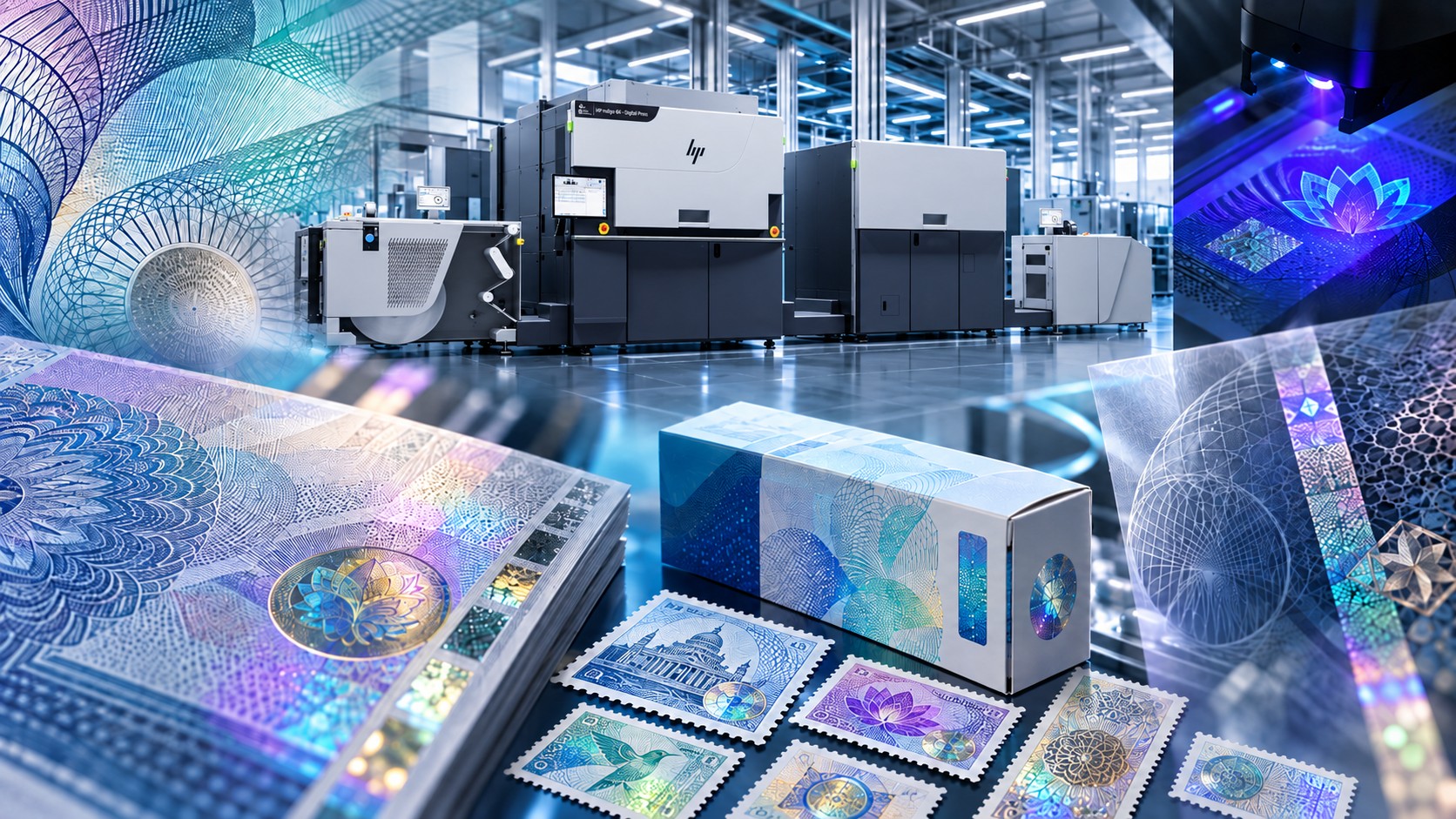
Liquid Electrophotography (LEP) has opened additional possibilities in this field by combining industrial digital printing with individualized security information. Developments involving HP Indigo, Jura, and other security technology providers demonstrate how variable graphics and selected security inks can be integrated into digital production workflows.
However, the technology is only one part of the solution.
A security feature is effective only when its behavior is understood, its production is controlled, and its authentication performance has been validated against the risks it is intended to address.
1. From Identification to Physical Authenticity
Serialization assigns an individual identifier to a product, document, or package.
It is essential in pharmaceutical traceability, controlled distribution, and many modern identification systems. Yet serialization alone does not establish the physical authenticity of the object carrying the identifier.
A genuine serial number can be copied. A digitally signed message may remain mathematically valid even when reproduced on an unauthorized package.
It is therefore necessary to distinguish three separate functions.
Identification establishes which product or individual item is being presented.
Data authentication establishes whether the information originates from an authorized source and whether its integrity has been preserved.
Physical authentication examines characteristics of the printed object to determine whether it matches authorized production.
These functions are related but not interchangeable.
A robust security strategy combines identification and data management with physical or material-based evidence of authenticity.
This leads to an important principle: the security value of a printed feature depends not only on the information it contains, but also on how it is produced, how it behaves during reproduction, and how reliably it can be authenticated.
2. The Main Families of Security Printing Features
Security printing techniques can be divided into several functional categories. The categories may overlap, and a single product can include more than one form of protection.
Overt Security Features
Overt features are intended to be recognized by users without specialized forensic equipment.
Examples include optically variable elements, holographic devices, color-changing effects, tactile printing, and distinctive surface structures.
These characteristics are especially valuable where authentication must be possible without access to a database or an electronic reader.
Banknotes provide a familiar example. Users are encouraged to examine tactile characteristics, view selected elements against transmitted light, and observe optical changes when the note is tilted.
The advantage of an overt feature is accessibility. Its limitation is that an observer may not always distinguish a sophisticated imitation from a genuine effect.
For this reason, overt features are normally combined with additional layers.
Covert Security Features
Covert features require a deliberate inspection method or an appropriate reader.
They may involve fluorescent materials, infrared-responsive markers, magnetic properties, hidden images, microtext, or other characteristics not readily recognizable under normal viewing conditions.
Some features can be checked using a simple magnifier or suitable illumination. Others require purpose-designed authentication devices.
Their value depends on the relationship between the characteristic being examined and the method used to verify it.
Forensic and Material-Based Features
Forensic features rely on characteristics that generally require specialized equipment, protected reference information, or laboratory analysis.
Examples may include proprietary taggant systems, particular chemical or spectral signatures, and material combinations selected for controlled identification.
Such features are not automatically superior to overt or covert features. Their effectiveness depends on the threat model, access to appropriate inspection equipment, and the security of the underlying materials and reference data.
Variable and Digital Security Features
Digital printing allows you to change part or all of a security design for each printed item.
This can include individualized microtext, variable security graphics, serialized latent images, linked visual information, and elements associated with a database record.
When appropriately designed, this approach creates a relationship between a physical printed characteristic and an individual product identity.
The key factor is not variability alone. It is whether the variation can be securely generated, controlled, and authenticated.
3. Security Graphics - When Image Structure Becomes Information
Many security features exploit the limits of image reproduction.
A conventional photograph or illustration is intended to survive scanning, resizing, screening, and printing with acceptable visual fidelity.
Some security graphics are designed with a different objective: they contain structural characteristics that must be preserved by the authorized production process, and that can be evaluated during authentication.
Microtext and Microprinting
Microtext is commonly used in security documents and high-value printed products.
It can be incorporated into graphical elements that appear as ordinary fine lines or decorative structures without magnification.
Under appropriate inspection, however, these elements reveal recognizable characters or information.
Microtext quality depends on several factors, including image resolution, screening behavior, substrate characteristics, ink transfer, registration, and printing-process stability.
A critical distinction must be made between nominal digital resolution and actual printed feature quality.
A press may accept a high-resolution file without necessarily reproducing every detail accurately on every substrate.
Similarly, a microtext feature may remain visually recognizable while losing characteristics needed for reliable machine authentication.
Consequently, microtext should be qualified on the finished printed product rather than approved solely from the electronic artwork.
Guilloché and Fine-Line Structures
Guilloché patterns consist of elaborate interlaced lines that create complex visual structures.
They have a long history in secure documents and financial printing.
Their security value isn't simply that the pattern looks complicated. A static digital file can potentially be copied, regardless of its apparent visual complexity.
The protection becomes more meaningful when fine-line structures are combined with controlled production, authorized design generation, personalized elements, or additional authentication characteristics.
Modern digital production can support variable graphic structures that differ between items, provided the feature-generation system and the printing process are qualified together.
Hidden and Latent Images
A latent image is designed to become visible or recognizable under defined viewing or inspection conditions.
Some effects depend on the viewing angle, the optical properties of the printed layers, or specially arranged graphical structures.
Traditional high-security applications may achieve distinctive latent and tactile effects using Intaglio printing.
Digital methods can produce certain related visual or surface effects, but they should not be assumed to reproduce all the characteristics of conventional Intaglio.
This distinction is important when evaluating digital security technologies for documents historically produced using specialized security presses.
Digital Watermarking and Embedded Information
Information can also be embedded within existing graphics.
Unlike a visible two-dimensional code, an embedded feature may be distributed through an image or background structure, reducing its impact on the visible artwork.
Such techniques may support identification, traceability, or authentication, depending on the technology used.
However, hiding information is not the same as resisting copying.
A hidden mark may survive reproduction and remain readable on a copied product. Whether this is acceptable depends on the system's intended purpose.
Therefore, an engineering evaluation must establish whether the feature provides data retrieval, copy detection, physical authentication, or a combination of these functions.
4. Jura and the Development of Variable Security Graphics
Jura is an established technology provider in security design and document protection.
Its publicly described technologies illustrate how security graphics can move beyond static artwork toward individualized, machine-verifiable structures.
Solutions such as Variable Modulated Text, MicroDot Text, Invisible Variable Information, and Serialized Latent Images combine graphical design with variable information.
These are proprietary Jura technologies, and their specific generation methods, software implementations, licenses, and authentication algorithms remain the intellectual property of their respective owners.
Nevertheless, their significance can be examined from a general engineering perspective.
Variable Modulated Text
Variable Modulated Text uses personalized microtext incorporated into a distinctive graphical structure.
Its purpose is to connect readable information with a controlled visual characteristic.
Authentication can therefore involve both examining the printed text and verifying its graphical behavior.
The engineering challenge lies in maintaining the relevant characteristics despite variations in the printing process.
MicroDot Text
MicroDot Text combines individualized information with very small printed structures.
This kind of feature requires more than sufficient nominal resolution. It demands predictable rendering and print reproduction.
It also raises the question of how a security feature should be evaluated when identical electronic input data produces slightly different physical results across production runs or printing systems.
Invisible Variable Information
Invisible Variable Information illustrates another approach: unique information can be incorporated into an existing printed image or background without a separate prominent graphic.
Its purpose is to associate individualized information with the printed design.
The feature must be considered together with the authorized verification system. You cannot determine its effectiveness based solely on whether the information is visually concealed.
Serialized Latent Images
Serialized Latent Images connect individualized information with an angle-dependent printed effect.
This introduces additional physical variables, including printed-layer structure, surface behavior, and registration.
These features require process-specific qualification because a latent image's appearance can be sensitive to production conditions.
Jura as a Technology Partner
The value of Jura's approach is integrating security design with variable data and an authentication workflow.
The individual technologies are not generic open-source methods. Their public product descriptions provide useful information about their intended functions, but they do not disclose all the mechanisms or establish universal performance figures.
A professional engineering assessment should therefore separate the manufacturer's published capabilities from independently measured production results.
5. HP Indigo and Jura - Bringing Digital Security Printing into LEP
In May 2021, HP announced the HP Indigo 6K Secure Press, developed in collaboration with Jura JSP.
The announcement marked an important step in applying Liquid Electrophotography to security printing.
HP later introduced the HP Indigo 7K Secure Press for sheetfed security applications, continuing to develop specialized digital workflows for this segment.
These products illustrate the potential to integrate variable information, fine graphics, selected security inks, and controlled production into a digital press environment.
How LEP Works
Liquid Electrophotography creates an electrostatic image on a photoconductive imaging surface.
In HP Indigo presses, HP Indigo ElectroInk develops the image; this proprietary ink technology disperses charged, pigment-containing particles in a liquid carrier.
The developed image is transferred through a heated intermediate blanket before being transferred to the substrate.
This process is commonly described as digital offset because the image reaches the substrate through an intermediate transfer system.
It differs fundamentally from dry-toner electrophotography and from inkjet printing.
The correct generic term for the printing technology is Liquid Electrophotography (LEP).
When discussing HP's specific materials, the appropriate proprietary name is HP Indigo ElectroInk.
The distinction is not merely terminological. It reflects the particular process physics and the role of ink development, intermediate transfer, and the formation of the final printed layer.
The Importance of Variable Imaging
A defining advantage of digital electrophotographic printing is that the image can change between successive printed items without requiring a new physical printing plate.
In security applications, this allows individualized graphical content to be linked to serial data, product information, or other authorized production records.
A security element can therefore be generated specifically for a particular document or package.
However, the resulting protection depends on the security of the entire workflow.
If unauthorized parties gain access to the original security files, production databases, or authentication credentials, variable printing's benefit may be significantly reduced.
Digital printing creates the opportunity for individualized security. It does not automatically guarantee that the individualization is secure.
Multiple Security Elements in One Production Pass
HP describes the ability of selected HP Indigo Secure configurations to combine different security elements within a single production pass.
These can include conventional graphics, variable information, selected covert elements, and special inks compatible with the specific press configuration.
In this context, a single pass refers to production integration, not creating the entire image through one exposure or one ink-transfer event.
This approach can reduce the need to move a product through several independent printing processes.
Nevertheless, it does not eliminate the need for separate operations involving specialty substrates, holographic devices, physical embossing, or other security elements not created directly by the LEP engine.
6. The DFE - Protecting Both the Printed Image and the Production Process
In commercial printing, the Digital Front End is normally associated with file interpretation, color management, screening, variable data processing, imposition, and job preparation.
In security printing, it takes on additional responsibilities.
It must support the integrity of security information and help maintain control over authorized production.
The challenge can be divided into two engineering domains.
Preserving Security Features During Image Processing
A conventional prepress workflow may perform transformations intended to improve print appearance or productivity.
These include scaling, resampling, color conversion, rasterization, and screening.
For some security elements, these operations may change authentication-relevant characteristics.
Consequently, a secure production workflow must establish how security-critical image elements are handled.
The objective is not to eliminate normal color management or RIP functions, but to validate that their implementation preserves the security properties required by the chosen feature.
Secure Production and Controlled Reprinting
The second domain concerns the authorization of production itself.
HP's public information about specialized Secure Press systems describes controlled workflows that can include restricted reprinting, protected job handling, and mechanisms intended to reduce unauthorized reproduction.
This addresses an important security risk that is sometimes overlooked.
A product may include sophisticated authentication features and still be vulnerable if an unauthorized production run can generate additional genuine-looking items from original files.
Physical product authentication must therefore be supported by information security, job accountability, controlled material access, and production reconciliation.
The combination of printing technology and secure operational procedures creates a complete security-printing environment.
7. Security Inks - More Than Visible Color
Not every security feature relies on fine graphic detail.
Some depend on ink properties or an added functional material.
Ultraviolet-Responsive Inks
Fluorescent security inks can reveal information under appropriate ultraviolet illumination.
They may allow text, patterns, or other elements to remain inconspicuous under normal viewing conditions while becoming visible during inspection.
HP Indigo has publicly described specialty ElectroInk solutions designed for security applications, including invisible inks responsive to suitable illumination.
Availability depends on the press model, configuration, application, and approved supply arrangements.
The relevant engineering considerations include the response of the printed feature under the specified inspection conditions, consistency across the production run, and compatibility with the substrate and finishing layers.
Infrared-Responsive Security Materials
Infrared-responsive materials provide another family of covert features.
Their authentication may require illumination or sensing equipment capable of detecting the intended material response.
Such features may be used independently or in combination with individualized markings.
The security value depends on the material's characteristics, the reader, and the protected reference information.
Taggant-Based Authentication
A taggant is a marker incorporated into a material for identification or authentication.
Taggant-based inks can support controlled inspection without relying entirely on visual image reproduction.
Publicly described commercial examples include solutions from VerifyMe, Bsecure, and Authentix.
These providers offer distinct technologies and verification systems. Their names should not be interpreted as interchangeable product families.
A manufacturer's statement that its ink can be printed using certain types of presses does not establish that every formulation is compatible with every model or substrate.
Each combination requires application-specific assessment.
Optically Variable Materials
Some security inks or applied materials change appearance under different viewing conditions.
These may involve optical effects that cannot be reproduced by ordinary process-color printing alone.
When such effects are required, the system may need dedicated materials or a separate application technology.
An LEP press can print excellent images, but conventional CMYK or OVG inks cannot replicate all properties of an optically variable security material.
8. A Wider Security Ecosystem
Security printing is rarely delivered by a single technology provider.
HP's public security-printing materials identify a broader partner ecosystem that includes companies with different areas of specialization.
Jura contributes security design and variable graphical features.
Scantrust focuses on secure printed identifiers and copy-detection solutions.
KURZ SCRIBOS combines physical and digital brand-protection technologies, including its ValiGate family.
VerifyMe provides specialized ink and taggant-based authentication technologies.
Digimarc is associated with digital watermarking and embedded identification.
Crane Authentication is known for advanced optical security technologies.
Bsecure contributes covert marking and reader-based solutions.
Agfa has long been involved in imaging materials and graphic technologies, including security-related applications.
Harris & Bruno operates in coating and finishing technologies that may form part of a larger secure-product manufacturing process.
ProQure focuses on connected-product and authentication approaches.
These organizations do not all provide the same kind of protection.
Some create a printed authentication element. Others supply functional materials, software, data services, applied devices, or specialized converting technologies.
The engineering task is to select compatible components that address the actual risk.
A sophisticated material feature may be unnecessary for a low-risk commercial package, while a purely digital identifier may be insufficient for an application involving significant fraud or public-safety consequences.
A partnership or published integration must not be interpreted as certification of every proposed feature combination.
9. Banknotes - Why Security Must Be Built into the Entire Document
Banknotes are among the most demanding applications of security printing.
They are handled repeatedly, exposed to environmental conditions, exchanged without constant database access, and expected to remain recognizable to both the public and specialized authentication systems.
Modern banknotes illustrate the value of combining several technologies.
Security elements may include specialized substrates, embedded watermarks, security threads, raised Intaglio printing, microprinting, holographic or optically variable devices, and additional features examined using ultraviolet or infrared equipment.
The European Central Bank and the U.S. Currency Education Program both emphasize checking multiple security characteristics.
The Role of Specialized Printing
Intaglio printing can create distinctive tactile characteristics through a specialized printing process.
Traditional banknote watermarks depend on controlled variation in the substrate itself.
Embedded security threads and certain transparent-window effects are likewise part of the document construction rather than ordinary surface graphics.
These features demonstrate why a banknote cannot be understood solely as an image printed on paper.
Where LEP Fits
LEP can support selected security-document applications by providing variable graphics, individualized information, and specialized printable features where authorized and technically qualified.
It should not be presented as a universal replacement for traditional banknote production technologies.
In particular, the ordinary LEP imaging process does not independently manufacture substrate-integrated watermarks, embedded security threads, or all the characteristics of conventional Intaglio printing.
These differences matter when evaluating whether a digital security solution can meet the full requirements of a particular secure document.
The strongest security systems use complementary technologies rather than assuming that one process can reproduce every protection mechanism.
10. Postage and Tax Stamps - Two Different Security Problems
Postage stamps and tax stamps are sometimes discussed together, but their security objectives may differ.
A postage stamp establishes payment for a postal service. Its security requirements may address unauthorized production, counterfeiting, and fraudulent reuse.
A tax stamp can serve additional fiscal, regulatory, and traceability functions depending on the country and product category.
Postage Stamps
Traditional postage stamps may incorporate distinctive substrates, fine printing, specialized inks, perforations, and other identifying characteristics.
Modern systems may also use serialized identifiers and digital registration.
The Universal Postal Union has highlighted the growing importance of counterfeit-stamp detection and the role of digital identification tools.
Its WNS system shows how verified reference information can help identify legitimate stamp issues.
However, identifying an authorized stamp design is not always the same as authenticating a particular physical specimen.
A complete postal security strategy must consider both unauthorized reproduction and improper reuse.
Tax Stamps
Tax stamps often require secure production, controlled issuance, and the ability to link an item to an authorized fiscal or distribution process.
Where variable data is necessary, digital printing can provide individualization that is difficult to achieve through a wholly static print process.
But the printing technology must operate within a controlled issuance and reconciliation system.
If a legitimate mark can be produced in unauthorized quantities, sophisticated graphics alone cannot provide complete protection.
For both postage and tax stamps, the fundamental issue is establishing confidence in the printed item's authorized origin and status.
11. Pharmaceutical Packaging - Security, Integrity and Patient Safety
Pharmaceutical packaging represents a different risk environment from commercial brand protection.
A falsified medicine can create direct consequences for patient safety.
Packaging must therefore support correct identification, accurate information, distribution control, and, where required, evidence of unauthorized opening or alteration.
Regulatory Requirements
Within the European Union, the Falsified Medicines framework requires most prescription medicines and certain other medicines to carry specified safety features.
These include a unique identifier and an anti-tampering device.
The unique identifier is carried in a two-dimensional Data Matrix symbol under the relevant regulatory framework.
This should not be confused with the claim that any ordinary QR Code fulfills pharmaceutical serialization requirements.
The anti-tampering device serves a different purpose: providing evidence that the package may have been opened or altered.
Neither of these requirements should be assumed to provide every possible form of physical anti-counterfeiting protection.
Secondary Packaging
Folding cartons often provide a practical surface for security printing.
They can accommodate conventional product graphics, regulatory information, serialized markings, and additional overt or covert features.
LEP can provide particular value where production involves short runs, multiple product versions, frequent artwork changes, or individualized information.
However, the final carton is more than a printed sheet.
It passes through processes that may include coating, die-cutting, creasing, folding, gluing, coding, and inspection.
Security elements must remain functional after the required manufacturing operations.
Microtext and Fine Security Graphics
Microtext may provide an additional inspection feature on pharmaceutical cartons.
Its effectiveness depends on reliable reproduction and clear acceptance criteria.
The ability to place fine lettering within a design does not establish its resistance to all forms of reproduction.
Covert Inks and Reader-Based Authentication
Specialized fluorescent or taggant-based marks can provide an additional layer for authorized inspections.
Such systems may be valuable when a pharmaceutical manufacturer wants to distinguish products in the distribution chain using a designated reader.
However, the qualification must include the actual substrate, coating, and final construction.
Tamper Evidence Is Not the Same as Counterfeit Resistance
A carton can be genuine but have been opened.
A counterfeit carton can carry a convincing imitation of a tamper-evident seal.
These are different failure modes.
Tamper evidence addresses package integrity, while authentication addresses whether the package matches authorized production.
An effective pharmaceutical security strategy must evaluate both, alongside regulatory serialization.
Braille and Accessibility
Braille embossing is another important requirement for certain pharmaceutical packages.
However, Braille is primarily an accessibility feature, not an anti-counterfeiting mechanism.
It should not be classified as a security feature merely because it creates a tactile structure.
The distinction illustrates why pharmaceutical packaging engineering must maintain separate requirements for patient information, accessibility, tamper evidence, print quality, and product authentication.
The next step is to connect those physical and regulatory functions to product identity and supply-chain information. This is where Track & Trace becomes an engineering discipline in its own right.
12. Track & Trace - Smart Packaging, Serialized Labels and the Digital Identity of Physical Products
Security printing does not end when a label is difficult to copy. In many markets, a manufacturer must also identify the product, document its movement, and establish what happened to it between production and the point of use.
This is the purpose of Track & Trace. It connects a physical data carrier on a product, label, carton, or logistics unit with trustworthy records in an information system. The printed mark becomes a key to a documented chain of events, not an isolated graphic.
The technology can help detect diversion, support targeted recalls, strengthen inventory control, and facilitate regulatory reporting. Yet an ordinary readable barcode does not, by itself, prove that the package carrying it is genuine.
Identification, Traceability and Authentication Are Different Functions
Identification answers which product, batch, or particular unit has been presented. Tracking follows its movement forward through the distribution network. Tracing reconstructs its provenance and previous handling, typically by moving backward through recorded events. Authentication evaluates whether the identifier, its associated records, or the physical marked object can be trusted.
A code containing a legitimate serial number may be copied onto many counterfeit packages. Every copy can decode correctly. If the backend only checks that the number exists, it may mistake successful identification for proof of authenticity.
The engineering objective is therefore to connect three layers: a controlled identity, reliable event capture, and-where counterfeit risk justifies it-evidence that links that identity to the physical object.
Printed Data Carriers - Choosing the Right Marker
Linear barcodes, including GS1-128, remain important for logistics and for workflows that require established one-dimensional scanning. However, their capacity and label footprint differ from two-dimensional symbols.
GS1 DataMatrix is a compact matrix symbol used extensively in regulated healthcare. It can encode structured identifiers such as GTIN, batch or lot number, expiration date, and serial number. GS1 Application Identifiers define the meaning of each data element: for example, (01) for GTIN, (10) for batch or lot, (17) for expiry, and (21) for serial number. These are data definitions, not authentication features.
A QR Code using GS1 Digital Link URI syntax can connect product identity to web-accessible information and services. This makes it attractive for consumer-facing packaging and some retail applications. It must not be confused with GS1 DataMatrix or assumed to replace a sector-specific mandatory carrier. In European pharmaceutical serialization, the required two-dimensional carrier is Data Matrix, not an arbitrary QR Code.
Digital watermarks can place a machine-detectable signal within ordinary package artwork instead of reserving a separate prominent code area. Their utility depends on the proprietary or standardized reader ecosystem, the data they encode, and how reliably the signal survives printing and converting. A detectable watermark is not automatically copy-resistant.
Copy Detection Patterns (CDPs), sometimes called secure graphics, take a different approach. Their fine printed structures are deliberately sensitive to additional reproduction. With a qualified capture and comparison method, they may provide evidence that an item was printed as an authorized original rather than copied from another printed specimen.
RFID and NFC add electronically readable alternatives. Passive UHF RFID can help automate logistics identification without line-of-sight scanning, while NFC can support close-range interaction. Such tags introduce hardware, reader, cost, material-integration, and privacy considerations. A basic RFID identifier, like a basic QR Code, can still be cloned unless the system includes suitable protection and verification.
Serialization - The Difference Between a Product Type and an Individual Unit
A GTIN identifies a trade item class. Adding a unique serial number distinguishes an individual instance of that class; batch and expiry data provide further manufacturing and lifecycle context. A serial number is useful only when its issuance and lifecycle are governed.
The serial-number service must prevent unintended duplication, define how identifiers are allocated to print jobs, and reconcile identifiers that were commissioned, rejected, destroyed, reworked, or legitimately reprinted. An identifier generated by software is not necessarily a physically released product.
Where several packaging levels are involved, aggregation links individual units to bundles or cases and links cases to pallets. A shipping container can then be scanned once while its recorded contents remain available, provided the parent-child relationships are current and accurate. Repacking, damage, and partial shipments must trigger corresponding disaggregation or correction events.
The Digital Event Layer - What, When, Where and Why
A practical Track & Trace architecture normally connects enterprise systems, serialization management, production and inspection equipment, aggregation stations, warehouse processes, trading partners, and an event repository.
GS1 EPCIS 2.0 provides a widely used framework for sharing visibility events. It structures the record around what object was involved, when the event occurred, where it occurred, and why it occurred in a business context. Where relevant, additional information can include sensor conditions such as temperature or shock.
A typical lifecycle may involve commissioning an identifier, printing and verifying the mark, packing the item into a case, associating the case with a pallet, shipping the pallet, receiving it at a distribution center, and later dispensing, selling, returning, or decommissioning the item.
Each event must be tied to an authorized actor, timestamp, location, and valid business step. A plausible-looking database entry does not demonstrate that the underlying physical handoff occurred. Scanning discipline, interface validation, exception handling, and access control are as important as the code printed on the package.
When a Valid Code Appears on a Counterfeit Package
One serial number observed at two distant locations in a physically impossible time interval may indicate duplication, diversion, a process error, or unauthorized scanning. Repeated scans after a product has been sold or decommissioned may likewise justify investigation. These are risk signals, not automatic proof of fraud.
A backend can check issuance status, expected market, shipment history, aggregation membership, and unusual scan patterns. Where stronger protection is needed, the printed identifier can be paired with a physical feature such as a qualified CDP, a covert ink marker, or a controlled security label.
Digital signatures or cryptographic tokens can help establish the origin and integrity of data, but a valid signed payload can still be photographed and reproduced unless the physical object or the transaction is separately protected. Scan-count limits alone can also reject legitimate repeated inspections, so their thresholds must be engineered for the use case.
The system should distinguish a confirmed physical counterfeit from a suspicious event, a duplicated identifier, a missing record, or a legitimate operational exception. Conflating these conditions causes unnecessary false alarms and undermines trust in the traceability platform.
The Printing Challenge - Connecting Variable Data to the Actual Package
From a printing-engineering perspective, Track & Trace introduces two independent quality questions. First, was the correct, unique data printed on the correct physical object? Second, can the symbol still be decoded and, where applicable, authenticated after all converting and handling steps?
Liquid Electrophotography (LEP) provides digital variable imaging suitable for integrating different identifiers into successive labels or cartons. Offset and flexography remain efficient for repeated high-volume packaging graphics, and variable codes may be added with a complementary digital station. Inkjet is also widely used for in-line variable coding. The appropriate architecture depends on line speed, substrate, unit economics, code size, and required security.
LEP is particularly relevant when the same digital workflow generates both the packaging graphics and variable identity. However, this capability does not remove the need to verify the printed serial against the intended database record or to control unusable output and reprints.
Substrate roughness, ink spread, electrostatic transfer behavior, coating, gloss, laminate haze, and curvature can affect module geometry and reader contrast. A barcode that passes a software preview may become unreliable on a shrink sleeve, textured label, metalized structure, or heavily varnished carton.
Barcode Verification and Industrial Quality Control
ISO/IEC 15415:2024 defines methods for evaluating the print quality of two-dimensional symbols. ISO/IEC 15416:2025 addresses linear symbols. These standards support consistent assessment of a printed mark rather than relying only on whether a handheld reader can decode one specimen.
For two-dimensional codes, practical quality factors include symbol contrast, modulation, print growth or loss, distortion, damage to finder or timing patterns, and adequate quiet zones. GS1 DataMatrix normally requires a quiet zone of at least one module around the symbol, while QR Code designs use a larger surrounding quiet zone. The exact size, X-dimension, and acceptance grade must be selected from the applicable symbology and application specifications.
The inspection station should verify both decoded content and print quality. Optical character recognition of human-readable data, where required, provides another control, but it does not replace verification of the machine-readable symbol. Inspection results should be reconciled with the serial-number register and downstream waste or finishing records.
A secure feature must also be validated after varnishing, lamination, die-cutting, folding, gluing, application to the container, and representative transport and handling. Verifying the press sheet alone cannot establish the performance of the final saleable pack.
Applications and Regulatory Context
In the European Union, the Falsified Medicines framework and Commission Delegated Regulation (EU) 2016/161 require specified safety features for medicines within their scope, including a unique identifier carried by Data Matrix and an anti-tampering device. The repository checks the identifier's status and product identity. These requirements should not be represented as a universal physical anti-counterfeit guarantee.
In the United States, the Drug Supply Chain Security Act (DSCSA) establishes product identification and interoperable pharmaceutical traceability requirements for affected trading partners. Implementation arrangements and exemptions have changed over time; therefore, a deployment must be checked against current FDA guidance and the trading partner's specific role rather than a single generic deadline.
The EU tobacco traceability system requires unit-level identifiers and reporting of movements for products within its scope. Requirements began for cigarettes and roll-your-own tobacco in May 2019 and expanded to other tobacco products in May 2024. Tobacco markings and security features are governed by their own rules and should not be assumed equivalent to pharmaceutical serialization.
Regulation (EU) 2024/1781, the Ecodesign for Sustainable Products Regulation, creates a framework for Digital Product Passports. A linked data carrier may provide access to product-specific sustainability or lifecycle information when applicable implementing requirements are established. It does not mean that every product currently needs the same passport or the same printed code.
Outside regulated sectors, brands use serialized labels and connected packaging to support recalls, channel monitoring, warranty validation, product instructions, and consumer engagement. The useful depth of traceability may differ greatly between a high-risk medicine, a spare part, a premium cosmetic, and a food package.
Engineering Qualification - From Secure Artwork to Trusted Events
Qualification should start by defining the threat model and the system's intended users. It should then establish the identity standard, serialization rules, appropriate carrier, marking technology, inspection method, data interfaces, event model, and controls for exceptions, access, and retention.
The test program should include legitimate product variation and deliberate threats: copied codes, duplicate numbers, swapped labels, incomplete aggregation, rejected prints, rework, missing network connections, physical abrasion, and changes in illumination or camera quality. Barcode read rates, formal symbol grades, data reconciliation, and physical-authentication false acceptance or false rejection are different performance measures and should be reported separately.
Finally, the printed data must remain useful without exposing more commercial or personal information than necessary. Public scans, authorized inspector scans, and supply-chain partner events may require different permissions and data views.
The central lesson is that a barcode is only the visible entrance to the system. Trust comes from the controlled relationship between the identifier, the specific physical package, the authorized production record, and the sequence of verified events that follows it.
13. Offset, Flexography, and LEP - Different Physical Routes to Security Printing
The three processes offer different capabilities and limitations.
Offset Lithography
Offset is well suited to reliably reproducing defined artwork and fine graphical structures under stable production conditions.
It has a long history in security printing and can work with compatible specialty materials and additional security processes.
When each product must carry different information, however, the workflow usually requires separate personalization technology or an additional variable-printing process.
Flexography
Flexography is widely used for labels, flexible packaging, and high-volume web-fed production.
Its ability to reproduce fine security structures depends on plate characteristics, anilox selection, ink-transfer behavior, substrate properties, press stability, and registration.
Qualifying fine features is especially important because a visually acceptable characteristic may not preserve the detail needed for reliable authentication.
Digital modules can be combined with conventional flexographic production where variable data is required.
Liquid Electrophotography
LEP provides an integrated digital imaging route for variable information, personalized graphics, and application-compatible specialty inks.
In selected configurations, several security elements can be combined within one digital production workflow.
Yet the printed image's physical behavior still matters.
The process must maintain the required feature characteristics despite variation in substrate properties, ink transfer, calibration, and production conditions.
For certain security graphics, the critical requirement may be reliable reproduction of a structural signature rather than the lowest possible color difference.
No single printing method should be described as universally superior for every security application.
The correct choice depends on the required security characteristics, production volume, substrate, degree of personalization, and authentication method.
14. The Engineering Challenge - Authentication Under Real Production Conditions
An authentication feature may work successfully during a controlled demonstration and still encounter difficulties in industrial production.
A central challenge is that every real printing process introduces variation.
The amount and type of variation depend on the process, materials, press condition, and production environment.
This issue has been studied in published research on Copy Detection Patterns.
A 2022 research paper by Roman Chaban and colleagues examined printing variability using samples generated on two industrial HP Indigo presses.
The study demonstrated the importance of considering printing conditions and substrate selection when evaluating these features.
It did not establish that every HP Indigo press or every commercially available security solution provides a particular level of counterfeit resistance.
This is precisely why qualification must be specific to the security feature and its production environment.
Print Quality Versus Authentication Quality
Conventional print quality measurements can include optical density, CIELAB values, Delta E, tonal response, registration, and image uniformity.
These parameters remain useful.
However, they do not fully describe a security feature's performance.
An authentication mechanism may depend on characteristics that are not represented by standard color-control measurements.
For example, excellent color matching does not necessarily guarantee that a reader can distinguish an authorized printed feature from a reproduction.
Similarly, a security mark may authenticate reliably even when minor color differences remain within the application's acceptable range.
Therefore, security-print qualification requires both printing measurements and authentication-specific evaluation.
Process Stability
It is essential to distinguish normal variation in genuine production from characteristics introduced by unauthorized reproduction.
If genuine production variation becomes excessive, the authentication system may reject legitimate items.
If the acceptance criteria are too permissive, the system may accept unauthorized copies.
This creates a balance between these two error categories.
False Acceptance Rate (FAR) measures the proportion of unauthorized or counterfeit items the system incorrectly accepts.
False Rejection Rate (FRR) measures the proportion of authentic items the system incorrectly rejects.
These figures must be obtained through an appropriate validation protocol using representative materials and inspection conditions.
No universal numerical threshold establishes adequate security for every product or document.
The acceptance criteria should reflect the risks, consequences, and intended inspection environment.
15. Why Finishing and Substrate Selection Matter
The authentication process does not necessarily end when the printed sheet leaves the press.
Many products undergo additional manufacturing steps.
These can change the surface or the optical behavior of the printed structure.
Lamination may alter reflectance, haze, and the apparent contrast of printed features.
Varnishing can change surface characteristics or affect the response of some specialized inks.
Folding, creasing, abrasion, and handling may introduce mechanical changes.
Substrates containing optical brightening agents can respond differently under different illumination conditions.
Consequently, a security feature approved before finishing may not automatically remain qualified after the final conversion process.
For pharmaceutical cartons, labels, and flexible packaging, use the finished product as the principal qualification reference.
Where inspection must take place at several production stages, separate acceptance criteria may be required for each stage.
This is particularly important when combining LEP with downstream conventional finishing operations.
16. Security Printing Requires a Secure Factory
A printing facility may produce technically excellent security features while lacking adequate protection against unauthorized production.
This represents a different class of risk from ordinary print defects.
A complete security management approach must consider the handling of controlled materials, security artwork, digital files, production records, and finished inventory.
The purpose is to ensure that the security features are manufactured only in accordance with authorized requirements.
ISO 14298:2021 provides an international framework for managing security printing processes.
Its relevance is organizational, not limited to the image quality produced by a specific press.
ISO 22383:2020 addresses selecting and evaluating authentication solutions for material goods.
The two standards address different needs.
A secure printing management system does not automatically establish the effectiveness of an individual authentication technology.
Similarly, a successful test of an authentication feature does not demonstrate that the entire production facility operates under a suitable security management system.
Both dimensions must be considered.
17. Developing an Effective Security Strategy
Selecting security features should begin with a clear understanding of the threat.
A pharmaceutical manufacturer may prioritize patient safety, package integrity, and protection against unauthorized substitution.
A postal authority may prioritize protecting revenue and preventing counterfeit or reused postage.
A tax authority may require controlled issuance and the ability to reconcile physical stamps with authorized records.
A premium brand may focus on counterfeit prevention, distribution control, and consumer verification.
These objectives cannot always be addressed by the same combination of technologies.
A suitable design may use a visible feature for rapid public inspection, a covert feature for trained personnel, an individualized identifier for traceability, and a protected material characteristic for advanced verification.
The authentication method must be realistic for the intended users.
A feature that requires expensive equipment may suit government inspectors but not consumers.
Conversely, smartphone-based verification may be convenient but must be evaluated against the application's reliability and security requirements.
The printing process, authentication technology, and information infrastructure should be selected as one system.
18. The Future of Security Printing
Security printing is moving toward greater integration between physical features and digital information.
Modern production workflows increasingly make it possible to associate a printed characteristic with an individual product record.
Digital printing contributes flexibility to this development, particularly when variable data is required.
But the most significant opportunity is not simply to print more complex patterns.
It is to create systems in which controlled production, physical authentication, and trustworthy digital records reinforce one another.
LEP is a relevant platform for selected applications because it can support individualized images and compatible security materials within an industrial digital workflow.
Jura and other specialist technology providers demonstrate how security design, hidden information, and verification systems can be integrated into such environments.
At the same time, traditional security technologies remain indispensable for many applications.
A banknote watermark, a specialized optical device, a covert material marker, and a digitally individualized graphic can perform different functions within the same security architecture.
Their value comes from their complementary characteristics, not from attempting to replace every mechanism with one technology.
The future will therefore be defined less by a single printing method than by the ability to combine different technologies in a controlled and verifiable production system.
Conclusions - The Printed Object Must Carry Evidence of Trust
The central purpose of security printing is not to make a printed product visually complicated.
It is to establish reliable evidence that the product or document is consistent with authorized manufacture.
Fine-line graphics, microtext, hidden images, specialized inks, optical devices, material characteristics, and digital identifiers can all contribute to this objective.
However, no feature becomes a complete authentication system merely because it is difficult to reproduce or contains proprietary information.
Its performance must be demonstrated within the conditions in which it will actually be manufactured, distributed, and inspected.
Liquid Electrophotography adds an important capability to this field through variable imaging and by integrating selected security elements into digital production.
The development of HP Indigo Secure in collaboration with Jura is a documented example of this direction.
For serialized packaging, the same principle applies to the integrity of the event history: a scan or a valid identifier is useful evidence only within an authorized and reconciled chain of custody.
Yet the core engineering principle remains independent of the manufacturer.
A security feature must be produced consistently, protected from unauthorized use, and authenticated with an appropriate method.
The challenge is not simply to print something that looks genuine.
The challenge is to build a printing and authentication system that establishes why the genuine product should be trusted.
References and Technical Sources
The following sources support the factual and technical context of this article. Proprietary product characteristics are discussed only at the level publicly described by their respective owners.
Industrial Security Printing and LEP
- HP - HP Indigo Secure. Public overview of compatible security printing technologies and application areas.
- HP - Launch of HP Indigo Secure and the HP Indigo 6K Secure Press, May 2021.
- HP - Advanced Digital Printing and HP Indigo 7K Secure Press, March 2024.
- HP Indigo, Pharmaceutical Folding Carton Packaging - How-to Guide, Revision 01, April 2024. Technical background concerning LEP production, pharmaceutical cartons, and security applications.
Jura Security Technologies
- Jura - Security Design Software and Modules.
- Jura - Covert Security Features.
- Jura - Stock Shield.
Security Partners and Authentication
- KURZ SCRIBOS - HP Indigo Collaboration and ValiGate.
- Scantrust - Secure Graphic Printing and Production Quality.
- VerifyMe - VerifyInk.
Independent Research
- Roman Chaban et al., Printing Variability of Copy Detection Patterns, 2022. Public research manuscript.
- Anomaly Localization for Copy Detection Patterns Through Print Estimations, IEEE International Workshop on Information Forensics and Security, 2022. DOI: 10.1109/WIFS55849.2022.9975416.
Banknotes, Postal Security and Pharmaceuticals
- European Central Bank - Euro Banknote Security Features.
- U.S. Currency Education Program - Banknote Authentication.
- Universal Postal Union - WNS 2.0 and Counterfeit Stamp Detection.
- European Medicines Agency - Falsified Medicines Overview.
International Standards
- ISO 14298:2021 - Management of Security Printing Processes.
- ISO 22383:2020 - Evaluation of Authentication Solutions.
Track & Trace, Data Carriers and Regulatory Frameworks
- GS1 - 2D Barcodes Powered by GS1: supported carriers, structured product data and retail/healthcare applications. https://www.gs1.org/standards/barcodes/2d
- GS1 - EPCIS 2.0 and Core Business Vocabulary: interoperable supply-chain visibility events and aggregation. https://www.gs1.org/standards/epcis
- GS1 - GS1 Digital Link: identifier-to-information linking and URI syntax. https://www.gs1.org/standards/gs1-digital-link
- GS1 - GS1 DataMatrix Guideline: symbol construction, X-dimension, quiet zones and verification considerations. https://www.gs1.org/sites/default/files/docs/barcodes/GS1_DataMatrix_Guideline.pdf
- European Union - Commission Delegated Regulation (EU) 2016/161: pharmaceutical safety features and identifier verification. https://eur-lex.europa.eu/legal-content/EN/TXT/?uri=CELEX:32016R0161
- U.S. FDA - Product Identifiers under the DSCSA: Questions and Answers; see FDA for current exemptions and implementation guidance. https://www.fda.gov/regulatory-information/search-fda-guidance-documents/product-identifiers-under-drug-supply-chain-security-act-questions-and-answers
- European Commission - Systems for Tobacco Traceability and Security Features; phased application in 2019 and 2024. https://health.ec.europa.eu/tobacco/product-regulation/systems-tobacco-traceability-and-security-features_en
- European Union - Regulation (EU) 2024/1781: Ecodesign for Sustainable Products and Digital Product Passport framework. https://eur-lex.europa.eu/EN/legal-content/summary/ecodesign-requirements-for-sustainable-products.html
- ISO/IEC 15415:2024 - Print Quality Test Specification for Two-Dimensional Bar Code Symbols. https://www.iso.org/standard/76876.html
- ISO/IEC 15416:2025 - Print Quality Test Specification for Linear Bar Code Symbols. https://www.iso.org/standard/83390.html
- EUIPO - Copy Detection Patterns: published explanation of print-and-copy-sensitive secure graphics. https://euipo.europa.eu/anti-counterfeiting-and-anti-piracy-technology-guide/marking-technologies/copy-detection-patterns
- Scantrust - Secure, serialized and hybrid code options; manufacturer-published product descriptions. https://help.scantrust.com/hc/en-us/articles/360013259733-What-are-the-different-Scantrust-Code-Options
- GS1 - ISO/IEC 18000-63: passive UHF RFID technology and optional security capabilities. https://support.gs1.org/support/solutions/articles/43000733399-what-is-iso-iec-18000-63-
Editorial and intellectual-property note: This article is an independently authored technical analysis. Company names, trademarks, and product names are used solely for factual identification and discussion. All such rights remain with their respective owners. No proprietary feature-generation methods, confidential production specifications, security artwork, protected authentication algorithms, or manufacturer graphics are reproduced. References to commercial solutions do not imply endorsement, affiliation, certification, or universal compatibility. Product capabilities should be verified against the applicable manufacturer's current documentation before implementation.