By Ronen Dolev
When the Design Looks Perfect, but the Embellishment Fails
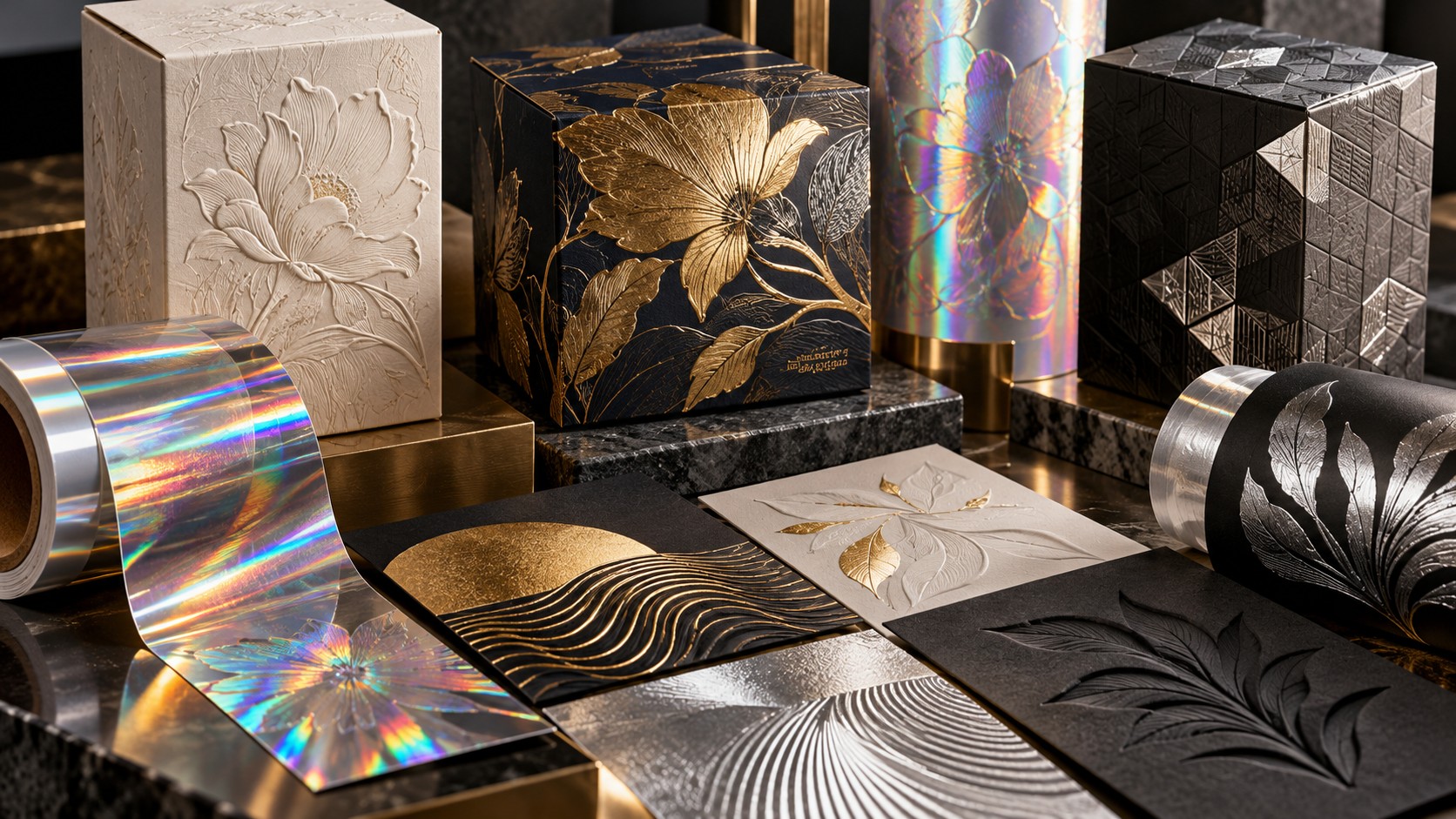
Three cosmetic cartons sit side by side. All three were printed on the same folding cartonboard using the same graphic file and color system. Their colors are accurate, the typography is sharp, and the printing meets the established quality requirements. Each carton carries a metallic logo intended to reinforce the brand identity and give the packaging a premium appearance.
The first carton received hot foil stamping with a heated die. The second was decorated using cold foil transfer, in which a metallic layer was transferred through an adhesive applied to selected areas. The third received a special holographic layer that creates shifting colors, apparent movement, and an impression of depth as the viewing angle changes.
At first glance, all three cartons are impressive. But when they are rotated under a light source, the differences become apparent. Conventional metallic stamping changes in reflection intensity with angle. The hologram produces optical movement and shifting color patterns. In some areas, the foil is incomplete or its edges are not sharp enough.
The design team now asks for one additional dimension: the logo should not simply reflect light; it should stand proud of the carton surface.
Embossing is selected to form a mechanical relief in the board. Yet the first trial reveals small cracks in the outer coating around some letters. Increasing pressure to obtain a deeper relief causes some fine details to lose definition. After creasing and folding, additional damage appears near a fold line.
The first suspicion falls on the die. Perhaps it lacks sufficient accuracy. Perhaps the temperature is wrong. Perhaps the pressure should be adjusted or a different foil selected. But the die may not be the source of the problem.
The cartonboard may not be suitable for the requested embossing depth. The varnish layer may be too rigid. The embellishment may have been positioned too close to a fold. In the cold foil process, the adhesive may not be wetting the ink surface adequately. In the hologram, the defect may concern registration or the microscopic optical structure of the transferred layer.
This is one of the fundamental challenges of print embellishment. We tend to view embellishment as a design step that adds gloss, luxury, or depth. In practice, it is an engineering process that changes the optical properties and sometimes the mechanical structure of a product's surface.
It can add a new layer, change wetting and adhesion, introduce mechanical deformation, influence perceived color, introduce security features, and impose new constraints on folding, gluing, lamination, and recycling. The important question is not only how to create an impressive effect, but how to produce it reliably, accurately, and repeatably without compromising the product it is intended to enhance.
What Is Embellishment, and What Actually Changes in the Product?
Print embellishment encompasses processes that give a printed product additional visual, tactile, and sometimes functional properties. Some techniques transfer decorative layers onto the surface, including hot foil stamping and cold foil transfer. Others reshape the substrate, as embossing and debossing do. Digital systems can create height and texture by depositing polymers, while other technologies create microscopic optical structures that alter the way light is reflected and diffracted.
Several approaches can appear similar to a designer. A gold logo might be created using hot foil, cold foil, or digital embellishment. Physical embossing can create a three-dimensional impression, while a hologram can create a visual illusion of depth without equivalent tactile relief.
From an engineering perspective, however, these processes differ. Mechanical embossing changes substrate geometry at a scale you can see and feel. A diffractive hologram can create an impression of depth or movement through microscopic structures that interact with light, without necessarily creating a raised feature perceptible to the fingertip. Choosing the effect must therefore be part of engineering the entire product, not simply a late design decision.
Hot Foil Stamping: Transferring Decoration Through Heat and Pressure
Hot foil stamping is one of the most established embellishment processes in printing and packaging. A decorative layer is transferred from a carrier film to the product through a controlled combination of heat, pressure, and contact time.
Conventional systems use a stamping die manufactured to match the intended design. Dies may be made of brass, magnesium, or other suitable materials, depending on the required precision, service life, and equipment. A typical transfer foil consists of a carrier film, release layer, decorative layers, and a bonding layer that enables transfer onto the substrate.
In metallic foils, the appearance may be produced by a very thin metallic layer, often aluminum, combined with other layers that determine its color and optical behavior. This is not the same as laminating a thick aluminum foil onto a carton. The transferred decorative layers are thin; the carrier film normally continues through the machine after stamping.
When the heated die presses on selected areas, the bonding layer can transfer the decorative material locally. A properly established process produces a defined metallic image with strong directional light reflection, clean edges, and adequate adhesion. Modern hot foil systems can process more than conventional gold and silver: matte, glossy, colored, diffractive, and holographic effects are also available.
This illustrates an important distinction. A hologram is not necessarily a different stamping technology. In many cases, it is the optical nature of the decorative material that is transferred by the same basic hot foil process.
Temperature, Pressure, and Dwell Time
Die temperature, stamping pressure, and dwell time are the three central operating variables. Insufficient temperature may cause incomplete transfer or inadequate adhesion. Excessive temperature can cause unwanted transfer beyond the artwork boundaries, blurred details, or thermal effects on underlying ink, varnish, or substrate.
Pressure must also be controlled. Too little pressure can leave irregular contact; too much can crush cartonboard, mark the substrate, or distort fine features. Dwell time controls the period available for heat transfer and bond formation, but longer contact does not necessarily improve the result. Changing one parameter often changes the effective window for the others.
The right approach is to define an operating window rather than rely on a single temperature or pressure that worked during the first trial. Temperature uniformity across the die, sheet transport stability, make-ready, and registration accuracy also matter. With holographic foil, requirements extend to preserving the optical effect: incomplete transfer, surface damage, or microstructure deformation may degrade the hologram even when parts of the foil remain attached.
Cold Foil Transfer: Adhesive-Defined Decoration
Cold foil transfer uses a fundamentally different transfer mechanism. Instead of a heated die defining the decorated areas, an adhesive or bonding material is applied to the intended image. A foil web is then brought into contact with the surface through a suitable roller system. Depending on the technology, the adhesive is cured or stabilized, and the decorative layer remains on the product after the carrier is separated.
Many systems use UV- or LED-UV-curable adhesive, although the transfer and curing sequence varies across equipment and formulations. The word cold does not mean that no energy is involved. It distinguishes the process from conventional transfer using a heated stamping die.
Cold foil can be integrated inline with suitable offset, flexographic, and other printing systems. You can also overprint a silver foil layer with compatible transparent inks, creating a wide range of metallic colors. This benefit requires a foil surface designed to accept further printing. Not every transfer material produces adequate overprint adhesion or the same optical appearance.
Wetting Comes Before Adhesion
For cold foil, the adhesive must wet the surface and spread appropriately within the printed image. Poor wetting can produce missing dots, discontinuous edges, or irregular adhesive coverage. Coat weight matters too: too little adhesive may cause incomplete coverage; too much can reduce edge definition or spread outside the intended area.
In flexographic application systems, anilox volume, plate characteristics, adhesive viscosity, and transfer conditions all influence the outcome. In offset systems, the adhesive and its rheology must match the application mechanism. Sometimes, however, the real cause of poor foil transfer lies upstream of the adhesive station.
Corona Treatment Before Cold Foil Adhesive Application
Corona treatment is one way to improve wetting before applying cold foil adhesive. Controlled electrical discharge changes the chemistry of the outermost surface. On appropriate polymers, it can introduce or increase polar functional groups and raise surface energy, allowing the adhesive to spread more uniformly and establish more complete interfacial contact.
This is particularly relevant to low-surface-energy synthetic substrates, including polyethylene (PE), polypropylene (PP), and certain grades of biaxially oriented polypropylene (BOPP). Without suitable surface preparation, adhesive can retract locally, creating discontinuity and irregular foil transfer. Controlled corona treatment immediately before adhesive application can improve the usable wetting window. It does not, by itself, guarantee good adhesion.
Treat the Surface the Adhesive Actually Encounters
The location of treatment matters. Corona treatment performed near the adhesive application station can reduce effects associated with aging or decay of previous surface treatment. But the engineer must first identify the actual surface being coated.
If the foil is applied directly to an unprinted polymer film, treatment concerns that film surface. If the adhesive is applied over printed ink, the exposed ink becomes the critical interface. In certain compatible systems, controlled corona treatment before cold foil application may improve adhesive wetting on the ink; the ink must first be qualified to ensure that treatment does not impair existing adhesion, color appearance, or film integrity.
The same principle applies to varnishes. A coating containing slip or release additives may have a different surface-energy profile from the ink underneath. Corona can sometimes help, but in other cases selecting a varnish or primer specifically compatible with cold foil is the better solution.
Corona is not a routine requirement for every coated paper or folding cartonboard. If adhesive wetting is already satisfactory, additional treatment may be unnecessary. The objective is not to achieve the highest possible dyne value, but to establish a surface condition appropriate for the adhesive and transfer system.
Dyne testing can provide a practical wetting indicator within the limitations of the chosen test method. It does not establish ultimate adhesion or durability. The qualification must also examine actual foil transfer, bond performance after Cure, and resistance to subsequent converting operations. Corona prepares a surface, but it is not a substitute for chemical compatibility and full process validation.
Holograms: Engineering Light, Not Just Metallic Shine
Holograms are among the most visually striking embellishments. A viewer may recognize them by changing colors, apparent depth, motion effects, or images that appear and disappear as the package moves relative to a light source. But industry uses holography for more than one optical technology.
Traditional optical holography records information about a light wavefront to reconstruct an image with depth-related properties. Packaging and security applications also use diffractive optically variable image devices (DOVIDs), which use microscopic patterns to control light distribution by wavelength and viewing angle.
Not every rainbow-colored effect is a true hologram in the strict physical sense. Some rely on diffraction gratings or other micro-optical arrangements. Nevertheless, the commercial term holographic foil is widely used for diffractive transfer materials that create hologram-like appearances. This distinction matters because two products may look similar yet use different optical structures and manufacturing processes.
How a Diffractive Effect Works
When white light interacts with very fine periodic grooves or related optical structures, different wavelengths can be directed into different directions. As the viewer changes angle, the spectral composition of the light reaching the eye changes. Colors shift, details appear and disappear, and patterns can appear to move.
More sophisticated optical designs can produce apparent depth, multiple image planes, direction-dependent movement, or information visible only from defined viewing positions. These effects do not necessarily correspond to a raised pattern the finger can feel. Diffractive microstructures operate at a fundamentally different scale from the dimensional relief produced in ordinary decorative embossing.
How Holographic Foil Is Manufactured
Manufacturing holographic transfer material begins before stamping or coating the final carton. First, a desired optical structure is designed or originated—a stage often called hologram origination. Depending on the technology, this may involve optical methods, lasers, or computer-controlled microstructure generation.
A tool suitable for replicating the optical geometry is then produced, sometimes as a precise metal shim. During material manufacture, the microstructure is replicated into a suitable coating on a film. Depending on the desired effect, subsequent layers may include metallization, optical coatings, release layers, and a bonding layer.
The resulting holographic transfer web can be supplied for a suitable stamping or transfer system. The original hologram is generally not recreated individually on every carton; instead, the optical structure is created in advance and reproduced repeatedly in the transfer material. This is why hologram creation and hologram application should be treated as distinct production stages.
Does Applying a Hologram Require a Different Embellishment Process?
Not necessarily. A holographic layer may be applied through hot foil stamping, cold foil transfer, a specialized label, or lamination with a holographic film. A diffractive effect can also be formed in a cured coating by Cast & Cure.
In other words, hologram often describes an optical property, while the application technology describes how that property reaches the package.
Hot stamping of holographic foil still uses a suitable die and controlled heat and pressure. The major differences may be the transfer material and registration requirements. Cold transfer uses adhesive application, contact, release, and curing appropriate to the system.
If only a repeated rainbow texture is needed, application may resemble conventional decorative foil transfer. If a unique security image must be placed in a precise location, the equipment may require additional optical registration of the image printed or originated on the transfer web.
Continuous Holographic Patterns Versus Registered Holograms
Two application families should be distinguished.
Continuous holographic patterns, sometimes called wallpaper patterns, repeat along the transfer film. They may include rainbow textures, geometric designs, or recurring diffractive motifs. Their primary purpose is often decorative: to create eye-catching effects across a selected area or the entire package.
Registered holograms contain a specific image that must arrive at a defined position. A security symbol, proprietary logo, or complex optical motif must align with printed elements on the product. In this case, accurately depositing foil onto adhesive is not sufficient: the optical image on the foil must also be correctly positioned.
Registration marks and optical sensor or camera systems can be used to synchronize web advancement with the substrate. Dedicated hologram-registration modules available on industrial equipment—including systems described by BOBST—are designed for such work. Registered holograms do not automatically require a different bonding chemistry, but they may require substantially more sophisticated mechanical and optical control.
Decorative Holograms Versus Security Holograms
An important application of holograms is brand protection and counterfeit deterrence. However, a colorful holographic appearance does not necessarily provide meaningful security. A widely available rainbow foil with a generic repeated pattern may look impressive yet be relatively easy for another supplier to obtain.
A purpose-designed security hologram can incorporate several optical features, including microtext, hidden images, view-dependent image changes, movement effects, unique codes, or details that require specific inspection methods. Some security devices use selective demetallization, removing metal from predetermined regions to combine reflective and transparent areas.
Serial numbers, barcodes, or digital identifiers may link a physical feature with an authentication or traceability system. Even a sophisticated hologram is not an absolute guarantee against counterfeiting. A professional security program must address how the feature will be verified, how materials will be controlled through the supply chain, and how suspicious products will be identified.
The question is not only how difficult the hologram is to copy, but how an authorized party, distributor, or consumer can establish that the product is authentic.
Holographic Film Lamination: A Different Material Structure
Another route to a holographic appearance is to laminate a polymer film that already carries the appropriate optical structure. The film is bonded to paper, board, or another substrate with a suitable adhesive system. It may produce a broad holographic surface or an effect in a selected area.
This is materially different from transfer foil. In conventional foil stamping, the carrier film is removed, leaving only the transferred decorative layers. In holographic film lamination, the polymer film itself remains part of the finished construction.
That changes thickness, flexibility, mechanical response, and potentially recycling behavior. On folding cartonboard, an added film may influence creasing and folding. On flexible packaging, it may affect how the construction responds to stretching, bending, and heat sealing. Holographic lamination and holographic foil stamping should therefore not be treated as interchangeable merely because their appearance is similar.
Cast & Cure: Diffractive Effects Without Transferring Metallic Foil
Cast & Cure provides another route to holographic-looking and diffractive effects. In a typical process, a compatible varnish or reactive coating is applied to the product. A film carrying a precise microscopic structure is brought into contact with the uncured surface. The film acts as a template, and its topography is copied into the coating while that coating is still formable.
The coating is cured—often using UV or electron beam (EB) energy, depending on the system—and the structured film is separated. The result is a coating whose microscopic surface can produce diffraction-related light effects. Unlike conventional metallic foil transfer, the process described does not require a metallic decorative layer to be deposited onto the product. The casting film can be reused as long as it remains within the supplier's process limits.
Cast & Cure is not confined to holographic effects: it may also create high-gloss, matte, textured, and other optical finishes. Not every Cast & Cure pattern qualifies as a purpose-designed authentication hologram.
The key difference is how the optical structure reaches the product. In holographic foil transfer, the microstructured decorative layer is transferred from the carrier. In Cast & Cure, a microstructured surface is formed in a coating that remains on the package. The resulting construction can therefore differ in thickness, transparency, gloss, adhesion, durability, and perceived color.
Embossing: When the Substrate Becomes a Relief
Embossing forms a raised feature in the substrate through controlled mechanical deformation. Conventional processes use a die and a corresponding counter-die or make-ready support to shape the material under pressure. The resulting relief rises above the surrounding surface and may form a logo, lettering, texture, or a more complex design.
When no added color or foil is used, the technique is known as blind embossing. Light and shadow reveal the altered topography even where the substrate color remains unchanged.
The difference between embossing and holography is important. Embossing is designed to produce a macroscopic change in the material's geometry. A diffractive hologram produces an optical effect through microscopic structure. Both can create an impression of depth, but they do so by different mechanisms.
Debossing: Creating Depth Through an Indentation
Debossing forms a recess rather than a raised relief. Like embossing, it uses suitable mechanical tooling to shape the substrate. Its appearance can range from a subtle pressed mark to a clearly defined recessed pattern.
Blind debossing achieves the effect without color or foil, creating the appearance of engraving or an impression pressed into the material. It can be particularly elegant on matte cartonboard and specialty papers.
Debossing still stresses the substrate. Depth, edge radii, substrate thickness, and internal strength determine whether the feature remains sharp and stable. It should not automatically be considered gentler than embossing simply because the shape is recessed.
Foil Embossing: Combining Light with Physical Relief
Combining metallic foil with embossing creates a structure that reflects light and also stands above the original surface. Some systems allow foil transfer and relief formation in a single combined die operation. Others perform the two steps separately.
When carried out separately, accurate registration between the metallic image and mechanical relief is essential. Even a small positional error can make the foil look misaligned, especially on fine lettering or geometric outlines.
When a holographic layer is included, the system becomes more demanding: the decorative film creates a variable optical appearance, while the substrate provides tangible relief. As embossing depth increases, strain in the decorative and printed layers can rise. Foil, ink, varnish, and cartonboard must withstand the deformation together.
Embellishment on Paper: Absorption, Roughness, and Fiber Structure
Paper is a common embellishment substrate, but its grades differ considerably. Coated, uncoated, textured, and recycled papers can respond differently to foil transfer and mechanical relief. With uncoated paper, porosity and absorbency influence cold foil adhesive application. If too much adhesive penetrates the sheet instead of staying at the surface, there may be insufficient continuous bonding material for reliable foil transfer. The result may be missing areas, poor uniformity, or loss of fine detail.
In hot stamping, roughness influences contact between die, foil, and sheet. Nevertheless, specialized transfer materials are available for uncoated and textured papers. Therefore, it is incorrect to claim that uncoated paper cannot be foil stamped; a compatible foil and suitable conditions are needed.
In holographic applications, surface uniformity can be especially important. Excessive roughness and local defects can affect the appearance of a transferred diffractive layer. Paper moisture also influences dimensional stability, mechanical response to pressure, and the tendency to crack during embossing or debossing. The substrate must be specified by its actual grade, structure, coating, and condition—not simply by grammage.
Embellishment on Folding Cartonboard: Relief Depth Versus Structural Strength
Folding cartonboard often allows deeper, more defined relief because of its thickness and multilayer construction. Yet cartonboard grades are not interchangeable. SBS, SBB, FBB, GC1, GC2, and other materials can differ in internal ply structure, bonding strength, surface coating, and mechanical response.
Embossing deforms the board. Outer layers experience local tensile and compressive stresses while inner layers participate in the shape change. If the structure cannot accommodate the requested depth, the result may be coating cracks, internal ply separation, or loss of definition. A crack in the board must be distinguished from a crack in varnish or ink: a rigid topcoat can fail while the board itself remains intact.
Folding cartons subsequently pass through die-cutting, creasing, folding, and gluing. Embossing close to a fold line can be distorted or cracked by that later operation. Foil applied to a gluing area can change how the carton adhesive wets and bonds to the surface. Registered holograms add another requirement: their location must remain correct relative to the carton geometry after cutting and folding.
This is why the final assembled package—not merely the embellished flat sheet—must be included in qualification.
Embellishment on Synthetic Substrates: Surface Energy, Heat, and Elasticity
Synthetic printing substrates include PE, PP, BOPP, PET, PVC, and other polymers. They are widely used for labels, sleeves, flexible packaging, and specialty applications. Their response to embellishment depends strongly on polymer chemistry, existing surface treatment, molecular orientation, and thermal and mechanical properties.
In hot foil stamping, thermal compatibility is a major concern. A film with limited thermal dimensional stability may shrink, distort, or change size when temperature and dwell time are inappropriate. In cold foil, the main challenge may instead be adhesive wetting and interfacial adhesion.
On PE and PP films, controlled corona treatment before adhesive application may improve wetting when the exposed surface is outside the required working window. However, it is essential to identify what the adhesive actually touches. A film treated before printing does not prove that cold foil adhesive will wet the ink or varnish printed onto it later.
For holographic labels and sleeves, stretching, winding, application, and subsequent forming may influence the continuity of the optical effect. A holographic layer can change in appearance when the construction is strained even if it does not visibly peel away.
Can Synthetic Film Be Embossed?
Many polymers can be textured or embossed, but conventional cartonboard tooling and pressures should not be assumed suitable for a thin synthetic film. Some polymers exhibit elastic recovery: the relief may become shallower or less defined once pressure is removed. Other materials can retain a shape through a qualified thermomechanical process, depending on polymer, thickness, and film structure.
Deep deformation can impair dimensional stability or functional layers. In flexible packaging, engineers must consider possible effects on lamination interfaces, barrier layers, and heat sealing. When tactile relief is needed on a thin synthetic label, a raised polymer or textured varnish may be more suitable than conventional mechanical embossing. The choice depends on the substrate and end-use requirements, not on appearance alone.
Comparing the Major Embellishment Technologies
Technology | How the effect is created | Principal characteristic | Critical control point |
|---|---|---|---|
Hot Foil Stamping | Decorative layer transferred using heat and pressure | Metallic or decorative appearance | Die temperature, pressure, dwell time |
Cold Foil Transfer | Adhesive-defined transfer of decorative layer | Inline processing; optional overprinting | Wetting, adhesive coat weight, curing |
Holographic Foil | Transfer of an optically microstructured layer | Angle-dependent colors and optical movement | Transfer quality and registration |
Registered Hologram | Specific holographic image positioned on product | Decorative or dedicated security feature | Precise optical-image position |
Holographic Film Lamination | Bonding an optically structured film to the substrate | Large-area holographic finish | Adhesive, tension, downstream converting |
Cast & Cure | Replicating a microstructure into a coating | Diffractive finish without metallic foil transfer | Replication fidelity and Cure |
Embossing | Mechanical deformation producing raised relief | Tactile, physical elevation | Substrate, tooling, pressure |
Debossing | Mechanical deformation producing an indentation | Engraved or recessed appearance | Depth, geometry, substrate strength |
Digital Raised Embellishment | Depositing and curing raised polymer | Height and texture without a conventional die | Adhesion, deposit thickness, Cure, durability |
The desired appearance does not by itself identify the manufacturing mechanism. A hologram can be produced through several application routes, not just one dedicated category of finishing machine.
How Ink and Varnish Affect Embellishment Quality
Many embellished products are not decorated directly on bare paper, board, or polymer film. Instead, the exposed surface may be an ink, primer, varnish, or functional coating. The chemistry of that top layer can determine whether the embellishment succeeds.
A varnish containing slip additives can be difficult for cold foil adhesive to wet. A polymeric ink may react to heat and pressure during hot stamping. A highly crosslinked varnish can resist abrasion yet crack under deep embossing. Even a well-bonded holographic transfer may lose its intended effect if subsequent finishing damages its optical structure.
Process order therefore matters. Is the foil applied before or after varnishing? Will the metallic layer be overprinted? Is embossing performed before or after foil transfer? Will the package be laminated, folded, or heat sealed afterward?
Treating embellishment as another functional interface within the printed construction makes these decisions more predictable. Treating it as an isolated decorative step often means discovering incompatibility only after production has begun.
Embellishment and Color Management: When Angle Changes the Result
Metallic foil and holograms create a very different optical system from conventional ink on white paper. Standard printed colors depend on absorption, scattering, and reflection. Metallic surfaces add a strong specular component. Diffractive holograms can change the spectral composition and direction of reflected light with wavelength, illumination angle, and viewing angle.
A holographic sample may appear to have several different colors when rotated. One CIELAB measurement cannot describe all this behavior, and a low single-angle Delta E00 value does not prove two holographic effects will look identical from every direction.
Where the optical effect is a defined brand attribute, a physical master sample and controlled viewing conditions are essential. Depending on complexity, quality assessment may require appearance records from several angles, gloss measurements, and appropriate optical measurement methods. A single color number cannot fully manage a feature that changes with viewing geometry.
Digital Embellishment: Height and Texture Without a Conventional Die
Digital embellishment systems can generate spot gloss, texture, height, and in some cases metallic-transfer effects through controlled polymer deposition. A polymer may be applied according to a digital file, then cured or used as a base for further decoration. Controlled buildup can create raised areas that visually resemble embossing.
The difference is structural. Conventional embossing reshapes the substrate; raised digital embellishment adds material above it. Their resistance to abrasion, folding, and repeated handling is not necessarily equivalent. Digital systems can be particularly attractive for short runs, personalized products, and frequently changing designs, because a dedicated mechanical die is not required for every artwork revision.
Troubleshooting: Diagnose the Failure Mechanism, Not Just the Appearance
As with coating and lamination, a visible blemish does not identify its own cause. A missing metallic patch may originate from poor wetting, incomplete transfer, or a substrate defect. A hologram defect may reflect registration error, inadequate adhesion, or damage to the optical microstructure. Cracks in a relief may arise from board construction, tooling geometry, varnish brittleness, or excessive embossing depth.
Symptom | Possible causes | First diagnostic direction |
|---|---|---|
Incomplete hot foil transfer | Heat, pressure, dwell, foil or substrate mismatch | Examine die, working conditions, and contact surface |
Blurred foil edges | Excess adhesive/transfer, heat, pressure, or release problems | Check artwork boundaries and vary one setting at a time |
Missing cold foil areas | Poor wetting, adhesive weight, or incomplete curing | Inspect surface state, adhesive application, and cure |
Foil lifting | Weak adhesion or layer incompatibility | Identify separation interface and test durability |
Weak holographic effect | Uneven transfer, optical damage, or viewing differences | Compare against a master under defined conditions |
Misregistered hologram | Foil advance, web tension, or incorrect mark detection | Check sensors, cameras, and foil synchronization |
Missing angle-dependent color | Optical structure damage, incompatible overcoat, or illumination | Examine effect at specified lighting and angles |
Cracking during embossing | Excess depth, sharp die geometry, unsuitable board/coating | Inspect tooling radii, relief depth, and layer failure |
Shallow emboss | Inadequate forming, counter-die, or elastic recovery | Check tool pair and substrate response |
Damage after folding | Relief too near crease, rigid coating, additional deformation | Test the fully folded product |
Failure on synthetic film | Heat sensitivity, poor wetting, dimensional change | Check film grade, corona treatment, and process window |
The goal is not to apply many corrections simultaneously. Identify where and when the failure begins. Controlled trials with a reference sample, documented machine conditions, and one principal changed variable at a time are more useful than automatically increasing pressure or temperature.
Case Study: Folding Carton with a Registered Hologram and Embossing
Consider a premium perfume carton printed on coated folding cartonboard. The design requires a dark background, a proprietary holographic logo, and subtle mechanical relief. The hologram should change appearance as the carton moves, while the raised image provides a tactile impression.
First, determine whether the design calls for a generic repeating holographic pattern or a dedicated registered hologram. Then select the transfer technology and define the hologram's position relative to the print and embossing features.
If registration is required, qualify the optical positioning system and the transfer-film marks. Next, assess how embossing affects the holographic layer and the cartonboard structure. Once an acceptable flat-sheet sample is obtained, pass representative samples through die-cutting, creasing, folding, and gluing. Only then can the team determine whether registration remains correct, the relief is retained, and the board remains undamaged.
A hologram and a mechanical emboss cannot simply be qualified independently and assumed to work perfectly together. Their interaction is part of the final application.
Case Study: A Synthetic Label with a Security Hologram
Consider a polymer-film label for a high-value cosmetic product. Here, the hologram serves not only as decoration but also for product authentication. The design may combine a proprietary optical image, variable-view features, microtext, and serial identification.
If the hologram is transferred by cold foil onto printed ink, the adhesive's wetting and compatibility with the ink must be confirmed. In an appropriate system, controlled corona treatment before applying the adhesive may improve wetting. The treatment must be qualified for the actual exposed ink or coating—not assumed safe simply because the base film can be corona treated.
Adhesion tests alone are not enough. The optical features and security elements must also be validated: image position, legibility of intended details, visibility of viewing-angle changes, and stability after label application. If the label is intended to show evidence of opening, tamper-evident behavior may also be required. In such an application, embellishment becomes part of a broader brand-protection system.
Embellishment on Food Packaging: Chemistry Still Matters
When embellishment is applied to food packaging, the materials and finished structure must be evaluated against relevant regulatory and end-use requirements. Foil, adhesive, UV coating, or holographic layers on the outside do not automatically make the construction suitable for food contact.
Material formulation, potential substance transfer, production conditions, and barrier structure all matter. Set-off is a particular consideration where the embellished outside surface contacts the food-facing side of a sheet or reel during storage or winding.
With UV-cured cold foil adhesive, the degree of curing matters for risk assessment. Cast & Cure coatings likewise must be compatible with the intended application and properly cured. European frameworks including Regulation (EC) No 1935/2004 and Commission Regulation (EC) No 2023/2006 establish general principles for food-contact materials and good manufacturing practice.
Embellishment must therefore be included in the qualification of the final packaging structure rather than treated as an addition outside the scope of food-contact evaluation.
Embellishment and Recycling: Transfer Layers Are Not Laminated Films
The recycling impact of embellishment depends on chemistry, coverage, and the relevant recycling route. In conventional metallic or holographic transfer, the carrier film is generally separated during application, leaving only thin decorative layers on the product. In holographic film lamination, by contrast, the polymer film itself remains part of the construction.
Cast & Cure transfers a surface pattern into a coating, while the casting film is removed and can potentially be reused. These are materially different approaches, but none automatically guarantees recyclability.
For paper and board, the influence of decoration on repulping and contaminant separation must be considered. For synthetic packaging, adhesives and decorative layers may affect sorting and recycled-polymer quality. It is also important to distinguish thin localized foil stamping from full-surface metalized film lamination.
A claim about lower process material consumption is not the same as evidence that the finished product can be recycled in a particular stream. Both questions deserve separate evaluation.
How to Qualify an Embellishment Process
When developing an embellished product, I prefer to start with the final effect and the product's actual requirements. Is the objective metallic shine, a decorative hologram, an authentication hologram, physical relief, a recess, texture, or a combination?
Next, identify the exact substrate and the layers already on it. General descriptions such as paper, board, or BOPP are inadequate. Grade, thickness, coating chemistry, surface condition, and intended use are required to define a realistic process.
Then select the applicable technology and its critical variables. For hot foil, these include temperature, pressure, dwell time, and die/foil compatibility. For cold foil, these include wetting, suitable surface treatment (where needed), viscosity, adhesive coat weight, registration, and curing. A registered hologram requires additional control of the optical image position. Cast & Cure requires accurate microstructure replication and adequate coating cure. Embossing and debossing require suitable geometry, deformation depth, and mechanical substrate behavior.
Run controlled trials, keep a master reference, and change one primary variable at a time. Test not only appearance immediately after embellishment but also performance after actual converting. Food packaging requires the applicable compliance assessment; security holograms require checks of optical features, authentication criteria, and registration.
The objective is not merely a striking prototype. It is a stable operating window that can be reproduced in industrial production.
Good Embellishment Does More Than Attract Attention: It Survives the Product's Life
Embellishment can transform a printed product into something with a stronger visual, tactile, and even security identity. Hot stamping can create a sharp metallic appearance and combine it with physical relief. Cold foil uses adhesive-based transfer and can integrate with suitable printing lines. Holograms introduce dynamic optical behavior and may support brand authentication. Embossing and debossing reshape the substrate. Digital raised embellishment creates height through added polymer; Cast & Cure forms microscopic optical patterns within a coating.
Yet each technique imposes different requirements. On paper, the challenge may be absorbency and fiber strength. On folding cartonboard, it may be preserving relief and coating integrity after creasing and folding. On synthetic films, it may be surface energy, thermal response, or dimensional stability. Holograms add the need to understand viewing-angle behavior and, for registered images, precise optical positioning.
The right embellishment technology should not be selected only because a sample in a catalog looks impressive. It should be chosen for the substrate, ink, coating, chemistry, application conditions, downstream converting, and end use.
When I receive a design containing foil, a hologram, and relief, my first question is not which finishing machine or stamping temperature to use. I want to understand what is on the surface, which optical or mechanical result is required, what the package must withstand afterward, and which tests will demonstrate long-term stability.
Because the goal is not simply to produce a carton that looks impressive as it leaves the machine. The goal is a package in which appearance, touch, authenticity, and performance continue to work together throughout the product's life.
Professional Sources and Further Reading
- 1. Hologram hot stamping, application modules, and registration control.
- 2. Foil application, embossing, precision, and carton finishing.
- 3. Holographic embellishment, hot and cold transfer, and security applications.
- 4. Metallic, diffractive, and dimensional decorative effects.
- 5. Holographic principles and authentication technologies.
- 6. 2D/3D and dot-matrix holograms and embossed security features.
- 7. Overt and covert optical security features.
- 8. Hologram origination, transfer processes, and registration.
- 9. Board structure, relief formation, and mechanical deformation.
- 10. The role of corona treatment in surface wetting and adhesion.
- 11. Replicating optical structures in coatings through curing.
- 12. Industrial implementation of holographic coating effects.
- 13. European food-contact framework.
- 14. GMP for food-contact materials.
Technical note: Establish stamping temperature and pressure, contact time, adhesive coat weight, corona treatment, curing, embossing depth, and registration tolerances for the specific materials, equipment, and approved application. The examples in this article are not universal production specifications.