The Hidden Science of Aroma Scalping, Polymer Sorption, and Flavor Loss in Printed Food Packaging
By Ronen Dolev | Technical Engineering Article | October 2026
When the Packaging Passes Every Test but the Flavor Changes
A beverage manufacturer launches a new fruit drink. The package has been carefully selected: oxygen-transmission performance meets the specification, seals are sound, the printing looks excellent, and the first storage tests produce no obvious warning. Several weeks later, however, the fruit character has weakened. The product remains within the safety and basic chemical specifications, but its characteristic aroma has become flatter, and one dominant note is barely perceptible.
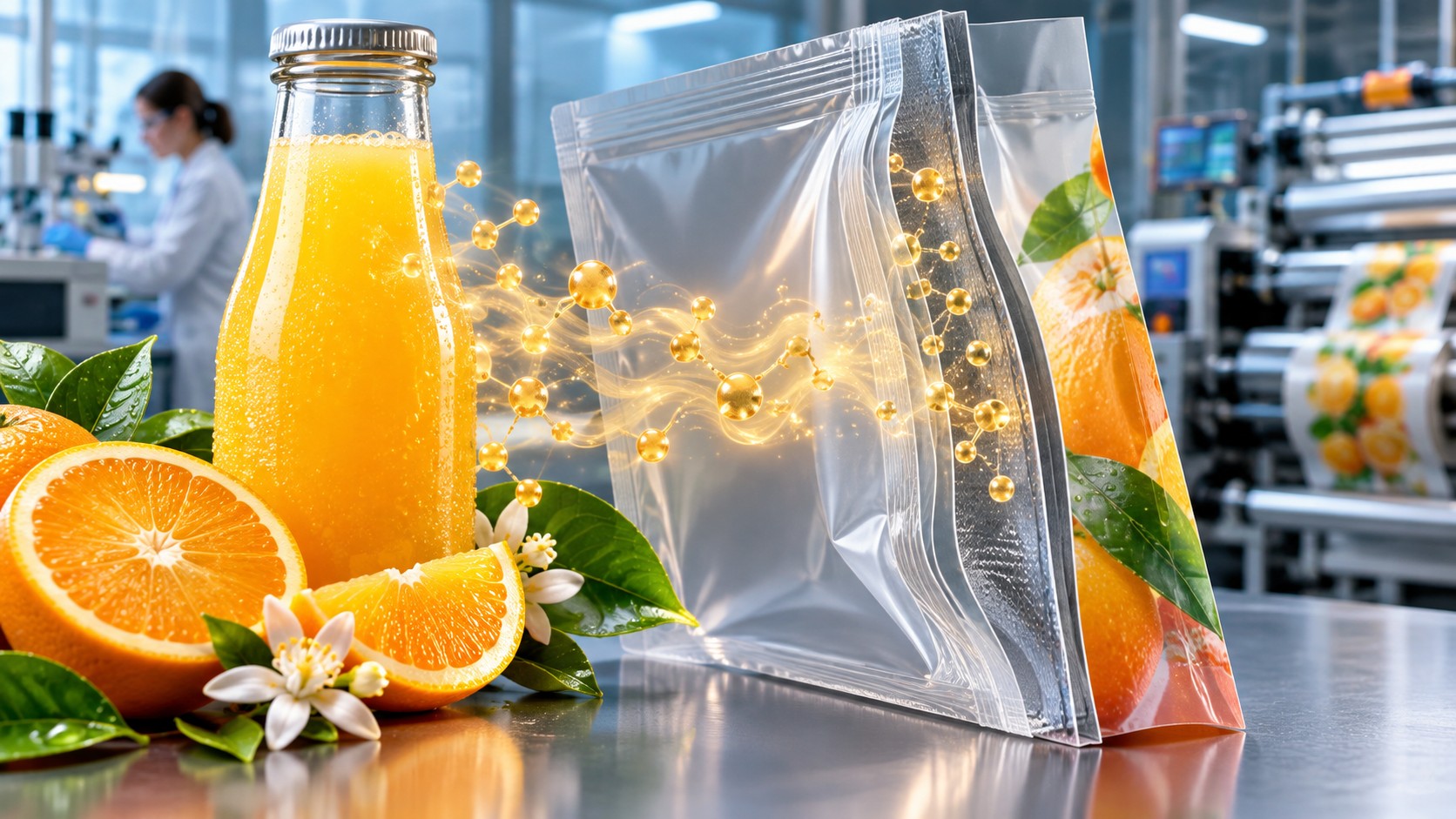
The first explanations are familiar: recipe variation, raw-material age, processing conditions, or oxidation. There is another possibility. Some of the aroma molecules originally present in the drink may have transferred into the packaging material. The phenomenon is called flavor scalping. Flavor molecules can partition from a food into a packaging surface and, in some constructions, diffuse farther into a polymer layer. The finished package can remain physically intact, exhibit acceptable oxygen-barrier performance, and still affect the food's sensory identity. Classic investigations and subsequent reviews describe this mechanism in food-contact polymers [1–4].
This distinction changes how package performance should be evaluated. A good package must not only restrict the entry of unwanted substances; for aroma-sensitive foods, it must also avoid removing the ingredients responsible for the intended flavor profile. That requires looking at polymer chemistry, the finished multilayer structure, bio-based and fiber-based materials, printing inks, conversion conditions, and the analytical methods used to separate one failure mechanism from another.
- Three Transport Mechanisms That Must Not Be Confused
Permeation describes the transfer of a substance through a packaging material, usually driven by a difference in chemical potential or partial pressure. Oxygen and water-vapor transmission are familiar examples. Migration in food-contact work commonly concerns substances originating from the package—such as components associated with a substrate, ink, coating, adhesive, or processing aid—that move into food or a food simulant. Flavor scalping reverses the direction of concern: one or more desirable food constituents are taken up by the packaging material [1, 2].
These mechanisms may occur simultaneously, but they answer different questions. Low oxygen transmission does not guarantee negligible uptake of limonene or another desirable aroma compound. Conversely, a package may preserve a flavor profile while requiring additional investigation of migrants from its ink or adhesive. OTR and WVTR do not directly measure aroma retention. Robust package qualification must name the property being measured and the mechanism the test is intended to challenge.
- Why Aroma Molecules Enter Polymers
Aroma molecules differ in polarity, molecular structure, volatility, concentration, and affinity for other phases. A compound with a favorable thermodynamic affinity for a particular polymer can transfer from the food or headspace into that polymer. The process involves partitioning, which governs how the molecule distributes between phases, and diffusion, which governs how it moves through the polymer over time. Polymer free volume, crystallinity, chain mobility, glass-transition behavior, density, and formulation can all contribute to the observed result [1, 4].
Under appropriately defined equilibrium conditions, a partition coefficient may be written as K = C(polymer) / C(food), provided the two concentrations use consistent definitions and the measurement conditions are specified. The coefficient is not a universal property of the resin family. It depends on the aroma compound, product matrix, temperature, and system conditions. Neither does it define the rate at which equilibrium is approached. Two polymers might show comparable equilibrium uptake for a molecule but very different uptake during the actual shelf-life window because their diffusion kinetics differ.
This is why a single, end-of-storage measurement can be misleading. The engineer needs to understand both the quantity transferred and the time-dependent trajectory, especially when the product is consumed well before true equilibrium is reached.
- Polarity Changes the Outcome
Polyolefins such as polyethylene and polypropylene are relatively nonpolar. They can therefore exhibit substantial affinity for certain nonpolar aroma compounds, but the result must be established for the exact molecule and material. Limonene, prominent in citrus aroma, is a well-known example. In the 1987 study by Kwapong and Hotchkiss, equilibrium partitioning of limonene into the plastics examined was much stronger than for benzaldehyde, citral, and ethyl butyrate. The study also reported sensory detectability under its test conditions [3].
The important lesson is not that every nonpolar aroma behaves like limonene or that all polyethylenes behave identically. It is that molecular selectivity can be large enough to alter what a person tastes. A packaging material may remove a small mass fraction of the total volatile content while disproportionately depleting a character-defining compound. Material selection should therefore be based on the relevant food chemistry, not only on a general statement that a resin is a 'good barrier.'
- Polymer Morphology Matters as Much as the Polymer Name
The designation PE, PP, PET, or PA does not capture the whole structure. Degree of crystallinity, density, chain architecture, orientation, processing history, and formulation can change how aroma molecules distribute through a material. More accessible amorphous regions or higher chain mobility may facilitate the uptake of some molecules, while denser or more constrained structures can reduce mobility under otherwise comparable conditions. These tendencies depend on the process and compound, not on guaranteed rankings [1, 4].
Glass-transition temperature (Tg) is relevant because molecular motion changes with the material's physical state, but Tg alone cannot predict flavor scalping. The aroma molecule's interaction with the polymer, food composition, time scale, and temperature history must also be considered. It is especially important not to transfer conclusions from a single research-grade film to every commercial grade within the same polymer family.
- An Engineering Comparison of Polymer Families
POLYMER FAMILY | RELEVANT CHARACTERISTICS | WHAT SHOULD BE QUALIFIED |
|---|---|---|
LDPE — Low-Density Polyethylene | Relatively nonpolar; accessible polymer morphology can favor uptake of some volatiles | Compound-specific sorption and time-dependent flavor change |
LLDPE — Linear Low-Density Polyethylene | Crystallinity and composition vary with grade | Sorption of product-specific aroma markers |
HDPE — High-Density Polyethylene | Typically denser and more crystalline than LDPE | Actual uptake and kinetics; higher density is no guarantee |
PP — Polypropylene | Relatively nonpolar polyolefin | Affinity for selected nonpolar aroma components |
PET — Polyethylene Terephthalate | Polar polyester; some studies show less uptake than selected polyolefin sealants | Grade, orientation, contact conditions, food composition |
EVOH — Ethylene Vinyl Alcohol | Often employed as an oxygen-barrier layer; response is moisture-dependent | Aroma transport in the actual multilayer construction |
PA — Polyamide | Polar amide chemistry; family and moisture state vary | Molecule-specific partitioning and transport |
PLA — Polylactic Acid | Polyester that may be produced from renewable feedstock | Direct testing; bio-based origin does not predict low scalping |
This comparison is a qualification guide, not a universal league table of aroma retention. The 1997 inverse-gas-chromatography study of LLDPE, an ionomer, and a heat-sealable PET illustrates that both compound identity and polymer choice affect the sorption response; limonene uptake was preferential in the LLDPE examined [5]. The finished structure may behave differently from a stand-alone test film.
- Selective Sorption: Why the Taste Can Shift Without Losing All the Aroma
Food aroma is usually a mixture. Each compound has a different sensory contribution and detection threshold, so equal percentage losses do not produce equal sensory consequences. Some notes can diminish while others remain comparatively stable. The result may be less a general reduction in intensity than a new and unbalanced flavor signature. This is the reason total volatile content is an insufficient specification for many foods [2, 5].
Consider a fruit drink in which a citrus top note is largely associated with compounds that partition readily into the sealant while other, more polar components are retained. The product may smell sweeter, duller, or simply different, even though the overall volatile mass has changed only modestly. The engineering investigation should identify the key aroma markers rather than assume that every compound in the product is equally relevant to consumer perception.
- In Multilayer Packaging, the Food-Contact Layer Can Dominate
Consider a simplified PET/Adhesive/PE construction. PET may provide dimensional stability and printability, while PE provides heat sealing and the intended food-contact surface where appropriately qualified. A good barrier on the outside of the structure does not remove the possibility that molecules originating in the food will sorb into the inner sealant. The location and thickness of each layer, not simply the presence of a named high-barrier material, determine the transport pathways available to the molecule.
Thickness influences both the amount of polymer available to hold a sorbed compound and the distance through which the compound must diffuse. A thinner food-contact layer may shorten the diffusion path, but reducing its thickness is not an automatic solution: the effect depends on the molecule, the amount of polymer, the exposure time, seal performance, and the rest of the construction. The correct comparison is between finished packages under the same intended food and storage conditions, not merely between nominal sealant thicknesses.
- What Happens in Fiber-Based Packaging?
Paper and paperboard behave differently from continuous polymer films. Fiber surfaces, porosity, coating chemistry, sizing, and humidity can affect interactions with volatile substances. A carton containing a polymeric or functional inner coating should be evaluated primarily through the food-contact surface and the complete path through the construction. In an uncoated or partially exposed fiber system, it may also interact directly with cellulosic material.
It is vital, however, not to mistake taint transferred from a carton into a food for scalping of aroma originally present in the food. A 2022 study of yogurt in paper-based cartons used headspace SPME–GC–MS to investigate off-flavor compounds and evidence of packaging-related contributions. That result raises concerns about potential sources of off-flavor and does not, by itself, prove that the package removed the yogurt's original aroma [7]. The practical lesson is to distinguish the direction of transfer by testing the food, the relevant packaging components, and reference conditions together.
- Bio-Based and Biodegradable Packages: Are They Better Aroma Barriers?
Interest in PLA, PHA, thermoplastic starch, cellulose-based coatings, and other bio-based materials is growing, but feedstock origin does not establish aroma performance. A bio-based polymer still has a specific polarity, chain structure, morphology, and transport behavior. Whether it is also biodegradable or compostable under specified conditions is a separate question from whether it preserves a given food's flavor.
Mauricio-Iglesias and colleagues compared scalping of four aroma compounds in LDPE and PLA under defined high-pressure/thermal treatments. The response depended strongly on the treatment and, for PLA, on temperature relative to its glass-transition behavior [6]. These findings do not establish a general superiority of one material across all foods and conditions. Water-sensitive cellulosic and starch-based coatings raise further questions because moisture can affect the material's state and the availability of molecular interaction sites. Product-specific qualification remains essential.
- What Does Printing Ink Have to Do With Aroma Retention?
Printing adds a separate class of potential interactions to the package. Flavor scalping is the transfer of desirable constituents from the food into the packaging. In contrast, inks, coatings, adhesives, or processing layers may be sources of undesirable volatiles or migrants entering the food, potentially producing taint or off-flavor. Those mechanisms should not be merged. They may occur together, but solving one does not necessarily solve the other [7, 8].
Liquid Electrophotography (LEP). LEP transfers a polymeric ink film under defined thermal and mechanical conditions. For food packaging, evaluation must consider print position, the actual laminate or board construction, the intended direct or indirect food contact, and the evidence supporting the use of the ink system. Exterior LEP print is not, by itself, proof of direct food-aroma uptake. Likewise, a qualified ink system does not automatically eliminate scalping into an inner polymer sealant.
Water-based flexography. Aqueous inks must be evaluated for compatibility with coated or hydrophilic surfaces, appropriate drying, and the full finished package. Under some conditions, effects on the substrate or coating are possible; however, they do not establish an aroma-scalping mechanism without measurements of uptake or sensory change.
Solvent-based flexography. Drying performance and residual volatile constituents matter for taint and food-contact assessment. If a packaged product develops off-notes, distinguish loss of original aroma constituents from the introduction of packaging-derived volatiles before changing the ink as a corrective action.
Conventional offset. For printed paperboard, evaluate the ink, drying mechanism, substrate, coatings, and possible transfer pathways together. Printing on the non-food-contact side must not be taken as proof that every relevant transport pathway is blocked.
UV and electron-beam (EB) systems. Evaluate the formulation, completeness of curing, appropriate residuals, and food-contact suitability for the actual application. Some UV systems warrant particular attention to photoinitiator-related constituents. It would be unsupported to claim that all UV or EB inks necessarily increase flavor scalping; that requires compound- and construction-specific evidence.
The central distinction is practical: choosing an ink designed for low migration does not, by itself, prove that the finished package retains the food's original aroma. The two claims require different evidence.
- Lamination, Coatings, and Converting Can Change the System
Every additional layer changes transport geometry. Adhesive and coating layers may alter diffusion pathways; an inner coating can change what the food contacts directly; and handling conditions may expose a package to temperatures different from those used in the first laboratory test. In fiber-based structures, scoring and folding can also affect coating continuity. However, such physical damage must not be confused with molecular sorption into an intact polymer. They call for different diagnostic tests.
Temperature matters because it can influence molecular mobility, diffusion, and phase partitioning. Qualification at room temperature may fail to represent a product subjected to hot filling, pasteurization, thermal processing, or unusual distribution conditions. The engineer should compare as-converted packages, under the full anticipated exposure profile, with a qualified baseline.
- Factors That Determine Aroma Loss Over Time
Flavor scalping is governed by interacting variables rather than one universal material property: molecule polarity and structure; the polymer's chemistry, morphology, density, and physical state; thickness and contact area; the package-area-to-food-volume ratio; filling and storage temperature; exposure duration; product composition (including fat, water, and other competing phases); and interactions among aroma compounds [1, 2].
Temperature changes may accelerate diffusion without producing a simple or universal change in equilibrium uptake. A formulation change can alter sorption behavior even when the nominal polymer designation stays the same. These complexities argue for a time series rather than one test result, and for retaining the full material-lot and process history associated with each test.
- How to Demonstrate That Scalping Is the Actual Failure Mechanism
A complaint about a weaker flavor cannot, by itself, be diagnosed as flavor scalping. Compounds may oxidize, degrade, escape to headspace, permeate out of the package, or change because of the food matrix. A discriminating investigation starts by characterizing the original product's sensory and volatile profile, then compares the same product in different packages and controlled reference conditions.
Analytical methods such as headspace solid-phase microextraction coupled with gas chromatography–mass spectrometry (HS-SPME–GC–MS) can be valuable for characterizing volatile constituents. But a decrease in a headspace signal does not prove uptake into packaging. Evidence is stronger when material extracts or well-designed sorption measurements show accumulation of the same marker compounds in the package, while plausible alternative loss mechanisms are controlled [5, 7, 8].
A sensory assessment is also necessary if the claim concerns perceived flavor. ISO 13302:2003 describes methods for assessing flavor modifications due to packaging and applies across paper, board, plastics, and other packaging materials [9]. For paper and paperboard, EN 1230-1 addresses odor and EN 1230-2 addresses off-flavor (taint). These standards complement chemical investigation; they are not substitutes for a mechanistic mass-balance study.
- A Practical Qualification Plan for a New Packaging Construction
Suppose a manufacturer wants to replace the inner sealant of a beverage package to reduce cost or improve recyclability without changing the flavor. Use the current qualified package and product as the baseline. Compare the proposed material under matched filling conditions, storage durations, temperatures, and sampling plans. Where possible, retain both virgin material and converted package samples so you can distinguish a change introduced during printing or lamination from the sealant's intrinsic sorption behavior.
PHASE | TEST OR COMPARISON | ENGINEERING QUESTION |
|---|---|---|
1 | Baseline aroma profiling | Which molecules define the intended flavor? |
2 | Component-level sorption work | Which materials take up those markers? |
3 | Finished-package comparison | Does the effect remain after print, coating, and lamination? |
4 | Time-series sampling | When does the change become relevant? |
5 | Process and storage exposures | How do filling and transport conditions change the result? |
6 | Packaging-component analysis | Can food-origin molecules be demonstrated in the material? |
7 | Sensory evaluation | Is the difference detectable and important to acceptance? |
8 | Food-contact safety review | Does the construction meet its applicable use requirements? |
Acceptance limits should be set using product requirements, qualified baselines, suitable analytical uncertainty, and the intended market. No single scalping threshold applies to every food.
- Engineering Case Study A: Citrus-Aroma Loss in a Drink
Consider a hypothetical citrus beverage packed in a flexible multilayer structure with a polyolefin sealant. Conventional oxygen-barrier and seal tests pass, but certain citrus notes diminish during storage. A screening analysis finds that some nonpolar compounds decrease faster than others. This is a useful observation, not yet an established cause.
The investigation compares the same beverage against suitable reference packages, measures aroma markers over time, and examines whether matching compounds accumulate in the sealant. A finding of loss from the food, together with measurable uptake by the polymer, would strengthen the scalping hypothesis, subject to mass-balance uncertainty and alternative pathways. The next stage could compare a different food-contact polymer, a revised contact-layer geometry, or an alternative construction, while retaining all seal, safety, and processing requirements. A material should be qualified by the finished product's performance, not by an isolated polymer label.
- Engineering Case Study B: Off-Flavor in a Printed Carton
In a second hypothetical example, a delicate food packed in coated printed board develops an unwanted odor note after storage. The ink becomes the first suspect because it is visible and easy to associate with the final package. But the source could also involve the board, its recycled-fiber history, a coating, an adhesive, a thermally generated volatile, or an interaction introduced later in converting.
Compare unprinted board, printed board, converted blanks, the completed package, and the food under controlled conditions. Separate compounds appearing from the package into the food from compounds originating in the food and disappearing into the material. Changing inks may resolve a source of taint, but it need not change scalping into a polymer inner layer; changing the inner layer may improve aroma retention without addressing a volatile from another component. A diagnosis should precede the corrective action.
- Food-Contact Compliance Is Not the Same as Sensory Compatibility
The European Framework Regulation (EC) No 1935/2004 includes provisions intended to prevent unacceptable transfer of constituents from food-contact materials, including transfer capable of causing unacceptable changes in food composition or deterioration in organoleptic characteristics [12]. It is not a universal numerical test for every form of flavor scalping. Migration assessment, sensory compatibility, and protection of the product's intended aroma are connected but distinct qualification tasks.
Evaluate a suitably selected ink, material declaration, or compliant barrier construction within the actual finished package and intended conditions of use. Legal conformity does not automatically demonstrate retention of every product-defining aroma constituent. Likewise, evidence of good flavor retention does not waive migration or other safety assessments. The engineering specification should carry these requirements side by side rather than allow one result to stand in for another.
- Conclusion: Packaging Is Part of the Food's Chemistry
Packaging engineering has long focused on what must be kept out: oxygen, moisture, and substances that should not reach a food. Flavor scalping adds a complementary question: what does the package take from the food? Molecules responsible for aroma can partition into a sealant or other packaging layer without any visible package failure or a conventional barrier test falling outside specification.
The effect depends on the exact aroma molecules, the composition and morphology of the contacting material, the multilayer construction, contact area, temperature, and time. Bio-based origin does not guarantee low sorption, and selecting a low-migration ink does not, by itself, demonstrate aroma retention. Fiber-based and printed structures also require careful differentiation between uptake of desirable food volatiles and transfer of packaging-derived off-odor compounds.
Reliable qualification therefore combines polymer science, food chemistry, converting knowledge, appropriate analytical methods, and sensory evaluation. A successful package does more than prevent the surroundings from changing the food. It must avoid changing the food itself.
References and Technical Standards
[1] Kontominas, M. G. (2026). "Flavor Scalping in Packaged Foods: A Review." Molecules, 31(8), 1358.
[2] Nielsen, T., and Jägerstad, M. (1994). "Flavor Scalping by Food Packaging." Trends in Food Science & Technology, 5(11), 353–356.
[3] Kwapong, O. Y., and Hotchkiss, J. H. (1987). "Comparative Sorption of Aroma Compounds by Polyethylene and Ionomer Food-Contact Plastics." Journal of Food Science, 52(3), 761–763.
[4] Charara, Z. N., Williams, J. W., Schmidt, R. H., and Marshall, M. R. (1992). "Orange Flavor Absorption Into Various Polymeric Packaging Materials." Journal of Food Science, 57(4), 963–968.
[5] Gavara, R., Catalá, R., and Hernández-Muñoz, P. (1997). "Study of Aroma Scalping Through Thermosealable Polymers Used in Food Packaging by Inverse Gas Chromatography." Food Additives & Contaminants, 14(6–7), 609–616.
[6] Mauricio-Iglesias, M., Peyron, S., Chalier, P., and Gontard, N. (2011). "Scalping of Four Aroma Compounds by One Common (LDPE) and One Bio-sourced (PLA) Packaging Materials During High Pressure Treatments." Journal of Food Engineering, 102(1), 9–15.
[7] "Identification and Source Analysis of Volatile Flavor Compounds in Paper Packaged Yogurt by Headspace Solid-Phase Microextraction–Gas Chromatography–Mass Spectrometry." Food Packaging and Shelf Life, 34 (2022), 100947.
[8] Ezquerro, Ó., Pons, B., and Tena, M. T. (2002). "Development of a Headspace Solid-Phase Microextraction–Gas Chromatography–Mass Spectrometry Method for the Identification of Odour-Causing Volatile Compounds in Packaging Materials." Journal of Chromatography A, 963(1–2), 381–392.
[9] ISO 13302:2003. Sensory Analysis — Methods for Assessing Modifications to the Flavor of Foodstuffs Due to Packaging.
[10] EN 1230-1:2009. Paper and Board Intended to Come into Contact with Foodstuffs — Sensory Analysis — Part 1: Odor.
[11] EN 1230-2:2009. Paper and Board Intended to Come into Contact with Foodstuffs — Sensory Analysis — Part 2: Off-Flavour (Taint).
[12] Regulation (EC) No 1935/2004. Materials and Articles Intended to Come into Contact with Food.
[13] European Printing Ink Association (EuPIA). Guideline on Printing Inks Applied to Food Contact Materials (2026 edition).
Evidence, Intellectual Property, and Use Note
This is an original technical article based on public scientific publications, standards metadata, and regulatory sources. It does not reproduce proprietary formulations, protected figures, or extended source passages. The industrial cases are hypothetical teaching examples, not reported customer investigations. Where a publication provides a mechanism or an observation under defined conditions, the text does not treat it as universal proof of performance for every commercial substrate, ink, or package. Food-contact suitability, sensory compatibility, and package qualification must be assessed for the specific finished construction, intended use, market, and current requirements.