Ronen Dolev | Materials, Applications & Printing Technology
Flexible packaging can look flawless and still fail in its most important function: protecting the product inside. Print quality may be excellent, lamination may appear uniform, the seals may pass strength testing, and the pouch may retain its shape. Yet after storage, coffee may lose aroma, a fat-rich snack may oxidize prematurely, or a moisture-sensitive powder may begin to agglomerate.
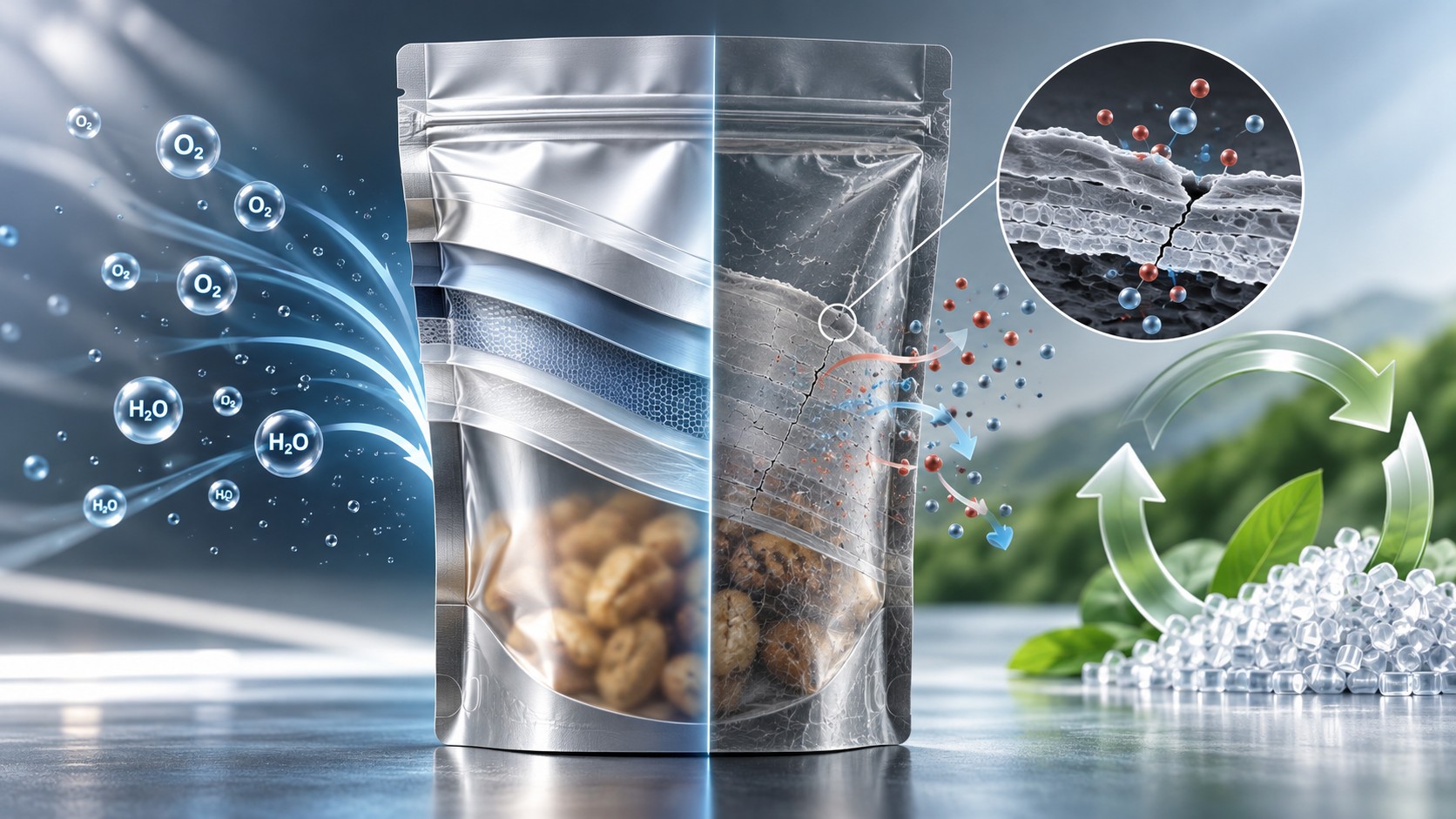
In such cases, the failure is not necessarily visible. A critical barrier layer may have been damaged during printing, lamination, converting, filling, transport, or consumer handling while the surrounding polymer films continue to provide mechanical integrity. The outer package remains intact; its functional protection has changed.
This challenge has become more complex as the industry redesigns traditional multi-material laminates, such as PET/Al foil/PE and PET/metallized PET/PE, into PE- or PP-dominant mono-material structures intended to improve recycling compatibility. These new constructions must preserve oxygen, moisture, aroma, and sometimes light barriers while satisfying printing, lamination, sealing, shelf-life, and end-of-life requirements.
The goal is therefore not to select the lowest initial oxygen transmission rate on a supplier data sheet. It is to engineer a package that retains sufficient protection after its complete production and use history—and that has a credible path through the relevant collection, sorting, and recycling system.
1. What actually determines a package's barrier performance?
Flexible laminates distribute different tasks across different layers: dimensional stability, print receptivity, mechanical strength, oxygen or water-vapor barrier, product contact, heat sealing, and sometimes chemical or light protection. The barrier layer may account for very little of the package's mass while determining whether the product survives its intended shelf life.
Two primary measures are oxygen transmission rate (OTR), commonly reported in cm³/(m²·day), and water-vapor transmission rate (WVTR), commonly reported in g/(m²·day). Lower values represent lower measured transmission under the stated test conditions. Temperature, relative humidity, pressure gradient, sample conditioning, and method are part of the result; values obtained under different conditions should not be compared without qualification.
OTR and WVTR do not describe every protection function. Aroma retention, external odor ingress, light shielding, oil resistance, and complete-package integrity may need their own assessments. A hygroscopic powder and an oxidation-sensitive snack do not have the same failure mode, even if they use films with similar nominal specifications.
Common barrier families and their limitations
Barrier technology | Primary strength | Potential vulnerability |
|---|---|---|
Aluminum foil (ALU) | Extremely high barrier to gas, moisture, and light when continuous | Pinhole formation, sharp creases, repeated flexing, puncture |
Metalized polymer film | Substantial barrier from an extremely thin deposited metal layer | Scratches, metal-layer discontinuity, microcracking, interfacial damage |
AlOx coating | Transparent inorganic barrier; thin functional layer | Strain-induced cracking and coating defects |
SiOx coating | Transparent inorganic barrier on a polymer support | Sensitivity to excessive deformation and coating flaws |
EVOH | Strong oxygen barrier under suitable moisture conditions | Moisture sensitivity; oxygen permeability can increase with humidity |
PVOH / polymer barrier coatings | Thin functional coating routes with useful gas-barrier potential | Moisture susceptibility, coating continuity, curing and recycling constraints |
PE or PP without dedicated O₂ barrier | Useful moisture-related and converting properties depending on grade | Typically limited oxygen barrier versus dedicated barrier technologies |
No single entry should be treated as the universal winner. Aluminum foil and a vacuum-metalized film may both show impressive barrier results, but their thickness, mechanical behavior, and end-of-life implications differ. What matters is the barrier's role within the complete laminate.
2. Flex-cracking: the failure that begins inside the laminate
When a multilayer web bends, the individual layers do not necessarily experience the same strain. The outside of the bend is stretched, the inside is compressed, and between them lies a neutral plane of reduced longitudinal strain. Its position depends on layer thickness, elastic modulus, construction order, and interlayer bonding.
For a simplified elastic-bending model, local longitudinal strain can be approximated as:
ε ≈ |z − z₀| / R
Here ε is strain, z is the position of the layer being evaluated, z₀ is the neutral-axis position, and R is the bending radius. This is a useful conceptual approximation, not a predictive failure equation for a viscoelastic, plastically deforming, or locally delaminating laminate. Its essential message is that a tighter bend can impose a higher local strain on a sensitive layer.
A compliant polyethylene film may deform without rupturing while a much thinner oxide coating or metal foil develops cracks. The package may remain liquid-tight and retain its seal strength even when its oxygen-barrier function has deteriorated. Mechanical integrity and functional barrier integrity are different engineering properties.
Three different flex-related failure mechanisms
Localized bending fracture
A sharp fold imposes a concentrated strain on a narrow zone. Damage is especially likely at pouch corners, gussets, creases, and regions where the film is forced around a small forming radius.
Progressive flex fatigue
Repeated bending, compression, and relaxation may initiate or extend microscopic defects. Individual cracks may connect into larger pathways. Cycle count, deformation amplitude, orientation, humidity, temperature, and layer architecture all influence the outcome.
Interfacial stress and delamination
Insufficient or nonuniform bonding can permit local slip, separation, or unfavorable load transfer between plies. Delamination and barrier-layer cracking are not identical defects, although one may intensify the other. The corrective action depends on which mechanism testing demonstrates.
A peer-reviewed study by Ge and coauthors compared aluminum-foil-centered laminates with laminates containing metalized oriented PET. In the constructions studied, the foil-centered laminate retained excellent oxygen protection after 20 flex cycles but did not maintain that barrier after 270 cycles; metalized-film laminates were less affected in oxygen barrier under those specific conditions. The water-vapor barrier was less severely affected than the oxygen barrier across the tested laminates. These results illustrate construction-specific behavior—not a rule that metallization always outperforms foil. [1]
3. Mono-material design changes the engineering problem
Mono-material packaging is commonly used to describe a construction predominantly based on one polymer family, such as PE or PP, rather than a single layer made of one chemically pure polymer. A mono-PE pouch can contain several PE grades with different densities, orientation, stiffness, sealing behavior, and heat resistance. It may also include inks, primers, adhesives, tie layers, or a thin functional barrier.
A PE-dominant structure can be better aligned with a PE recycling stream than an inseparable PET/foil/PE laminate. However, neither the label "mono-material" nor a high PE percentage establishes recyclability at scale. Sortability, non-PE components, process compatibility, recovered-polymer quality, and available local infrastructure remain decisive.
The PE design challenge
Many PE grades provide useful moisture protection and good sealant performance, but their intrinsic oxygen barrier is limited compared with EVOH, oxide coatings, or metal-based barriers. High-oxygen-sensitivity products therefore often need additional functionality. Oriented PE and other engineered grades can improve outer-web performance, yet converting and printing stability, heat tolerance, toughness, and seal initiation must be balanced within one polymer family.
The PP design challenge
BOPP and CPP can be combined to obtain stiffness, transparency, moisture protection, and heat sealing for numerous applications. However, oxygen-sensitive products may still require a dedicated barrier. Seal-window robustness, external-layer thermal behavior, crease response, and the availability of suitable PP-flexible recycling routes in the destination market must be verified, not assumed.
The practical complication is that a barrier layer that performs well inside PET/ALU/PE may experience a different strain distribution in a mono-PE or mono-PP laminate. Replacing the carrier changes modulus, orientation, thermal shrinkage, bending response, and sometimes neutral-axis position. The barrier must be requalified as part of the new complete structure.
4. Adding barrier performance without undermining recyclability
EVOH: strong oxygen protection, with humidity and recycling limits
EVOH can deliver high oxygen-barrier performance when its moisture environment is controlled, typically within a coextruded polyolefin structure with suitable tie layers. Water uptake can increase segment mobility and oxygen permeability; the oxygen barrier observed under dry laboratory conditions may not persist at high relative humidity. OTR must therefore be tested under realistic conditioning, not only at the most favorable reference condition.
For recycling, EVOH behaves differently from PE or PP. Its impact depends on its concentration, compatibility with the matrix, the specific tie-layer chemistry, and the recycling process. Earlier RecyClass test findings considered EVOH up to 5 wt% in PE film in a defined context, but subsequent guidance further differentiates the role of tie layers and compatibility levels. A percentage alone is not a universal approval. The current applicable RecyClass and CEFLEX guidance, plus any necessary full-structure testing, governs design decisions. [2–4]
AlOx and SiOx: transparent, thin, and mechanically sensitive
Aluminum-oxide and silicon-oxide barrier coatings can add substantial barrier performance while retaining transparency and a polyolefin-dominant architecture. Because the functional coating is thin and inorganic, local flex strain, scratches, coating nonuniformity, or poor protection in downstream converting can damage its continuity even though the polymer support remains intact.
Protective overcoats or subsequent lamination may improve robustness for a given system, but they introduce new adhesive, coating, and recyclability considerations. Any proposed protection must be judged after flexing and conversion, not solely on its as-coated barrier result.
Metallization: very little metal is not the same as no consequence
Vacuum-deposited aluminum on PE or PP can offer substantial barrier with much less metal than a separate aluminum-foil web. The small metal fraction may improve the position of some designs relative to a traditional foil laminate, but the metal layer must still be assessed for sorting behavior, optical detection, recycling-process compatibility, and effects on recyclate quality. Scratch resistance and flex stability remain functional qualification requirements.
Waterborne polymer coatings
Waterborne barrier-coating systems can add functionality without another thick film web. Their performance depends on polymer chemistry, crosslinking, coating continuity, drying and curing, adhesion, and environmental exposure. "Waterborne" refers to the application medium; it does not automatically mean recyclable, low-impact, or moisture-insensitive.
Across all options, two questions must be answered independently: does the barrier meet the shelf-life specification in the converted pouch, and does the complete printed, laminated structure fit an evidenced end-of-life route?
5. Comparing conventional and mono-material structures
Illustrative structure | Potential benefit | Principal qualification risk |
|---|---|---|
PET / INK / ADH / ALU / ADH / PE | High barrier; stable print carrier; functional sealant | Foil damage, multiple adhesive interfaces, poor compatibility with many polyolefin recycling streams |
PE / INK / ADH / barrier / PE | Potentially PE-dominant, with improved PE-stream compatibility | Oxygen barrier after flex, print/heat stability, compatible coatings, adhesives, and tie layers |
PP / INK / ADH / barrier / CPP | Potentially PP-dominant with designed stiffness and sealing | Barrier after pouch forming, seal-window design, local PP-flexible sorting/recycling availability |
These are illustrative architecture families, not approved recipes. Barrier chemistry, print location, layer order, adhesive and primer selection, food-contact compliance, and sealant construction require application-specific definition. The material substitution is not merely a purchasing change: it is a mechanical and thermal redesign of the package.
6. Where the damage may be introduced in production
Printing
The web passes transport rollers, tension zones, dryers, and thermal-control systems. If a barrier-bearing film is mechanically sensitive, excessive web tension, small wrap radii, tracking instability, or poorly controlled heat history may add deformation. Polyolefin-dominant designs also require careful print-surface treatment and dimensional control. Corona treatment can improve wetting and anchorage in appropriate systems; it cannot repair an already fractured barrier layer.
An observed failure should not be attributed to the ink or primer without comparison of unprinted, printed, laminated, and converted specimens. A printed layer may alter local stiffness or interfacial behavior, but a press transport issue may be the actual origin.
Adhesive lamination
Lamination changes the structure's stiffness and load sharing. Web-tension mismatch, nip conditions, thermal exposure, residual shrinkage, adhesive coat-weight variation, cure history, and mechanical properties of the cured adhesive can influence the strain transferred to the barrier. A sound bond-strength result shows one form of interface performance; it does not prove the barrier remains continuous.
A locally stiff adhesive may accentuate stresses in a given design, while a weak bond can allow separation and unfavorable stress redistribution. A softer adhesive is not automatically the solution: sealing heat, chemical resistance, migration requirements, cure kinetics, and long-term durability must still be met.
Slitting, rewinding, and pouch forming
Slitting and rewinding introduce contact pressure and tension history. Winding hardness, lateral tracking, wrinkles, and localized compression may create defects that appear only on particular roll positions or downstream pouches. Pouch forming then converts the flat web into a three-dimensional shape, producing sharp corners, gusset folds, and new bending axes.
A film whose as-laminated OTR is within specification may lose oxygen barrier during gusset formation. In that case, the forming geometry and strain distribution should be tested before the barrier formulation is replaced.
Filling, sealing, transport, and use
Filling may apply internal pressure or localized forces from sharp, granular, or rigid contents. Heat sealing changes the local temperature field and creates a distinct interface geometry; transport adds vibration, stacking compression, impact, and repeated handling. The finished package may therefore face stresses that were absent from all flat-film qualification tests.
7. A higher OTR does not always prove flex cracking
An increase in OTR can be produced by several independent mechanisms. EVOH may become more permeable at higher relative humidity without physical cracking. An oxide or metalized coating may develop discrete discontinuities, while the bulk polymer remains intact. A pouch may have a localized seal channel or a poorly integrated valve. Highly effective flat barriers can also make ingress through edges, closures, or imperfect interfaces proportionally more important.
A pinhole in a metal layer is not necessarily a through-hole across the full thickness of a multilayer pouch. Gas may still have to diffuse through intact polymer plies. Pinhole size, location, distribution, interface separation, and remaining layer resistance affect measured transmission. Counting visible pinholes alone therefore cannot quantify the oxygen ingress of the complete package.
This distinction matters financially as well as technically. Replacing a barrier film to correct a leaking seal raises material costs without fixing the root cause. Conversely, changing sealing temperature will not repair a coating that fractures under every sharp corner fold.
8. Measurement must follow the package—not just the flat web
Supplier data are an essential starting point, not final proof. A robust validation program distinguishes at least three states: incoming barrier web; printed and laminated flat construction; and converted, filled, stressed finished package. Selected samples should also be conditioned at relevant relative humidity and temperature, flexed according to a defined procedure, and evaluated at high-strain features such as gussets and corners.
Extracting a test coupon from a formed corner can itself alter the damaged zone. Specimen preparation needs a documented method, and flat-coupon data should be complemented by complete-package integrity or permeation methods when suitable. Moisture measurements, oxygen measurements, leak detection, and shelf-life testing answer different questions and should not be used interchangeably.
Relevant test standards and what they establish
Standard | Technical role | Important limitation |
|---|---|---|
ASTM F392/F392M-23 | Controlled flex conditioning of flexible barrier materials | Conditioning itself does not measure OTR/WVTR or prove shelf life |
ASTM D3985-24 | Oxygen transmission measurement through suitable film/sheet specimens | Film test result is not automatically whole-pouch oxygen ingress |
ASTM F1249-25 | Water-vapor transmission measurement of films/sheeting | Temperature, humidity, specimen, and method must be reported |
ASTM F2338-24 | Nondestructive package leak detection by vacuum decay in suitable applications | Leak test is not a substitute for material gas-transmission assessment. |
ASTM F392/F392M specifically distinguishes flex conditioning from the subsequent measurement required to evaluate changes in barrier properties. Conditions D and E are commonly used when post-flex permeability is the principal concern. [5–8]
9. Troubleshooting: isolate the mechanism before changing the material
Begin by preserving representative samples and defining the failure precisely: oxidation, moisture pickup, aroma loss, measurable OTR or WVTR drift, or a localized package leak. Samples collected along the same material lot and production route are much more informative than unrelated "good" and "bad" rolls.
Observed symptom | Hypothesis to test | Discriminating test | Engineering action if confirmed |
|---|---|---|---|
Good incoming OTR; high OTR after pouch forming | Cracks at fold/gusset | OTR pre/post flex; microscopy at high-strain zones | Change radius, gusset geometry, layer architecture |
OTR increases at high humidity | EVOH or moisture-sensitive barrier response | Matched OTR tests across RH conditions | Protect barrier from moisture or change barrier strategy |
Barrier degrades after lamination. | Coating or interface damage | Staged OTR; microscopy; peel/bond tests | Adjust tensions, nip, adhesive, curing under controlled trial |
Failure clustered at pouch corners | Localized mechanical strain | Spatial defect map; repeatable forming trial | Reduce strain concentration or reposition fold |
Leak observed despite good peel strength | Seal channel, closure, or valve problem | Method-appropriate whole-pack leak test | Correct seal geometry/process or component interface |
Only some rolls fail. | Coating, winding, storage, or processing variability | Lot/position traceability and matched samples | Correct demonstrated material/process variable |
Good barrier, poor recycling assessment | Noncompatible coatings, tie layers, inks, adhesives | Guideline review and recycling trials | Reformulate full structure, then requalify barrier |
A disciplined five-stage plant investigation
1 Preserve the evidence and trace the production history
Retain incoming, printed, laminated, slit, empty pouch, filled pouch, transport-conditioned, and aged specimens where available. Preserve lot identifiers, roll position, run speed, tension changes, storage conditions, and machine events.
2 Separate permeability changes from through-package leakage
Select OTR, WVTR, leak detection, microscopy, and interface tests based on the failure signature. A positive pinhole indication should trigger a pathway analysis rather than an immediate conclusion that all plies are penetrated.
3 Reproduce the suspected stress
Use a defined flex-conditioning program and include matched unflexed controls. If the issue occurs at a pouch fold, test the actual forming feature as well as a laboratory flex protocol; the two may generate different damage patterns.
4 Change one factor—or run a deliberately designed DOE
Test forming radius, web tension, adhesive construction, cure conditions, or film thickness in a controlled design. If interactions are expected, use design of experiments rather than an uncontrolled sequence of adjustments.
5 Validate the corrective action on the finished application
A corrective action is not verified until finished packages pass applicable barrier, integrity, handling, and shelf-life criteria. Also repeat the recyclability assessment when the solution changes coatings, adhesives, polymers, or layer thicknesses.
10. Engineering solutions: preserving the barrier at its weakest point
When flex fracture is confirmed, replacing the barrier chemistry is not necessarily the first or most economical solution. Increasing a tight bend radius, moving the fold line, altering gusset geometry, or reducing localized compression may lower strain without changing barrier mass. These design changes can be particularly valuable for thin oxide coatings and foils.
A second approach is to change load sharing within the laminate. Layer order, thickness, modulus, and adhesive properties affect the neutral-axis position and interfacial stresses. Where feasible, calculate their effects and then verify them experimentally. A protective topcoat over an inorganic barrier may improve resistance in some constructions, but it can also alter recyclability, migration qualification, or the converting process.
Where the barrier technology truly cannot survive the application, compare alternatives such as foil, metallization, oxide coating, or EVOH-containing polyolefin systems under the same actual manufacturing and handling conditions. A thinner or more modern barrier material is not automatically more durable or more sustainable.
11. The sustainability barrier: recyclability without product loss
Reducing virgin material use, removing incompatible layers, and aligning packaging with established recycling streams are meaningful goals. They are not complete sustainability outcomes if the redesign undermines the product's protection. Premature spoilage, oxidation, moisture damage, or product loss can create environmental burdens that outweigh modest savings in packaging mass.
Three terms need to remain distinct. Environmental performance concerns the complete life-cycle effects of the package and protected product. Technical recyclability describes compatibility with a particular sorting and recycling process and the quality of its output. Actual recycling requires collection, sorting, reprocessing capacity, and viable markets in the region where the package is discarded.
A mono-PE pouch may be a promising design for a PE stream, yet an incompatible adhesive, high ink loading, unsuitable barrier coating, closure, or tie layer can reduce its technical recycling compatibility. Likewise, metallization uses far less metal than a standalone foil layer but is not automatically neutral in sorting or extrusion. CEFLEX and RecyClass provide evidence-based design criteria, including evolving compatibility guidance for inks, coatings, EVOH, metallization, and other layers. [2–4]
Fiber-based formats face an analogous challenge.
Paper and paperboard offer useful recovery routes in many markets but do not inherently deliver every oxygen, moisture, grease, or sealability function required for flexible food packaging. Functional polymer films, coating layers, and adhesives may provide those properties but can change repulpability, fiber yield, reject mass, or process behavior. A package that looks like paper must still demonstrate compatibility with the specific fiber-recycling route and its actual functional performance.
When extreme product-protection requirements make a complex multilayer the reliable solution, document the technical choice transparently rather than hide it behind an unsupported environmental claim. A sustainability program should redesign the complete system with measured trade-offs, not promise equivalence without evidence.
12. Approving a new barrier architecture for commercial production
Qualification begins with the product: required shelf life, oxygen and moisture budgets, aroma and light sensitivity, storage conditions, seal integrity, product-contact constraints, production rate, abuse conditions, and destination-market recycling system. Only then should you select and compare candidate constructions consistently.
Each candidate should be measured as received, after printing and lamination, after conversion, after controlled flex exposure, and as an actual filled package where possible. The specification must include absolute barrier limits and the relevant process conditions. Storage and accelerated-aging studies need to correlate with real-product performance rather than rely solely on a single film-transmission measurement.
In parallel, assess Design for Recycling requirements under the currently applicable CEFLEX and RecyClass documents and, if necessary, laboratory recycling trials. This prevents a late discovery that a solution meeting the barrier requirement is incompatible with the intended recycling stream.
A practical internal metric: Barrier Degradation Factor
During development, teams may track the ratio between measured OTR after a defined conversion/stress process and OTR before that process:
Barrier Degradation Factor = OTR after conversion / OTR before conversion
A ratio of 1 means no measured OTR change under matched conditions; a ratio above 1 means increased oxygen transmission. For example, a change from 0.2 to 1.0 yields a factor of 5. This is a proposed internal comparison metric, not a standardized acceptance criterion. Both test values must be above the relevant measurement floor and taken under the same valid test conditions.
The factor cannot replace the absolute specification: an increase from 0.02 to 0.10 and one from 2 to 10 both produce a factor of 5, yet they can have radically different consequences for product shelf life. Decisions must combine the absolute post-conversion transmission rate, durability, whole-package integrity, and shelf-life evidence.
13. The next generation of functional, circular packaging
The next step in flexible packaging will not be defined solely by replacing mixed-polymer laminates with mono-PE or mono-PP. It will depend on designing thin, durable functional layers whose barrier performance survives the package's real mechanical history and whose composition remains compatible with a demonstrable end-of-life route.
Achieving this requires coordination among resin and film suppliers, barrier-coating developers, ink formulators, printing specialists, adhesive and lamination engineers, converters, brand owners, testing laboratories, and recycling operators. A film supplier cannot establish the finished pouch's shelf-life protection from a pristine flat-film value alone. A converter cannot release a high-barrier pack solely because its print and seals look good. A brand owner cannot claim recyclability based only on the dominant resin designation.
The most important engineering shift is from testing a material at one convenient moment to testing the material's history: deposition, printing, lamination, slitting, folding, sealing, transport, aging, and end-of-life processing. These are not separate departmental questions. They are connected stages of the same functional system.
Conclusion — a successful package must preserve its promise
Barrier performance is not defined by film thickness, a material name, or one laboratory result. Aluminum foil may deliver exceptional initial protection and later develop flex cracks. An oxide layer may enable a transparent mono-polyolefin design but fail at a tight gusset. EVOH may maintain excellent oxygen protection when kept sufficiently dry and lose some of it under elevated humidity. Each mechanism demands a different investigation and remedy.
Mono-material architecture adds the important goal of compatibility with recycling streams, but it cannot displace the obligation to preserve product quality throughout the stated shelf life. The engineering question is not simply whether a package can be made with one polymer family or with the lowest initial OTR. It is whether the complete construction can satisfy printing, lamination, mechanical durability, sealing, food protection, use, and recovery requirements at the same time.
A package does not prove its performance as it leaves the converting machine. It proves its performance when the product reaches the end of its intended shelf life with the promised protection intact. In a genuinely circular design, responsibility continues beyond that point—to collection, sorting, reprocessing, and the quality of the material that can be used again.
References and technical reading
[1] Ge, C., Verma, S. S., Burruto, J., Ribalco, N., Ong, J., & Sudhahar, K. (2021). Effects of flexing, optical density, and lamination on barrier and mechanical properties of metalized films and aluminum foil-centered laminates prepared with polyethylene terephthalate and linear low-density polyethylene. Journal of Plastic Film & Sheeting, 37(2), 205–225. https://doi.org/10.1177/8756087920963532
[2] CEFLEX. Designing for a Circular Economy (D4ACE): 2025 flexible-packaging design guidelines and technical resources. https://guidelines.ceflex.eu/guidelines/
[3] RecyClass. Design for Recycling Guidelines (including March 2026 updates for PE and PP flexibles). https://tool.recyclass.eu/en/plastics/guidelines/
[4] RecyClass. Technical findings on EVOH barriers and PE flexible-film recycling; review the applicable latest guideline and tie-layer conditions. https://recyclass.eu/news/pe-flexible-films-recycling-new-findings-for-functional-barriers/
[5] ASTM International. ASTM F392/F392M-23, Standard Practice for Conditioning Flexible Barrier Materials for Flex Durability. https://store.astm.org/standards/f392_f392m
[6] ASTM International. ASTM D3985-24, Oxygen Gas Transmission Rate Through Plastic Film and Sheeting Using a Coulometric Sensor. https://store.astm.org/d3985-24.html
[7] ASTM International. ASTM F1249-25, Water Vapor Transmission Rate Through Plastic Film and Sheeting Using a Modulated Infrared Sensor.
[8] ASTM International. ASTM F2338-24, Nondestructive Detection of Leaks in Packages by Vacuum Decay Method.
[9] Dolev, R. (2026). The Industrial Printing Journey: From Idea to Shelf. Background discussion of flexible-film structures, barrier loss, and end-to-end qualification.
[10] Dolev, R. (2026). The Personal Journey of an Industrial Printing Expert. Background treatment of converted-pouch qualification under flex, humidity, and transport exposure.
[11] Dolev, R. (2026). When Packaging Becomes Circular: The Industrial Reality of Sustainable Print, Materials and Recycling. Framework for mono-material functionality and evidence-based recyclability claims.
Engineering note: The manufacturing scenarios and troubleshooting pathways above are structured engineering analyses, not representations of an undisclosed field case. Requirements, suitability, and recycling compatibility must be confirmed against application-specific test data and current regional guidance.