Ronen Dolev | 2026
A Paper Cup Is More Than a Printed Disposable Product
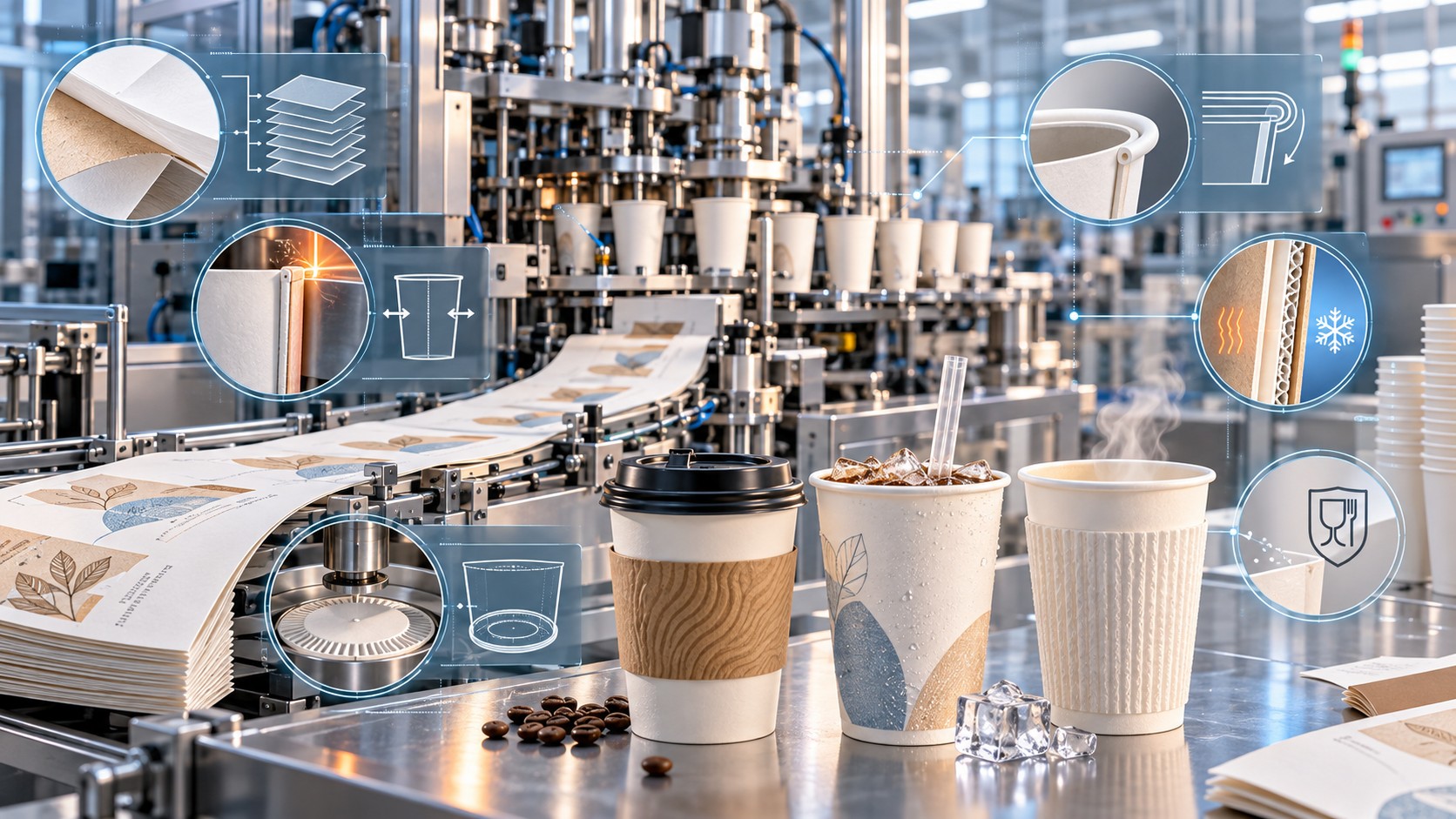
Paper cups are among the most familiar food-service packaging products. They are used in coffee shops, restaurants, fast-food chains, hotels, events and institutional catering, as well as for ice cream and other portioned foods. The structure looks simple: a printed paperboard sidewall, a circular bottom, and a rolled rim that supports drinking and, where required, a fitted lid. Behind that apparent simplicity is an engineered combination of fiber-based material, polymer barriers, printing inks, coatings, and precisely controlled mechanical and thermal processes.
The finished cup must withstand the intended beverage temperature, resist leakage through the side seam and bottom joint, retain sufficient rigidity during filling and handling, and provide a comfortable drinking edge. It must also stack and dispense reliably, and its dimensions must match the selected lid. From a food-safety perspective, the construction presents an additional challenge: the inner surface contacts the beverage directly, while the rim may contact both the consumer's lips and the liquid itself.
A paperboard blank can leave a printing press with excellent color accuracy and ink adhesion yet fail later during side-seam sealing, bottom knurling, or rim curling. Successful development therefore begins with the intended finished cup, not with the printing press alone. The entire production chain needs to be specified and qualified as one application.
Define the Application Before Selecting the Material
The first decision is what the cup will hold and how it will be used. Hot coffee and tea, chilled beverages containing ice, frozen desserts, yogurt, and soup do not have the same requirements. Beverage temperature, expected contact time, fat content, acidity, filling method and handling conditions all influence material and construction choices. A takeaway coffee cup, for example, may need touch-temperature insulation and a secure lid. A cold-drink cup may encounter substantial external condensation and must protect its paperboard against moisture from both directions. A cup for frozen dessert needs to retain its barrier and structural performance during cold storage and subsequent consumption.
Volume, top and bottom diameters, service conditions, and required stiffness should be established before design is finalized. The application definition also determines which food-contact tests, migration conditions, organoleptic evaluations and production trials are necessary. No single cupstock or coating construction is automatically suitable for every food or beverage.
Paper Cup Constructions: Single Wall, Double Wall and Ripple Wall
Paper cup terminology distinguishes the functional wall construction from the temperature of the intended contents. The same broad construction category can have different barrier layers and specifications depending on whether it is used for hot or cold beverages.
Cup construction | Engineering principle | Typical applications |
|---|---|---|
Single-wall cup | One paperboard sidewall with an appropriate liquid barrier | Hot or cold drinks, depending on specification |
Double-wall cup | Inner liquid-containing wall and a separate outer wall, often with an insulating air gap | Hot coffee and tea |
Ripple-wall cup | Inner cup with a corrugated or embossed outer sleeve | Hot beverages requiring insulation and enhanced grip |
Cold-drink cup | Cupstock protected against liquid contact and external condensation | Chilled drinks and beverages with ice |
Paper food cup | Barrier and construction adapted for the particular food | Ice cream, yogurt, soup and other portioned foods |
Single-Wall Cups
A single-wall cup uses one principal paperboard sidewall. A barrier layer on the beverage side prevents the liquid from reaching the cellulose fibers and commonly participates in heat sealing. The construction is economical in material use and relatively straightforward to convert. It can suit hot beverages when specifically qualified, but heat transfer through a single wall may make the outer surface uncomfortable to hold. An additional insulating sleeve can be used where needed.
Double-Wall Cups
A double-wall cup has an inner cup that contains the beverage and a separate outer wrap. The geometry can create an insulating air space between the walls, reducing heat transfer to the user's hand. Wall alignment, adhesive or mechanical attachment, and gap control are integral to the design. The added wall should not interfere with the mouth rim or the lid's final fit. Successful production requires the inner and outer parts to remain assembled throughout normal use.
Ripple-Wall Cups
Ripple-wall cups use a corrugated outer sleeve to create a textured gripping surface and additional thermal separation. Their manufacture adds a forming and joining operation for the outer wrap. When the outer sleeve is printed before corrugation or forming, the print and protective coating must be flexible enough to survive deformation without cracking, scuffing, or losing adhesion. The corrugated sleeve is a functional part of the cup, not merely a decorative element.
Hot-Drink and Cold-Drink Cups Have Different Barrier Challenges
The main distinction is not simply basis weight. A hot-drink cup with an uncoated paper exterior and a suitable interior polymer barrier must withstand the beverage's thermal exposure while retaining its shape, seal integrity, and consumer comfort. Cold drinks introduce another mechanism: condensation can form on the outer wall when a cold beverage is surrounded by warmer, humid air. If moisture reaches the paper fibers, they may swell, and the cup can lose stiffness.
For that reason, some cold-drink cup stocks use polymer protection on both sides. Other constructions may use different qualified barrier technologies. These distinctions depend on the application rather than universal rules. The selection should be confirmed by testing the completed cup with the relevant temperature, fill level, contact time, and ambient humidity.
Cupstock Paperboard: Stiffness, Formability and Surface Quality
Paperboard used in paper cups is commonly called cupstock. It must offer sufficient bending stiffness to retain cup geometry while remaining formable enough for a tapered sidewall, a bottom joint, and a tightly curled rim. Basis weight, thickness, moisture content, fiber composition, layer construction, and grain direction all affect performance.
Long fibers contribute to several strength properties; shorter fibers can improve formation and print-surface quality. Some grades combine fiber layers of different composition or bulk to deliver stiffness at a controlled grammage. The exact fiber recipe is less important than the measurable properties and compliance of the final material. Surface cleanliness and the potential to impart undesirable odor or taste must also be considered. A mechanically satisfactory cupstock is not necessarily suitable for beverage contact if it affects the drink's sensory quality.
Conditioning and storage deserve particular attention. Paperboard absorbs or releases moisture as environmental conditions change. Such changes affect stiffness, curl, feeding and forming response, and can contribute to problems during rim curling and die cutting. Condition and handle the material within a qualified range, rather than subjecting it to abrupt temperature or humidity changes before printing and converting.
Barrier Layers: PE, PLA and Other Functional Coatings
Unprotected paperboard cannot reliably hold a liquid because its fibers can absorb moisture. A functional layer on the inner surface provides liquid resistance and, in many constructions, a heat-sealable interface. Polyethylene (PE), including suitable low-density grades, is widely used for extrusion-coated cupstock. Extrusion coating deposits a molten polymer layer onto paperboard and consolidates it under controlled conditions before cooling. The finished barrier must have the required continuity, coat weight, adhesion, and sealing behavior.
Alternative systems include polylactic acid (PLA), other food-contact polymers, and certain water-based dispersion barrier coatings. These materials are not interchangeable without process qualification. Heat-seal activation, bond strength, resistance to hot beverages, coating flexibility, and the equipment operating window may all change. A shift from PE to another barrier must therefore be assessed at the side seam, bottom joint, rim, and in the completed cup under its intended service conditions.
An environmental benefit should not be presumed from the name of the polymer. Compostability, recyclability and practical recovery depend on the complete structure, relevant test standards and available collection and processing infrastructure.
Structural Design: From a Three-Dimensional Cup to a Flat Blank
Most paper drinking cups have the geometry of a truncated cone: the top diameter is larger than the bottom diameter. The sidewall is therefore produced from a curved, sector-shaped flat component, commonly called a cup sidewall blank. When the blank is wrapped around a forming mandrel and its ends overlap, it becomes the cup sidewall. A separate circular bottom is then inserted and secured.
The engineering drawing must specify top and bottom diameters, cup height, the sidewall blank profile, overlap width, sealing zones, bottom geometry, and rim allowance. Artwork must be mapped to the curved blank, so it appears balanced and correctly oriented after forming. A logo or horizontal line positioned without consideration of the blank geometry may appear tilted or uneven on the finished cup. Cut geometry, sealing overlap, and final graphics are interdependent and should be approved together.
Keep Seal Zones Free From Incompatible Ink and Coating
One of the most important design rules is preserving the functional sealing interface. The side seam is formed where the two ends of the sidewall overlap. If the joint depends on heat bonding between compatible polymer surfaces, an intervening ink or varnish can weaken or prevent that bond. A no-print and no-coating zone should therefore be defined wherever the selected sealing method requires direct polymer contact.
The same engineering discipline applies near the bottom joint and drinking rim. The outer print should not extend into a functional contact or sealing area unless the exact construction has been qualified for it. Some specific systems can tolerate a particular primer or prepared surface in a defined joint; this cannot be generalized to all primers. Seal-zone boundaries belong in the structural specification, not merely an artwork preference.
Preparing the Surface for Printing
Surface preparation depends on the material presented to the press. An uncoated or pigment-coated paper surface behaves differently from a polyethylene-coated surface. Paperboard roughness, porosity, and absorbency influence ink laydown, print appearance, and primer coat weight. A polymer surface such as PE typically has lower surface energy and may require a validated treatment step to achieve the desired wetting and adhesion.
Corona treatment can increase the wetting capability of certain polymer surfaces before priming or printing. It is not always required for bare paperboard. Dyne measurements can help monitor polymer-surface wetting but do not, by themselves, prove adhesion or long-term durability. Where a primer is used, it must be compatible with the surface, ink system, and subsequent heat and friction during cup forming. A primer that performs well on a flat print sample must still be qualified on the completed cup.
Printing Technology Is a Process Choice
Paper cups can be printed by various methods, including conventional offset, flexography, UV offset, UV flexography and qualified digital processes such as liquid electrophotography (LEP). The selection depends on run length, format, artwork variation, print quality, substrate type, equipment, and food-packaging requirements. No technology is inherently qualified for food contact simply because it can print on cupstock.
Printing technology | General approach | Critical qualification considerations |
|---|---|---|
Conventional offset | Ink transferred through an offset system. | Drying, adhesion, downstream heat and rub resistance, food-packaging suitability |
Flexography | Ink deposited using a flexographic plate and metering system | Ink-layer uniformity, drying or curing, surface compatibility |
UV offset | Offset printing with photochemical UV curing | Cure validation, residual mobile constituents, converting durability |
UV flexography | Flexographic ink deposition followed by UV curing | Coat-weight control, UV dose, migration risk and substrate adhesion |
Digital LEP | Transfer of a polymer-based ink film | Substrate preparation, interfacial adhesion, thermal resistance and food-packaging suitability |
Press qualification must include dimensional and registration control. Sheet-fed printing needs an imposition matched to flatbed die cutting; web-fed printing needs accurate repeat length and alignment with rotary tooling. Approve finished color after the relevant protective coating because surface-finish differences can affect perceived appearance and color measurements.
Drying and UV Curing Are Not the Same
The term drying is sometimes used broadly for the point at which ink no longer feels tacky, but that description conceals important chemical differences. In water-based systems, drying generally involves removing water or other volatile constituents and developing the polymer film. UV inks undergo photochemical curing, which converts reactive constituents into a polymer network. A UV surface that feels dry is not necessarily cured enough for food-packaging use.
UV cure depends on chemistry, ink-film thickness, wavelength, irradiance, delivered energy, exposure time, and press speed. UV-LED sources must be spectrally matched to the formulation. Lamp aging, dirty optics, and operating changes can reduce the delivered dose. Simple touch or rub tests can monitor some physical aspects of performance but do not demonstrate that potentially mobile residues have been controlled. Where necessary, chemical and migration assessments must support the qualification.
Water-based inks also demand controlled drying temperature, airflow and dwell. Inadequate drying may lead to blocking, print damage or transfer to adjacent surfaces during winding and stacking. The correct drying or curing process is part of food-packaging engineering, not a cosmetic finishing detail.
Low Migration Must Be Evaluated on the Complete Cup
A paper cup presents a direct food-contact application. The inner barrier contacts the beverage and the rim may contact both the beverage and the consumer's lips. The exterior ink and varnish are not automatically in direct food contact, but the location of these layers does not eliminate every possible route of transfer. Constituents can potentially move through relevant materials or reach the food-contact face through manufacturing-related set-off.
Low-migration inks and coatings are designed to reduce the potential for constituent movement, but the designation does not mean zero migration or automatic approval for all foods. Risk assessment should address the food type, beverage temperature, contact duration, layer construction and barrier effectiveness. Residual monomers, photoinitiator-related substances, reaction products and non-intentionally added substances (NIAS) can be relevant in some systems.
The complete printed and converted cup, rather than the supplier's ink label alone, is the appropriate basis for qualification. Requirements for hot coffee may differ from those for cold water, ice cream, or a fat-containing product. Tests must be selected according to the applicable regulations and realistic intended use.
Set-Off: Transfer Before the Cup Is Formed
Before cup forming, printed cupstock may be stacked as sheets or wound on reels. During storage, the printed exterior can contact the surface that will later become the beverage-contact interior. Under unsuitable conditions, ink or coating constituents can transfer between surfaces. This phenomenon, called set-off, may occur without visible color transfer.
Drying or curing, stack pressure, winding tension, storage temperature, and contact time influence the potential. The production process must therefore control printed-material handling as well as ink chemistry. A visually clean reverse surface does not, by itself, prove absence of chemical transfer. Food-safety assessment must consider the material's entire contact history before cup forming.
Protective Coatings: Heat, Scuff and Rub Resistance
Paper cup sidewalls contact tooling and guides during conversion. Heat is applied at sealing areas, while mechanical pressure and rotation are used in bottom forming and rim curling. Protective overprint varnish (OPV) may help prevent scuffing, abrasion, local image distortion, and unwanted marking. It serves a functional as well as decorative role.
Water-based heat-resistant coatings are often valuable on suitable paper surfaces. UV coatings can provide high gloss and robust surface protection where the chemistry is appropriate, and the coating is sufficiently cured. Do not choose either coating type based solely on its initial appearance. It must retain adequate adhesion, flexibility and heat resistance throughout cup forming and intended use.
Drying or curing is especially important for high coat weights. Inadequate stabilization can create blocking, set-off, or poor durability. Excessive coat weight may cause unwanted stiffness or make the coating harder to dry or cure. The overprint varnish must also respect the no-coating zones reserved for a clean side seam and other functional joints.
Die Cutting and Punching: Producing the Sidewall Blank
Following printing and coating, the cup sidewall is cut to its engineered curved profile. Flatbed die cutting is commonly used with sheet-fed production; rotary die cutting is suited to many roll-fed production routes. The goal is a repeatable blank with accurate geometry, clean edges, and minimal loose fibers. Mechanical or digital cutting methods may suit particular volumes and development applications.
A standard paper cup sidewall is formed around a mandrel and generally does not require the fold-crease network typical of a folding carton. Its principal converting operation is precision cutting, often called punching. Incorrect dimensions can affect the side seam, the final top and bottom diameters, and registration of the printed artwork. Loose fibers and dust can affect print quality, cup-making performance, and hygiene.
Side-Seam Sealing: Forming the Tapered Wall
The prepared blank is fed into a cup-forming machine, wrapped around a mandrel, and overlapped at its designed side-seam area. The joining method depends on the barrier chemistry and equipment: certain polymer-coated structures can be heat-sealed, while other systems use suitable alternative bonding methods. The side seam must retain the cup geometry and prevent liquid leakage over the intended contact period.
A printing ink or incompatible varnish in the seal land can compromise the bond. Incorrect overlap, nonuniform pressure, insufficient interface temperature, or short dwell may also cause weakness. Overheating can damage the construction. Qualification should measure performance at the actual joining interface rather than relying solely on the heater's indicated setpoint. Seam alignment also affects whether cups can move smoothly into the subsequent bottom-forming operation.
Bottom Forming and Bottom Knurling
Once the tapered sidewall is formed, the machine inserts a separately prepared circular bottom. The bottom component is normally cut and shaped from material compatible with the sidewall barrier. The machine brings the bottom flange and sidewall skirt into a designed multilayer joint. Heat and mechanical pressure are applied, often using a rotating knurling operation, to develop a continuous, liquid-tight bottom seal.
Bottom knurling is one of the most mechanically demanding steps in cup manufacture. Material thickness, bottom geometry, sealing compatibility, temperature, applied pressure, and tool condition all affect performance. The joint must be tested for leakage under actual filling conditions. External print and varnish can also be abraded or distorted through contact with metallic guides and forming parts. Protective coating selection and tooling design should account for this exposure before commercial production is approved.
Rim Curling: Strength, Drinking Comfort and Lid Retention
The upper sidewall edge is subsequently rolled outward to form the characteristic rim curl. This operation increases local stiffness, creates a smoother drinking edge, and provides the interface used by many snap-on lids. The correct curling radius, material moisture, and stiffness must match the tool geometry and forming conditions.
Overly dry or brittle material may crack or split during curling. Excessive coating stiffness can also cause local damage. Because the rim can contact the consumer's lips and beverage, artwork, ink, and varnish placement must be reviewed against the applicable food-contact specification. The finished rim must be uniform around the circumference and dimensionally stable under the expected beverage temperature.
Lid Fit and Retention Are Part of Cup Engineering
A lidded cup is a matched assembly rather than two independent commodities. The lid must fit the top diameter and rim profile, with enough retention to remain in place in normal use but without requiring so much force that it deforms the cup. Depending on the product, lid material and design may involve thermoformed polymers, fiber-based structures, or another qualified construction.
Lid fit should be evaluated on finished cups made under production conditions. Tests should consider attachment and removal force, dimensional variation, hot beverage use where relevant, and the potential for spillage during normal handling. A visually attractive cup is not fully qualified if its rim and lid do not function as a system.
Odor and Taint: Preserving the Beverage Experience
A safe cup must also avoid unacceptable changes to the beverage's smell and taste. Odor and taint are related but distinct considerations, and a product can perform acceptably in one assessment while failing another. Paperboard, polymer barriers, primers, printing inks and coatings can each contribute substances that are relevant to the cup's sensory behavior.
For paper and board intended for food contact, EN 1230-1 addresses odor assessment and EN 1230-2 addresses taint assessment under defined test conditions. Sensory panels can compare food or beverage samples exposed to cup materials with suitable controls. Results depend on the test design and should be interpreted alongside chemical safety evidence. A compliant migration test alone does not guarantee that a hot drink will be free from an unwanted smell or flavor.
Food-Contact Regulation, HACCP and Food-Safety Management
Consider the regulatory framework for the finished cup and intended market. In the European Union, Regulation (EC) No 1935/2004 establishes the general safety requirements for food-contact materials and articles. Regulation (EC) No 2023/2006 establishes Good Manufacturing Practice requirements, including relevant controls for printed surfaces and prevention of unacceptable transfer by set-off. Regulation (EU) No 10/2011, as amended, applies to plastic materials and layers within its scope; relevant amendments such as Regulation (EU) 2025/351 must be evaluated where applicable. Multilayer paperboard structures are not automatically subject to identical provisions for every constituent.
In the United States, the applicable FDA food-contact provisions must be evaluated according to the specific components and conditions of use. Certain paper and paperboard food-contact applications can involve provisions of 21 CFR 176.170; that reference is not an automatic authorization for every cup material or printing system.
Food safety also requires management of production hazards. HACCP (Hazard Analysis and Critical Control Points), developed within the Codex Alimentarius General Principles of Food Hygiene, provides a structured method for identifying and controlling biological, chemical, and physical hazards. Relevant paper-cup hazards can include chemical migration, set-off, loose fibers or foreign particles, contamination during handling, and failures that create an unacceptable food-safety risk. Determine whether a specific operation constitutes a Critical Control Point through documented hazard analysis, rather than labeling every press or forming setting as a CCP.
ISO 22000 provides a food-safety management system framework. FSSC 22000 is a certification scheme built on ISO 22000, relevant prerequisite programs, and additional scheme requirements. For packaging manufacture, ISO 22002-100:2025 and ISO 22002-4:2025 can form part of the applicable prerequisite program framework. These management systems complement—but cannot replace—the legal and analytical evaluation of the specific finished cup.
Performance Qualification Under Real Conditions
Cup qualification should go beyond a brief room-temperature water test. Evaluate a hot-drink application with a representative beverage temperature, fill level, and contact duration. A cold-drink application should be tested under relevant humidity and condensation conditions. Frozen dessert cups may require low-temperature conditioning and assessment after temperature changes. Side-seam and bottom leakage, rim integrity, stacking and dispensing behavior, and lid retention should be checked as appropriate.
Chemical testing must reflect intended beverage contact, and sensory testing should consider the use conditions. Use production-representative materials and settings for forming trials. Differences in board moisture, barrier batch, coating weight, or tool wear can affect performance. One successful prototype confirms technical feasibility; repeatable results within a validated operating window are required for reliable industrial manufacture.
Sustainability and End-of-Life Claims Need Evidence
A paper cup is not necessarily made entirely of paper. Polymer-coated paperboard is a composite structure, and its recovery depends on barrier chemistry, collection practices, and available recycling infrastructure. A claim that a cup is recyclable needs support for the relevant geographic system; a paperboard layer alone does not prove practical recyclability.
Similarly, a PLA lining does not by itself prove that the finished cup is compostable in every environment. Where a compostability claim is made, the completed construction should meet applicable criteria, such as EN 13432 when relevant. A water-based barrier does not automatically guarantee paper-stream recyclability. EU rules under Directive (EU) 2019/904 and Implementing Regulation (EU) 2020/2151 establish marking requirements for specified beverage cups containing plastic. Regulation (EU) 2025/40 adds broader packaging requirements based on application dates and relevant transitional provisions. Environmental claims and graphic markings should therefore be addressed during structural and artwork design.
Qualification Matrix for the End-to-End Application
The following categories provide a practical engineering framework. They are not universal acceptance limits: each specification must reflect the product, market and equipment used.
Production stage | Principal evaluations | Qualification objective |
|---|---|---|
Cupstock and storage | Thickness, grammage, moisture, stiffness and layer construction | Reliable forming and structural strength |
Barrier coating | Continuity, resistance to liquid and heat-seal compatibility | Liquid containment and robust sealing |
Surface preparation | Cleanliness, wetting and adhesion | Stable ink or primer interface |
Printing | Registration, color, artwork location and ink-film integrity | Accurate, durable graphics |
Drying and curing | Process sufficiency and relevant mobile residues | Stable ink film and controlled migration risk |
Overprint coating | Heat, rub and scuff resistance, drying or cure | Protection during cup forming |
Die cutting | Blank dimensions, edge quality and cleanliness | Accurate forming with minimal debris |
Side seam | Bond strength, alignment and leak resistance | Stable tapered cup wall |
Bottom knurling | Bottom-joint continuity and leakage performance | Liquid-tight bottom seal |
Rim curling | Curl consistency, stiffness and edge condition | Drinking comfort and lid interface |
Food safety | Migration, NIAS as relevant, set-off, odor and taint | Regulatory and sensory suitability |
Finished cup | Hot/cold use, stacking, dispensing and lid retention | Robust performance in actual service |
Troubleshooting: When the Finished Cup Fails
When a defect appears, the most useful first question is where the product stopped meeting its specification. Comparing samples before and after coating, die cutting, forming, bottom knurling, and rim curling helps separate a pre-existing print or material weakness from damage introduced later.
Symptom | Potential mechanism | Investigation direction |
|---|---|---|
Ink peeling from the sidewall. | Unsuitable surface preparation, primer, or drying | Identify failed interface and test after forming. |
Color shift after finishing | Optical, thermal, or chemical interaction | Compare the measurements before and after coating. |
Ink scuffing in the forming machine | Insufficient mechanical or heat resistance | Review OPV system, tooling contact and exposure |
Blocking or set-off | Insufficient drying or curing, excessive pressure or unsuitable storage | Validate production conditions and transfer risk |
Weak side seam | Ink/varnish in seal land, insufficient bond development or misalignment | Verify seal zone, interface conditions and geometry |
Leakage at the bottom | Incomplete bottom knurling, barrier damage, or incompatible layers | Inspect the actual bottom construction and sealing window |
Cracked rim | Material moisture, stiffness, or curling geometry mismatch | Review cupstock conditioning and rim tooling |
Lid comes loose | Dimensional or rim-profile incompatibility | Test cup and lid together under representative conditions |
Cold cup loses rigidity. | Moisture entering unprotected board. | Evaluate external condensation resistance and barrier. |
Unwanted odor or taste | Board, barrier, ink or coating constituents | Use chemical and organoleptic testing on the finished cup |
Unacceptable migration | Mobile constituents, inadequate barrier or set-off | Evaluate full construction, process and contact conditions |
Ink scuffing and ink damage on the formed cups | Heat buildup on the cup guides in the forming machine | Verify the performance of the heat-resistant overprint varnish and consider applying a Teflon coating to the forming machine guides. |
A leak should first be localized to the side seam, bottom joint or a defect in the barrier, rather than attributed to printing by default. A sensory defect should be traced to its possible material sources without assuming that ink is always responsible. When migration is unacceptable, the complete construction and handling history must be evaluated; arbitrary increases in UV power, corona treatment or sealing temperature can obscure the real cause and generate new problems.
Conclusion: The Printing Press Creates the Graphic; Engineering Creates the Cup
Paper cup manufacture is an end-to-end process that joins material science, industrial printing, barrier coatings, mechanical forming, thermal sealing, and food safety. Cupstock determines structural properties and formability. The inner barrier determines liquid resistance and bonding options. Single-wall, double-wall and ripple-wall structures allow the designer to balance material use, insulation and consumer comfort. Printing technology is selected for production needs, but the ink and varnish must also withstand forming operations and satisfy relevant food-contact requirements.
The curved blank must be cut accurately; the side seam must provide strength and leak resistance; the bottom must survive filling and use; and the curled rim must offer drinking comfort and consistent lid retention. Beyond mechanical performance, the completed cup must not impart unacceptable odor or taste and must satisfy applicable migration and hygiene requirements.
A high-quality printed sheet is a valuable intermediate product, not the final measure of success. A successful paper cup is a coordinated materials-and-process system in which every layer and every production step contributes to safety, sealing integrity and the consumer experience.
Regulatory and Professional References
- Regulation (EC) No 1935/2004 — European framework for materials and articles intended to contact food.
- Regulation (EC) No 2023/2006 — Good Manufacturing Practice for food-contact materials and articles, including printing-related controls.
- Regulation (EU) No 10/2011, as amended, including relevant provisions of Regulation (EU) 2025/351 — Plastic food-contact materials and layers within the regulation's scope.
- Relevant U.S. FDA food-contact requirements, including applicable provisions of 21 CFR 176.170 — Paper and paperboard components in specified food-contact applications.
- Codex Alimentarius CXC 1-1969 — General Principles of Food Hygiene and HACCP-based hazard analysis.
- ISO 22000:2018, including Amendment 1:2024 — Food safety management system requirements.
- ISO 22002-100:2025 and ISO 22002-4:2025 — Prerequisite program requirements relevant to food packaging manufacture.
- FSSC 22000 — Food safety system certification scheme based on ISO 22000 and relevant additional requirements.
- EN 1230-1 and EN 1230-2 — Sensory assessment of odor and taint of paper and board intended for food contact.
- Directive (EU) 2019/904 and Implementing Regulation (EU) 2020/2151 — Requirements relevant to specified single-use beverage cups containing plastic.
- Regulation (EU) 2025/40 — European packaging and packaging-waste requirements, subject to applicable implementation and transitional dates.
- EN 13432 — Requirements for packaging recoverable through composting and biodegradation when claims and applicability warrant.
Regulatory and technical compliance must be determined for the intended market, the food or beverage, contact temperature and time, the completed cup construction, and the validated manufacturing process. Neither a low-migration declaration nor a management-system certification alone approves the finished cup for every application.