By Ronen Dolev | 2026
A new order arrives. Which press should run it?
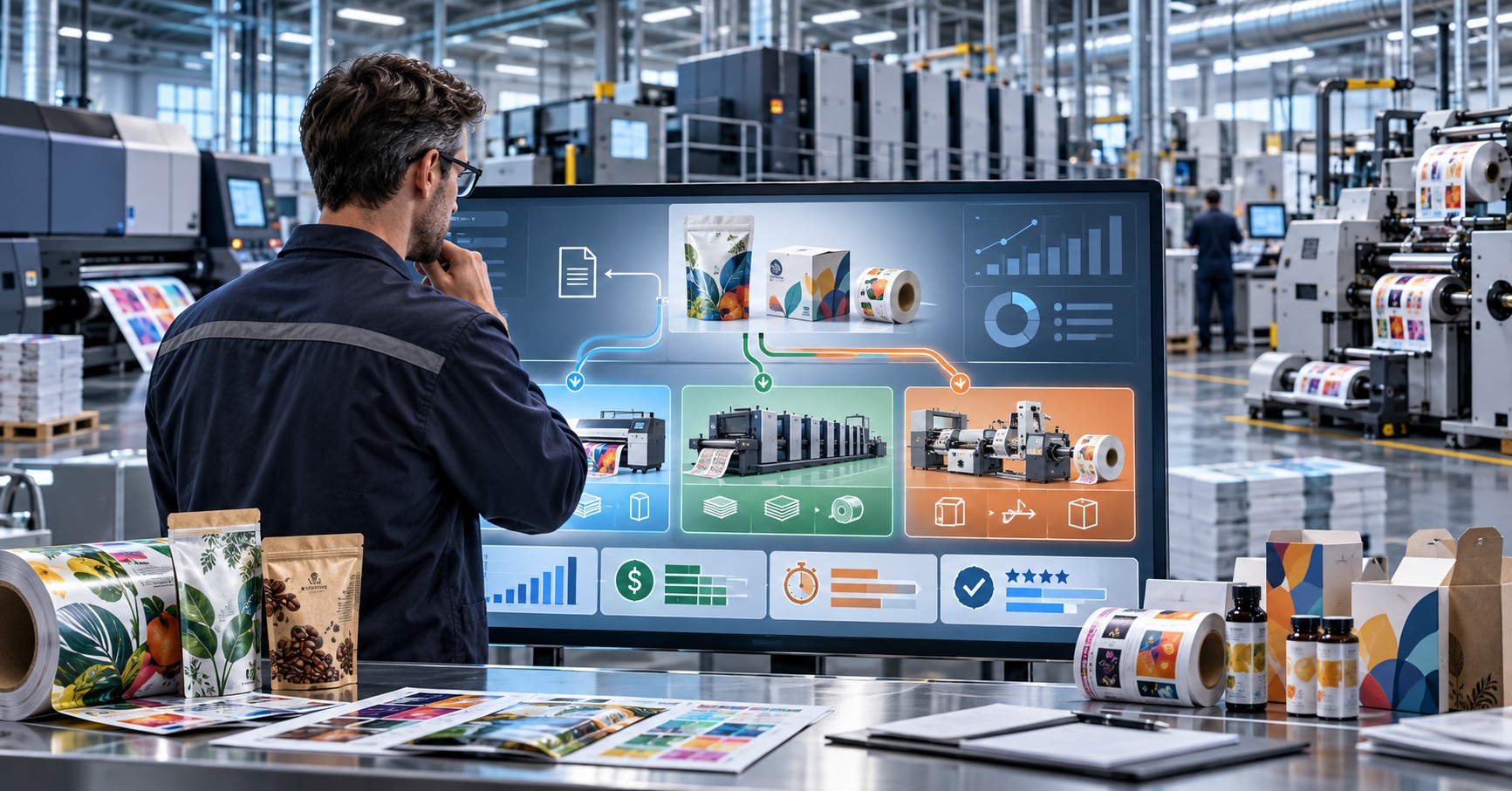
A production manager receives a new order: 120,000 flexible packages in six artwork versions, with a brand-critical color requirement and delivery due in three weeks.
The plant has two apparent options. A digital press has capacity tomorrow; a flexographic press with higher sustained output becomes available in four days. At first glance, the decision looks straightforward. The volume seems to favor flexography, while digital production offers an earlier start and avoids plate preparation.
But is press availability really the deciding factor?
Two artwork versions are still awaiting approval. The film designated for digital production has already been qualified, but we're considering an alternative material for flexography. The brand color must remain consistent after lamination, and the pouch-making machine is approaching a capacity constraint next week.
The question is no longer simply which press should print the order. It is which combination of substrate, surface preparation, printing process, operating condition, finishing, inspection, and available capacity can deliver an acceptable finished package on time and at the lowest defensible total cost.
That is the distinction between press selection and manufacturing-route selection.
Why route selection is an engineering and economic decision
Industrial printing plants often have more than one way to manufacture the same product. Flexible packaging may be printed digitally or by flexography; folding cartons may be produced using sheetfed offset or sheetfed digital printing; and labels may be produced with several technologies or with different presses within the same technology family.
Each route has its own cost structure and operating constraints. A conventional route often involves higher setup costs but may offer lower variable costs at stable volume. A digital route can reduce some setup burdens and accommodate changing artwork, multiple versions, and variable data, although its unit cost and productivity depend on the actual print mode and operating conditions.
It would be a mistake to assume that every short order belongs on a digital press, or every long order belongs on a conventional press. One hundred thousand units of one frozen artwork are not operationally equivalent to one hundred thousand units distributed across twenty versions, each approved on a different date.
The customer may see the same aggregate quantity. Manufacturing sees two fundamentally different jobs. Route selection must therefore begin with the order structure, not a comparison of nominal press speeds.
1. Define exactly what the customer is buying
Before scheduling production, establish what the finished product must achieve and what constitutes acceptance. A purchase order may identify quantity, material, and delivery date, but the complete requirement may also include artwork versions, color, substrate construction, barrier or sealing performance, converting tolerances, packing, regulatory requirements, and the conditions of final release.
For flexible packaging, the customer does not buy only a printed web. The customer buys a construction that must survive lamination, the specified conditioning or curing period, slitting, pouch forming, sealing and final use.
For folding cartons, the deliverable is not simply a color-correct printed sheet. The board must pass through coating, die cutting, creasing, folding and gluing without unacceptable damage or loss of function.
For a clear label, an attractive print on the release liner does not prove that the same artwork will look correct on a dark container or one filled with a colored product. White-ink buildup, backing, and application conditions can change the finished appearance.
The essential rule is that routes must be compared against the same approved finished-product requirement, even if they use different materials, preparation methods, ink recipes, or operating settings to reach it.
2. Identify technically credible manufacturing routes
Once the product requirement is controlled, identify the candidate routes without choosing a favorite. This step distinguishes a theoretically available process from a route that can genuinely meet the job's technical and release conditions.
Product | Candidate route | Evidence to examine |
|---|---|---|
Flexible packaging | Digital web printing | Film and primer compatibility, color capability, lamination and converting |
Flexible packaging | Flexography | Plates, anilox, inks, drying, film and laminate compatibility |
Folding cartons | Sheetfed offset | Board compatibility, plates, color, coating, folding and gluing |
Folding cartons | Sheetfed digital | Approved/prepared board, print mode, color, layout and finishing |
Labels | Digital label printing | Facestock, white ink, versions, variable data and die cutting |
Labels | Conventional label printing | Setup, plates, color capability, finishing and economic run length |
This is a screening table, not a ranking. It distinguishes routes that warrant qualification or comparison from routes that fail a mandatory requirement. An available press is not necessarily a qualified or production-ready route.
3. Match the actual substrate to the actual print process
A common route-selection error is assuming a substrate approved in one process can move unchanged to another. Consider a PET film that performs well on a digital press. Can the identical material be assigned to flexography?
Not without evaluating the exact film grade, intended print face, surface-treatment history, primer or receptive coating, ink system, adhesive compatibility, and behavior after converting. The same polymer family and nominal thickness do not prove the printing surface is equivalent.
The same logic applies to folding-carton board. A board that performs well under offset printing may require different preparation or a more receptive surface for a particular digital process. If offline priming is required, that preparation must be included in both the route and its cost; it cannot be hidden in an assumption that digital production begins when the press starts.
Two routes are not required to use identical material recipes. They are required to demonstrate equivalent acceptable finished-product performance against the customer's specification. A lower material quotation can become more expensive once preparation, reduced printing speed, scrap, or fresh qualification are included.
Substrate qualification is therefore both a technical gate and an economic input.
4. Prove that the route can deliver the required color and appearance
It is not enough for a press to accept and print the artwork. The selected route must consistently reproduce the approved finished appearance. Different processes can require different separations, color modes, and ink strategies while still pursuing the same customer-approved visual target.
A flexographic route may use a dedicated spot color where appropriate. A digital route may use another validated color strategy based on its installed ink set and print condition. The goal is not to reproduce identical CMYK values across technologies; it is to reproduce the approved finished appearance.
Assessment must account for substrate whiteness and transparency, the white-ink layer where applicable, primer, laminate or varnish, and agreed viewing and measurement conditions. On a clear label, the filled container affects appearance. On a carton, a matte or gloss finish changes what the customer sees. On a reverse-printed flexible film, lamination can alter the optical result.
Color evaluation should therefore include the relevant intermediate conditions and the finished construction, not only a single attractive press sample. The route must also maintain performance during production, with appropriate checks at the beginning, middle, and end of the run. Targets, tolerances, measurement conditions and approvals should be defined for the actual application.
A route that cannot meet a mandatory quality requirement is not acceptable because of a lower cost estimate.
5. Follow the order beyond printing
One of the most expensive scheduling mistakes is comparing when presses will finish printing instead of when each route can deliver finished, validated product.
A flexible-packaging route might be: substrate receipt → surface preparation → printing → lamination → curing or conditioning → slitting → pouch making → final inspection → authorized release.
Digital printing may finish in one day, but that advantage can disappear if lamination capacity is unavailable for another five days. Flexography may start later but arrive at a protected laminator slot and complete the full route sooner. Similar issues arise with carton converting, where a fast printing stage may be followed by queues for coating, die cutting, creasing, folding or gluing.
The relevant time is the end-to-end lead time to the agreed release boundary. That time is not necessarily the simple sum of individual task durations because some preparations can occur in parallel. Consider capacity constraints, dependencies, waiting time, and the critical path.
The route that prints first is not necessarily the route that delivers first.
6. Calculate the cost of the complete route
Once technically valid routes are identified, compare their economic performance. Comparing only printing cost per impression or per meter ignores much of the manufacturing burden. Depending on the product, total relevant route cost may include substrate, preparation and priming, plates or tooling, make-ready, inks, printing time, expected scrap, coatings, lamination, curing, slitting, converting, testing, packing and release activity.
It may also include version complexity, route-qualification expenditure and inventory exposure. Not every cost belongs in every decision; the key is to compare relevant, avoidable costs over consistent boundaries.
The simplest economic model is:
TOTAL ROUTE COST = FIXED ROUTE COST + (VARIABLE COST PER FINISHED UNIT × QUANTITY)
A conventional route may have a comparatively high setup cost but a low variable cost, while a digital route may have a lower setup cost and a higher variable cost. This provides the basis for a theoretical break-even calculation.
7. Calculate the digital–conventional break-even quantity
Define the total costs of the conventional and digital routes as:
Cc = Fc + Vc × Q
Cd = Fd + Vd × Q
Where F represents the fixed route cost, V the variable cost per acceptable finished unit, Q the required quantity, c the conventional route, and d the digital route.
Set the two expressions equal and rearrange:
Q* = (Fc − Fd) / (Vd − Vc)
When the denominator is positive, and the modeled assumptions hold, Q is the theoretical crossover quantity at which the two routes have equal cost. This formula appears in The Route Behind the Product* as the simple linear break-even case.
The calculation is useful—but only within the conditions that produced its inputs. Artwork versions and their approval dates can add setups. A slower validated color mode can increase the variable cost. Surface preparation, material availability, downstream capacity and finishing can change the viable route. The crossover is therefore a decision tool, not a permanent rule linking a particular quantity to a particular press.
8. Worked example: 120,000 flexible packages
Return to the six-version packaging order. For illustration, assume that both digital and flexographic routes have been technically validated for the finished construction, and that variable costs include the expected cost per acceptable finished package, including applicable finishing and scrap. The following figures are hypothetical, currency-neutral cost units, not supplier quotations or market benchmarks. All numerical costs in this example use the same arbitrary unit of account; they do not refer to any national currency.
Parameter | Digital | Flexography |
|---|---|---|
Fixed route/setup cost (cost units) | 2,400 | 18,000 |
Variable cost per finished package (cost units) | 0.42 | 0.25 |
Required quantity | 120,000 | 120,000 |
For digital printing:
Cd = 2,400 + (0.42 × 120,000) = 52,800
For flexography:
Cc = 18,000 + (0.25 × 120,000) = 48,000
Under these assumptions, the conventional route is 4,800 cost units less expensive. The crossover is:
Q* = (18,000 − 2,400) / (0.42 − 0.25) ≈ 91,765 finished packages
Above approximately 92,000 packages, the conventional route is cheaper in this simplified model—provided that all six versions can be produced with the assumed setup plan, and the technical and delivery constraints remain satisfied.
9. When artwork changes, the economics change
Now suppose that only four of the six versions are fully approved. The other two arrive five days later, preventing the original single conventional campaign. In this example, splitting the flexographic production adds 9,000 cost units in setup and operating costs.
Revised Cc = 18,000 + 9,000 + (0.25 × 120,000) = 57,000
If the digital route can accommodate the staggered approvals without changing its modeled costs:
Cd = 52,800
The decision has reversed. Digital is now 4,200 cost units cheaper. The quantity, print technologies, and finished-product requirement did not change. The approval sequence and campaign structure did.
That is why it is unreliable to assign a new job to a conventional press solely because its volume exceeds a historic break-even value. The relevant setup cost must reflect the number and timing of real executable campaigns, not just the grand total on the purchase order.
10. Can a hybrid route be the best choice?
Yes—when the order contains distinct economic and operational behaviors, and both routes can demonstrate acceptable finished-product equivalence.
Assume four stable versions account for 100,000 packages, while two late-changing versions account for 20,000. The stable base could be allocated to flexography and the variable tail to digital production. Consider these illustrative costs:
For the stable flexographic volume:
Cc = 12,000 + (0.25 × 100,000) = 37,000
For the two digital versions:
Cd = 800 + (0.42 × 20,000) = 9,200
Allow an additional 1,800 cost units for coordination, validation, and route separation:
TOTAL HYBRID ROUTE COST = 37,000 + 9,200 + 1,800 = 48,000
The three updated scenarios now compare as follows:
Manufacturing scenario | Total illustrative route cost (cost units) |
|---|---|
All digital | 52,800 |
All flexographic, with split campaign | 57,000 |
Stable versions on flexography; late versions on digital | 48,000 |
Under these assumptions, the hybrid route saves 4,800 cost units relative to all-digital production and 9,000 cost units relative to the split flexographic campaign.
The arithmetic does not, however, authorize the hybrid program. Both routes must still meet the accepted color and appearance, functional construction, converting performance, and release requirements. If equivalence has not been demonstrated, the apparent cost advantage is not sufficient to approve a split.
The point is not that hybrid production is inherently superior. One order can contain a stable high-volume base and a volatile short-run tail that deserve different manufacturing decisions.
11. Lowest cost is not enough: apply mandatory gates first
Suppose flexography offers the lower printing cost, but its available film has not been approved for the adhesive-lamination construction. Or suppose digital printing is cheaper for a particular quantity but cannot meet a mandatory brand-color requirement on the specified material.
Neither route becomes acceptable just because it is inexpensive. Product function, finished appearance, safety or regulatory obligations, release criteria and delivery commitments must be treated as feasibility requirements, not casual penalties in a weighted ranking.
The engineering decision can be expressed as:
MINIMIZE: Total relevant manufacturing-route cost
SUBJECT TO: qualified material and process compatibility; required print and finished quality; functional performance; protected capacity; committed delivery; and valid approval/release evidence.
This is a practical decision formulation, not a claim that every route-selection problem is a simple linear optimization. Where no route satisfies the mandatory constraints, the organization must seek a controlled change in scope, schedule, product requirement, or route, rather than quietly accept nonconforming production to keep a press running.
12. Inventory exposure: the hidden cost of a cheap unit
A conventional press may offer an attractive variable cost if the production quantity is increased from 150,000 to 300,000 packages. But does the customer actually need the additional inventory?
If ingredient declarations, regulatory text, market languages, or design elements can change, the additional packages may become obsolete before use. Apparent manufacturing savings can then be overtaken by financing, warehousing, write-offs or disposal costs.
The economic model must distinguish confirmed demand from forecasts. A future volume estimate is not the same as a purchased quantity. Digital production at a higher unit cost can be more economical when it reduces exposure to unusable inventory; conversely, a long conventional campaign can be advantageous when demand and artwork are genuinely stable.
The right decision depends partly on demand reliability and version stability, not merely on nominal unit production cost.
13. An earlier successful route is evidence, not automatic approval
Plants accumulate valuable production knowledge. They know which materials worked, which presses maintained color stability, and which converting conditions produced a reliable result. Reusing that evidence is good engineering—but only when its scope remains valid.
A change in substrate grade, surface treatment, coating, ink, press, finishing method, or packaging geometry can invalidate some of the assumptions behind earlier approval. Two digital presses are not necessarily interchangeable simply because they share a broad process family. Installed color capability, width, white-ink support, substrate path, operating condition, calibration status, workflow compatibility, and finishing connections may differ.
The book describes Transfer Readiness as the demonstrated ability to move a defined product to an alternative route while preserving required performance, evidence, control, and release responsibility. It is not a universal permission to swap presses, nor a separate headline score. It determines whether a particular alternative can legitimately enter the current comparison.
Past success should inform the next decision—not replace the evidence that decision requires.
14. When should route selection be reopened?
Customer requirements and plant conditions can change after a route is selected. Quantities can increase, artwork can be revised, materials can be delayed, a press can break down, or a protected finishing slot can disappear.
The right response is not to restart the entire qualification process after every small change. Instead, identify which assumption supporting the current decision is materially weakened or invalidated.
A file revision may require version control and artwork approval, without reopening unchanged substrate evidence. A material substitution can require new surface, adhesion, and laminate testing. A delivery-date change may alter capacity and economic comparisons. A loss of finishing capacity may require reassessing the commitment and potentially the selected route.
Only affected decisions should reopen. The original assumptions, evidence, and approval history must remain visible, so the organization can explain why a recommendation changed without rewriting the past.
15. A practical route-selection sequence for every new job
The following sequence turns the principle into a repeatable production-engineering review.
Stage | Core question | Required decision |
|---|---|---|
1. Customer requirement | What finished product was actually ordered? | Control mandatory acceptance criteria. |
2. Job structure | How many units per version, and how stable is the artwork? | Identify feasible production campaigns. |
3. Materials | Is the exact material suitable for each candidate route? | Verify construction and preparation. |
4. Print capability | Can the route meet color, image, and process requirements? | Qualify the printing conditions. |
5. Converting | Will the finished product survive downstream operations? | Validate product performance |
6. Capacity and time | When can each full route achieve authorized release? | Build a realistic end-to-end schedule. |
7. Economics | What is the total relevant cost of each eligible alternative? | Compare cost and crossover conditions. |
8. Authorization | Which eligible route best meets the current requirements? | Obtain accountable approval |
9. Changed conditions | Has a material assumption become invalid? | Reopen only the affected decisions. |
A plant can begin with a carefully maintained comparison sheet; sophisticated software is not a prerequisite. What matters is transparent data, qualified alternatives, and a traceable explanation for the recommendation.
16. How should the recommendation be presented?
A useful recommendation does not merely say "run digital" or "move it to flexography." It identifies the selected manufacturing route and, where justified by evidence, the specific press; states the approved production condition; describes the expected finished-product quality; shows realistic release timing; and presents total route cost.
It must also state the assumptions that can reverse the decision. A flexographic recommendation might depend on all artwork being frozen by a specified deadline, the material arriving in its qualified condition, and lamination capacity remaining protected. A digital recommendation might depend on a slower validated color mode that must be used in the production estimate.
The comparison should preserve the alternatives considered, their qualification state and the reasons any candidate was rejected. Decision-support software can connect information and recommend an option, but it cannot become the technical, commercial, production or release authority. Those responsibilities remain with designated professionals.
17. The important question is not which press is free
As plants combine digital and conventional technologies, more substrates, color configurations and downstream processes, the temptation is to schedule the next available press and resolve the remaining questions later. That sequence may improve local utilization while making the finished order more expensive or less reliable.
A disciplined process instead identifies the customer's full requirement, removes alternatives that cannot meet it, proves material and finished appearance, maps the real converting route, protects the needed capacity, and only then compares cost. The economic crossover remains useful—but it changes when quantity, versions, preparation, release dates, or finishing conditions change.
Sometimes one process will clearly dominate. Sometimes the correct answer will be a qualified hybrid route. Sometimes the evidence will show that no current route can responsibly support the requested commitment without an approved change.
The purpose is not to discover the plant's favorite press. It is to choose the most suitable route for this particular order under today's conditions.
Conclusion: the correct choice starts with the finished product
When a new job arrives, press availability, run length, print speed, and unit cost are natural starting points. They matter, but they cannot support the full decision on their own.
Manufacturing-route selection must begin with the customer's acceptable finished result: the required quality, functional performance, release evidence, delivery date, and defensible total cost. Only then should the plant determine which processes and specific assets can deliver it.
The cheapest printing step may not produce the lowest-cost finished order. The fastest press may not deliver the first acceptable product. A route proven on a previous job may no longer be suitable after material, artwork, or capacity conditions change.
The right route delivers the product the customer actually ordered, at the required quality, on the committed date, and at the lowest justifiable total cost among fully eligible alternatives.
That is the practical meaning of choosing a complete manufacturing route rather than merely choosing a press.
Source and attribution
This article is based on The Route Behind the Product: How Materials, Color, and Manufacturing Choices Shape Packaging, by Ronen Dolev (2026). The book examines how material qualification, conventional and digital printing, color, finishing, route economics, readiness, and customer commitments shape the finished package. The break-even principle follows the simplified linear model presented in the book. The numerical costs and route scenarios in this article are newly constructed educational examples expressed in arbitrary cost units, not figures reported in the book or measured costs from a named factory. Actual production decisions require current material and equipment evidence, commercial terms, qualified operating conditions, and appropriate release authority.