Ronen Dolev | 2026 Industrial Printing, Materials, Applications & Color Science
Introduction - Speed Is Only Part of the Story
For many years, the distinction between digital and conventional printing was relatively straightforward. Digital printing excelled at flexibility, short runs, and changing content from one impression to the next. Flexography and offset, meanwhile, offered established solutions for long industrial runs, high throughput, and integration with multiple printing and converting stations.
The emergence of LEPx, particularly its implementation in the HP Indigo V12, has changed the basis of that comparison. Six parallel imaging engines enable a manufacturer-rated speed of up to 120 meters per minute when printing with up to six color separations-a significant speed for a narrow-web digital press.
But speed alone does not determine a printing process's competitiveness. Can a digital press reproduce the same fine image detail as a well-optimized conventional press? Are tonal transitions equally smooth? Are brand colors equally accurate? What happens to registration, solids, and fine text throughout a long run? And how does the answer change with the substrate and the finishing process?
An engineering comparison must also avoid an obvious methodological error: comparing a 340 mm digital press against a conventional machine that is two or three times wider. Such a comparison can confuse the benefits of printing technology with the benefits of web width.
This article therefore considers three narrow-web platforms in approximately the same nominal 340 mm web-width class, and differentiates publicly documented machine specifications from output-quality claims that would require controlled comparative testing. The proposed common 320 mm image area provides an equal-width target for experimental print-quality work; it does not suggest that all three machines have identical maximum printable areas or identical mechanical generations.
1. Selecting the Presses - A Comparable Web-Width Class
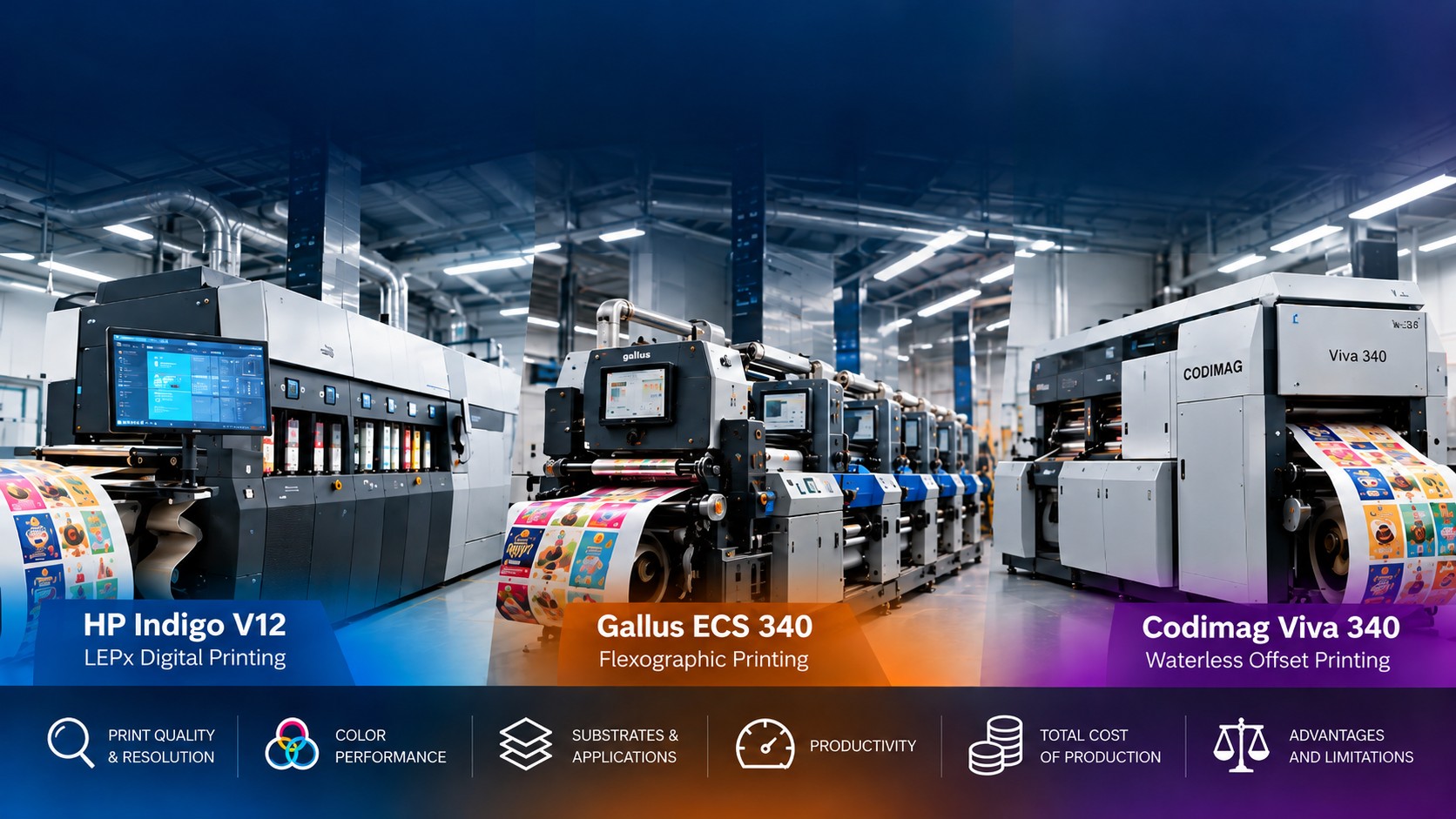
The comparison uses the following representative platforms:
HP Indigo V12 - LEPx digital printing. A liquid-electrophotographic digital press with six parallel imaging engines, LED writing arrays, and a shared intermediate blanket belt. The multi-separation image is transferred to the substrate through an indirect thermal transfer process.
Gallus ECS 340 - flexographic printing. A narrow-web flexographic press employing photopolymer plates, anilox metering, and ink-transfer and drying or curing systems. Its possible applications and finishing options depend on the particular configuration.
Codimag Viva 340 - waterless offset printing. A narrow-web offset platform in which ink is transferred from an image-carrying plate to a blanket and then to the substrate, without the conventional dampening-water system. Published Viva 340 configurations include machines from different generations, so their individual specifications must not be generalized to every modern offset press.
Table 1. Representative machine and process characteristics
Parameter | HP Indigo V12 | Gallus ECS 340 | Codimag Viva 340 |
|---|---|---|---|
Printing technology | Digital LEPx | Flexography | Waterless offset |
Nominal web-width class | 340 mm | 340 mm | 340 mm |
Maximum printed image width | 322 mm | Configuration dependent, up to approximately 340 mm | Approximately 330 mm in documented configurations; verify individual press |
Published top running speed | Up to 120 m/min in up-to-six-color mode | Up to approximately 165 m/min in published ECS 340 specifications | Depends on model and configuration |
Image generation | Electrostatic digital imaging engines | Photopolymer relief plates | Offset printing plates |
Different image on successive copies | Native digital capability | Requires a complementary variable-printing system or plate change | Requires a complementary variable-printing system or plate change |
Ink transfer | Multicolor image from intermediate blanket | Directly from plate to substrate | Plate to blanket to substrate |
Screening | Published 175, 196 and 200 lpi options | Plate and process dependent | CTP and process dependent |
Published maximum speed is not net productivity. Plate changeover, make-ready, waste, substrate changeover, and finishing capacity must all be considered before an economic conclusion can be reached.
2. Three Technologies - Three Image-Formation Mechanisms
The underlying physics matters as much as the specification sheet.
In LEPx, the color separations are developed electrostatically using charged liquid-ink particles. The separations are assembled on a shared blanket belt, and the composite image is then transferred to the substrate. Digital content can change without replacing a physical printing plate.
In flexography, the anilox roll meters ink to raised image areas on the printing plate. Those areas transfer ink directly to the web. In multicolor production, the web passes through successive printing stations; registration therefore depends on mechanical synchronization, web behavior, and effective process control.
In offset, the image originates on a printing plate and passes through a rubber blanket before reaching the substrate. Waterless offset differentiates printing and non-printing areas without the conventional ink-and-dampening-water balance. Certain Codimag configurations also incorporate distinctive ink-metering arrangements; those arrangements should not be attributed to all offset machinery.
These different pathways lead to different mechanisms of dot growth, image-edge formation, ink-film variation, registration error, and surface interaction. No technology is completely immune to physical process limits. Each has its own control parameters and failure modes.
3. Resolution - Why DPI Alone Is Not a Print-Quality Metric
Resolution figures are among the most frequently misused numbers in printing comparisons. One specification may show 1,624 dpi, another 2,400 dpi, and a plate-imaging system may advertise 4,000 ppi or more. These numbers do not necessarily measure the same stage of the process and cannot be ranked by final print quality alone.
Imaging resolution
Imaging resolution describes the spatial addressability or writing capability of a laser, LED array, plate-imaging device, or related imaging system. HP publishes an imaging resolution of 1,624 dpi and a RIP resolution of 812 dpi for the V12. These two values are not interchangeable.
Advanced flexographic plate-making systems may employ resolutions such as 2,400 or 4,000 ppi; computer-to-plate equipment for offset may also use high imaging resolutions. Those figures describe plate imaging, not the actual resolution delivered on the printed substrate.
Screen ruling
Screen ruling, expressed in lines per inch (lpi), characterizes a halftone structure used to simulate continuous tones. Published V12 screening options include 175, 196, and 200 lpi. Modern flexographic and offset systems can also use high screen rulings and specialized AM, FM, or hybrid screening approaches, depending on their configurations.
Two systems operating at 175 lpi do not automatically create identical dot geometry or tonal behavior. Dot shape, minimum dot stability, highlight reproduction, and substrate influence can all differ.
Effective printed resolution
For a label or package buyer, the most important metric is the detail that can be reproduced accurately and repeatably on the actual substrate. Useful test measures include minimum continuous positive-line width, minimum open reverse-line width, positive and reverse microtext readability, highlight-dot stability, shadow separation, and image-edge sharpness.
A controlled test can also examine printed-edge variation, visual graininess, mottle, and the retention of defined spatial features. These measurements evaluate the finished print, not an imaging subsystem in isolation.
A 340 mm web is not necessarily a 340 mm printable image.
Equalizing the nominal maximum web width removes one obvious distortion, but does not make the productive image widths identical. The public V12 specification lists a 340 mm maximum web and a 322 mm maximum printed width, while the Gallus ECS 340 specifies a 340 mm maximum web and print width. Used Codimag Viva 340 configurations differ by year and equipment package; their printable width must be checked on the selected machine.
For experimental image-quality comparisons, a common 320 mm test area is defensible only if the selected press and setup can reproduce it without clipping, registration loss, or unusual finishing margins. Report usable width independently from nominal width and include side-trim and label-layout constraints when comparing finished-label output.
4. Has Modern Flexography Gained an Advantage in Fine Detail?
Modern flexography should not be judged against the limitations of much older equipment. Plate technology, laser imaging, anilox manufacturing, exposure control, and screening methods have advanced substantially.
Flat-top-dot plate structures, controlled surface patterns, and hybrid screening can improve ink transfer and stabilize fine image features. Modern plate-making systems can combine high-resolution imaging with relatively fine production screens, supporting detailed photographic images and smoother transitions into highlights.
Nevertheless, a technically sophisticated plate is only one element of the printing system. Its fine details must survive plate processing, mounting, the printing nip, ink transfer, and ongoing press operation.
The plate is an elastic body. Impression pressure affects dot contact and may influence printed-dot geometry. Anilox engraving, cell volume, ink viscosity, transfer behavior, and substrate surface all contribute to the result. Pushing screen ruling higher may reduce the stable process window unless the supporting materials and controls are adjusted.
Consequently, it would be inaccurate to claim that LEPx is categorically superior in printed detail. A well-optimized modern flexographic press can deliver excellent photographic reproduction, fine text, and controlled gradations. The appropriate conclusion requires physical print testing under stated conditions.
Resolution protocol: printed modulation rather than imaging-unit numbers
Report the original test-art dimensions, the smallest stable positive and reverse structures, the measured widths of printed lines, and edge spread or modulation-transfer behavior where appropriate. Flexo plate-screen imaging at 2,400 or 4,000 ppi, offset CTP exposure, and LEPx LED addressability belong to different physical stages and should not be ranked as equivalent print-resolution numbers.
A representative test should record plate type, anilox details, and impression conditions for flexo; plate, inking, and blanket conditions for offset; and publicly defined screen/operating modes for LEPx. Maintain the same evaluation instruments, substrate lot, and viewing conditions. The purpose is to compare reproduced information, not the most impressive nominal dpi.
5. LEPx Image Quality - Where Does Digital Imaging Help?
LEPx does not require a newly imaged physical plate for every artwork revision. Its image can be updated through digital production data and process-specific calibration. This matters especially for multiple SKUs, language variations, serialized content, and frequent job changes.
Unlike flexography, LEPx does not use a raised, compressible flexographic plate to transfer each image separation directly to the substrate. It therefore does not share the same plate-compression-related dot-deformation mechanism. That distinction does not imply that LEPx is immune to dot growth, edge variation, or image distortion. Electrostatic development, halftoning, blanket condition, and final transfer still determine the printed result.
Tonal transitions
Smooth gradients depend on the relationship between the available halftone structures, process calibration, ink transfer, and printed noise. LEPx employs digital screening and calibration to control tone reproduction. Flexographic tone response additionally depends on the plate and impression system, while offset depends on plate, ink train, and blanket conditions.
All three technologies can produce strong tonal performance. Quantitative assessment requires tone-reproduction curves, highlight/shadow tests, visual review under controlled conditions, and measurements of variation across the full gradient.
Solid areas
Solid uniformity is a different challenge. In flexography, anilox-to-plate-to-substrate transfer is a major influence. In offset, ink-train stability and blanket transfer matter. In LEPx, electrostatic development and transfer of the assembled ink layer are significant.
Optical density, spatial uniformity, mottle, pinholes, and surface appearance should therefore be measured rather than inferred from dpi or lpi. A press with excellent line resolution can still produce unacceptable solids for a demanding application.
6. Waterless Offset - A Serious Competitor in Image Reproduction
Flexography is not the only conventional technology LEPx should be evaluated against. Offset has a long record of high-quality photographic reproduction, fine detail, and smooth gradation.
Waterless offset can operate without a conventional dampening-water system. That removes the usual ink/water interaction as a process variable, although temperature, ink properties, plate condition, and blanket transfer remain critically important. Certain Codimag Viva configurations use anilox-related ink-metering concepts, but such configurations must be identified specifically rather than generalized across offset technology.
For suitable premium-label work, waterless offset can offer accurate fine detail, controlled halftones, and strong image reproduction. On the other hand, new designs still require new plates and make-ready. It does not inherently provide the per-impression variability of digital printing.
There is no technical basis for assuming that LEPx necessarily produces better image detail than an optimized narrow-web waterless-offset press. Nor should offset automatically be designated the winner. Substrate, screening, image content, equipment generation, and real production controls determine the result.
7. A Meaningful Print-Quality Comparison - What Should Be Measured?
A rigorous comparison requires more than a visual judgment of the best-looking sample. It should evaluate optical, spatial, and production-repeatability characteristics.
Table 2. Recommended measurements for a common 320 mm test form
Metric | Engineering question |
|---|---|
Effective printed resolution | Which fine structures remain distinguishable on the substrate? |
Minimum positive line | What is the thinnest reliably continuous printed line? |
Minimum reverse line | What is the narrowest reliably open gap? |
Positive microtext | What text size and stroke weight remain legible? |
Reverse microtext | What reversed text remains readable in a solid area? |
Highlight-dot reproduction | Are the smallest required tonal elements stable? |
Shadow detail | Can nearby dark tones be distinguished? |
Tonal gradation | How smooth and monotonic are tone transitions? |
Solid uniformity | How much mottle, density variation, or pinholing is present? |
Print contrast | Is contrast preserved in the required tonal regions? |
Color-to-color registration | What are the MD and CD displacement distributions? |
Color accuracy | How closely does the print match specified CIELAB targets? |
Repeatability | How stable is the result within and between runs? |
A press can achieve excellent color differences while showing poor edge sharpness or unreadable small text. Conversely, a press can reproduce very fine lines yet miss a brand-color target. Print quality is multidimensional; a single resolution figure or ΔE value cannot represent it adequately.
8. Color Performance - LEPx Versus Flexography and Offset
Color accuracy relates to, but is distinct from, spatial image resolution. More imaging pixels do not automatically produce a wider color gamut or closer reproduction of a brand color.
CMYK reproduction
LEPx uses liquid-electrophotographic inks, while flexography and offset use different ink systems and transfer processes. Sending the same CMYK numbers to three printing processes will not necessarily yield the same CIELAB values, even on nominally identical media.
Each process has its own characterization data and its own calibration behavior. A fair color comparison therefore evaluates how closely each technology can reproduce a shared colorimetric target, using appropriate process-specific calibration and color management.
Spot colors
Flexography and offset can use specially formulated spot-color inks. This can be efficient for a stable, high-volume brand color. LEPx offers digital ink configurations that may include process and extended-gamut colors, depending on the system and operating mode.
A simulated brand color produced through multiple process inks is not always equivalent to printing a dedicated spot ink. A proper comparison should include ΔE00, achievable gamut, stability, metameric behavior, and the intended viewing conditions.
Extended gamut
Extended-gamut printing is possible in more than one technology. The number of installed ink stations does not by itself determine the size or shape of the gamut. Ink spectra, substrate reflectance, separation algorithms, tone reproduction, and process conditions all matter.
To compare gamut meaningfully, characterize each process under declared conditions and calculate the reproducible region in a common color space. The comparison should also examine the proportion of real customer colors that can be matched within the agreed tolerances.
9. Registration - Does One-Shot Give LEPx an Advantage?
In LEPx, the multicolor image is assembled on a blanket belt and transferred to the web in a single final transfer event. In conventional narrow-web flexography and offset, different colors generally reach the moving web at different printing stations.
That distinction can matter, particularly on films sensitive to tension or dimensional variation. A conventional press must maintain registration between stations while the web moves through the press and may experience thermal or mechanical effects between them.
LEPx instead must maintain registration among the independently generated separations assembled on its intermediate blanket. One-Shot reduces the need for multiple separately registered color transfers onto the substrate, but it does not eliminate the demanding internal registration task.
Modern flexographic and offset presses also employ servo drives, register cameras, and automated correction. One-Shot should therefore be described as a potential architectural advantage, not proof of superior registration under all conditions.
Comparative measurement should report machine-direction (MD) and cross-direction (CD) registration distributions across the run, including variation with speed and substrate.
Prepress throughput can be the bottleneck before the web moves.
Digital print capacity depends on more than the press's mechanical web speed. PDF complexity, transparency and blending, raster preparation, imposition, variable-data processing and print-server performance can affect whether a sustained stream of printable data reaches the engine. A claimed press-speed advantage must not be treated as a measured shop-floor throughput advantage until file preparation and job switching are included.
The proper comparison is finished, accepted labels per paid production hour, with transparent inclusion of artwork changes, plate manufacture and mounting (where applicable), proofing, job make-ready, digital raster processing, start-up scrap, stopping losses, and postpress capacity. Record the bottleneck explicitly rather than attributing all losses to the printing technology.
10. Substrates - Which Process Works Better With Sensitive Materials?
Substrate compatibility involves more than moving a web through a press. Surface chemistry, dimensional stability, ink interaction, drying or thermal exposure, and finishing requirements all influence whether a printed construction is commercially fit for purpose.
PE and BOPP
Flexography can use ink systems formulated for particular polymer films and converting routes. LEPx compatibility depends on the selected substrate, transfer process, and any required priming or surface preparation. In both cases, surface energy and interface behavior matter; neither process is automatically compatible with every PE or BOPP construction.
PET
PET behaves differently from PE and PP mechanically and thermally. Technology selection should consider not only printability but also the final packaging construction, processing temperatures, and post-print requirements.
Coated papers
Coated papers are important substrates for all three methods. Surface texture, coating structure, optical brightening agents, and print-layer uniformity can influence the appearance of solids, fine lines, and halftones. Quality comparisons must use well-documented media and suitable measurements.
Performance after converting
A print can look excellent when it exits the press and still fail during lamination, coating, die-cutting, abrasion, or other downstream operations. A useful distinction is between print quality, which concerns visible and measurable reproduction, and application performance, which concerns the finished product's fitness for purpose.
The most attractive proof sample is not necessarily the most reliable production construction.
11. LEPx - Strengths and Limitations
Strengths. LEPx enables variable digital content without replacing plates for each artwork change. This can simplify multiple-SKU production, language variants, personalization, and frequent short jobs. The V12's parallel imaging architecture offers relatively high throughput for a digital narrow-web press. Its One-Shot architecture can benefit color registration on certain substrates, while digital workflow and calibration support repeatable production when implemented correctly.
Limitations. Consumables, maintenance, service arrangements, and process-specific material preparation may contribute materially to cost. Approved substrates and treatments depend on the model and application. On V12, work with more than six separations has a lower published maximum speed than work requiring up to six. Very long, unchanging jobs may not favor digital economics. Above all, neither superior spatial resolution nor superior color accuracy over optimized flexography or offset can be assumed without head-to-head measurements.
12. Flexography - Strengths and Limitations
Flexography offers high throughput, a broad choice of compatible ink systems, extensive inline converting options, and an established route to long, stable production. When print volume is large and artwork is fixed, plate-related preparation costs can be amortized over many impressions.
Its disadvantages include plate preparation time and cost, additional make-ready following artwork changes, and dependence on plate quality, anilox condition, impression setting, and process control. Very small highlight dots may require careful optimization and can limit some jobs.
These limits should not be exaggerated: modern high-definition plate-making and screening have materially advanced flexographic quality.
13. Narrow-Web Offset - Strengths and Limitations
Narrow-web offset can reproduce fine detail, photographic images, and typography exceptionally well. Waterless configurations remove the dampening-water subsystem and may suit premium-label applications. Depending on equipment design, the line can also incorporate specialist converting functions.
The trade-offs include printing plates, initial setup, mechanical and thermal process control, and the need for further preparation when artwork changes. The absence of dampening water does not remove the need for stable ink, plate, and blanket conditions.
Like flexography, conventional offset does not inherently change printed content from impression to impression without an additional variable-printing system.
14. Throughput - Why Maximum Speed Does Not Tell the Whole Story
Comparing presses within the same nominal web-width class removes one source of distortion, but maximum published running speed remains different from net production.
Make-ready time, setup waste, plate changes, substrate changes, color changes, roll handling, inspections, stoppages, and finishing capacity all affect the number of accepted labels delivered per shift.
A conventional flexographic press may run very quickly once stable. LEPx may reduce certain preparation steps when the job mix involves many designs. Offset may offer excellent quality and productivity in a suitable product class, but the exact outcome depends on its generation and configuration.
The economically relevant measurements are therefore: maximum mechanical speed; production speed at which the defined quality limits are met; and accepted finished-product output per complete production hour.
Quality at production speed
Testing at a conveniently slow speed is not sufficient. A press that delivers outstanding detail only after major speed reduction may not provide the expected economic benefit. Equally, a published top speed may not be available for all inks, substrate constructions, or quality requirements.
Set the acceptance criteria first, then determine the sustainable throughput at those criteria.
15. True Cost - More Than the Price per Printed Meter
The right unit of comparison is usually the fully completed, accepted job, not simply ink cost per meter or the press's nominal speed.
A complete costing model should include setup labor, plates or other job-specific preparation, substrate consumption, consumables, maintenance, energy, scrap, inspections, and converting. The number of artwork variants is often as important as run length.
Consider a product family with twenty distinct label versions. LEPx can transition between digital files within a planned production workflow. A conventional press may require plate changes and additional setup, unless the job has been engineered around a hybrid or other specialized solution.
Conversely, when one design is printed in a long, stable run, conventional plate costs can be spread across a large quantity of product. The economic crossover point is not a fixed number of labels or meters. It changes with version count, ink coverage, color count, media, local production costs, and finishing constraints.
One width-normalized productivity example
At an assumed common 320 mm active image width, the idealized image-area rate equals 0.320 m times the mechanical linear speed. This yields an illustrative 38.4 m²/min at 120 m/min, versus 52.8 m²/min at 165 m/min. The arithmetic is deliberately an upper-bound geometric comparison, not a prediction of actual saleable throughput; it excludes gaps, die layout, make-ready, interruptions, quality rejects, and finishing capacity.
The advantage can reverse for frequent versions or short work orders when fixed plate/make-ready costs dominate. It can favor conventional flexography for stable, very long runs. Model each job basket using setup hours, variable consumables, scrap, number of artwork versions, substrate and ink price, and good-output yield. No universal crossover run length exists independently of those inputs.
16. How to Run a Fair Comparative Experiment
A credible comparison begins by selecting a substrate suitable for all three platforms, preferably from a single documented material lot. When no material is equally qualified across all technologies, run separate pairwise comparisons and state the limitation explicitly.
Create a standardized test form within the shared 320 mm image width. Include photographic images, tonal ramps, positive and reverse fine lines, tiny text, solids, overprints, registration targets, and color-control patches.
Two complementary comparison modes
Best achievable production mode. Operate each printing technology with its best qualified and commercially practical configuration. This tests each system's real capability instead of forcing a possibly suboptimal common setup.
Harmonized target mode. Where feasible, use common image content, screening targets (for example, 175 lpi when supported), colorimetric objectives, and inspection criteria. This helps isolate differences under comparable stated conditions, but should not be confused with equalizing process physics.
Measurement and sampling
Use microscopy or imaging analysis to evaluate printed dots, microtext, line continuity, and edge definition. Measure CIELAB values and spectral reflectance using declared conditions compatible with ISO 13655, including the selected measurement condition and backing.
Include solid uniformity, tonal reproduction, registration in MD and CD, and variation over time. Collect samples at the beginning, middle, and end of a sufficiently representative run. Report distributions and uncertainty, not only average values.
Finally, measure production speed while maintaining accepted quality, and assess finished samples after the relevant converting operations. Where substrates differ, avoid attributing resulting differences to the print engine alone.
Table 3. Public-specification versus production-output comparison
Metric | LEPx V12 | Gallus ECS 340 | Engineering limitation |
|---|---|---|---|
Maximum web width | 340 mm | 340 mm | Nominal width only |
Published max print width | 322 mm | 340 mm | Common 320 mm sample region |
Published mechanical speed | 120 m/min, up to six separations | 165 m/min maximum | Neither is good-label throughput |
Additional LEPx separations | Published 60 m/min for seven to twelve | Depends on color stations/configuration | Must compare matching artwork |
Prepress content variation | Native variable digital files | Plate changes or auxiliary digital unit | Measure RIP, make-ready and scrap |
Finished-label output | Measured at converting exit | Measured at converting exit | Count accepted labels/hour |
17. Which Printing Technology Is Better?
No single answer fits all applications.
When the job requires variable data, frequent design changes, multiple versions, or reduced plate-preparation activity, LEPx can offer a compelling operational advantage.
For a stable, high-volume job, flexography may offer strong throughput and cost efficiency, together with excellent image reproduction when properly optimized.
For premium applications that prioritize fine graphic detail and photographic reproduction, narrow-web waterless offset remains a credible competitor, provided that the press and production economics suit the job.
The correct choice also depends on substrates, finishing, lead time, brand-color requirements, and the customer's definition of acceptable quality.
It is not scientifically sound to assign one technology the highest print resolution simply because its imaging specification carries the largest dpi number. Nor does operating at 200 lpi prove that different printing systems reproduce identical fine features.
Real print quality is the measurable result on the substrate, sustained at a production speed that yields acceptable finished product economically.
Software features cannot be generalized across V12 releases.
The publicly named Production Pro DFE is part of the V12 product ecosystem, but individual workflow capabilities should not be assumed identical across releases or interchangeable with capabilities advertised for other Indigo families. For an independent comparison, state the software configuration, rendering mode, and job-data complexity used in the study; verify available trapping, spot-color, and inline measurement functionality on the actual press instead of assuming its presence.
This distinction matters for fairness: flexographic quality depends heavily on plate-making and prepress, and LEPx quality depends on both physical electrostatic imaging and digital job preparation. Comparing one process under a mature, validated workflow and another under a non-equivalent workflow is a study of workflows as much as print engines.
Conclusions - Competition Is About Consistent Quality and Net Output
LEPx brings digital printing closer to production segments historically dominated by conventional narrow-web flexography and offset. Its high-speed digital imaging and ability to change content without new plates provide clear flexibility advantages for certain job mixes.
That development does not erase conventional printing's strengths. Modern flexography can produce high-definition images with excellent consistency, and offset remains highly capable in fine detail and tonal reproduction. Each technology creates and transfers images differently, with distinct sensitivities and process-control needs.
A meaningful comparison must go beyond dpi, lpi, and advertised meters per minute. It should ask whether the presses reach the required visual quality; whether that quality is sustained throughout the run; whether the substrate and converted product perform as required; and what it costs to deliver acceptable final units.
The best printing technology is not necessarily the one with the highest nominal imaging resolution or published top speed. It is the process that consistently delivers the required product quality, efficiently and economically.
Technical and Scientific References
- HP Indigo V12 Digital Press - Technical Specifications. Published web width, imaging resolution, screening, speed, and substrate information.
- Gallus ECS 340 - Product and Technical Documentation. Published narrow-web flexographic machine information and options.
- Codimag Viva 340 - Published Machine Configurations. Example of a documented narrow-web waterless-offset press configuration, not a comprehensive manufacturer specification.
- Flexographic Technical Association - High Resolution Project, Final Report (2022). Research into high-definition plate imaging and evaluated flexographic reproduction.
- Esko - Flexo Application Guide. Guidance concerning plate-making resolution and screened reproduction.
- Miraclon - What Is Modern Flexo? (2024). Public discussion of modern plate structures and ink transfer.
- ISO 12647-6:2020 - Graphic Technology: Process Control for the Production of Halftone Color Separations, Proof and Production Prints - Part 6: Flexographic Printing.
- ISO 13655:2017 - Graphic Technology: Spectral Measurement and Colorimetric Computation for Graphic Arts Images.
- Presstek - Waterless CTP Imaging. Public information concerning waterless-offset plate imaging.
2026 revision - independently accessible source checks
Official HP Indigo V12 specification. https://www.hp.com/us-en/industrial-printers/indigo-digital-presses/labels-flexible-packaging-digital-presses/v12-printing-press.html
Gallus ECS 340 manufacturer specification. https://www.gallus-group.com/en/label-printing/products/gallus-ecs/
Published specific Codimag Viva 340 machine listing (not a universal model spec). https://www.pressxchange.com/en/codimag-viva-340-year-2006/machine-id/253121/
FTA high-resolution flexography research report. https://www.flexography.org/wp-content/uploads/2022/05/High-Resolution-Final-Report-3.4.22.pdf
Publication boundary: This revised article uses general printing science, independently published material, and publicly accessible manufacturer specifications. Customer notes, internal technical updates, restricted training, and confidential maintenance instructions were not used as evidence for any new externally publishable assertion. Product or software capabilities may depend on configuration and release; absence of a publicly verified feature must not be interpreted as proof of its availability.
Publication and intellectual-property note: This article is an independently written engineering analysis based on publicly accessible technical material and established scientific principles. Manufacturer and product names are used solely for identification and comparison. Numerical specifications refer to documented machines and configurations, not guaranteed results across all applications. No physical comparative trial of the three presses was performed specifically for this article. Conclusions requiring such tests are presented as hypotheses, considerations, or proposed measurements rather than proven findings. No proprietary formulas, confidential algorithms, internal service data, or non-public production parameters are disclosed. This article is not sponsored by, affiliated with, or endorsed by any of the named manufacturers.