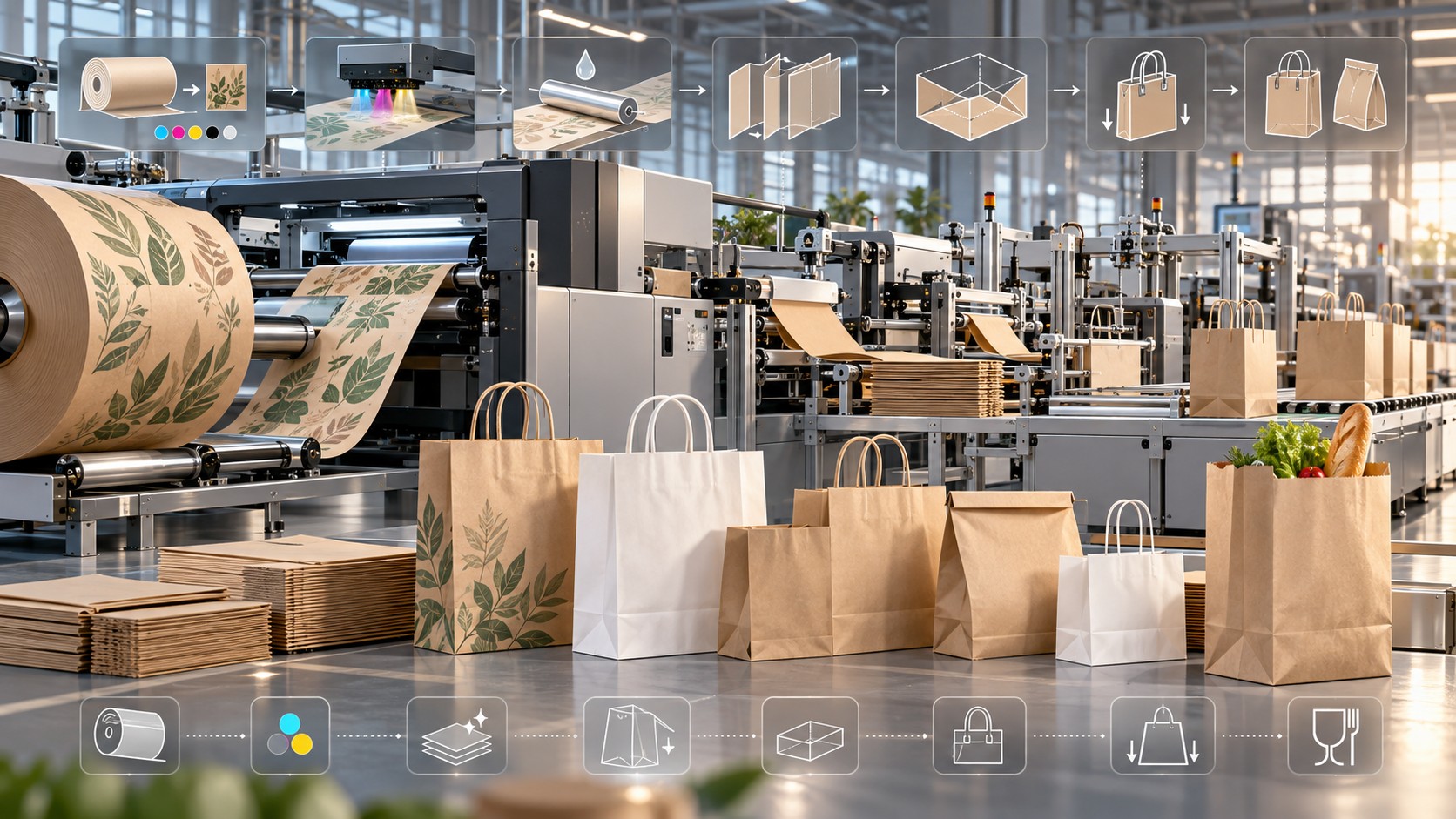
A paper bag is more than a printed sheet with handles
Paper bags are among the world's most familiar packaging products. They are used in fashion stores, food retailers, bakeries, restaurants, pharmacies, gift shops, and a broad range of commercial markets. From the outside, the construction appears straightforward: printed paper, folded side panels, a bottom that supports the contents and, in many cases, handles.
Behind this apparent simplicity is an engineered system in which every decision affects the finished product's performance. The paper grade governs tensile strength and folding behavior; basis weight and structural design influence load capacity; the ink and protective coating must withstand the mechanical stresses of converting; the adhesive must maintain seam integrity; and the handles must transfer the load into the bag without tearing the paper.
Print quality is consequently only one condition for a successful application. A sheet can leave the printing press with accurate color, excellent registration and a premium finish, yet fail when the bag is filled or lifted. Developing paper-bag applications must therefore begin with the intended use rather than selecting a printing technology. The real objective is a bag that carries its contents, protects the product, retains its printed appearance and survives the defined distribution and use conditions.
Applications: one product family, many different requirements
A bakery bag for a lightweight pastry is not designed to the same mechanical specification as a shopping bag carrying several beverage bottles. A jewelry or perfume bag may prioritize appearance, surface texture and decorative finishing. A food-service bag may need grease or moisture resistance. A heavy-duty bag places particular demands on its bottom, sidewalls and handle attachments.
Paper bags should therefore be treated as a family of applications rather than one standardized product. Their final requirements determine the substrate grade, number of plies, seam geometry and manufacturing route.
Application | Typical contents | Primary requirements |
|---|---|---|
Retail shopping bags | Clothing, shoes and consumer goods | Carrying strength, handle integrity and branding |
Luxury gift bags | Jewelry, perfumes and gifts | Premium print, finishing and accurate corners |
Bakery bags | Bread, pastries and cookies | Food suitability and breathability or barrier performance as needed |
Food-service bags | Prepared food, takeaways and meals | Stable bottom and appropriate moisture and grease resistance |
SOS grocery bags | Groceries and everyday retail products | Flat base, dimensional stability and load capacity |
Industrial paper sacks | Powders, granules and industrial materials | Mechanical strength, multiple plies and transport durability |
The principal structural formats
Paper-bag engineering begins by distinguishing among the main formats. Each uses the sheet differently, and each distributes mechanical loads through a different geometry.
Flat bags
The flat bag is one of the simplest constructions. It is generally a relatively flat envelope with a side or back seam, depending on the production method. It suits light merchandise, bakery items and other products that do not demand substantial internal volume. The simplicity of the construction can make production efficient, but a bulky product must distort the paper to fit; the finished dimensions and paper grade must therefore be chosen accordingly.
Satchel bags and side gussets
Satchel bags usually incorporate gussets: folded side sections that expand as the bag is filled. The gussets create more useful internal volume and influence how stresses are distributed when the bag opens. Correct gusset geometry allows convenient filling while maintaining the integrity of the paper and its folded joints.
Self-Opening Satchel (SOS) bags
SOS bags are among the most significant industrial formats. They open into a structure with a square or rectangular bottom, allowing the bag to stand unsupported. This property is particularly useful for automated filling, grocery shopping, bakeries and food-service operations. Stability does not arise from geometry alone; it also depends on paper stiffness, folding accuracy and the strength of the bottom adhesive bonds.
Carrier bags with handles
Carrier bags incorporate a handle system attached to the bag body. The handles may be formed from twisted paper, folded flat paper, rope or another suitable material. Some constructions use reinforcement patches around the attachment points. Here, the engineering requirement extends beyond the handle's strength: the entire load path between the handle and the paper body must be designed to resist tearing.
Bag structure: geometry matters as much as material selection
A paper bag is a three-dimensional package converted from flat stock. When filled, the product's weight acts on the bottom. The bottom transfers loads to the walls and bonded seams. When a handled bag is lifted, stresses pass through the handle anchors. These forces are not necessarily distributed uniformly.
A heavy item positioned to one side produces an uneven load. A bottle with a narrow base may concentrate pressure on the bottom, while a product with sharp corners may initiate a local tear. Carrying capacity cannot therefore be determined solely from the basis weight of the paper. Assess it for the full construction, using the intended product and a realistic load scenario.
Substrate selection: Kraft paper
Kraft paper is one of the most widely used substrates in paper-bag production. The term refers to a pulp-manufacturing process that can produce fibers with useful strength characteristics. Kraft grades are available in different compositions, surface textures, and appearances.
Brown Kraft has a relatively natural brown appearance that is often selected for everyday retail packaging or a deliberately understated brand identity. White, bleached Kraft provides a brighter background for multicolor graphics and premium presentation. These differences are not merely aesthetic. Each grade must also be evaluated for tensile strength, tear resistance, surface smoothness, absorbency, and folding performance.
A rougher paper surface may require different printing conditions than a smooth, pigment-coated sheet. The specific grade, rather than the generic term 'Kraft,' determines the practical manufacturing window.
Bleached, recycled and wet-strength paper
Bleached Kraft enables a brighter printed appearance. Recycled Kraft incorporates recovered fiber according to the grade's specification. Wet-strength Kraft is designed to retain more strength after moisture exposure than ordinary untreated paper.
Recycled paper is not automatically mechanically weak, and virgin-fiber paper is not automatically suitable for every product. Fiber quality, processing history, furnish, and finishing govern the actual result. In food applications, recycled fiber suitability also requires chemical assessment: not every recycled paper grade is appropriate for direct food contact. Fiber origin, potential contaminants, and intended contact conditions must be considered.
Coated paper and duplex board
Luxury carrier bags sometimes use pigment-coated paper or thinner paperboard engineered for high-quality printing. A smooth mineral coating can improve print uniformity and make photographic graphics or refined color work easier to reproduce. Duplex board and other multilayer paperboard constructions may be chosen when greater structural stiffness is needed.
Increasing thickness does not invariably improve the finished bag. A sheet that is too stiff may be difficult to fold into gussets or a square bottom. It may also require a different converting machine or creasing arrangement. Substrate selection must therefore be coordinated with the paper-bag converter before the job is approved for production.
Paper weight: GSM is not carrying capacity
Basis weight is expressed in grams per square meter (GSM) and is often the first material property considered. Lightweight flat and satchel bags may use grades in the approximate range of 35–80 GSM. SOS bags are commonly produced from grades around 45–130 GSM. Retail carrier bags and luxury applications can require higher basis weights or substantially thicker paperboard depending on the structure.
These ranges describe examples of paper selection, not universal weight ratings. A bag made from 120 GSM paper does not necessarily carry more weight than every bag made from 100 GSM paper. Fiber quality, machine direction, bottom construction, adhesive bonding and handle anchorage all affect actual capacity. Testing the finished bag establishes the product's load rating.
Tensile strength, tear resistance and burst strength
Several mechanical properties help characterize paper-bag substrates. Tensile strength describes a sheet's resistance to pulling force under a defined test. Tear resistance measures resistance to the propagation of an existing tear, which is especially important around punched holes and handle attachment points. Burst strength measures resistance to rupture under an appropriate applied pressure.
These properties are not interchangeable. Paper with high tensile strength does not automatically exhibit equally high tear resistance. A sound qualification plan must therefore select tests relevant to the intended bag geometry. Testing after conversion is indispensable because folds, glue seams, perforations and handle attachments can govern the overall failure mode.
Moisture content and dimensional behavior
Paper is hygroscopic: it absorbs or releases moisture as the surrounding conditions change. This affects dimensions and mechanical properties. Excess moisture can impair feeding, flatness, and print consistency; overly dry paper may be more susceptible to cracking or tearing during folding.
Therefore, storage and conditioning conditions must be controlled. A room temperature of approximately 21–24°C and relative humidity around 50% can be a useful starting point for some manufacturing environments, provided the substrate and machine specifications permit it. These conditions are not universal requirements. Rolls or sheet stacks arriving from a different warehouse climate must be allowed sufficient time to equilibrate, taking into account their wrapping, size and storage conditions.
Multilayer paper structures and functional barriers
Not all paper bags are constructed from a single ply of uncoated paper. Certain applications combine paper with polyethylene (PE), other polymer films, aluminum, or specialized barrier coatings. The purpose may be to protect against moisture, grease, gas transmission, or aroma loss, depending on the product.
A bag for fresh bakery goods may not need the barrier structure required for a dry, moisture-sensitive powder. Grease-resistant papers can serve some food applications without a continuous conventional plastic film, while other products require a functional coating or laminate. The selection must be based on the completed bag's performance and the actual conditions of use.
Window bags: a transparent view of the product
Window bags combine a paper body with a transparent panel so that consumers can see the contents. They are common in bakery packaging, dry foods, and selected retail products. The window may be made from a suitable polymer film or another transparent material selected for the application.
The joint between the window and the paper is a critical interface. It must survive filling and handling and, where relevant, comply with food-contact requirements. A window also changes the bag's mechanical structure and potentially its recyclability. Its area, position, and attachment chemistry belong in the initial design, not as late additions.
Paper-bag engineering: from flat artwork to a three-dimensional bag
After selecting the substrate, the converter specifies the finished width, height, gusset depth, bottom construction and seam locations. A carrier bag also needs handle positions and reinforcement details. Although the dieline is two-dimensional, the actual product must be assessed in three dimensions.
Certain printed areas disappear inside folded joints, others wrap around side panels, and some are turned inward to make the bottom. A logo too close to a fold may appear distorted on the finished bag. Artwork occupying a bonding area may interfere with adhesion. Prepress must therefore use an approved structural drawing with clear fold locations, glue zones and turning allowances.
No-print and no-coating zones
One of the most important design rules is to protect the surfaces that will form glued seams. A water-based adhesive needs to wet and bond to the actual surfaces in the joint. A low-energy varnish on a glue flap can prevent reliable contact, while a continuous ink film may change the adhesive interface.
The dieline must identify the relevant no-print and no-coating zones for the side seam, bottom and handle reinforcements. In some systems a compatible primer may remain in a bonding area, but its suitability must be demonstrated; not all primers improve glue adhesion, and not all glues adhere to every ink or coating. The objective is a durable joint after the adhesive has fully set or dried.
Printing technologies: offset, flexography and LEP
Paper bags can be printed using several technologies. Flexography is common in roll-fed manufacture; conventional offset serves a broad range of sheet-fed premium bags; UV variants are employed where the ink system and job requirements justify them; and Liquid Electrophotography (LEP) enables a digital production route for selected paper-bag applications.
Digital LEP can be particularly attractive for short and medium runs, multiple brand versions, personalized bags and fast product changes. The printing process must nevertheless match the paper grade and the downstream converting sequence.
Printing technology | Principal characteristic | Key qualification needs |
|---|---|---|
Conventional offset | High-quality sheet-fed graphics | Drying, absorption, registration and finishing |
Flexography | Suitable for many continuous roll-fed lines | Ink chemistry, drying, tension and repeat accuracy |
UV offset | Ink polymerization under UV radiation | Curing, adhesion and folding durability |
UV flexography | Flexographic printing with UV curing | Surface preparation, curing and finishing performance |
Digital LEP | Digitally transferred polymer-based ink image | Primer, adhesion, color stability and converting durability |
No printing technology is automatically suitable for every paper-bag style. The choice depends on substrate behavior, production economics, machine capabilities, and the finished product's technical specifications.
LEP printing on paper bags: what makes the application different?
Liquid Electrophotography creates the printed image using pigmented polymer-based ink particles that form a layer transferred to the substrate through a controlled process. Rather than relying primarily on a liquid ink soaking deeply into paper fibers, the transferred LEP ink must form a stable bond with the surface or its prepared interface.
Uncoated Kraft can be relatively rough and porous, while coated paper presents a smoother surface with different absorbency and chemistry. These substrates may need different primer systems. After printing, the sheet is folded, glued, and sometimes punched for handles, placing additional demands on the ink layer. LEP qualification for paper bags must therefore extend beyond visual image and color approval to the completed converted package.
The role of primers in LEP
In many LEP workflows, primer creates an interface that improves adhesion between the substrate and the polymer-based ink. Its job extends beyond initial printability: the printed construction must retain adhesion through coating, creasing, folding, gluing, and handling.
Some LEP printing platforms offer integrated primer application; others require a separately primed substrate or offline priming. The appropriate approach depends on the press platform and the media specification. A primer designed for a synthetic film should not be assumed to perform identically on porous Kraft. Each material combination requires its own qualification.
Primer application: coating uniformity and drying
Primer must be applied with enough uniformity to cover the relevant substrate surface. On rough paper, penetration and coat-weight distribution may vary across the sheet. Insufficient coverage may leave local regions of weak ink adhesion; excessive primer may complicate drying or alter surface properties.
Drying must bring the primer to a state appropriate for printing without creating blocking or excessive heat exposure. Where priming and printing are performed separately, the allowed interval between them is another process parameter: certain primer chemistries have a limited effective working window after application. The interval and drying conditions must follow the selected system's specification, not an assumed universal rule.
Is corona treatment required before LEP printing?
Corona treatment is often used to improve wettability on low-surface-energy polymeric substrates. It should not be treated as a mandatory routine step for ordinary Kraft or mineral-coated paper. However, if the print face carries a synthetic layer, appropriate surface treatment may be needed.
A crucial distinction is the difference between corona treatment before primer application and treatment after LEP printing in preparation for a varnish. These address different interfaces and require separate qualification. More treatment is not inherently better; the minimum effective level should be established through wettability and adhesion testing.
Color management: printing on brown versus white Kraft
Substrate color affects the final printed appearance. White Kraft provides a comparatively bright background, whereas brown Kraft influences color through its natural shade. Yellow may appear darker, pale graphics may lose brightness, and other colors may shift perceptually because of the interaction between the ink layer and the paper.
A single color profile is therefore not necessarily suitable for both papers. Color management must account for the actual substrate. Where the specific LEP platform and application support a compatible white ink, a white underlayer can reduce brown paper's influence on colored graphics. This improvement must still be evaluated against ink-layer thickness, adhesion and folding behavior.
Calibration and color consistency between print processes
Commercial brands often require repeated production across several runs, sometimes across offset, flexographic, and LEP printing. The workflow must establish an agreed color aim and appropriate measurement conditions for each substrate and print process.
Final evaluation should include the actual paper shade and the intended coating or lamination. A glossy laminated surface may appear different from a matte-finished bag even when the underlying ink image is similar. Press maintenance, calibration, media settings, and process control are essential to consistency in LEP; the file alone cannot guarantee identical color on every substrate.
Varnishing and coating before bag forming
Overprint varnish can protect graphics against scratches, rubbing and contact with components of the bag-making machine. It can also supply a gloss, semi-matte or matte appearance. In paper bags, however, you must judge coating performance during and after conversion.
A varnish that survives a rub test on a flat sheet may crack when folded sharply. A coating that creates an attractive surface may interfere with adhesive bonding at a seam. Varnish selection must therefore include flexibility, ink compatibility, bondability where relevant, and the mechanical stresses of the bag-forming line.
Water-based versus UV varnish
Water-based coatings are widely used on paper and paperboard. Their performance depends on how the formulation forms a stable film during drying. UV varnishes cure through a photochemical process and can provide various gloss and protective effects.
Characteristic | Water-based varnish | UV varnish |
|---|---|---|
Film formation | Drying and polymer-film development | Photochemical curing |
Rub and scuff protection. | Formulation-dependent | Formulation-dependent |
Folding flexibility | Depends on chemistry and coat weight | Depends on chemistry and degree of cure |
Uncoated paper | Often viable with suitable formulation | Absorption and final appearance must be assessed |
Compatibility with embellishment | Chemistry-dependent | Chemistry-dependent |
Food-packaging suitability | Requires appropriate assessment | Requires assessment, including curing and migration |
Neither family is universally superior. The specific formulation and its application conditions decide the outcome. If hot stamping or lamination follows coating, that compatibility must be confirmed before production.
Drying and curing coatings over LEP
LEP leaves a polymeric ink image that must be appropriately wettable for any subsequent varnish. Some processes use carefully controlled surface treatment between printing and coating. Wetting-tension measurements can help assess the prepared surface.
Values around 40–44 dyn/cm can be useful starting points in certain systems, but they are not universal requirements for every coating or LEP platform. The target must come from coating-system requirements and adhesion testing. A water-based varnish needs appropriate water removal, whereas UV varnish needs sufficient curing. Incomplete stabilization can cause blocking, unwanted transfer, or finish damage. Unnecessary heating should also be avoided because it can affect the paper's moisture content and folding characteristics.
Lamination and embellishment for luxury carrier bags
Luxury bags may incorporate decorative film lamination, hot stamping, embossing, debossing or other finishing effects. A laminated film can add distinctive texture and print protection; hot stamping transfers decorative foil with heat and pressure; embossing and debossing mechanically shape the surface.
Each operation can influence converting performance. A laminate may change the flexibility of the sheet; a stiff cured coating may crack at sharp folds; and foil situated across a fold may fracture. Finishing order and material compatibility must be established around the finished bag's geometry, not simply the appearance of a flat proof.
Sheet-fed and roll-fed manufacturing routes
Paper-bag manufacture can begin with printed sheets or printed reels. Sheet-fed work typically moves through cutting and converting steps matched to sheet format. Roll-fed systems can continuously combine web handling, folding, adhesive application, cutting, and bag forming.
Luxury carrier bags with rope handles and complex embellishment may require several separate machines and assembly operations. Standard SOS styles are frequently produced on automated roll-fed equipment. No single manufacturing route fits all bag structures. The application must match the converting plant's capabilities.
Die-cutting, scoring and folding
Once printing and finishing are complete, the paper must be prepared for the bag's geometry. Some lines use sheet die-cutting; others cut the material continuously as part of the bag-forming machine. Fold lines define the side panels, gussets, and bottom.
Machine mechanisms can often fold thin paper directly, whereas thick paperboard may need appropriate creasing or scoring. The goal is an accurate fold without unacceptable fiber tearing or damage to ink and coating layers. Fiber direction can also influence folding behavior and structural strength and should be considered during layout and tooling design.
Bag forming: constructing the body
The bag-making stage transforms prepared material into a three-dimensional package. On automated equipment, the sheet or web is fed, folded into its required geometry, and joined at the longitudinal seam. Side gussets are formed where the bag design calls for them, followed by bottom construction.
Depending on the machine and bag format, bottom forming can incorporate cutting, multiple folds, adhesive application, and compression. In SOS bags, the resulting rectangular base allows the bag to stand. Incorrect fold registration may produce an asymmetric bottom; inconsistent glue application can create weak joints. This stage reveals whether the printing, coating, paper and adhesive choices were truly compatible.
Selecting the adhesive chemistry
Paper-bag lines may use water-based adhesives formulated with starch, dextrin or suitable polymer dispersions. Certain applications employ compatible hot-melt systems. The choice depends on the paper grade, surface absorbency, machine speed and required bond strength.
Absorption must be considered carefully. If a water-based adhesive is absorbed too quickly by an open paper structure, insufficient material may remain at the joint interface. Conversely, a varnished or polymer-coated surface may resist wetting. The adhesive must match the actual mating surfaces. Excess glue does not automatically create a stronger joint; it can prolong drying, stain the paper, or cause local distortion. Controlled coat weight and consistent application are essential.
Side seam: maintaining the bag body
The longitudinal side seam joins the prepared paper edges to form the bag body. It experiences both pulling and bending stresses during use. Its overlap must provide enough contact area for reliable adhesion, but excessive overlap can increase local thickness and disrupt bag-machine operation.
Artwork and protective coatings should not occupy the joint if they impair bonding. The seam should be qualified after the adhesive has reached its specified developed strength, not solely when it first exits the machine.
Bottom forming: where the carried load acts
The bottom is among the most critical parts of a paper bag. As contents are inserted, their weight bears on the base, which must transmit forces into the sidewalls without opening its folds or joints. SOS bottoms are produced through a planned sequence of folds and bonded areas.
Luxury bags may also use a separate internal paperboard bottom insert to distribute the load and help maintain shape. This reinforcement does not excuse weak bottom seams. Both the base construction and any supporting insert must work together under the intended loading conditions.
Handle manufacture and attachment.
Carrying handles may be made from twisted paper, folded flat paper, rope, or other materials. Twisted paper handles use paper strands formed into a cord-like structure. Flat paper handles are built from folded or bonded strips. Rope handles, often chosen for luxury products, are installed through holes or attachment systems with appropriate reinforcement.
The chosen handle must fit the bag's intended load and appearance. A strong handle alone does not guarantee a strong bag: paper can still tear around the anchor. Qualify handle material, bonding area, paper tear resistance, and local reinforcement as a single mechanical system.
Reinforcement patches and load distribution
When a bag is lifted, loads concentrate at the handle anchoring points. Reinforcement strips or patches can spread those loads over a larger area. They may be made from paper, paperboard, or another qualified material.
The reinforcing patch itself needs reliable adhesion. A patch that separates from the sidewall cannot protect the paper beneath it. Handle strength testing must therefore examine the entire attachment system, including adhesive joints and the onset of paper tearing.
Carrying load: kilograms versus force in newtons
A retail bag is commonly specified by the mass it should carry, expressed in kilograms. Mechanical test equipment, by contrast, may measure the force applied to handles or seams in newtons. Do not confuse the two quantities. The static gravitational force of a load is approximately its mass multiplied by local gravitational acceleration, but lifting sharply and walking with the bag can create dynamic forces higher than the static load.
A sound test program should therefore define both representative static loading and dynamic handling, according to how the bag will actually be used. The load value, test duration, lifting method, and acceptance criteria must all be specified. For example, the specification should state whether local stretching is allowed, whether any bottom distortion is acceptable, and whether tear initiation at a handle anchorage counts as failure.
Food contact: when the bag holds unwrapped food
Not every paper bag is intended for direct food contact. A shopping bag carrying individually packaged products has different requirements from one holding bread, pastries or other unwrapped food. Direct or foreseeable food contact requires assessment of the paper, inks, varnishes, adhesives, and any functional barrier.
The food type matters. Dry, greasy and moist foods may require different constructions and evaluation conditions. Food temperature and contact time also influence suitability; a bag holding a warm pastry is not necessarily equivalent to one containing a dry ambient-temperature product. A generic statement that a paper grade is 'food suitable' cannot substitute for an application-specific assessment.
Low migration and set-off
Migration describes the movement of relevant substances from packaging components into food. Inks and varnishes can be relevant even when printed on the outside of a paper bag. Set-off is another possible pathway: when printed sheets are stacked or printed stock is wound, the printed face can contact a surface that will later face the food.
Such transfer does not necessarily create visible color marks. Proper ink and coating drying or curing is therefore part of chemical risk control. UV systems require appropriate cure for their chemistry; water-based inks and coatings require sufficient drying. A 'low-migration' formulation is not, on its own, a blanket approval for every food-contact use. The finished structure and its intended conditions must be evaluated.
Food-contact regulations
In the European Union, Regulation (EC) No 1935/2004 establishes the general safety framework for materials and articles intended to come into contact with food. Regulation (EC) No 2023/2006 defines Good Manufacturing Practice requirements, including controls to prevent unacceptable transfer from the printed side to the food-contact side.
Where a paper bag contains plastic layers falling within the scope of Regulation (EU) No 10/2011, the relevant requirements must be assessed under the applicable amended text. National requirements and professional recommendations, including BfR Recommendation XXXVI where relevant, may also need consideration for paper and board food-contact materials. In the United States, evaluate the applicable FDA provisions for the constituent materials and intended use. Regulatory suitability depends on the destination market and on the actual contact conditions.
Sustainability and recyclability: paper is not an automatic guarantee
Paper is a fiber-based material that can often be recovered through appropriate paper-recycling systems. However, a finished bag with plastic lamination, a window film, aluminum, specialist adhesive, or other components can present additional processing challenges.
Recycled content does not automatically mean the finished bag is recyclable. Likewise, a bio-based constituent does not automatically mean the bag will biodegrade in the natural environment or qualify for composting. Environmental claims require suitable evidence, tests and the relevant market's criteria. Regulation (EU) 2025/40 on packaging and packaging waste should also be considered for European markets in accordance with its applicable requirements and transition dates.
Responsible engineering should therefore consider end-of-life performance alongside load capacity, print quality and material efficiency from the beginning of development.
The end-to-end qualification plan
A successful paper-bag application requires verification through every production stage, using representative materials and industrial conditions rather than relying on a single laboratory sample.
Stage | Principal tests and controls | Qualification objective |
|---|---|---|
Paper | GSM, tensile and tear strength, moisture response | Suitability for the intended load |
Bag engineering | Dimensions, gussets and bottom design | Geometric and structural stability |
Surface preparation | Wettability and adhesion | Compatibility with primer and ink |
Priming | Coverage, drying and adhesion | Stable base for printing |
Printing | Color, registration, uniformity and ink durability | Consistent graphics |
Varnishing | Rub, scuff, drying and flexibility | Protection through converting |
Die-cutting / folding | Dimensional accuracy and fold performance | Correct construction |
Side seam | Bond strength and interface suitability | Bag-body integrity |
Bottom forming | Joint strength and base stability | Load transfer |
Handles | Handle and reinforcement bond strength | Reliable lifting |
Food contact | Migration, set-off and material suitability | Product safety |
Finished bag | Static and dynamic load tests and use durability | Final application qualification |
The plan must account for variation between paper lots, environmental humidity, adhesive materials and machine settings. One successful sample demonstrates technical possibility, not necessarily stable industrial production.
Relevant standards and test methods
Paper-bag production draws on material tests, bag-performance specifications and food-safety frameworks. A critical distinction must be made between retail carrier bags and industrial paper sacks: do not apply a test or standard written for one category indiscriminately to the other.
Standard | Subject | Main relevance |
|---|---|---|
EN 13590:2003 | Characteristics, volume and carrying capacity | Flexible retail carrier bags |
ISO 536 | Basis weight | Paper and board |
ISO 1924-2:2008 | Tensile strength and elongation | Paper and board |
ISO 535:2023 | Cobb water absorptiveness | Paper and board within method scope |
ISO 6590-1:2025 | Paper-sack terminology | Industrial sacks, not ordinary retail bags |
ISO 6591-1:2026 | Empty paper-sack dimensions and measurements | Paper sacks |
ISO 22000:2018 | Food-safety management | Organizations in the food chain |
ISO 22002-100:2025 | Common prerequisite programs | Relevant food-chain and packaging operations |
ISO 22002-4:2025 | Packaging manufacturing prerequisite programs | Food packaging production |
These standards do not remove the need to establish a product specification. Carrying capacity, for example, requires a defined test method and acceptance criteria tailored to the intended retail bag. Relevant edition and market applicability should be checked before contractual or regulatory use.
Troubleshooting: when the bag looks good but fails in use
When defects appear, the first task is to identify the stage and interface at which the failure originated. Many failures that are visible on the finished bag are not printing-press problems.
Symptom | Possible mechanism | Technical investigation |
|---|---|---|
Ink peeling from Kraft. | Primer incompatibility or surface characteristics | Qualify primer/ink adhesion on the actual paper. |
Color shift between brown and white Kraft | Substrate shade affects reflected color | Adjust color-management aim and substrate profile |
Cracking at folds | Rigid varnish or unsuitable stock | Verify coating flexibility and fold geometry |
Ink abrasion in the bag machine | Insufficient mechanical protection | Qualify varnish and inspect machine-contact path |
Blocking in stacks | Inadequate drying or curing | Check drying/cure and storage conditions |
Side seam opens | Coated glue area or incompatible adhesive | Inspect no-coating zones and bonding system |
Bottom opens under load. | Faulty fold geometry or weak adhesive bond | Qualify bottom-forming and adhesive application |
Handle tears away | Local stress concentration or weak reinforcement | Re-engineer handle anchor and patch geometry |
Bag loses stiffness in humidity. | Paper unsuitable for exposure conditions | Reassess wet strength and barrier construction. |
Unacceptable migration | Mobile constituents, set-off or material mismatch | Evaluate and test the completed food-contact system |
Dimensional changes after finishing | Moisture exchange or thermal stress | Optimize conditioning and drying |
When a bag tears during lifting, the fracture location is essential evidence. Tearing around a handle suggests a local reinforcement or tear-propagation problem; opening at the bottom points to bottom geometry or bonding; separation of the longitudinal seam calls for examination of the actual adhesive interface.
Cracking at folds requires analysis of coating flexibility and material selection. A color shift after finishing should be distinguished as an optical change from gloss or lamination versus an actual chemical change to the colorants. The solution should follow the identified mechanism. Increasing paper GSM does not automatically solve a handle-bond failure; applying more glue does not cure an incompatible coated seam; and adding more varnish may reduce fold durability. Controlled comparative trials are preferable to changing several variables at once.
Conclusion: a paper bag is tested when someone lifts it
Paper-bag manufacture is an end-to-end application that combines paper engineering, structural design, printing technology, coatings, adhesives, and converting operations. Substrate selection governs strength and folding; geometry governs load paths through the bottom, walls, and handles; and offset, flexography, or LEP can deliver the intended graphics when matched to the substrate and downstream processes.
The ink and varnish must survive folding, gluing, and actual use. Bottom joints must remain stable, longitudinal seams must maintain strength, and handles must transfer the expected load without unacceptable paper tearing. Food applications add chemical safety, risk-management, and product-contact requirements.
A printing press creates the graphics. Paper, joint, adhesive chemistry, and bag structure engineering create the package that can carry the product.
A paper-bag application is not fully qualified when the printed sheet leaves the press. It is qualified when the printed, coated, cut, folded, glued, and finished bag meets its intended performance.
The real test is not how the bag looks at the end of printing, but whether it stays attractive, stable, and intact when it is filled, lifted, and carried to its destination.