RONEN DOLEV
When Packaging Becomes Part of the Product Experience
Luxury packaging is not designed solely to protect the product inside. In many applications, it is an integral part of how customers perceive the product, its quality, and the brand behind it.
A box for jewelry, a watch, perfume, or premium electronics is expected to communicate quality before the product itself is revealed. The texture of the wrapping material, the precision of the corners, the fit between the lid and the base, the resistance felt during opening, and even the sound produced when closing the box can all influence the user's experience.
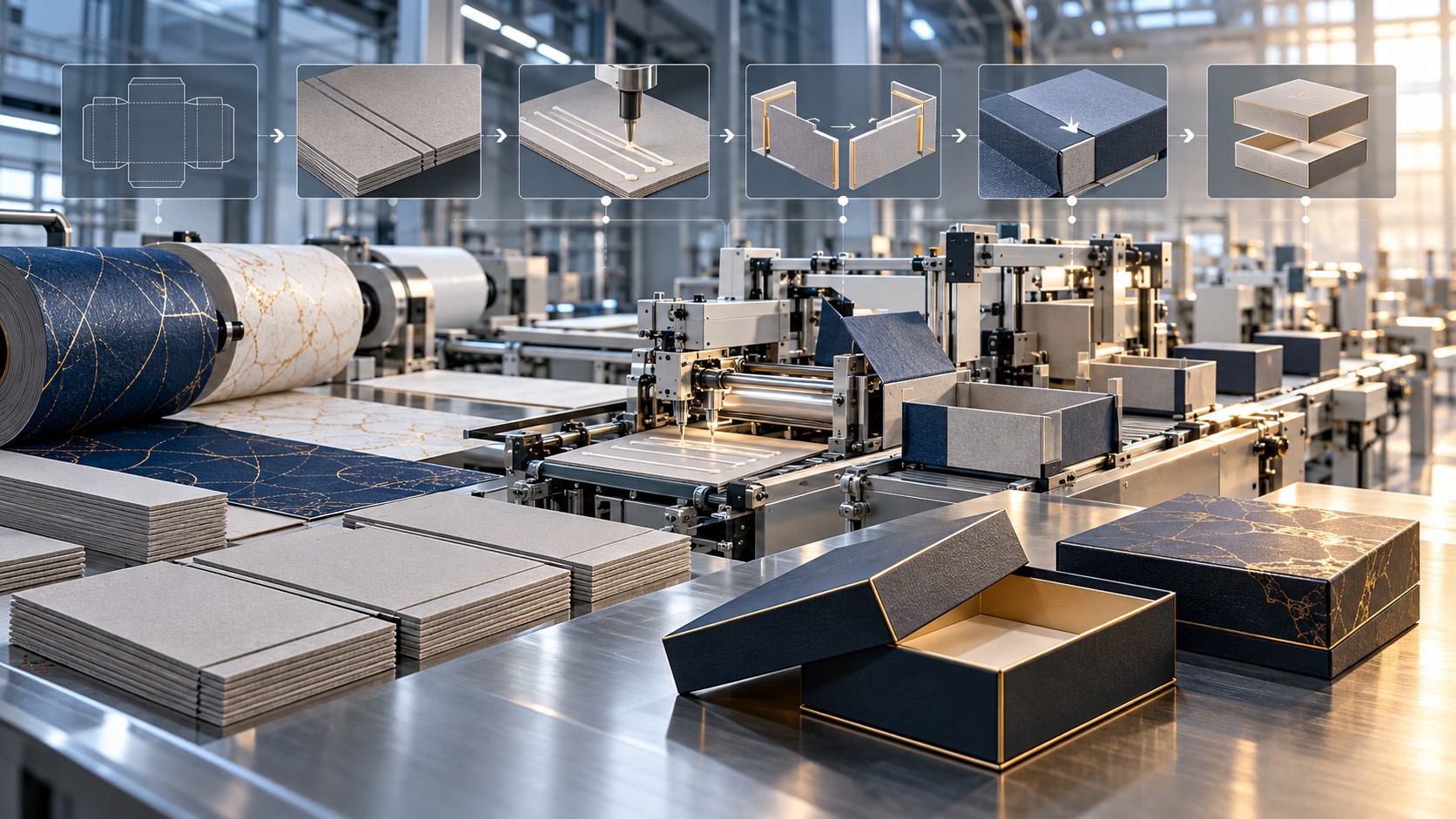
Behind that appearance lies a demanding engineering system. Unlike a typical folding carton, which is generally cut and folded from one relatively thin paperboard sheet, a rigid box is usually made from several components. A thick, compressed paperboard core supplies structural rigidity. A thinner printed wrap provides the visual and tactile finish. Adhesive bonds these two materials, while cutting, grooving, forming, and wrapping operations create the final three-dimensional structure.
Successful printing does not guarantee successful wrapping. A sheet may exhibit excellent color accuracy and ink adhesion yet develop wrinkles, blisters, distortion, or delamination once it is bonded to the rigid board. For that reason, application development begins with the finished box's performance and appearance, not with selecting a printing press.
What Is a Rigid Box, and Where Is It Used?
Rigid boxes, also known as set-up boxes, are packaging structures designed to retain their three-dimensional shape even when empty. Unlike many folding cartons, they do not usually collapse into a flat configuration for shipment. Their construction allows substantial rigidity, defined corners, controlled lid fit, and a uniform premium finish.
They are widely used for jewelry, watches, cosmetics, perfumes, premium chocolates and confectionery, consumer electronics, gifts, collectibles, presentation kits, and luxury retail products. Some versions incorporate internal trays, partitions, cushioning, ribbons, magnets, or other features that present and retain the product.
This format isn't automatically the best choice for every application. Rigid boxes usually require more material, more conversion steps, and greater storage and transportation volume than collapsible cartons. The additional value must therefore justify the cost and complexity. For some premium products, the box becomes an object the customer keeps and reuses. In these cases, assess performance over repeated opening, closing, handling, and storage cycles, not just the first delivery.
Main Rigid-Box Styles
A rigid box's construction is selected according to product geometry, the intended opening experience, and the way the box must function.
Construction | Design principle | Common applications |
|---|---|---|
Full telescope box | A separate lid covers most or all of the base height | Jewelry, luxury goods, gift sets |
Partial telescope box | A separate lid covers only part of the base | Cosmetics, games, presentation packaging |
Shoulder or neck box | An internal shoulder locates and supports the lid | Perfume, watches, premium gift boxes |
Slipcase or drawer box | An inner tray slides out of an outer sleeve | Electronics, collectibles, presentation kits |
Hinged flip-top box | Lid and base are joined through a hinge structure | Jewelry, watches, premium gifts |
Book-style rigid box | A case opens in the manner of a book cover | Promotional kits and premium sets |
A full telescope box places the lid over nearly the complete base. Here, dimensional fit is critical: an excessively tight fit makes opening difficult, while an oversized fit undermines the sense of precision. A shoulder box uses an internal component to define where the lid stops and can create a distinctive reveal. A drawer construction requires sufficient clearance for smooth movement without excessive play. Hinged and book-style structures introduce repeated bending and durability requirements at the hinge.
These are not simply design variations. Each calls for a different combination of board thickness, cutting geometry, adhesive selection, assembly method, and dimensional tolerances.
Two Material Systems: A Rigid Core and a Printed Wrap
One of the defining features of rigid-box construction is that structural performance and printed appearance are supplied by separate materials. In a folding carton, the printed paperboard typically provides much of the mechanical structure. In a rigid box, the roles are divided.
Rigid chipboard or greyboard establishes the shape and stiffness. The printed wrap supplies the surface the customer sees and touches. An adhesive layer joins them. A typical structure, viewed from outside to inside, can include a protective varnish or decorative laminate; printed ink; a primer where required; thin wrapping paper or paperboard; adhesive; and a thick compressed board core. An additional liner or decorative paper may be applied inside.
This design flexibility also introduces interfaces that require qualification. A failure between wrap and adhesive, or between adhesive and core, can ruin the appearance and integrity of the entire package even when the individual materials are acceptable.
Selecting the Rigid Core: Greyboard and Chipboard
The rigid core is generally made from highly compressed paperboard with relatively high caliper and basis weight. Greyboard, often manufactured using recovered fibers, is common. Other grades may have a lighter or white-facing side, depending on the required appearance of the box interior.
Selection depends on box size, product weight, handling conditions, and the required rigidity. Materials around 1–4 mm thick and with a wide range of basis weights are frequently used, but these are material-selection ranges, not mandatory specifications for every construction.
Thickness alone is not enough. Two boards with the same caliper can behave differently if their densities, fiber structures, and mechanical properties differ. A dense core may respond differently during cutting and grooving than a bulkier board. Moisture content also matters: excessively dry material can crack or fracture at a fold, while excessive moisture can lead to dimensional instability, weak edges, and distortion.
The core must therefore be qualified for cutting quality, grooving performance, corner formation, flatness, and dimensional stability under the conditions of the actual converting process.
Selecting the Printed Wrap
The outer wrap is the substrate used for most printing and embellishment operations. It may be a premium paper, coated paper, textured stock, or thin paperboard suitable for printing, bonding, and folding around edges.
The material must meet two requirements that can appear contradictory. Its surface must support high-quality reproduction and finishing, while the sheet must remain sufficiently flexible to wrap around corners without cracking. Printing performance in the flat state does not prove that a substrate will survive sharp turns in a wrapping machine.
Selection must consider surface smoothness, brightness, coating structure, caliper, stiffness, fiber direction, back-side bondability, and the intended corner radius. If the wrap will be laminated or given a relatively rigid UV coating, evaluate the resulting multilayer construction—not just the untreated paper—for foldability.
SBS, FBB and WLC: Different Paperboard Families
Several board families may be considered when a paperboard rather than a lighter paper is required for the decorative wrap.
Solid Bleached Board, often described as SBS or SBB, is made predominantly from bleached chemical pulp. It generally provides a bright surface and good printability. Folding Boxboard (FBB) is a multilayer structure that combines different pulp types to achieve a useful stiffness-to-weight ratio. White Lined Chipboard (WLC) commonly incorporates recycled fibers with one or more improved surface layers.
The correct choice is not simply the most expensive or thickest grade. Printability must be assessed alongside surface flexibility, back-side adhesive interaction, moisture sensitivity, and the geometry of the box. For a sharply wrapped corner, a thinner and more compliant substrate can sometimes produce a better result than a thicker, stiffer paperboard.
Moisture and Grain Direction Continue to Matter After Printing
Paper and paperboard are hygroscopic. They absorb and release moisture in response to their environment, changing both mechanical properties and dimensions. Their behavior also differs between the machine direction (MD) and the cross direction (CD), in part because of fiber orientation developed during manufacture.
A sheet can therefore expand or contract by different amounts along its two principal axes. These differences may appear as waviness, curl, or a change in flat dimensions. The effect becomes particularly significant in a rigid box because the printed wrap is bonded to a much thicker substrate. When the wrap and core change dimension by different amounts, stress develops at their interface.
Grain direction must therefore be considered in the layout, cutting plan, and intended fold geometry. Storage and acclimatization conditions also need to be controlled. Two materials stored in the same room are not necessarily at the same moisture equilibrium, especially when one arrives in tightly wrapped stacks and the other in thick boards.
Structural Design: From Flat Components to a Three-Dimensional Box
After selecting the materials, the construction must be engineered in two dimensions for assembly into three dimensions. Unlike a typical single-piece folding carton, the rigid core and the decorative wrap require different cutting layouts.
Core components establish the internal and external box dimensions. Wrap components require extra allowance to cover walls, edges, corners, and material folded inside. The design must account for wrap caliper, adhesive layer, corner construction, turn-in locations, and any internal liner.
For a separate lid and base, design each component as part of the same fitting system. Correct dimensions in isolation are not enough. After adhesive, wrap, and finishing layers are added, the two components must still engage and separate at the intended force and with the expected feel. Dimensional tolerances must accommodate the realistic variation of raw materials and machinery.
Prepress: Artwork Across Edges and Corners
A rigid-box graphic is printed on a flat sheet, but some areas are later carried around edges onto adjacent surfaces. Artwork placement must therefore follow the approved engineering dieline rather than the nominal printable rectangle.
Turn-in zones need to be defined. Critical text, logos, foil elements, and embossing should be kept clear of problematic fold or cut regions unless specifically designed and qualified for them. A logo too close to an edge may appear visually off-center after wrapping; an embellished feature crossing a sharp fold may distort or crack.
Graphic registration should relate to the actual core placement and wrapping reference, not simply the sheet edge. An approved mock-up is especially valuable for complex constructions because it reveals distortions not evident in a flat proof.
Selecting the Printing Technology
Decorative wraps can be printed using different technologies depending on substrate, run length, and design requirements. Conventional offset printing is widely used. Suitable digital printing processes, including liquid electrophotography (LEP), can also be used when the substrate and ink system qualify. Other printing processes may suit particular applications.
Digital printing offers commercial advantages for short runs, limited editions, personalization, and multiple graphic versions. Conventional processes may be effective for long production runs. Neither route automatically guarantees successful converting.
The ink must adhere to the wrap and remain stable through coating, lamination, stamping, handling, and wrapping. Printing registration must also match downstream cutting and assembly tolerances. When color is matched across printing technologies or suppliers, consistent color standards, measurement conditions, and substrate characterization are essential.
Final color approval should account for the finished surface. A shade measured before a gloss laminate can look different after lamination because the optical interface and surface reflectance have changed.
Ink Drying and Curing Are Part of Application Qualification
Before embellishment, the printed ink must be in a suitable state for the next process. Depending on the chemistry, ink setting may involve evaporation, absorption, oxidation, chemical reaction, or ultraviolet curing. Drying and curing are not the same process.
For UV inks, the emitted wavelength distribution, irradiance, exposure time, and photochemical formulation must provide an adequate cure. A dry-to-touch surface does not necessarily demonstrate complete reaction. Inadequate cure can contribute to blocking, poor adhesion, residual mobile constituents, or failure during finishing.
For drying-based systems, you must manage air movement, temperature, residence time, absorption, and substrate moisture. In rigid-box production, inadequate ink stability becomes particularly important during lamination, foil transfer, and frictional contact in the wrapping machine. Therefore, ink qualification should be repeated after the relevant finishing and assembly steps, not judged solely at the printing press delivery.
Overprint Varnishes: Appearance and Protection
Overprint varnish (OPV) can improve scuff and rub resistance and provide a desired gloss, matte, or satin appearance. Water-based and UV-curable systems may be used according to the substrate, ink chemistry, and subsequent conversion.
A water-based coating can protect the printed surface while a properly formulated and cured UV varnish may deliver strong decorative effects and mechanical durability. However, rigid boxes add another requirement: the coated wrap must bend around corners and edges. Excessively stiff coatings or excessive coat weight can crack at these locations.
The drying or curing process must not make the coating brittle or create blocking and set-off. If hot stamping or lamination follows, the OPV must be specifically suitable for that operation. A highly protective, heat-resistant varnish is not necessarily stampable or laminatable. Finishing sequence and chemical compatibility should therefore be established at the beginning of product development.
Decorative Lamination: One of Two Very Different Bonding Operations
In rigid-box production, the word lamination may refer to two distinct operations. The first is decorative lamination, where a film is applied to the printed wrap. The second is the adhesive bonding of the completed wrap to the rigid core during box assembly. Their mechanisms and failure modes are different.
Decorative lamination can use an appropriate polymer film to obtain a glossy, matte, tactile, or protective surface. It may improve scratch and handling resistance. But it also changes the wrap's bending behavior, moisture response, and composite stiffness.
An unsuitable film, adhesive, or laminating process can introduce residual stress, curl, bubbles, cracks, or delamination during corner wrapping. The film, adhesive, and process temperatures must be selected for the exact ink and substrate system. Qualification must include folding and wrapping trials at realistic corner radii, rather than relying on peel results measured only on flat sheets.
Hot Stamping: Metallic and Specialty Effects
Hot stamping uses a transfer foil, a suitable die, and controlled heat and pressure to decorate designated regions. Metallic and other specialty foils can add distinctive brilliance and optical effects to premium packaging.
Transfer depends on the compatibility of the foil's adhesive layer with the printed or coated surface. Some OPVs impair foil adhesion even though they perform well in standard scuff testing. Too much heat or an unsuitable pressure distribution can distort the printed surface or damage the substrate.
Fine details demand correctly prepared dies and appropriate support. Foil elements near corners or folds should be qualified for the mechanical loads they will face. The objective is not merely a clean foil impression on a flat sheet; the transferred feature must remain intact on the finished box.
Embossing and Debossing: Introducing a Third Dimension
Embossing creates raised areas, while debossing produces recessed features. Both use mechanical deformation to add texture, depth, and tactile differentiation to the decorative wrap.
The process depends on tooling geometry, pressure, substrate caliper, fiber structure, and whether the substrate has a coating or lamination. A film-laminated wrap may require different forming conditions from untreated paper. Feature location also matters: embossing too close to a sharp turn-in can deform or flatten during assembly.
Whether embellishment is performed before or after wrapping should be decided based on the box structure, decoration type, and equipment capability. The finished feature—not the isolated flat-sheet impression—is the acceptance criterion.
Die-Cutting the Wrap and the Core
Printing and finishing are followed by cutting operations. Two distinct cutting tasks follow: producing the thin decorative wrap and producing the thick rigid-board components.
Wrap cutting requires accurate graphic registration, clean edges, and protection of the ink and finishing layers. Core cutting must handle dense, thick board without uncontrolled splitting or ragged edges. The cuts determine corner accuracy, overall geometry, and the final fit between components.
Small core dimensional errors can become conspicuous once the wrap and adhesive are applied. For that reason, both cutting operations should be controlled against a common approved structural design and realistic process tolerances.
Creasing, Scoring and Grooving: Different Methods for Different Thicknesses
Thin wrapping materials can use creasing to guide folding and distribute strain. Thick compressed board often requires a more pronounced local reduction in bending resistance, achieved by scoring, controlled partial cutting, or grooving.
A half-cut leaves sufficient material to function as a hinge while reducing the effort needed to form a corner. V-grooving removes material in a shaped channel to permit precise folding with a particular corner geometry. The correct choice depends on board thickness, density, grain direction, and the required geometry.
A groove that is too shallow can cause cracking, spring-back, or inaccurate corner angles. Too deep a groove weakens the hinge region and can cause failure during forming or use. The engineering objective is not simply to bend the core; it is to achieve straight, stable, repeatable corners without sacrificing necessary strength.
Corner Pasting: Preparing the Rigid Structure
Once the core has been cut and prepared, its flat components are formed into a tray or related shape. In a common construction, a corner-pasting machine uses adhesive tape or another suitable fixing method to hold the formed corners in position for the subsequent wrapping step.
Corner-pasting quality matters because the decorative wrap cannot reliably correct a distorted rigid structure. Misaligned corners, out-of-square geometry, and dimensional inconsistency remain visible—or become more apparent—after the box is wrapped. Corner angles, geometry, and structural stability should therefore be inspected before the core enters the wrapping station.
Adhesive Application: Bond Chemistry and Moisture Balance
Bonding the decorative wrap to the rigid core is one of the most sensitive operations in the production chain. The adhesive must create reliable contact between the back of the wrap and the compressed board surface. Many applications use water-based polymer dispersions, including suitable polyvinyl acetate (PVAc) systems, while other adhesive chemistries may be selected for particular materials and machinery.
Adhesive choice depends on surface absorbency, roughness, chemical compatibility, viscosity, solids content, application weight, open time, and set or drying behavior. Excess adhesive does not necessarily improve bond strength. It can introduce excess moisture, curl, stains, slow drying, or equipment contamination. Insufficient or uneven coverage can cause blisters and local debonding.
Water-based adhesive may temporarily expand the paper wrap. Subsequent drying can then cause contraction while the wrap is already constrained by the rigid core. The resulting stress can distort surfaces or corners. Proper coating weight, uniform application, environmental control, and timely transfer to wrapping are therefore critical.
Wrapping: Where the Printed Surface Becomes the Box
In the wrapping process, the printed cover is registered precisely with the rigid core. On many automatic systems, the printed face is oriented downwards while adhesive is applied to the reverse side. The wrap is transferred to an assembly station, often with vacuum assistance to maintain flatness.
The core is positioned accurately on the adhesive-coated sheet. Controlled pressure establishes the initial bond, after which mechanical wrapping elements fold the remaining material over the walls and inward around the edges. The turn-ins are secured, creating a seamless-looking external covering and concealing the raw board wherever the construction allows.
This step depends on registration, pressure distribution, surface flexibility, controlled adhesive tack, and the movement of the wrapping elements. An inflexible wrap may crease or tear near a corner. A moisture-unstable wrap may change dimension before or during assembly. Too little initial tack can permit displacement; too much moisture may encourage later distortion.
Success is measured by the assembled box: clean corners, smooth surfaces, symmetrical artwork, secure turn-ins, and an intact bond throughout the structure.
Understanding Wrinkles, Bubbles and Curl
Wrinkles, blisters, and curling are sometimes attributed immediately to insufficient adhesive strength. Yet the mechanism can be very different.
A bubble can result from nonuniform adhesive coverage or air trapped during positioning. Curl can develop when one side of the decorative wrap absorbs more moisture than the other, particularly if a decorative laminate restricts expansion on the printed face. Drying and subsequent differential contraction then generate stresses within the composite.
A thick UV coating can influence bending behavior, while excessive adhesive can add more water than the construction can tolerate. Therefore, increasing adhesive weight or pressing force without investigating the cause may worsen the problem. The correct experiment separates moisture effects, coating stiffness, adhesive chemistry, application uniformity, and machine registration.
Semi-Automatic and Fully Automatic Forming
Rigid boxes can be made on semi-automatic or fully automatic production lines. In semi-automatic production, core forming, adhesive application, and wrapping may be performed on separate machines, with manual positioning or transfer between stages. Such systems offer flexibility for varied constructions and relatively short runs, but repeatability depends heavily on operator consistency and alignment.
Fully automatic systems feed the core and wrap along separate paths and bring them together at the assembly station. Vacuum handling may keep the printed wrap flat while adhesive is applied and the core is registered. Pressure and wrapping mechanisms then produce the finished structure.
Automation increases the importance of dimensional repeatability, board flatness, consistent adhesive response, and stable moisture content. Moving from a semi-automatic to a fully automatic process is therefore not simply about speed. It can require tighter material specifications and revised process tolerances.
Internal Inserts, Trays and Product Presentation
In luxury packaging, the external box is often only one part of the finished application. A product-retaining insert may be necessary to support an object, hold it in a deliberate position, or protect it from impact and scratching.
Inserts can be made from paperboard, molded fiber, appropriately designed polymer trays, or other cushioning materials. Selection depends on product shape and weight, damage sensitivity, and the desired unboxing experience.
A jewelry item may require accurate positioning, while an electronic device may need impact restraint and an easy removal path. Magnets, ribbons, and specialty closures introduce additional interfaces and assembly considerations. These components also influence material separation and recyclability and should therefore be designed with the outer box rather than added at the end of development.
Functional Performance of the Finished Luxury Box
Rigid-box qualification must evaluate both appearance and function. Visually, the inspection may cover color consistency, graphic registration, gloss, foil quality, clean corners, smoothness, and the absence of trapped air or delamination. Mechanically, it should address stiffness, bond integrity, lid-to-base fit, and repeated operation of closures or hinges.
A box designed for repeated use may need defined opening-and-closing cycle tests. For distribution applications, vibration, compression, impact, conditioning, and drop tests may be relevant depending on the complete packaging system.
A crucial distinction is the difference between testing the presentation box alone and testing the full shipping unit, which may include an outer carton, protective inserts, and other cushioning. Successful results from one configuration cannot automatically be transferred to the other.
Standards and Test Methods
Rigid boxes do not have a single universal standard governing every performance attribute. Suitable test methods are selected according to the materials, the final structure, its contents, and the distribution environment.
Standard or method | Subject | Engineering relevance |
|---|---|---|
ISO 187:2022 | Conditioning of paper and board for testing | Controls environmental effects when comparing material properties |
ISO 534:2011 | Thickness, density, and specific volume of paper and board | Core and wrap dimensional consistency |
ISO 536 | Grammage of paper and board | Incoming substrate qualification |
ISO 535:2023 | Water absorptiveness by the Cobb method | Moisture sensitivity when relevant to the substrate |
ISO 12048:1994 | Compression and stacking tests for complete, filled transport packages | Evaluation of the complete shipping system |
ASTM D5276 | Free-fall drop testing of loaded containers | Transport impact performance |
ISO 18601:2013 | Packaging and the environment: general requirements | Framework for environmental assessment |
These methods do not necessarily specify one pass/fail value for all luxury boxes. Opening force, for example, depends on box dimensions, intended user experience, and closure design. Measure adhesive bond performance using a defined method and sample geometry, with acceptance limits appropriate to the construction.
Interpreting Adhesive Bond Failures
Evaluating adhesion between the wrap and core requires more than recording a peak peel force. The failure location is equally important.
If adhesive remains on the rigid board while the decorative paper separates, the interface between adhesive and wrap should be examined. If adhesive remains attached to the wrap but separates from the board, the opposite interface deserves attention. If paper fibers tear within one substrate, the bond may exceed the local cohesive strength of the paper, but this does not establish that every other packaging requirement has been met.
A robust assessment includes bond uniformity, bubble-free surfaces, corner integrity, and performance after environmental conditioning. Failure-mode documentation helps distinguish a chemistry problem from a material or process problem.
Visual Quality Is an Engineering Requirement
Premium rigid boxes are especially sensitive to small defects. A slight shift in artwork can be conspicuous on a large flat panel. Minor lid curl can damage the perception of precision. An uncovered corner can reveal the grey core. Small wrinkles near turn-ins may be highly visible even when the box is mechanically sound.
Visual acceptance must therefore be specified alongside mechanical limits. Suitable viewing distances and lighting conditions should be defined. Assess metallic foils and gloss laminates at different viewing angles, because directional reflections can reveal defects that remain hidden under diffuse lighting.
In premium packaging, the tactile and visual finish is not an optional afterthought. It is a functional deliverable of the application.
Product Safety: Food, Cosmetics and Medical Applications
Not every rigid box is intended to contact its contents directly. Many are secondary packages containing a product already enclosed in a primary pack: a sealed perfume bottle, a protected confectionery tray, or an electronic device held in an insert.
Direct-food-contact legislation should not automatically be applied to every decorative box. Instead, the role of each packaging layer and the possible contact or transfer routes must be assessed. If a rigid box or its liner is intended for direct food contact, or if a relevant route for substance transfer exists, requirements such as Regulation (EC) No 1935/2004 and Regulation (EC) No 2023/2006 may apply, depending on the product and market.
Where relevant, migration, odor, and taint risks must be examined. In medical-device applications, a decorative rigid box must be clearly distinguished from a validated sterile barrier system. Regulatory requirements follow the packaging's function and intended use—not its premium appearance.
Sustainability and Recycling: Paper-Based Does Not Mean Automatically Recyclable
Rigid boxes can contain a substantial proportion of fiber-based material, and recycled fibers are common in many greyboard grades. However, the finished product may also include polymer film laminates, metallic-effect layers, adhesives, magnets, and complex inserts.
The presence of a paperboard core does not establish that the complete package can be recycled through every paper recycling stream. Actual recyclability depends on material composition, local collection and processing systems, the ability to separate components, and how the assembled structure responds during repulping.
Permanently embedded magnets, some laminated finishes, and mixed-material inserts can add complications. At the design stage, alternatives that provide the necessary function with simpler or more separable structures should be evaluated against performance, appearance, cost, and environmental objectives.
For products placed on the European market, Regulation (EU) 2025/40 on packaging and packaging waste should be considered according to its applicable requirements and implementation dates. The goal is not to eliminate premium packaging but to engineer its value in proportion to the materials and complexity used.
End-to-End Qualification Matrix
Rigid-box development requires a qualification plan that follows the construction through every production stage. Individual material tests are valuable, but the finished product must be assessed as an integrated system.
Stage | Principal verification | Intended outcome |
|---|---|---|
Greyboard core | Thickness, density, flatness, moisture, and stiffness | Stable structure and forming behavior |
Printed wrap | Surface, flexibility, dimensional stability, and cleanliness | Printability and wrapping suitability |
Printing | Color, registration, ink adhesion, and durability | Reliable graphic reproduction |
Drying or curing | Appropriate ink and coating state | Reduced blocking and finishing failures |
OPV | Adhesion, rub, scuff, flexibility, and fold resistance | Protection through subsequent conversion |
Decorative lamination | Bond strength, bubbles, curl, and fold performance | Integrity of the decorated wrap |
Hot stamping | Transfer quality, registration, and foil adhesion | Consistent decorative effect |
Die-cutting | Dimensions and edge cleanliness | Accurate components for forming |
Scoring and grooving | Depth, geometry, and bending behavior | Strong and accurate corners |
Adhesive application | Coating uniformity, weight, and open time | Reliable wrap-to-core bond |
Wrapping | Registration, turn-ins, corners, and smoothness | Finished-box appearance and integrity |
Finished box | Lid fit, stiffness, cycling, transport, and visual quality | Qualification for the intended use |
Testing should use production-representative materials and machine settings. Variability between batches of paper, greyboard, adhesives, and finishing materials must be considered. A successful prototype demonstrates feasibility; it does not by itself establish reliable industrial repeatability.
Troubleshooting: When the Print Is Good, but the Box Is Not
Some defects appear only after the rigid box has been assembled. Their causes may lie in the adhesive, moisture balance, decorative lamination, cutting accuracy, or local stresses generated by the wrapping operation. The correct investigation identifies both the failure mechanism and the stage at which it developed.
Symptom | Possible cause | Investigation or corrective direction |
|---|---|---|
Wrap curls after gluing. | Adhesive moisture, differential swelling, or residual laminate stress | Review adhesive coat weight, conditioning, and laminate properties |
Bubbles beneath the wrap | Nonuniform glue coverage or trapped air | Inspect coating uniformity and bonding sequence |
Wrap separates from the core. | Incompatible adhesive, surface condition, or open time | Locate the failure interface and qualify the bond system |
Cracking at corners | Stiff varnish or laminate, or excessively sharp bend | Review wrap construction and corner geometry |
Foil peels or cracks | Unsuitable interface or hot-stamping conditions | Check coating compatibility, pressure, and temperature |
Core breaks at the groove. | Incorrect groove depth or excessively dry board | Requalify scoring or grooving and board conditioning |
Corners are out of square. | Cutting or corner-pasting inaccuracy | Check tooling, dimensions, and formed-core alignment. |
Artwork is off-center | Wrap-to-core registration mismatch | Correct the wrapping registration references |
Lid is difficult to open. | Insufficient clearance or dimension change during drying | Review tolerance stack-up, layer thickness, and conditioning |
Printed surface scuffs | Mechanical contact or insufficient protective coating | Trace machine contact points and qualify a compatible finish |
When curl appears, changing glue is not necessarily the first corrective action. The investigation should measure the water introduced into the structure and how the paper and laminate respond. When delamination appears, the exact separation interface must be identified. When a corner cracks, the bend geometry and flexibility of the entire decorative structure matter as much as the ink's initial adhesion.
If the lid binds, examine dimensional tolerance stack-up, including the core, the wrap, adhesive build, and environmental changes during drying. Increasing adhesive weight, wrapping pressure, or varnish coat weight without isolating the mechanism can conceal the real issue or create a new defect. Engineering improvement requires a controlled comparison focused on the confirmed failure mode.
Conclusion: Where Materials Engineering Meets Industrial Design
Rigid-box manufacturing combines materials with fundamentally different functions into one finished product. The compressed board provides structure. The decorative wrap delivers appearance and tactile experience. Coatings, laminates, and embellishments add protection and distinctive visual effects. Adhesive bonds the components. Die-cutting, scoring, corner pasting, and wrapping transform flat parts into a precise three-dimensional box.
But success is not defined by one layer or one machine. An attractive wrap that cannot bend fails at the corners. A strong core that isn't grooved properly can break. A high-strength adhesive can still lead to curl if moisture and drying behavior are uncontrolled. A well-formed lid will not fit its base if the thickness of the final wrap was ignored during dimensional design.
Application engineering must therefore connect every stage, from material selection and graphic preparation to adhesive chemistry, assembly, and functional qualification.
The printing press creates the graphic image. Materials engineering, bonding, and precision assembly turn it into a durable, refined rigid box.
In premium packaging, true quality lies not only in color, gloss, or metallic embellishment. It lies in the precision with which the layers become one structure—and in the consistency of that experience every time the box is opened and closed.
Standards and Regulatory Frameworks
- ISO 187:2022 — Conditioning and testing atmospheres for paper, board, and pulps.
- ISO 534:2011 — Determination of thickness, density, and specific volume of paper and board.
- ISO 536 — Determination of grammage of paper and board.
- ISO 535:2023 — Determination of water absorptiveness by the Cobb method, where applicable.
- ISO 12048:1994 — Compression and stacking tests using compression testers for complete, filled transport packages.
- ASTM D5276 — Drop testing of loaded containers by free fall.
- ISO 18601:2013 — Packaging and the environment: general requirements for use of standards.
- Regulation (EU) 2025/40 — European Union packaging and packaging-waste rules, subject to specific applicability and transition provisions.
When a rigid box is intended for relevant direct or indirect food contact, assessment must also reflect applicable food-contact legislation and the exact conditions of use. The methods and acceptance criteria must be selected according to the box design, product mass, use cycles, storage environment, and distribution route. A listed test method is not automatically mandatory for every rigid box, and passing a single test does not qualify the entire packaging system.