Ronen Dolev | 2026
A Liquid Carton Is More Than Printed Paperboard
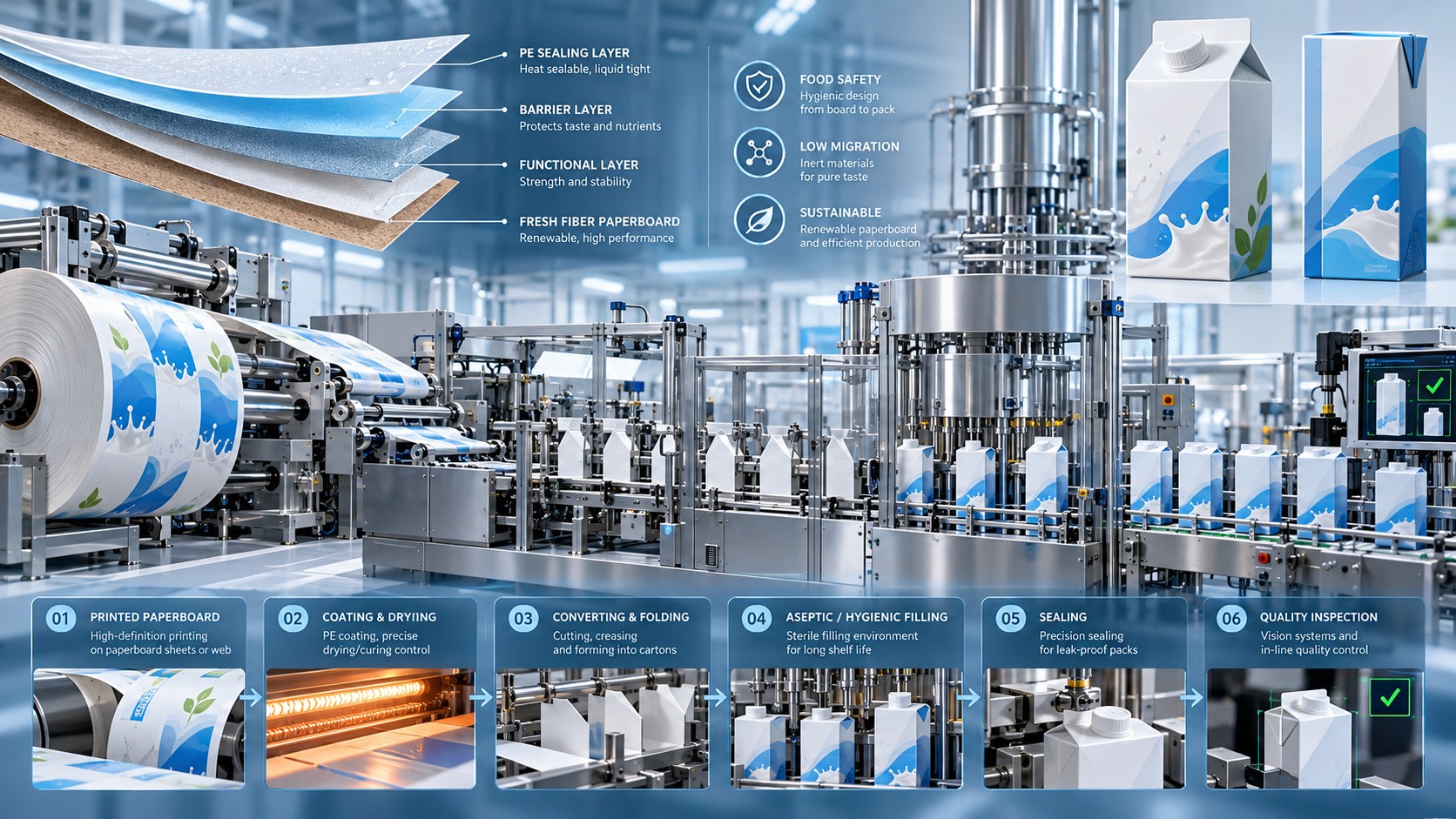
A carton of milk, juice or a plant-based beverage is one of the most familiar packages in the food industry. It is relatively lightweight, efficient to transport and store, and provides a generous surface for branding, information and product differentiation. Behind that apparent simplicity, however, is a carefully engineered system of paperboard, polymers, barrier materials, printing inks, protective coatings and precisely controlled sealing interfaces.
The package must meet several requirements simultaneously. Structurally, it must support the liquid and remain stable during transportation, storage, and consumer use. Functionally, it must resist leakage and protect the contents against environmental factors that could shorten their shelf life. Chemically, its materials must be suitable for food-contact applications and must not transfer constituents to the food at unacceptable levels. In production, the structure must survive printing, coating, cutting, creasing, folding, heat sealing and filling without compromising those properties.
The challenge becomes greater when a carton is designed for aseptic filling. The packaging material may encounter a validated microbiological treatment, controlled heat exposure, chemical agents, mechanical forming and sealing inside the dairy or beverage filling plant. Conditions there may differ significantly from those at the printing facility. For this reason, developing a liquid-carton application cannot begin and end with choosing a printing press. It begins with the food product and intended distribution conditions, and it ends only when the filled, sealed carton has demonstrated the required safety and performance throughout its expected shelf life.
The End-to-End Manufacturing Chain
An effective liquid-packaging project requires a shared vocabulary across the entire production chain. Material manufacturing produces the paperboard and the polymer or barrier layers required by the package. Packaging design and engineering define the geometry, dimensions, creases, joining areas, and graphic boundaries. Printing and coating encompass substrate preparation, printing, drying or curing, and any protective finishing layers.
Carton converting then transforms the printed material into a form suitable for subsequent processing. Depending on the manufacturing route, this may include die cutting, creasing, edge treatment, side-seam formation, or supplying a prepared printed reel. The material moves to the food and beverage processing and filling plant, which may be a dairy processing plant, a beverage production and filling plant, or another food-production site. There, the relevant processes of forming, filling and sealing take place. In aseptic systems, the product, packaging and filling environment are treated according to a validated process designed to achieve the required microbiological condition.
After filling, the packaged product is inspected, placed into secondary packaging, palletized and distributed. The precise order of operations varies between blank-fed and roll-fed systems, but the engineering principle does not: each stage's output must meet the next stage's requirements. A locally successful print is of limited value if the carton cannot be formed, sealed, filled, or safely distributed.
Carton Shape and Filling Technology Are Different Classifications
One fundamental distinction is often overlooked. Brick and gable-top describe carton geometry, while aseptic, non-aseptic, extended shelf life (ESL), and chilled distribution describe aspects of processing, filling, and distribution. A gable-top carton is not automatically a refrigerated, non-aseptic package; aseptic gable-top systems also exist. Equally, a brick shape alone does not make a carton aseptic.
Industry term | Meaning | Implication for the production route |
|---|---|---|
Gable-top carton | Carton with a folded, roof-shaped top | May be used with chilled, ESL or appropriately designed aseptic filling systems |
Brick carton | Predominantly rectangular carton geometry | Can support different product and filling systems when designed and qualified accordingly |
Aseptic packaging | Product and package are prepared and filled under a validated aseptic process. | Requires microbiological and process qualification of the filling system |
Non-aseptic packaging | Packaging and filling without a complete aseptic process | Common in fresh foods and refrigerated distribution |
Extended shelf life (ESL) | Integrated processing and filling measures intended to extend usable life | Often involves enhanced hygiene and chilled distribution |
Form-fill-seal (FFS) | Equipment forms, fills, and seals packages within a production sequence | May be fed from printed rolls or prepared blanks, depending on equipment design |
These definitions matter because substrate and ink specifications must be based on the actual process, not the carton silhouette. Two cartons with the same external geometry can require substantially different barrier structures, printing materials, sealing conditions, and microbiological qualification.
Start With the Food Product
The first technical decision is what you will fill. Fresh milk, shelf-stable milk, juice, plant-based beverages, and liquid foods vary in acidity, fat content, oxygen sensitivity, aroma retention, and processing temperature. The target shelf life, whether the finished product is distributed chilled or at ambient temperature, and whether the filling operation is aseptic must also be established before specifying the packaging material.
A product sensitive to oxygen may need an oxygen-barrier layer; a product whose quality is affected by light may need an additional light barrier. Volatile aroma components introduce further considerations related to adsorption into packaging layers or transmission through them. Package volume and geometry affect the mechanical stresses encountered during handling and stacking. Successful engineering therefore requires coordination between the food manufacturer, packaging producer, printing operation, and filling plant from the earliest development stage.
Paperboard, Polyethylene and Functional Barrier Layers
Liquid cartons are normally multilayer structures. Paperboard supplies most of the package stiffness, but cellulose fibers alone cannot safely contain liquid. A simple structure can be described schematically as outer PE/paperboard/inner PE. The inner polyethylene layer protects the board from direct liquid contact and commonly provides a heat-sealable surface. The outer polyethylene layer offers protection against external moisture and, when suitably treated, can provide an appropriate printing or coating surface.
This basic structure cannot meet every product requirement. Additional oxygen, light, or aroma barriers may be necessary, together with tie layers that bond chemically dissimilar materials. Different polyethylene grades may also be selected for their specific sealing and processing behavior. No single layer performs every protective function, and an individual layer's properties do not determine the performance of the completed package.
EVOH and Aluminum Foil Serve Different Barrier Roles
Ethylene vinyl alcohol (EVOH) can provide strong oxygen-barrier performance when appropriately protected and used under suitable humidity conditions. Moisture exposure can change its barrier properties, which makes its position within the laminate especially important. Aluminum foil, by contrast, can provide very high light and gas barrier performance when it remains continuous and defect-free. Thin foil can nevertheless be affected by folding stresses, flexing, and mechanical damage, so its performance must be verified after converting, not only on the incoming roll.
Oxygen transmission rate (OTR) and water vapor transmission rate (WVTR) are useful measures when relevant to the product, but they answer different questions. Neither measure alone proves that the package will meet its shelf-life requirements. Assess the barrier system against the packaged food, storage temperature, humidity, forming method, and expected mechanical handling.
Producing and Coating Liquid-Packaging Board
A common material-manufacturing process is extrusion coating. Molten polymer is delivered through an extrusion die, applied to the moving paperboard and consolidated using a roller arrangement before cooling. More complex constructions can be manufactured using suitable co-extrusion or lamination technologies. In either case, the process must deliver the specified layer thickness, continuous coverage, and reliable interlayer bonding.
A smooth-looking surface does not guarantee a sound barrier. Pinholes, inconsistent coat weight, weak adhesion, and defects introduced during winding or downstream handling can compromise liquid resistance or seal integrity. The board must also offer the stiffness and folding behavior needed for the target package. Fiber direction, thickness, moisture content, and the interaction between the board and its polymer layers all influence converting performance.
Structural Design Comes Before Final Artwork
Packaging engineering defines panel dimensions, crease lines, overlap widths, top and bottom closures, and any opening or reclosure feature. The paperboard fiber direction must be considered because it affects stiffness and response to creasing. Tooling has to create folds at the intended locations without imposing excessive strain on the laminate or barrier layers.
Only after these functional boundaries are established should the artwork be finalized. Heat-seal regions are particularly important. Where the structure depends on direct bonding between compatible polyethylene surfaces, ink or varnish can interfere with the sealing interface. Consequently, no-print and no-coating zones should be defined around side seams and any top or bottom seal areas that require clean polymer contact. A primer may remain in a specified zone only when that exact primer and sealing process have been qualified for it. This is an engineering requirement, not merely a prepress convention.
Preparing the Surface for Printing
Printing on an outer PE surface requires attention to surface chemistry. Polyethylene ordinarily has relatively low surface energy and may require corona treatment, a suitable primer, or another validated preparation method to achieve the required ink wetting and adhesion. A dyne measurement helps assess wetting behavior but does not, by itself, establish bond strength or long-term print durability.
The appropriate preparation depends on the printing process, the polymer grade, surface cleanliness, and the subsequent converting conditions. Some materials arrive with a prepared print surface; others require treatment near the time of printing. Excessive treatment is not automatically beneficial, and a primer that produces good initial print adhesion may still need to be tested after coating, folding, heat sealing, and the conditions used in the filling plant.
Printing Is a Process Choice, Not the Definition of the Application
Liquid-packaging cartons can be printed using several technologies, including liquid electrophotographic digital printing, UV offset and UV flexography, when the substrate, ink system and production process are suitable. These technologies differ in how they form and stabilize the ink film, so their qualification requirements are not interchangeable.
Printing technology | Ink-film formation | Primary application considerations |
|---|---|---|
Liquid electrophotographic (LEP) printing | Transfer of a polymer-particle-based ink layer | Surface preparation, adhesion, appropriate carrier removal, downstream durability and food-packaging suitability |
UV offset | Transfer through an offset printing system followed by UV curing | Substrate compatibility, cure performance, residual mobile constituents and downstream converting |
UV flexography | Ink deposited by a flexographic printing system followed by UV curing | Coat-weight control, even ink transfer, cure performance and substrate compatibility |
The decisive question is not whether a press can reproduce the intended graphics. It is whether the entire printed construction remains compatible with the packaging structure, the sealing process, food-contact requirements, and the filling line. Each selected ink and coating system must be evaluated on that basis.
Drying and UV Curing Are Not the Same Process
In some ink systems, drying primarily involves removing water or other volatile constituents and allowing the film structure to develop. UV inks operate differently: irradiation initiates photochemical reactions that build a cured polymer network. A UV-printed surface that is dry to the touch is not necessarily sufficiently cured for a food-packaging application. Mobile substances may remain if the system has not reached the required reaction state.
Cure performance depends on ink chemistry, deposited film thickness, wavelength, irradiance, delivered energy, and exposure time. Press speed determines how long the film remains under the source. UV LED systems require appropriate spectral matching between the emission source and the formulation's photoinitiator package. Lamp degradation, contamination, and changes in operating speed can also affect the delivered dose.
Therefore, a fixed power setting is not an adequate cure qualification on its own. Nor can a simple rub or touch test establish that potential migration has been controlled. Production monitoring must be complemented by appropriate chemical or analytical assessment where required by the application and its risk profile.
Low Migration Is a System Requirement
Low-migration inks and coatings are formulated to reduce the potential for constituents to move from the printed layers toward the food. The designation does not mean that every component is immobile, or that the product has automatically been approved for direct food contact. Migration potential depends on the formulation, degree of drying or curing, position of the printed layer, effectiveness of the intervening barrier and foreseeable use conditions.
UV-based systems may require particular attention to residual monomers, photoinitiator-related substances, reaction products and other potentially mobile constituents. Non-intentionally added substances (NIAS), including impurities or substances created through processing or degradation, may also need evaluation. The appropriate evidence comes from a risk assessment of the completed structure, supported by composition information and testing that reflects the food and conditions of use.
Set-Off Can Occur Even When the Print Is on the Outside
In sheet stacks and wound reels, the printed face may contact the surface that will later face the food. Under unsuitable conditions, ink or overprint varnish constituents can transfer from the printed side to the food-contact side. This is known as set-off. Visible color transfer is not necessary; chemical transfer can occur without an obvious graphic defect.
Drying or curing quality, stack pressure, winding tension, storage temperature, and contact time all influence the risk. As a result, food-safety controls cannot be limited to checking whether the ink was intended for direct food contact. They must also assess how the material is handled after printing and whether unacceptable transfer to the future food-contact surface is prevented.
Drying and Curing Protective Varnishes
Overprint varnishes can improve resistance to scuffing, rubbing and moisture, while delivering a chosen gloss or matte finish. For liquid packaging, these benefits must be balanced against flexibility at the creases and food-contact suitability. Water-based varnishes generally require controlled water removal and proper film development. UV varnishes require sufficient photochemical curing. The two mechanisms should not be treated as identical.
Inadequate drying or curing can cause blocking, set-off, adhesion defects, and mobile constituents. An excessive coating weight may make drying or curing more difficult and may create a brittle surface that cracks during folding. A varnish that performs well on a flat printed sheet is not necessarily suitable for a sharply creased carton. The selected formulation, coating weight and finishing process must therefore be qualified together with the converter's folding operations.
Die Cutting, Creasing and Barrier Integrity
Converting turns printed paperboard into package blanks or a suitable roll-fed format. Cutting accuracy matters because it governs whether the material can be formed and sealed reliably. Clean cut edges also help limit loose fibers and particles that could affect subsequent operations.
Creasing controls where the board folds and helps distribute strain across the structure. It must be matched to board thickness, fiber direction, and the laminate construction. Improperly designed creases may cause visible cracking, but more importantly, they may damage PE or other functional layers. The absence of an obvious surface crack is not enough to prove barrier integrity; the converted package must be tested where that risk is relevant.
Skiving and Hemming Protect the Exposed Board Edge
When PE-coated paperboard is cut, the cross-section can expose cellulose fibers even though both faces are protected by polymer layers. If that raw edge is placed in contact with the liquid, the board can absorb moisture and swell. This may weaken the carton, affect the side seam, and compromise performance over time.
Skiving and hemming are used in certain carton structures to protect that edge. During skiving, part of the board thickness is removed from a defined joining region. The remaining portion is then folded or hemmed to enclose the exposed edge and place a protected surface toward the liquid. The process also helps manage the local thickness of the overlapped seam. Removing too much material may weaken the area; removing too little can leave an unnecessarily thick or poorly formed joint. Tool settings must therefore match the actual board and laminate construction.
Blank-Fed and Roll-Fed Manufacturing Routes
No single end-to-end route fits all liquid cartons. In blank-fed systems, the material may arrive at the filling plant as die-cut, creased blanks, sometimes already provided with a side seam. The filling machine opens and forms the carton, completes relevant closures, fills the product, and seals the remaining opening. In roll-fed systems, prepared printed material is supplied on reels and can be formed, filled and sealed continuously within the packaging equipment.
This distinction affects artwork repeat, registration, crease placement, the joining strategy, transport format and the stages performed by the packaging converter versus the filling plant. It is also why the exact machinery and handling pathway should be agreed upon before the printing and material structure are approved.
The Processing and Filling Plant Is the Final Manufacturing Test
At the dairy or beverage filling plant, packaging materials meet stresses that may not exist in the print shop. Depending on the system, they can undergo mechanical opening, bending, guided transfer, localized heat, pressure, microbiological treatment, and sealing. A structure with excellent print quality and initial adhesion can still fail if its ink, primer, varnish, or barrier system is not suited to these subsequent exposures.
A meaningful qualification should therefore include actual or representative conditions from the intended filling equipment. A defect seen for the first time during filling does not automatically mean that the printing press malfunctioned. It may indicate that one of the interfaces was never validated under the process conditions encountered later.
Heat-Sealing Performance Is Defined at the Interface
Many liquid cartons rely on heat bonding between compatible polymer layers. Bond development depends on the material chemistry and the temperature reached at the sealing interface, together with contact time and applied pressure. The temperature displayed at a machine heater is not necessarily the temperature inside the laminate at the actual bond line. Board thickness, material conductivity, production speed, and heat-transfer geometry all matter.
Insufficient interface temperature or dwell can weaken joints, while excessive exposure can degrade materials or affect nearby printed or coated layers. Uneven pressure can generate areas with inconsistent seal strength. A qualified sealing window must therefore be established using relevant peel, seal-integrity and leak tests, rather than appearance alone.
Aseptic Treatment and Food Heat Processing Are Different Exposures
Aseptic filling systems are designed to control the microbiological condition of the product, packaging and filling environment. Food may undergo thermal processing such as UHT in a separate system before entering the controlled filling zone. Meanwhile, approved methods can treat the packaging material using heat, radiation, chemical agents, or combinations of these technologies. Hydrogen peroxide is used in some systems, but not all systems use it, and the exact route and exposure vary.
This distinction matters to printing and coating durability. The temperature used in UHT food processing is not automatically the temperature experienced by the printed ink layer. Similarly, a packaging-treatment chemical is not necessarily applied to every printed or unprinted surface. Qualification must be based on the actual surfaces exposed, chemical concentration where applicable, surface temperature, treatment duration, and subsequent handling and sealing operations.
Ink and Varnish Durability at the Filling Plant
Printed and coated surfaces may encounter mechanical rubbing, warm tooling, moisture, or approved treatment chemicals during filling. Depending on the chemistry and exposure, an unsuitable system might show changes in gloss or hue, haziness, reduced adhesion, or local coating deterioration. Such effects are possible failure modes, not inevitable consequences of a particular printing technology.
The correct approach is comparative testing on representative printed materials before and after a validated simulation or an actual machine trial. Adhesion, color, varnish resistance, crease integrity, and seal performance should be assessed as appropriate. When chemical treatment is part of the system, reproduce the actual exposure conditions rather than immersing samples in an arbitrarily stronger solution. The purpose is to establish fitness for the real application without rejecting suitable materials or accepting untested ones.
Migration Assessment After Downstream Processing
A migration assessment performed only on a flat, freshly printed sheet may not reflect the condition of a finished carton. Depending on the materials involved, subsequent heat exposure, mechanical operations, or chemical treatment could change the availability of mobile substances or introduce relevant new reaction products. An application-specific risk assessment should determine whether testing after representative converting and filling-plant exposures is required.
Three mechanisms must be distinguished. Migration is the transfer of packaging constituents into the food. Sorption describes food constituents being absorbed or adsorbed by the packaging materials. Permeation is movement through the structure, such as oxygen ingress or loss of volatile aromas. Tests for one mechanism cannot automatically stand in for tests for another. The test plan must follow the actual safety and performance risks of the final product.
Food-Contact Regulations and Standards
Food safety in liquid packaging must be addressed throughout the manufacturing chain, from raw material selection, printing, and converting to final forming, filling, and sealing at dairy and beverage processing plants.
In the European Union, Regulation (EC) No 1935/2004 establishes the general safety framework for materials and articles intended to come into contact with food. Regulation (EC) No 2023/2006 defines Good Manufacturing Practice (GMP) requirements, including controls intended to prevent unacceptable transfer of printing ink or coating constituents through the substrate or by set-off. Regulation (EU) No 10/2011, as amended, establishes composition and migration requirements for plastic materials and layers within its scope, including relevant provisions introduced by Regulation (EU) 2025/351.
These requirements must be complemented by a structured food safety management approach. Hazard Analysis and Critical Control Points (HACCP), as established within the Codex Alimentarius General Principles of Food Hygiene (CXC 1-1969), provides a systematic methodology for identifying, evaluating, and controlling biological, chemical, and physical hazards throughout food production.
In liquid packaging, relevant hazards may include chemical migration from inks and varnishes, insufficient UV curing or coating drying, set-off contamination, foreign material contamination, compromised barrier integrity, and sealing failures that could affect food safety. The appropriate preventive measures, monitoring activities, and Critical Control Points (CCPs), where justified, must be determined through documented hazard analysis rather than automatically assigning every printing or converting parameter as a CCP.
ISO 22000 sets requirements for a Food Safety Management System (FSMS), incorporating HACCP principles, prerequisite programs, communication, and systematic risk-based management across organizations involved in the food chain.
FSSC 22000 provides an internationally recognized certification scheme based on ISO 22000, sector-specific prerequisite programs, and additional scheme requirements. For food packaging manufacturers, the applicable prerequisite program framework includes ISO 22002-100:2025 and ISO 22002-4:2025, which address hygiene, contamination prevention, operational controls, and food safety practices specific to packaging production.
These frameworks complement, but do not replace, legally applicable food-contact regulations. The suitability of inks, primers, varnishes, polymer layers, and completed packaging structures must still be demonstrated through appropriate documentation, migration assessments, process validation, and testing under representative conditions of use.
In the United States, relevant FDA food-contact provisions must likewise be evaluated according to the materials, food type, and intended conditions of use.
The central engineering principle remains unchanged: successful liquid packaging qualification requires not only high-quality printing and reliable converting, but also verified food safety controls extending through the filling operation and the completed package's intended shelf life.
A Qualification Program for the Complete Application
A representative qualification program must span the materials, printed construction, converting process, filling plant, and final product. Not every carton requires the same test package, and applicable specifications and regulatory obligations should set test acceptance values. Nevertheless, the following engineering categories provide a practical framework.
Production stage | Principal tests and evaluations |
|---|---|
Incoming materials | Layer composition and thickness, dimensional stability, barrier properties |
Surface preparation | Wetting behavior, treatment conditions and adhesion |
Printing | Color consistency, coverage, ink-film integrity and adhesion |
Drying / curing | Process adequacy, mobile residues and chemistry-specific controls |
Protective coatings | Adhesion, rub/scuff resistance, folding behavior and downstream durability |
Food-contact assessment | Migration, NIAS, set-off, documentation and regulatory suitability |
Die cutting/creasing. | Dimensional accuracy, clean edges and barrier integrity |
Skiving/hemming | Edge protection and seam construction |
Heat sealing | Seal strength, interface quality and leak resistance |
Filling plant | Resistance to forming, heating, treatment agents and handling |
Finished package | Leakage, mechanical durability, functional integrity and shelf-life performance |
Tests should use materials and settings representative of production, and should address expected lot-to-lot variation. One successful laboratory sample demonstrates feasibility, not long-term process stability. The transition to manufacturing requires reproducible results within a defined operating window.
Troubleshooting: When the Failure Appears After Printing
The most useful diagnostic question is often not "Which printing parameter should be changed?" but "At what point did the package first cease to meet its specification?" By comparing material sampled before and after each relevant operation, engineers can distinguish print-shop issues from failures introduced or revealed during converting, sealing, or filling.
Symptom | Potential causes | Investigation direction |
|---|---|---|
Poor ink adhesion | Inadequate surface preparation, incompatible primer, or later exposure | Identify the failed interface; check substrate preparation and durability after processing |
Cracks along folds | Coating rigidity, unsuitable creasing, or excessive strain | Evaluate varnish flexibility, board construction, and crease tooling |
Blocking or set-off | Insufficient drying/curing, pressure, storage conditions | Check process records and potential transfer to the food-contact side |
Unacceptable migration | Mobile constituents, cure deficiency, inappropriate barrier or set-off | Evaluate formulation, finished structure and intended use conditions |
Color shift after package treatment | Thermal, chemical, or optical interaction | Compare samples before/after accurately reproduced exposure |
Varnish damage on filling equipment | Incompatibility with machinery conditions or treatment chemistry | Test under the actual equipment cycle and identify the failure mechanism |
Leakage at the side seam | Poor joining, exposed board edge, or geometry error | Examine sealing conditions and edge treatment |
Weak top or bottom seal | Inadequate interface temperature, pressure, dwell, or compatibility | Establish a validated sealing window and verify integrity |
Barrier loss after folding | Mechanical stress or a structurally unsuitable laminate | Check creasing design and the barrier in converted samples |
When a failure first becomes apparent at the filling plant, the investigation should preserve samples from upstream stages and reproduce the actual thermal, mechanical, and chemical conditions. If migration limits are exceeded, no single layer should be blamed without evidence. If color shifts after treatment, optical effects must be separated from possible chemical changes to the ink or coating. Arbitrary increases in UV power, corona treatment, or sealing temperature can obscure the underlying mechanism and introduce new risks.
Conclusion: Qualification Ends With the Filled Carton
Liquid-packaging manufacture is an end-to-end engineering process that connects materials science, structural design, printing, coating, converting, food processing, and filling. Paperboard provides mechanical structure; PE and other functional polymers supply liquid protection and sealing; additional barrier layers protect the product as required. Printing technology is chosen to meet production and graphic objectives, but the ink and varnish systems must also satisfy drying or curing, migration, adhesion, and downstream durability requirements.
Converting must preserve the laminate and protect vulnerable cut edges. Heat sealing must produce consistent, leak-resistant joints. The dairy or beverage filling plant must form, treat, fill, and seal the package without compromising any of these features. This is why a liquid-carton application cannot be considered fully qualified at the printing press alone.
High-quality printing is essential, but it is only one part of success. A successful liquid carton is a coordinated materials-and-process system that delivers food safety, reliable sealing, and product stability throughout its intended shelf life.
Regulatory and Professional References
- Regulation (EC) No 1935/2004 — Materials and articles intended to come into contact with food.
- Regulation (EC) No 2023/2006 — Good Manufacturing Practice for materials and articles intended to come into contact with food, including printing-related provisions.
- Regulation (EU) No 10/2011, as amended — Plastic materials and articles intended to come into contact with food; assess the applicable provisions of Regulation (EU) 2025/351.
- Relevant U.S. FDA food-contact regulations, including applicable provisions of 21 CFR, according to material and intended use.
- Codex Alimentarius CXC 1-1969 — General Principles of Food Hygiene: Establishes the internationally recognized principles of food hygiene and HACCP-based hazard analysis and control.
- ISO 22000:2018, including Amendment 1:2024 — Food Safety Management Systems: Requirements for managing food safety hazards throughout the food chain.
- ISO 22002-100:2025 — Prerequisite Programs on Food Safety: Common prerequisite program requirements supporting sector-specific food safety controls.
- ISO 22002-4:2025 — Prerequisite Programs on Food Safety, Part 4: Food Packaging Manufacturing: Sector-specific requirements for hygiene, contamination prevention, and operational food safety controls in packaging manufacturing.
- FSSC 22000 — Food Safety System Certification: Certification scheme combining ISO 22000, applicable sector-specific prerequisite programs, and additional food safety management requirements.
Regulatory suitability must be evaluated for the intended market, packaged food, contact conditions, structure, and completed production process. References to regulations are not substitutes for qualified legal or food-contact compliance review.