When the Print Is Perfect, but the Coating Changes the Result
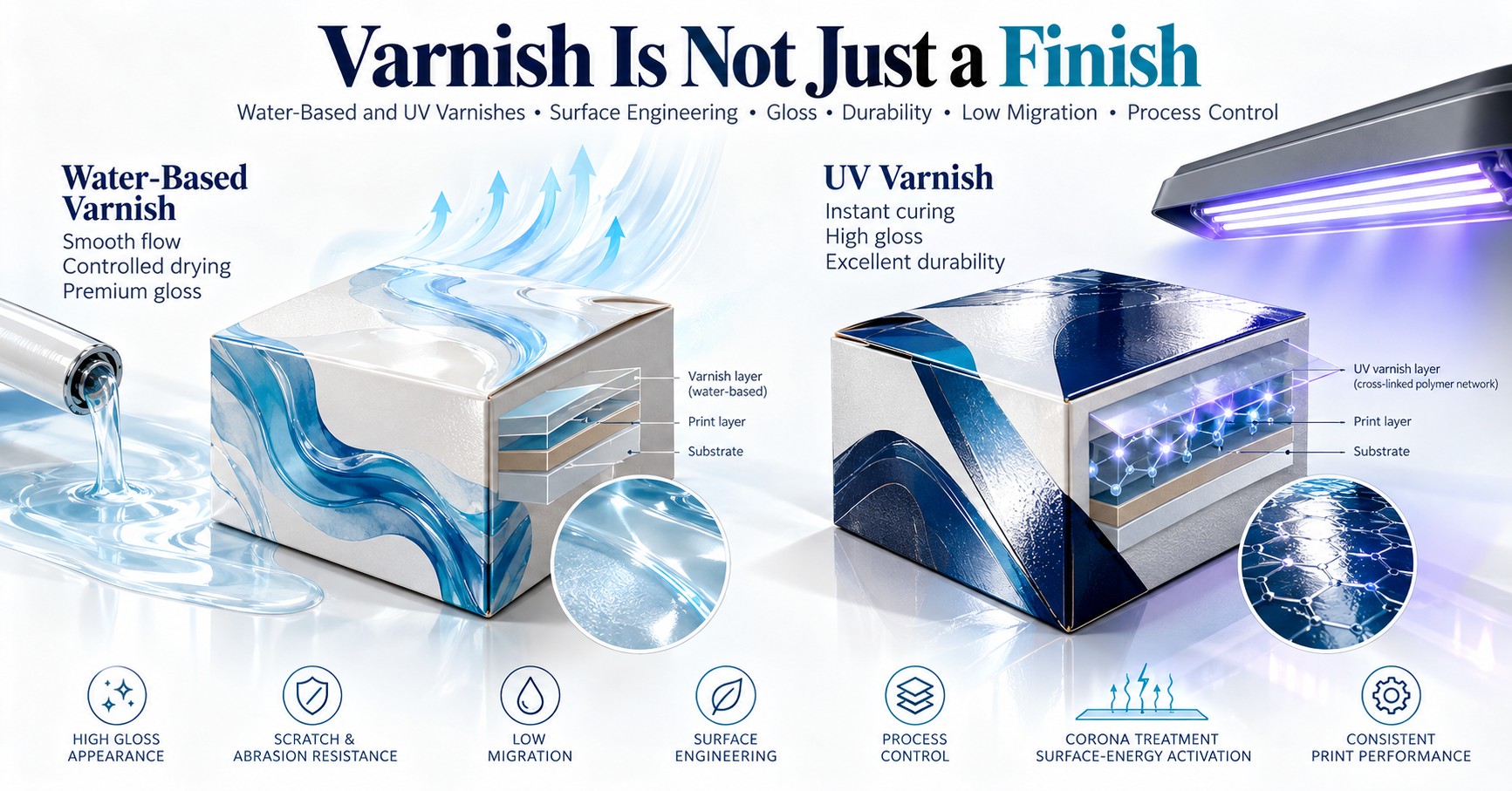
Two folding cartons emerge from the same printing process. Both were printed on the same board, on the same printing press, with the same ink system and the same artwork. Color is accurate, image definition is good, and quality-control measurements fall within the agreed tolerances. At the coating stage, however, the paths separate. A high-gloss water-based varnish is applied to the first carton, while a high-gloss UV varnish is applied to the second.
Although the print underneath is identical, the final appearance need not be. A water-based coating applied at a relatively high wet coat weight, allowed to level properly, and dried under appropriate conditions may develop more gloss than a UV varnish applied as a thinner layer. Under other conditions, the UV system may produce higher gloss. The outcome depends not only on the curing technology but also on solids content, final dry coat weight, surface topography, substrate and ink properties, and the drying or curing process.
Gloss, however, is only the beginning. Both cartons move on to creasing, folding, and gluing. One develops cracks along a fold; the other presents a gluing problem. A rub test favors one coating, but a chemical-resistance test favors the other. When the carton is intended for food packaging, appearance and mechanical performance are not sufficient: the suitability of the full construction for the intended food-contact application and potential migration pathways must also be evaluated.
Now consider another familiar production-floor situation. A coating looks excellent at the beginning of a shift but later develops a texture resembling orange peel. An operator increases the drying temperature, expecting the surface to improve, but only makes the texture more pronounced. Later, sheets block together in the delivery pile, even though they felt dry as they left the press.
These are not necessarily isolated accidents. They illustrate how strongly coating performance depends on the relationship among chemistry, rheology, application, drying, curing, and production conditions. A varnish is not simply a transparent material added after printing. It is another engineered layer that can determine a product's appearance, durability, compatibility with converting, suitability for food packaging, and even its end-of-life behavior.
The useful question, therefore, is not which varnish produces the highest gloss. It is which coating system lets the finished package complete every process and withstand every condition it was designed for.
Understand the Coating Structure Before Comparing Technologies
An overprint varnish, or OPV, forms a layer over an ink film or substrate. It can be glossy, satin, matt, or textured, and it may influence abrasion resistance, scratch resistance, chemical and moisture resistance, heat response, coefficient of friction, and suitability for further processing.
But the varnish never operates in isolation. On a folding carton, it may encounter areas of heavy ink coverage, light ink coverage, unprinted board, and a pre-existing board coating. On flexible packaging, it may contact ink printed on PET, BOPP, PE, or a dedicated primer layer. Each surface can behave differently in terms of wetting, adhesion, absorption, flexibility, and thermal response.
Three properties must therefore remain separate: wetting, adhesion, and durability. Wetting describes how the liquid varnish spreads over the surface and makes continuous contact with it. Adhesion describes how securely the formed coating bonds to the underlying material. Durability describes whether that coating and the complete structure survive the mechanical, thermal, chemical, and environmental stresses of the intended application.
Corona treatment is one way to improve wetting before coating. Corona discharge modifies the chemistry of the outermost surface and generally increases its surface energy. With a compatible coating formulation, that change can help the liquid varnish spread more uniformly and provide better starting conditions for adhesion. It is especially relevant to low-surface-energy films such as PE and PP, including certain BOPP grades, which may otherwise resist satisfactory wetting.
The critical point is to identify the surface the varnish will actually meet. When a film is coated directly, corona treatment affects the exposed polymer. When an overprint varnish is applied over existing print, however, it contacts the ink layer, not necessarily the base film. In some constructions, an additional controlled corona treatment before coating may improve the wetting of the printed ink surface. That treatment must nevertheless be qualified for the particular ink system; it must not damage, embrittle, discolor, or otherwise unacceptably change the printed layer.
The same logic applies to pre-primed or previously coated materials. Decisions about surface treatment must be based on the actual exposed interface, not just the polymer family under the construction. On ordinary paper and paperboard, corona should not be treated as a routine preparation step: coating chemistry, porosity, absorption, surface strength, and smoothness are usually more immediately relevant.
More corona is not automatically better. Excessive or uncontrolled treatment can adversely affect a sensitive ink or coating layer or produce an unstable surface condition. The objective is not the highest possible dyne reading but a qualified surface window for the varnish and application in question. A dyne test may provide useful information about wetting, provided the method is appropriate for the surface, but it does not prove adhesion or durability.
Good wetting can coexist with poor adhesion. Good adhesion can coexist with poor abrasion resistance. A hard, highly resistant varnish may still crack when a carton is folded. These properties require different evidence; a single test should never be expected to prove all three.
Water-Based versus UV Varnish: Different Routes to a Coating Film
Water-based varnishes commonly use polymer dispersions in an aqueous medium. The polymer system may be acrylic, polyurethane, or a combination of chemistries. Additives influence wetting, leveling, foaming, friction, gloss, and stability. After application, sufficient water must leave the wet layer for the polymer to form a continuous film. Some formulations then develop additional crosslinking.
Many UV varnishes work by a different mechanism. Reactive oligomers, monomers, and related ingredients undergo polymerization when exposed to suitable radiation. In conventional UV-curable acrylate systems used in printing, photoinitiators initiate the reaction that builds the polymer network. The coating develops its properties through chemical curing rather than relying primarily on water evaporation.
Both families can provide high gloss and strong functional performance, but they achieve these results differently.
Property | Water-based varnish | UV varnish |
|---|---|---|
Main film-forming mechanism | Water evaporation, film formation, sometimes additional crosslinking | Radiation-initiated polymerization and crosslinking |
Common production equipment | Heated and moving air; exhaust; sometimes IR | Compatible conventional UV or UV-LED curing systems |
Key process sensitivities | Moisture, viscosity, temperature, evaporation and air exchange | Wavelength, irradiance, exposure, formulation, oxygen effects |
Development of final properties | Depends on adequate drying, film formation and formulation | Depends on sufficient curing and formulation |
Gloss potential | Can be very high | Can be very high |
Typical process risks | Incomplete drying, blocking, viscosity drift | Undercure, residual reactive components, adhesion problems |
Food-packaging evaluation | Must cover formulation and complete construction | Must cover formulation, cure, and complete construction |
This comparison is not a ranking. Each category contains many formulations designed for different substrates, machines, finish levels, and performance requirements.
How a Water-Based Varnish Dries
It is tempting to think that drying a water-based varnish simply means heating it until the water is gone. In practice, several coupled physical processes must occur. After application, water evaporates and, on porous substrates, some may also be absorbed into the substrate. As water content decreases, polymer concentration increases. Polymer particles move closer together and, under suitable conditions, deform and merge into a continuous coating film. This is commonly described as film formation or coalescence.
Film formation is not determined by residual water alone. Some polymer dispersions require a minimum temperature for effective particle deformation and film formation, expressed as the minimum film-forming temperature, or MFFT. If the actual coating and substrate temperature is too low for the formulation, an apparently dry layer may still be incompletely formed and fail to develop its expected performance. Certain systems also crosslink chemically after initial water removal, meaning that their ultimate properties may develop over time.
In production, water-based varnishes are usually dried with controlled combinations of heated air, air movement, exhaust, and sometimes infrared energy. Hot air contributes thermal energy, but moving air has a second essential function: removing water vapor from the area around the coating. When local air becomes too humid and isn't replaced effectively, evaporation slows even if the heater keeps running. IR can assist energy transfer but cannot replace moisture removal.
Faster is not always better. If water evaporates too rapidly from the coating surface, viscosity may rise before the wet film has leveled. Under some conditions, an altered surface layer can impede further water transport, or the developing topography can remain frozen into the coating. The result may be loss of gloss, orange-peel texture, or a layer that looks dry but does not yet perform satisfactorily.
Drying too slowly creates another set of problems. Remaining water or other volatile constituents can contribute to blocking, low abrasion resistance, transfer to the reverse side, or difficulties during later converting. Good drying therefore requires a controlled balance among energy input, airflow, humidity removal, coat weight, and production speed.
Dryer air temperature is not the same as actual web or sheet temperature. Increasing set-point temperature does not guarantee that water is removed effectively, and it may distort sensitive substrates or change surface appearance. Paper and board require attention to moisture absorption, curl, shrinkage, and dimensional stability. Synthetic films require attention to thermal sensitivity and tension-related distortion. Drying specifications should describe the coating and substrate under real operating conditions, not just the number displayed on the dryer controller.
How UV Varnish Cures
UV varnish commonly forms its final network through a light-initiated chemical reaction. Photoinitiators absorb suitable radiation and generate reactive species that initiate polymerization of the coating's reactive components. The degree of conversion and crosslinking depends on both the chemistry and the exposure conditions.
Key variables include the light source's emission spectrum, irradiance reaching the coating, accumulated radiant exposure, exposure time, coating thickness, and chemical composition. Irradiance is typically expressed in W/cm², while radiant exposure or dose is expressed in mJ/cm² or J/cm². These quantities are related but are not interchangeable. Two machines delivering the same integrated energy at different irradiance levels and residence times may not produce identical cure results.
The light source matters. Traditional mercury-based UV systems emit over a relatively broad spectrum, whereas UV-LED systems have narrower emission bands selected by their design. A varnish qualified on a conventional UV system is therefore not automatically suitable for an LED-UV system. Photoinitiator absorption, lamp output, coating opacity, and cure depth must all match.
One important limitation in free-radical curing is oxygen inhibition. Atmospheric oxygen can react with active radicals and interfere with polymerization at the coating surface. The underlying film may develop substantial conversion while the uppermost surface remains tacky or insufficiently resistant. In selected applications, inerting systems use nitrogen to lower oxygen concentration in the curing zone and improve surface cure. This approach requires compatible equipment, chemistry, and process control.
Not every coating labeled UV is a fully reactive, solvent-free formulation. Waterborne UV dispersions also exist. Depending on the system, they may require water removal before, or alongside, radiation curing. It is important to understand the chemistry rather than assume all UV coatings follow the same sequence.
Drying Is Not the Same as Curing
A water-based varnish may feel dry while retained moisture or incomplete film formation still affects performance. A UV varnish may feel hard while reactive groups have not reached a degree of conversion adequate for the intended application. Both problems can remain hidden until the coated material reaches a later production step.
Assess water-based coatings for functional drying, blocking tendency, mechanical resistance, and the effects of conditioning or aging. UV coatings require checks appropriate to cure performance. Rub, scratch, and carefully selected solvent-resistance tests can provide useful production indicators, especially when compared against a previously qualified condition. They do not necessarily quantify chemical conversion.
For a more detailed investigation, methods such as FTIR may help evaluate the consumption of reactive functional groups, together with other analytical methods selected for the formulation. For food packaging, a coating that passes a fingernail or rub test is not, by itself, proof of compliance with migration requirements. A claim of 'fully cured' must be connected to defined test methods and acceptance criteria.
Viscosity: A Small Number with a Large Influence
Viscosity is among the most important process variables in coating. It influences transfer from an anilox roll or other application unit, wet-film leveling, coat-weight uniformity, and the visual finish. Excessively high viscosity can impair leveling and produce transfer defects or an uneven texture. Excessively low viscosity can alter the amount transferred, cause uncontrolled flow, or reduce deposited dry solids when thinning is achieved through excessive dilution.
Viscosity is not independent of temperature. Even a modest temperature change can significantly affect a flow-cup reading. In water-based coatings, evaporation during circulation can increase solids concentration and viscosity. Poor storage, inadequate mixing, or dispersion instability can also shift behavior. In some formulations, pH is another critical control variable and must remain in the supplier's specified window.
UV varnishes can exhibit substantial temperature-dependent viscosity changes without water loss. Adjusting a UV formulation by adding water or unapproved solvents is inappropriate. Uncontrolled additives or diluents can change cure, film properties, and food-packaging suitability.
You may use flow cups and viscometers, depending on the formulation and process. If a flow cup is specified, include its type, orifice diameter, measurement temperature, and procedure with the result. '40 seconds' is not a complete viscosity specification. Some varnishes also exhibit non-Newtonian rheology, so a single low-shear flow-cup value may not represent their behavior in high-shear transfer conditions.
Application guides sometimes give example viscosity windows for particular sheetfed coating systems, but those examples must not be copied into unrelated specifications. The correct range is the one established for the specific product, measuring method, equipment, and operating temperature.
I consider viscosity measurement a routine part of process control, not merely a start-up check. Record viscosity and material temperature before production and at an agreed interval during the run. Where relevant, also track pH and solids. Keep containers closed, mix as the supplier recommends, and limit unintended evaporation. Matt varnishes deserve particular attention because some matting components may settle if mixing and circulation are inadequate.
When viscosity drifts, don't automatically add water. First check material temperature, mixing, evaporation, contamination, and whether the material is still stable. Keep dilution and other adjustments within supplier-approved limits. This is especially important for food-packaging coatings, where formulation changes can invalidate the original safety assessment.
Orange Peel: When the Coating Looks Like Citrus Skin
Orange peel is a familiar coating defect in which the finished surface develops waves or a texture reminiscent of citrus skin. The uneven micro-topography changes specular reflection and can lower or make gloss inconsistent. The immediate production response is sometimes to increase coat weight or dryer temperature. Either intervention can worsen the problem if it doesn't address the root cause.
A common cause is poor leveling. When a varnish transfers to the substrate, it needs sufficient flow and time to form an even film. If viscosity is too high, or if water at the surface evaporates too quickly, the coating may lose its ability to level before the texture disappears. Uneven anilox transfer, excessive coat weight, temperature drift, and a mismatch between surface wetting and coating formulation can produce similar appearances.
Corona treatment may help when poor wetting of the actual coating surface is part of the problem. However, it is not a universal remedy for orange peel. If the cause is excessive viscosity or premature drying, increasing surface energy alone is unlikely to solve the defect.
My first step would be to verify the varnish condition before application: mixing, viscosity, temperature, and compliance with the technical data sheet. I would then determine whether the texture is present immediately after the coating unit or develops during passage through the dryer. This timing is one of the most valuable diagnostic observations.
If the texture is visible before drying, focus on transfer, wetting, anilox condition, viscosity, and leveling. If a wet surface appears smooth but becomes textured during drying, investigate the drying profile and premature surface immobilization. Next, make a single controlled change, such as restoring viscosity to its approved range or adjusting one drying variable. Changing dryer temperature, line speed, anilox, and coating volume together may produce a usable sample but does not reveal the root cause.
The practical objective is to establish whether the defect begins during transfer, leveling, or drying, and then correct the relevant mechanism.
Incomplete Water-Based Drying: A Dry-Looking Sheet That Blocks in the Pile
Blocking occurs when coated or printed sheets, or adjacent layers in a roll, stick together after production. You may not discover it until storage, transport, or later converting. Insufficient drying is a frequent cause, but coating formulation, temperature, pressure, and storage conditions may also contribute.
A water-based coating can remain inadequately dried because coat weight is excessive, line speed exceeds dryer capacity, humid air is not exhausted efficiently, dryer settings are unsuitable, or the underlying ink has not stabilized. Pile temperature is another factor. Warm sheets stacked under pressure can behave differently from individual sheets examined immediately after coating; heat and moisture dissipate less effectively in a dense pile.
Certain ACTEGA sheetfed troubleshooting recommendations refer to keeping pile temperatures below approximately 35°C for the applicable products and operating conditions. This is a product-specific practical guide, not a universal release specification. The appropriate limit depends on the coating, board, pile geometry, and storage conditions.
For diagnosis, I would not rely only on a touch-dry check. I would examine the sheets after cooling and conditioning, then use a blocking test with controlled time, pressure, and temperature representative of the real pile or roll. If drying is inadequate, the investigation should cover moisture exhaust, dryer capacity, coat weight, line speed, and actual material temperature. Simply increasing IR power can create a different failure while leaving the original moisture-management problem unresolved.
The required result is a coating that performs after drying, on a substrate that remains dimensionally and mechanically stable during storage and converting.
UV Undercure: When the Lamp Is On, but the Film Is Not Fully Developed
Insufficient UV cure can appear as tackiness, blocking, poor abrasion resistance, unusual odor, weak adhesion, or changes in finished-product performance. A common mistake is to assume that because a UV lamp is illuminated, the coating must be curing correctly. Lamp operation is not the same as delivering the required spectrum, irradiance, and exposure to the film.
Performance can deteriorate because of lamp aging, contamination of lamp windows or reflectors, changes in working distance, cooling problems, a mismatch between emission spectrum and photoinitiators, or production speeds beyond the validated process window. Excessive coat weight may also leave a thicker film that requires different curing conditions. A system qualified at one dry-film thickness should not be assumed to give the same chemical conversion at a substantially greater thickness.
On some porous substrates, reactive components may penetrate the material rather than remain in a continuous surface film. Their exposure to UV can then differ from that of the visible surface layer, potentially affecting cure efficiency and coating behavior. The substrate is therefore part of the curing problem, not just a passive carrier.
Imagine PP labels protected with UV varnish. Rub resistance is satisfactory at the start of production but declines several hours later. If the ink, substrate, and nominal varnish formulation are unchanged, curing-system stability should be among the first areas investigated. However, it is not the only possibility: changes in surface chemistry, transfer, adhesion, or coat weight can also affect the result.
The first diagnostic question is whether the curing equipment is compatible with the varnish. Next, measure irradiance and integrated energy at the substrate level using instruments suitable for the emission spectrum, where the equipment allows. Check lamp condition, reflectors or LED windows, web speed, lamp distance, and actual coat weight. When surface cure appears especially weak, assess whether oxygen inhibition contributes to the failure.
Functional rub, scratch, adhesion, and chemical-resistance tests are useful indicators when compared with a qualified control. Where the risk justifies it, analytical evaluation such as FTIR can help characterize residual reactive groups or conversion. For food packaging, suspected undercure must trigger a controlled evaluation of the affected material; the absence of surface tack is not a sufficient release criterion. Insufficient cure may affect not only durability but also the migration potential of unreacted substances.
Foam, Pinholes, Cratering, and Other Surface Defects
Not every visible coating defect is orange peel. Different failure mechanisms can look similar until the actual morphology is examined. Microfoam, for example, consists of small air bubbles introduced by mixing, pumping, or recirculation. If they do not escape before film formation, they can remain trapped and affect gloss, integrity, and resistance.
High pump speeds, turbulent return flow into a supply vessel, or air ingress on the suction side can contribute. I would first examine the circulation path, pump settings, suction connections, and return-line position. An antifoam additive should not be the reflex solution, especially for food-packaging materials where unapproved additions can change the regulatory assessment.
Cratering or fish eyes are different. In these defects, the wet coating retracts around local areas and leaves a small crater or poorly covered spot. Silicone, oil, cleaning-agent residues, slip additives, or other surface-active contaminants can cause this. Sometimes the real issue is chemical incompatibility between the varnish and the ink or substrate; sometimes contamination has entered the coating system from elsewhere.
Useful observations include whether the defect repeats at the same position, occurs only over one ink color, appears after machine cleaning, or can be reproduced on unprinted material. Pinholes may also result from wetting problems, entrained air, contamination, or transfer defects. Although they may look similar to fish eyes, they should not automatically be assigned the same root cause.
Defect identification matters because it points to the stage where the failure started and prevents arbitrary changes that introduce new problems.
A Disciplined Troubleshooting Method for Varnishing
In production, diagnosis must be efficient. Yet a quick change that temporarily hides a symptom may allow the same defect to reappear on the next shift. I prefer to separate what is observed, what might cause it, and what would provide evidence of the cause.
Observed defect | Possible mechanisms | First diagnostic direction |
|---|---|---|
Orange peel | Excessive viscosity, poor leveling, premature drying, unsuitable coat weight | Check temperature and viscosity; inspect film before and after drying. |
Poor drying of water-based varnish | Inadequate moisture exhaust, excessive coat weight, excessive speed, unsuitable dryer setup | Examine air movement, exhaust, actual substrate temperature, and coat weight. |
UV undercure | Spectrum mismatch, deteriorated lamp, inadequate exposure, thick film, oxygen inhibition | Verify source, irradiance, integrated energy, coat weight, and cure evidence. |
Blocking | Incomplete drying or curing, pile temperature, pressure, unsuitable formulation | Test representative storage conditions and condition samples before release. |
Microfoam | Turbulent circulation, air ingress, inappropriate mixing | Inspect pump, suction, circulation loop, and return flow |
Fish eyes/cratering | Silicone, oil, surface contamination, wetting incompatibility | Examine cleanliness and compare printed with unprinted areas |
Low or uneven gloss | Rough or absorbent substrate, uneven coat weight, poor leveling | Measure gloss and coat weight; assess substrate and anilox |
Weak coating adhesion | Surface incompatibility, contamination, unsuitable ink, poor drying or curing | Locate the failure interface; qualify any corona or primer treatment. |
Cracks on folding | Excessive stiffness or thickness, unsuitable board or crease design | Test fully converted cartons after relevant conditioning |
Poor reprintability | Surface additives, incompatible wetting or ink chemistry, insufficient adhesion | Test the real downstream printing process on the actual coated structure. |
This is not a universal repair chart. It is a framework for narrowing the hypotheses. A retained good sample from the start of production, along with viscosity, coating temperature, line speed, coat-weight, and dryer or UV-exposure records, is often more useful than trying to reproduce a failure without baseline evidence.
A useful troubleshooting practice is to compare a qualified condition with the suspect condition and change one controlled parameter at a time. The investigation should end with an identified process window and an acceptance test, not simply with the statement that the new sample 'looks better.'
Gloss, Satin, and Matt: More Than a Visual Preference
The choice among gloss, satin, and matt finishes is often treated as a design decision. A brand may want a premium, natural, tactile, or contemporary appearance and ask the converter to reproduce it. But the finish changes how light leaves the product and reaches the eye.
A glossy varnish generally promotes stronger specular reflection from an optically smooth surface. Matt varnishes scatter reflected light more broadly and reduce direct glare. Satin finishes commonly occupy an intermediate range, but the word 'satin' is not a universal numerical gloss grade: two products with that label may yield very different measurements.
For repeatable production, 'gloss' and 'matt' are not sufficient specifications. The agreed gloss range, measurement geometry, sample condition, and test method should be defined. ISO 2813 describes gloss measurements at geometries including 20°, 60°, and 85° for suitable coatings. The geometry and operating method must match the expected finish and specification.
How Coat Weight Changes Gloss
Coat weight influences coverage and leveling. Increasing the deposited amount can improve gloss by filling surface irregularities and forming a smoother, more continuous film. But comparisons must distinguish wet from dry coat weight. A water-based varnish can be deposited at a relatively high wet weight while leaving a much smaller mass of dry solids after water removal. A high-solids UV varnish may leave most of its applied mass in the cured layer.
For example, a water-based product containing 40% solids and applied at 5 g/m² wet has a nominal solids application of approximately 2 g/m², before accounting for process losses or substrate effects. This cannot be compared directly with 5 g/m² of a nearly 100%-solids UV varnish. The arithmetic illustrates the difference; it is not a recommended production target.
Adding more varnish indefinitely is not a valid gloss strategy. Beyond the useful process window, more material may impair leveling, drying, curing, folding, friction, economy, or appearance while delivering little additional visual benefit. Matt systems introduce another challenge because matting agents and their dispersion influence light scattering. Poor mixing, particle settling, or an unsuitable coat-weight range can produce gloss variation, marred areas, or inconsistent textures.
Control therefore needs to cover not only applied weight but also solids, mixing, surface conditions, and application reproducibility.
How Varnish Changes Color Appearance
Varnish is part of a printed package's optical system. Suppose a print is approved before coating and its measured colors are within an agreed ΔE00 tolerance. Applying a high-gloss or matt coating may change how the final package looks, even without changing the underlying ink recipe.
The surface now reflects and scatters light differently. A gloss finish may increase the perceived depth or contrast of certain colors under particular viewing conditions. A matt finish may reduce direct highlights and alter perceived lightness or saturation. Depending on measurement geometry and how the specular component is treated, instrumental color readings may also be affected.
The consequence for color management is straightforward: a folding carton with a gloss coating, a satin label, and a matt flexible pouch should not be assumed to show the same brand color just because the same ink recipe was printed. Define whether the color target refers to the unvarnished print or to the finished construction. For critical brand appearance, verify the final coated product using controlled measurement and viewing conditions.
Gloss measurement does not replace color measurement, and ΔE00 does not replace a gloss specification. Each describes a different aspect of the object as the customer sees it. In a cross-substrate color program, the finishing layer must be part of the appearance definition.
What Makes a Varnish Durable?
The term 'durable varnish' sounds specific, but it does not describe a single property. Abrasion resistance is not the same as resistance to a localized scratch, and neither guarantees chemical resistance. A varnish suitable for a beverage label may not suit a cleaning-product label that encounters alcohol, oils, detergents, or other liquids. Heat and pressure add another set of performance requirements.
On a flexible package that is heat-sealed, the outside varnish may briefly contact heated sealing jaws. In that case, evaluate resistance to the actual combination of temperature, contact pressure, and dwell time. A coating that passes a rub test may still discolor, soften, mark, stick to metal, or transfer material when it touches a sealing jaw. Heat-jaw resistance is not the same as heat-seal functionality: a protective OPV must survive the heat exposure, while a functional heat-seal coating is specifically designed to create a bond under defined sealing conditions.
In folding-carton production, flexibility may be more important than maximum surface hardness. A highly crosslinked coating may resist scratches well but crack along a sharp score or crease. The relevant failure mechanism should therefore be defined before varnish selection. Testing may include abrasion, scuffing, scratching, adhesion, chemical exposure, blocking, folding, heat contact, and finished-product simulation.
ASTM D5264 provides a method for assessing relative abrasion resistance of printed materials, while ISO 2836 addresses resistance of prints to various agents. They are useful within their respective scope but cannot substitute for application-specific criteria. A durable varnish meets the demands of its actual product, not a single generic test.
Reprintable Varnishes and Compatibility with Further Converting
One of the most useful questions to ask when selecting a coating is what will touch the surface next. A varnish may provide strong resistance and low friction but also be difficult for a second ink or adhesive to wet. Surface energy, slip additives, release components, and polymer compatibility can all influence the result.
Consider labels that require a batch number, expiration date, barcode, or variable data after the primary print and overprint coating are complete. If the next operation is thermal-transfer printing, select a varnish qualified for the particular transfer ribbon and printing conditions. For inkjet printing, check compatibility with the actual ink chemistry and its drying or curing system. A coating suitable for thermal-transfer reprinting is not automatically suitable for inkjet, and vice versa.
ACTEGA, for example, has marketed UV gloss coatings specifically intended to support thermal-transfer reprintability, including applications involving labels produced with HP Indigo printing. The key lesson is that not every UV varnish is reprintable. Reprintability is a designed and verified feature of an individual formulation.
The same principle applies to hot-foil stamping and gluing. Hot-foil compatibility depends on the foil construction, heat, pressure, and bonding system. A surface to be glued must permit the adhesive to wet it and create an adequate bond. Sometimes the correct answer is a varnish formulated for the next operation. In other cases, areas intended for gluing, sealing, or coding should deliberately remain unvarnished.
Lamination requires especially careful analysis. Ask which layer the laminating adhesive actually contacts. If it meets the varnish, that coating becomes part of the structural bonding interface, and its adhesion and cohesion can limit laminate performance. A protective coating that resists abrasion is not automatically suitable under a laminating adhesive. Nor should a heat-resistant OPV be confused with a functional heat-seal coating designed to develop adhesion between two surfaces.
In every case, the surface created by one production step becomes the substrate for the next. That is why coating selection should be made with the full process sequence in view, rather than based solely on the finish coming off the printing press.
Low-Migration Varnishes for Food Packaging
Food packaging is one of the most sensitive areas of varnish selection. The term 'low migration' is widely used for systems designed to reduce the potential transfer of selected substances from a printed structure to food. It is not, by itself, a certificate that any package made with that varnish is suitable for food contact.
Migration can occur through a material by diffusion, through the gas phase for suitable volatile or semi-volatile substances, and through set-off. Set-off happens when the printed or coated outer face touches another surface in a roll or sheet pile, including a surface that later becomes the food-facing side of a package. This pathway deserves attention even when the finished package includes an inner barrier layer, because contact may occur before converting or filling.
For UV varnishes, the risk assessment must consider constituents with migration potential, including reactive components that have not been fully converted, relevant photoinitiators or their reaction products, and other substances present in the chemistry. Low-migration UV systems may rely on carefully selected raw materials and efficient curing chemistry. But curing outside the qualified process window may change residual-substance levels and consequently alter the migration potential of the printed construction.
Water-based varnishes are not automatically food-safe merely because the principal liquid carrier is water. Their polymers, additives, processing aids, residual volatiles, and other constituents still require appropriate evaluation. 'Water-based' describes a formulation route, not a blanket food-contact approval.
European Regulation (EC) No 1935/2004 establishes overarching principles for materials and articles intended to come into contact with food. Regulation (EC) No 2023/2006 establishes good manufacturing practice requirements. EuPIA guidance addresses risk assessment and the selection and control of printing-ink and coating components for relevant food-packaging applications. The legal position also depends on the material category, applicable specific measures, jurisdiction, and intended use.
Non-intentionally added substances, or NIAS, must not be overlooked. These may include impurities, by-products, and reaction or degradation products not deliberately added to the formulation. Where they may migrate, they belong in the appropriate exposure and safety assessment.
Meaningful qualification requires a defined food type, contact time, storage and use temperature, full packaging structure, converting history, and possible migration pathways. Direct and indirect food contact must be distinguished. A varnish formulated or evaluated for one type of contact does not automatically confer the same suitability on the underlying ink or entire construction. Equally, a material intended for the non-food-contact side does not become suitable for direct contact merely because one migration test has passed.
The correct conclusion is that the varnish is one component of a system. Food-packaging approval must be supported by assessment of the finished construction and the intended conditions of use, not simply by a supplier's 'low migration' label.
How Varnish Influences Recycling
The coating also matters after the package has completed its first life. A highly durable protective film may keep the printed image intact during use but influence how ink and coating layers separate from the substrate during recycling.
In a route requiring deinking, a chemically resistant or highly crosslinked coating may restrict wash liquor from reaching the interface below it. In another route, such as one designed to remove a printed component from the main package, retaining the ink and varnish on that separated component may be desirable because it reduces color and fine-particle release into the recycling wash.
Paper and board introduce their own questions: can the package be repulped effectively, can coating fragments or other contaminants be removed, and what effect does the varnish have on the quality of recovered fiber? These outcomes depend on coating chemistry, coat weight, packaging construction, and the actual recycling process.
It is therefore too simplistic to declare water-based varnish inherently more recyclable than UV varnish, or the reverse. Nor does a low-solvent description automatically establish a superior environmental outcome. Recycling compatibility and broader sustainability claims must be evaluated in the context of the intended end-of-life route and the complete product.
The varnish specification should include end-of-life behavior when that behavior matters to the commercial claim, just as it includes gloss, abrasion resistance, and converting requirements.
Qualify the Coating System Under Real Production Conditions
When selecting a new coating system, I prefer to begin with the finished product and work backward toward the press. Start by defining what the package must survive: storage conditions, use conditions, appearance requirements, abrasion, chemicals, folding, gluing, sealing, reprinting, and, where applicable, food-packaging obligations.
Next, identify the actual printed structure: substrate grade, treatment history, primer, ink system, artwork coverage, varnish, coat weight, and planned application method. For synthetic substrates, confirm the coated side and the surface condition reaching the coater. Surface treatment can decay during storage. If corona is proposed immediately before coating, it must be qualified on the real exposed layer, including printed ink or primer when present, rather than being assumed beneficial from a nominal dyne target for the base polymer.
Only then should you compare candidate coatings. Use a controlled test design. When studying coat weight, retain the same formulation and appropriately controlled drying or curing conditions. When comparing different formulations, run each within its own supplier-qualified window rather than forcing unrelated products to use identical settings. Otherwise, the experiment may measure poor process setup rather than inherent coating performance.
For water-based systems, record at least viscosity and its measurement method, coating temperature, wet and, where possible, dry coat weight, dryer airflow and exhaust conditions, line speed, and substrate condition. Include pH and solids measurements where the formulation requires them. For UV systems, document curing technology, spectral suitability, measured exposure where available, lamp or LED condition, line speed, coat weight, and functional cure checks.
Condition samples for a period appropriate to the application before selected evaluations. Coefficients of friction, adhesion, gloss, blocking, and durability can change after production. Test the actual converting route: a carton after folding and gluing, a label after variable-data printing and application, or a package after its intended heat-seal cycle. For food packaging, complete the relevant compliance assessment for the final structure.
Most importantly, qualify an operating window rather than a single successful machine setting. Define parameter limits, monitoring frequency, inspection methods, sampling points, and release criteria. A successful laboratory sample is useful evidence; a robust industrial coating process must also tolerate normal, controlled production variation.
Coating Quality Starts Before Application and Ends With the Finished Product
In industrial printing, we devote considerable effort to accurate color, stable calibration, spectral measurement, and controlled press conditions. That discipline is essential. But accurate print alone cannot guarantee a successful finished package if the coating system is wrong.
A water-based varnish may offer exceptionally high gloss, good durability, and the flexibility required for one application. A UV varnish may offer rapid chemical curing, high resistance, or other properties needed for another application. Neither technology is a universal answer. Every decision needs to account for what happens before coating, during application, and afterward.
Drying is not merely switching on heat. Curing is not merely switching on a UV lamp. Viscosity is not just a number measured at the start of a shift. Orange peel does not necessarily indicate insufficient varnish, and undercure is not always solved by increasing lamp power. Corona treatment may improve wetting of an appropriate surface, but it does not replace chemical compatibility, controlled application, or adhesion testing.
Each of these phenomena has physical or chemical causes, and effective troubleshooting starts with identifying the right mechanism. The final package is the result of a complete system: substrate, surface treatment, primer, ink, varnish, drying or curing, and downstream converting. Changing one component can influence the behavior of every other layer.
For that reason, I treat varnish selection as part of product engineering, not as a finishing decision made only after the printed image has been approved. The varnish may be the last layer applied to the package, but it should never be the last layer considered in designing it.
When someone proposes a new varnish, I don't start by asking how glossy it is or how quickly it dries. I ask what the package must withstand after coating, what could cause it to fail, and which tests will show that the layer is truly right for the job.
A successful coating isn't just one that looks good when it leaves the press. It keeps performing long after printing is finished.
Technical References and Further Reading
- ACTEGA — Orange Peel Effect. Troubleshooting guidance on leveling, viscosity, and coating conditions.
- ACTEGA — Insufficient Drying of Water-Based Coatings. Guidance on water removal, hot air, IR, and drying defects.
- ACTEGA — Insufficient UV Coating Curing. Guidance on UV lamp performance, curing conditions, and troubleshooting.
- ACTEGA — Viscosity Difference. Guidance on viscosity measurement, temperature, and storage.
- ACTEGA — Blocking of Printed Sheets. Troubleshooting guidance for sheetfed coating and delivery-pile conditions.
- ACTEGA — Adhesion Problems with UV Coatings. Surface compatibility and coating adhesion.
- Corotec — Digital Printing Surface Treatment. Applications of corona treatment before printing and coating.
- ACTEGA — UV Gloss with Thermal Transfer Reprintability. Example of a varnish designed for a specific secondary print process.
- IST METZ — UV Inertisation. Oxygen control in UV curing.
- EuPIA — Guidelines on Printing Inks Applied to Food Contact Materials. Guidance on chemistry, GMP and risk assessment for the intended application.
- EuPIA — Raw Material Selection. Resources on raw materials and photoinitiators in food-contact applications.
- Regulation (EC) No 1935/2004 — Materials and Articles Intended to Come into Contact with Food.
- Regulation (EC) No 2023/2006 — Good Manufacturing Practice for Materials and Articles Intended to Come into Contact with Food.
- ISO 2813 — Determination of Gloss Value at 20°, 60° and 85°; ISO 2836 — Resistance of Prints to Various Agents; ASTM D5264 — Abrasion Resistance of Printed Materials.
Technical note: Viscosity ranges, temperatures, coat weights, radiant exposure, dryer settings, and other operating values must be established from the current technical data sheet, equipment instructions, and qualification results for the particular application. The illustrative values and mechanisms discussed here are not universal manufacturing specifications.