Ronen Dolev | November 2026
Abstract
In 2003, Lloyd W. Brown of Tekra Corporation presented Membrane Switch Substrates for the HP Indigo Press at the IS&T International Conference on Digital Production Printing and Industrial Applications. The paper described an industrial opportunity: producing the graphic overlays of membrane switches by HP Indigo digital printing rather than relying exclusively on conventional screen printing.
The original study addressed the selection of polymer films, ink-receptive coatings, suitability for digital printing, and the demanding mechanical life of a component subjected to repeated actuation. One of its most valuable observations was that the quality of the receptive coating could influence not only ink adhesion to the film but also the completeness of ink transfer from the printing blanket.
Twenty-three years later, the technological setting is substantially different. Commercial films designed for Indigo printing remain available, modern sheet-fed liquid electrophotographic (LEP) presses offer broader application capabilities, and recent materials-science studies have improved our understanding of how surface chemistry, polymer structure, thin coatings, and repeated deformation interact. Nevertheless, the central engineering question remains: how can a film–coating–ink system deliver consistent printing, adequate adhesion, and verified functional durability over the intended life of the product?
This article traces developments from 2003 through November 2026. It distinguishes directly documented results from engineering interpretation, identifies the limits of transferring findings across ink systems, and proposes a modern qualification framework for LEP-printed membrane switch overlays.
1. The 2003 Starting Point: A New Opportunity for Digital Printing
In the early 2000s, screen printing was an established process for the graphic layers of membrane switches. It could deposit opaque ink layers, provide appropriate adhesion on selected polymer films, and accommodate special-purpose inks and functional graphics. Its limitations became more evident when customers needed short runs, frequent artwork changes, multiple languages, or prototypes. Separate screens and related setup work created cost and scheduling burdens for these applications.
Brown identified an opportunity for HP Indigo printing to bring digital flexibility to the sector. Liquid electrophotography could deliver complex, multicolor graphics without preparing new screen sets for every design change. Potential applications included variable logos, language variants, customization, prototypes, and relatively short production runs. [1]
The difficulty was that films familiar to membrane-switch manufacturers were not necessarily engineered to accept liquid electrophotographic ink. A good-looking print at the delivery stack was not enough. The graphic layer would later be converted, assembled, embossed in some designs, and actuated repeatedly during use. Its printed structure had to remain intact throughout those operations.
The necessary connection between the digital press and the functional product was therefore materials engineering, particularly selecting and qualifying receptive coatings on the polymer film.
2. Substrate Selection: PET, Polycarbonate, and PC–PET
Brown discussed three important film families: polyester, usually polyethylene terephthalate (PET); polycarbonate (PC); and blended polycarbonate–polyester films (PC–PET). The original paper characterized PET as generally advantageous for flex life and chemical resistance, while PC could offer practical advantages in embossing, die cutting, appearance, and available thickness or texture options. Blended films sought a balance between those behaviors. [1]
PET and flex life. For a switch operated frequently, fatigue resistance of the graphic film is fundamental. PET often performs well under repeated deformation, but "PET" alone is not a complete specification. Thickness, molecular orientation, degree of crystallinity, coating structure, and the direction of mechanical loading can alter performance.
PC and converting behavior. Polycarbonate can be attractive where design geometry, embossability, surface texture, and optical clarity are decisive. Ease of forming does not automatically mean superior long-term actuation life. The actual PC grade and the finished geometry must be considered together.
Blends and engineered compromises. PC–PET films can provide intermediate or deliberately balanced properties. They should not be treated as a universal substitute for either component polymer, and compatibility with a particular LEP press cannot be assumed from the polymer description alone.
The modern lesson is to select a film based on its complete property set and intended service conditions, rather than on the generic polymer family alone. Two nominally similar PET films can behave differently because of their coating formulations, orientation, additives, and manufacture.
3. From a Printable Film to an Engineered Multilayer Interface
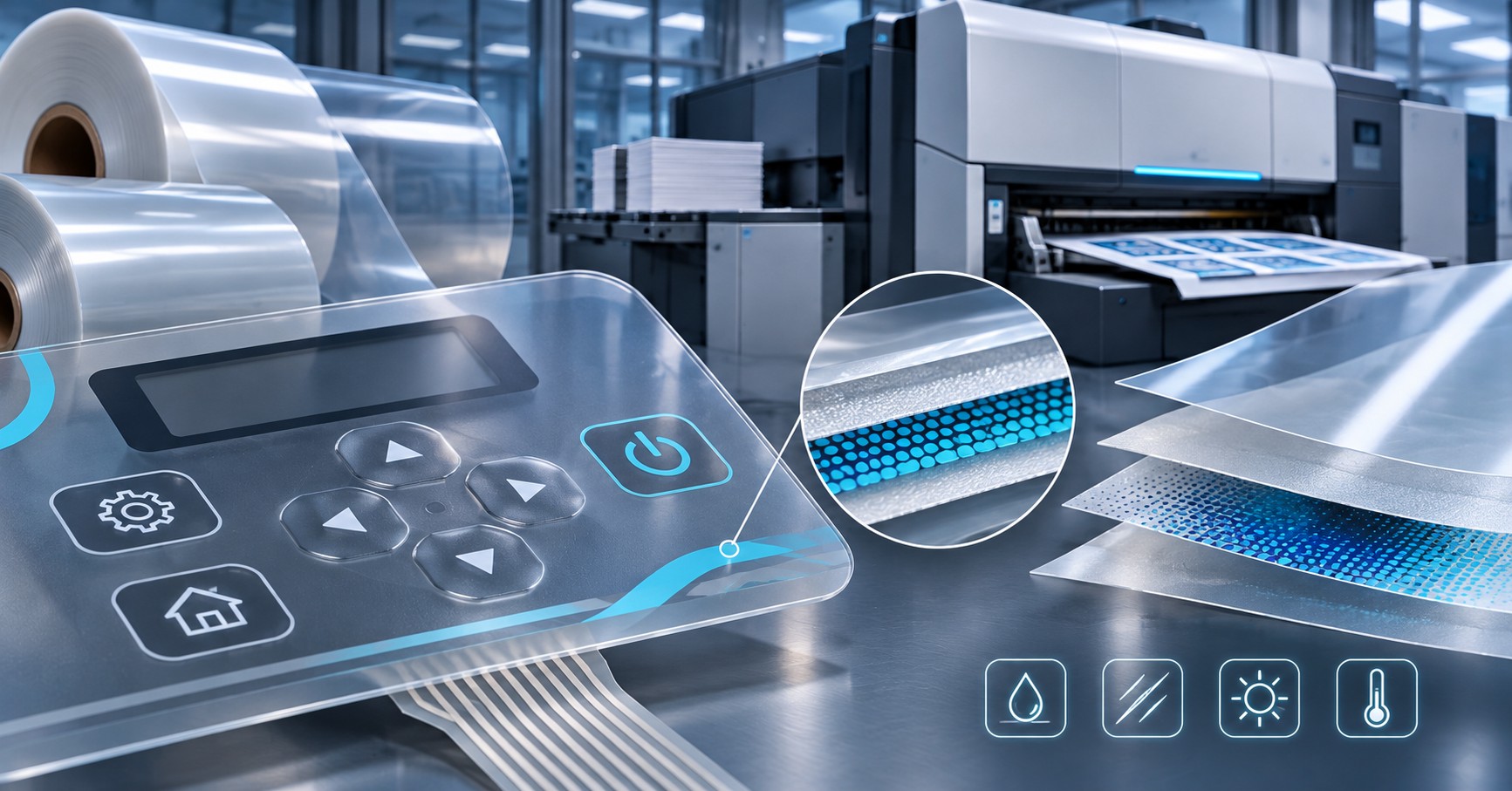
A reverse-printed graphic overlay may combine a transparent polymer film, an outer protective hardcoat, an inner ink-receptive layer, graphic inks, an opaque backing layer, and an adhesive or laminated assembly. Each component has a distinct role, and the weakest interface may control the reliability of the entire structure.
A hardcoat is typically designed to improve the user-facing surface's resistance to abrasion, scratching, or cleaning chemicals. A print-receptive coating on the opposite surface is formulated to support printing and adhesion. They should never be regarded as interchangeable: a protective outer finish that performs well in a cleaning test may not accept LEP ink, and an excellent print-receptive coating may not withstand direct physical abuse.
A successful film also does not guarantee a successful stack. The ink can detach from the receptive layer; the receptive layer can detach from the film; an adhesive can separate from the printed surface; or a thin coating can crack while the polymer substrate remains unbroken. The mechanisms must be distinguished. Adhesive failure occurs at an interface, whereas cohesive failure occurs within a material layer.
This multilayer perspective is especially important after embossing or cyclic flexing because the local strain and stress are not necessarily distributed equally through the construction.
4. Coating Chemistry: What Was Known in 2003 and What Is Known Today
Brown emphasized that suitable chemical coatings were often necessary to obtain reliable adhesion of HP ElectroInk to polymer films. Some printers applied coatings internally, whereas many bought films already prepared for printing. The paper linked coating quality to consistent imaging, strong adhesion, and fewer problems from incomplete ink transfer. It did not disclose a complete proprietary binder formulation. [1]
In 2026, film suppliers still list PET and PC constructions designed for Indigo printing, including clear films, hardcoated films, and textured products intended for graphic overlays and related applications. Such products demonstrate continued commercial availability; they do not by themselves establish approval for every press generation, ink configuration, or finished switch. [7]
From a scientific perspective, several phenomena may influence the performance of the coated interface:
- Wetting and intimate contact: the transferred ink must interact appropriately with the receptive surface during printing.
- Intermolecular and chemical interactions: the chemistry of the ink and receptive layer can influence bonding after transfer.
- Polymer compatibility: the composition and physical state of the coating help determine whether a stable interface develops.
- Coating continuity: thickness variations, defects, weak boundary layers, or contamination may create local failure sites.
- Thermomechanical response: the coating and ink must remain functional when subsequent lamination, embossing, and cyclic strain are applied.
These are possible mechanisms, not evidence of any one proprietary formula. Public technical data sheets do not necessarily identify binder families, crosslinkers, functional groups, or additives in sufficient detail to support a chemical attribution. A coating's successful performance cannot be used to infer that it must contain polyurethane, acrylic, polyester resin, or another named binder without independent evidence.
The central distinction is between understanding the mechanisms that could support adhesion and establishing the chemistry that actually controls a particular commercial film.
5. Research in 2025: Why Corona Treatment Cannot Be Reduced to Dyne Level
A 2025 study in Polymer Engineering & Science, titled Improving Water-Based Ink Adhesion on Commercial Polymers by Corona Treatment, investigated the effects of corona treatment on commercial polymers, including PE, an ethylene–acrylic acid copolymer, EVOH, and polyamide. It considered surface energy together with surface chemistry, morphology, and ink adhesion. [3]
A key conclusion was that surface energy alone did not adequately explain adhesion performance. Chemical changes and topographical features provided important information about the treated interface. This is relevant because industrial practice sometimes treats a dyne measurement as if it were an adhesion test.
Raising a measured surface-energy value can improve wetting conditions, but a high dyne level does not establish a durable ink–substrate bond. The interface may still contain incompatible chemistry, weak material, migrated additives, contamination, or other defects. A wetting measurement and a bond-strength or failure-analysis test answer different questions.
The limitation of applying this study to membrane switch overlays must be explicit. It examined water-based ink on packaging-related polymers, not ElectroInk printed onto PET or PC for membrane switches. It therefore supports a general materials-engineering principle, not a directly validated LEP recipe.
For the modern production engineer, a dyne test may remain useful as one process-control indicator, but it cannot replace ink-adhesion assessment, environmental conditioning, and examination of failed interfaces.
6. Ink Release from the Blanket: A 2003 Observation Still Worth Testing
One particularly important observation in Brown's 2003 paper concerned the relationship between the receptive coating and ink transfer. The author noted that an effective coating could help eliminate "blanket memory" associated with incomplete ElectroInk transfer to the film. [1]
This observation points to two related but distinct stages of printing. Ink transfer describes what happens as ink moves from the blanket to the substrate. Ink adhesion concerns whether the deposited ink subsequently remains bonded to that substrate. A visually attractive print may still show inadequate adhesion; conversely, ink that transfers successfully can adhere well even if an independent transfer problem occurs elsewhere in the run.
By 2026, the publicly available work reviewed for this article still does not establish a quantitative relationship linking the complete proprietary chemistry of a membrane-switch receptive coating to blanket-memory behavior over long production runs on a current-generation sheet-fed LEP press. This absence in the reviewed public record does not mean that manufacturers have no internal test data.
A controlled investigation should distinguish the effects of film, coating, ink system, blanket characteristics, and press conditions rather than attributing a defect automatically to a single chemical component. Measurements should cover the beginning and later stages of production, because a result on initial sheets may not represent a sustained run.
Where a change in blanket release performance is suspected, observed behavior should be compared with the press manufacturer's applicable performance criteria. Without objective measurements, a claim of chemical deterioration or declining release-layer effectiveness is a hypothesis, not an established root cause.
7. The Modern Sheet-Fed LEP Press and Its Qualification Limits
Contemporary sheet-fed LEP equipment offers capabilities that were not widely available or equally mature in 2003. For example, published information about the HP Indigo 18K describes options for approved transparent media, white ink, and qualified synthetic substrates, alongside defined format and thickness limits. [7]
Those capabilities create a plausible technical route for printing selected PET or PC overlays. They are not a blanket authorization to print any transparent film of a given thickness. Feed reliability, thermal stability, coating compatibility, ink transfer, adhesion, and the press-specific substrate approval must all be examined.
Similarly, the presence of a digital primer option on a press does not demonstrate that the primer can replace a film supplier's specialized receptive coating. The actual material and finished product must be qualified.
Two practical supply routes are available. One begins with a precoated film explicitly prepared for the intended LEP system. Its coated side and treatment instructions must be verified, and additional corona treatment should not be assumed beneficial. The other begins with an uncoated or differently coated film, using a separately qualified offline surface-treatment and primer-coating process. That route requires validation of coating application, drying, storage stability, print transfer, adhesion, and converting durability.
Neither route is automatically superior. The right decision depends on reproducibility, material availability, production volume, customer requirements, cost, and the ability to inspect the finished construction.
8. Research in 2024: Interlayers as Mechanical Design Elements
The 2024 RSC Sustainability study Recyclable in-mold and printed electronics with polymer separation layers, led by Yannic Brasse and colleagues, investigated polymer separation layers in printed-electronics assemblies. The work considered both materials separation for recycling and the mechanical behavior of printed structures. [2]
The researchers used thin polyvinyl-alcohol (PVA) layers on PC substrates and printed conductive materials using inkjet and screen-printing techniques. In selected structures, the interlayer influenced the resistance of printed tracks to repeated bending.
The significance extends beyond adhesion chemistry alone. A thin interlayer can alter how mechanical stresses are transmitted to a printed coating, including how cracks initiate or progress. In an overlay construction, it is therefore reasonable to evaluate the mechanical response of a receptive coating in addition to its ability to receive ink.
However, the 2024 experiments did not evaluate ElectroInk, an LEP printing process, or membrane-switch graphics. They do not justify recommending PVA as a specific LEP primer. They support the narrower principle that the mechanical characteristics of interlayers can be a functional design variable in a printed multilayer assembly.
9. Research in 2026: PET Anisotropy and Hardcoat Fracture
The 2026 Journal of Materials Science article by Chen Shen, Junhua Xiao, and Guorui Wang, Substrate-anisotropy-dominated bending fracture of hard-coated PET films for foldable display applications, examined cracking in acrylic-hard-coated PET under bending conditions. [4]
The study focused on foldable-display cover films, not membrane switches. Its relevant contribution is the observation that the substrate's directional mechanical properties and structural characteristics can influence crack patterns in an attached coating. A coating is not isolated from the mechanical response of its polymer support.
This result calls for a more detailed characterization of membrane-switch films. Film orientation, converting direction, embossing geometry, local radii, and the alignment of repeated strain may all warrant investigation. Two films with similar apparent coating properties may perform differently after embossing if their underlying mechanical behavior differs.
That application to switch design remains an engineering inference. The researchers did not prove a specific lifetime for LEP-printed PET overlays, and the data should not be presented as a direct qualification of ElectroInk under millions of actuations.
10. New Studies of Printed Layers Under Repeated Bending
In 2026, Juuso Puutio and colleagues published Electromechanical characterization of flexible screen-printed tracks in Flexible and Printed Electronics. Their experiments examined conductive traces on flexible substrates subjected to repeated bending and related electrical-mechanical characterization. [5]
The broader finding is that reliability depends on the substrate–ink combination and on the imposed deformation. Yet a conductive printed trace and an LEP graphic layer do not necessarily fail in the same manner. An electrical trace may register failure as a resistance change, whereas a graphic overlay may fail through cracking, peeling, color change, or loss of visual legibility.
A separate 2026 review by Bilge Nazli Altay examined formulation strategies for printed electronics, highlighting connections among ink design, substrates, processing, and final performance. [6] This research is likewise adjacent rather than LEP-specific.
Together, these publications reinforce a modern qualification philosophy: assess the printed system under the mechanical and environmental conditions of its final use, while resisting the temptation to transfer numerical lifetime claims directly from a different ink system or application.
11. White Ink, Opacity, and Hybrid Production
Brown already described a possible need for a screen-printed flood coat behind the digital graphic, both to increase opacity and to add protection. A white laminating adhesive was another option. [1]
Contemporary LEP presses may offer white-ink capabilities, but the existence of digital white does not automatically remove the need for a backing layer. Backlit control surfaces must manage transmitted light, light leakage, optical separation between symbols, and the appearance of color both when the illumination is on and when it is off.
Depending on the construction, the optical design can combine CMYK graphics, white or other backing inks, opaque blocking areas, selectively translucent windows, and adhesive layers. A hybrid process that prints complex colored graphics digitally and applies a functional flood coat by screen printing may remain practical for some jobs. For other jobs, a qualified digital-white construction may be sufficient.
The decision requires measuring the assembled product, including opacity, haze, or transmission where relevant, viewing under the intended light source, and assessing color appearance in ambient illumination. A successful color match on a flat white proof does not necessarily predict the perception of a reverse-printed, backlit overlay.
12. The Evolution of Durability Testing
Brown reported successful appearance after more than five million switch actuations for tested ElectroInk-printed overlays. The report remains valuable, but its short conference-paper format does not provide a complete experimental protocol, with all sample geometries, loading conditions, construction details, replicates, and failure statistics. It cannot serve as a universal five-million-cycle certification for today's films or presses. [1]
A modern qualification plan must align tests with the finished product. ASTM F1578-24 concerns contact-closure cycling of membrane switches and is pertinent to the functional test context. ASTM F1842-15, a historical method for ink or coating adhesion on flexible membrane-switch or printed-electronics substrates, was withdrawn in 2024; it should not be described as a current active standard. [8]
Other procedures may be useful within their stated scope. ASTM D3359-23 provides tape-based adhesion ratings but has limitations when applied to flexible polymer multilayer structures. ASTM D1003-21 can be relevant to haze and luminous transmittance of transparent plastics. Test methods should be selected and documented with attention to the substrate and acceptance criteria rather than borrowed uncritically from a dissimilar application. [8]
It is also vital to distinguish initial adhesion, mechanical fatigue, optical durability, and functional switch life. One favorable result does not guarantee all four. When a specimen fails, the location and mode of damage are as important as the pass/fail label.
13. A Modern Qualification Plan for LEP-Printed Overlays
A meaningful qualification program begins with the product's functional requirements: anticipated actuation cycles, cleaning agents, exposure conditions, embossed-key geometry, dimensional tolerances, optical requirements, and intended service life.
Next, choose representative PET and PC constructions with documented coating systems. Record the coated side, film thickness, orientation, protective finishes, handling conditions, and material lots. Confirm each candidate's press-specific eligibility before production testing.
During printing, examine feeding and dimensional behavior, ink transfer, image consistency, color, initial adhesion, and stability over a representative run. Avoid changing film, primer, press conditions, and ink configuration simultaneously when the purpose is to isolate a failure mechanism.
Then produce realistic converted specimens: backing or flood-coat layers where required, lamination, embossing, die cutting, bonding, and complete membrane-switch assembly if that is the intended product. Evaluate appearance and mechanical integrity after each critical stage.
Finally, test the finished construction under representative actuation, abrasion, cleaning-chemical exposure, environmental conditioning, and optical conditions. The acceptance threshold must come from the application requirements and an agreed test protocol, not a generic historical cycle count.
Failure analysis should distinguish separation of ink from the receptive coating, the receptive coating from the polymer, the adhesive from the printed surface, cohesive cracks within ink or coatings, and cracks or dimensional damage within the base film. The objective is not only to identify which construction passed but to understand why it passed and within which operating window it remains reliable.
14. Does Digital Printing Still Offer a Commercial Advantage in 2026?
The opportunities identified in 2003 remain conceptually relevant: short runs, multilingual artwork, rapid prototyping, frequent design revisions, and customer-specific variations. However, the competitive landscape now includes more UV inkjet processes and hybrid print-converting systems alongside traditional screen printing.
Screen printing continues to offer practical advantages for certain opaque, thicker, or functional layers, and for repetitive volume production when setup costs are distributed over substantial runs. LEP can be attractive for high-quality variable graphics and shorter runs when appropriate qualified films are available. UV inkjet offers another digital route, but its inks, curing mechanisms, and adhesion requirements differ from those of LEP; a coating labeled "digital printable" cannot be assumed suitable for both.
Hybrid manufacturing may combine the strengths of different processes, but it introduces added registration, process-control, and logistics requirements. A serious economic comparison must include not only printing cost per sheet but also precoated-film prices, setup work, embossing tools, scrap rates, inspection, qualification costs, and delivery flexibility.
The publicly reviewed sources do not establish LEP's global market share in membrane-switch overlays in 2026, nor do they provide a verified profitability ranking among LEP, screen printing, and UV inkjet. Claims of overall superiority would therefore be unwarranted.
15. What Has Still Not Been Demonstrated Publicly?
Several questions remain open in the public literature reviewed for this article.
First, a complete, independently documented chemical formulation for a current proprietary LEP-receptive membrane-switch coating is generally unavailable. This limits the ability to quantitatively link a specific binder chemistry to transfer efficiency, adhesion, and fatigue resistance.
Second, the reviewed material does not include a contemporary, controlled comparison of several LEP-receptive coatings that measures both blanket-to-film ink transfer throughout a production run and the durability of the same printed constructions after embossing and millions of actuations.
Third, the mechanical effect of a thin LEP-receptive layer—its modulus, strain accommodation, adhesion, and fracture behavior—requires further direct investigation under realistic switch geometries.
Fourth, no public evidence identified in this review authorizes a general claim that one modern LEP press, film, primer, and ink combination will achieve five million switch actuations without a dedicated qualification program.
These gaps do not establish that the application is immature or commercially unworkable. They distinguish a technically plausible and commercially supported application from a fully demonstrated scientific explanation for one specific material system.
16. Conclusions: What Changed Between 2003 and 2026?
In 2003, the central task was to demonstrate that HP Indigo printing could be applied to polymer-film graphic overlays by using appropriate films and ink-receptive coatings. Brown connected film choice, coating quality, ink adhesion, transfer from the blanket, and mechanical service performance in a way that remains relevant. [1]
By 2026, commercially offered coated films and expanded LEP press capabilities provide more developed routes for evaluating the application. At the same time, materials-science research has made it clearer why the reliability of a multilayer product cannot be predicted by one substrate property, one surface-energy value, or one initial adhesion test. The interaction of the polymer, receptive coating, ink, backing layers, adhesives, processing conditions, and local deformation governs the final result.
The most important change, therefore, is the scope of qualification. In 2003, the question could be framed as whether a graphic could be printed successfully on a suitable plastic film. In 2026, the more useful question is whether an engineered film + coating + LEP ink + converting process can provide stable transfer, robust adhesion, controlled optical behavior, and verified mechanical durability over the product's service life.
Digital printing creates the graphic image. Materials engineering and process qualification determine whether that image remains a dependable functional interface.
References and Source Notes
[1] Brown, Lloyd W. "Membrane Switch Substrates for the HP Indigo Press." DPP2003: IS&T International Conference on Digital Production Printing and Industrial Applications, pp. 193–194, 2003. https://www.imaging.org/common/uploaded%20files/pdfs/Papers/2003/DPP-0-289/9018.pdf
[2] Brasse, Y., et al. "Recyclable in-mold and printed electronics with polymer separation layers." RSC Sustainability, vol. 2, 2024, pp. 1883–1894. https://doi.org/10.1039/D4SU00092G
[3] "Improving Water-Based Ink Adhesion on Commercial Polymers by Corona Treatment." Polymer Engineering & Science, vol. 65, no. 12, 2025, pp. 6823–6835. https://doi.org/10.1002/pen.70167
[4] Shen, C., Xiao, J., and Wang, G. "Substrate-anisotropy-dominated bending fracture of hard-coated PET films for foldable display applications." Journal of Materials Science, 2026. https://doi.org/10.1007/s10853-026-12197-x
[5] Puutio, J., Laine, K., Pourkheirollah, H., and Mäntysalo, M. "Electromechanical characterization of flexible screen-printed tracks." Flexible and Printed Electronics, vol. 11, 2026, article 015004. https://doi.org/10.1088/2058-8585/ae383f
[6] Altay, B. N. "Ink formulation design strategies for printed electronics: a review on fundamentals, materials, and processing." The International Journal of Advanced Manufacturing Technology, vol. 144, 2026, pp. 6215–6249. https://doi.org/10.1007/s00170-026-18295-z
[7] Commercial and technical sources: Tekra Corporation, product information for Indigo-oriented PET and PC films and overlay applications, https://www.tekra.com; and HP, HP Indigo 18K Digital Press product and media specifications, https://www.hp.com/us-en/industrial-printers/indigo-digital-presses/commercial-digital-presses/18k-printing-press.html. Product listings and general press specifications are supplier documentation, not independent certification of any finished construction.
[8] Standards discussed: ASTM F1578-24 (contact-closure cycling of membrane switches); ASTM D3359-23 (tape-method adhesion rating); ASTM D1003-21 (haze and luminous transmittance of transparent plastics); ASTM F1842-15 (historical adhesion standard, withdrawn in 2024). Current status, applicability, and edition should always be verified before inclusion in a binding product specification.
Scientific and Technical Disclaimer
This article is a literature review and engineering analysis, not a report of newly performed LEP experiments. The 2003 paper is an industry-conference contribution; commercial film data are manufacturer claims; and some research published in 2024–2026 concerns different inks or applications. Findings from those sources therefore cannot be treated as automatic approval of a film, primer, press model, ink set, or manufacturing process. Every specific substrate–coating–ink–converting combination requires documented qualification against its intended application and applicable safety and quality requirements.