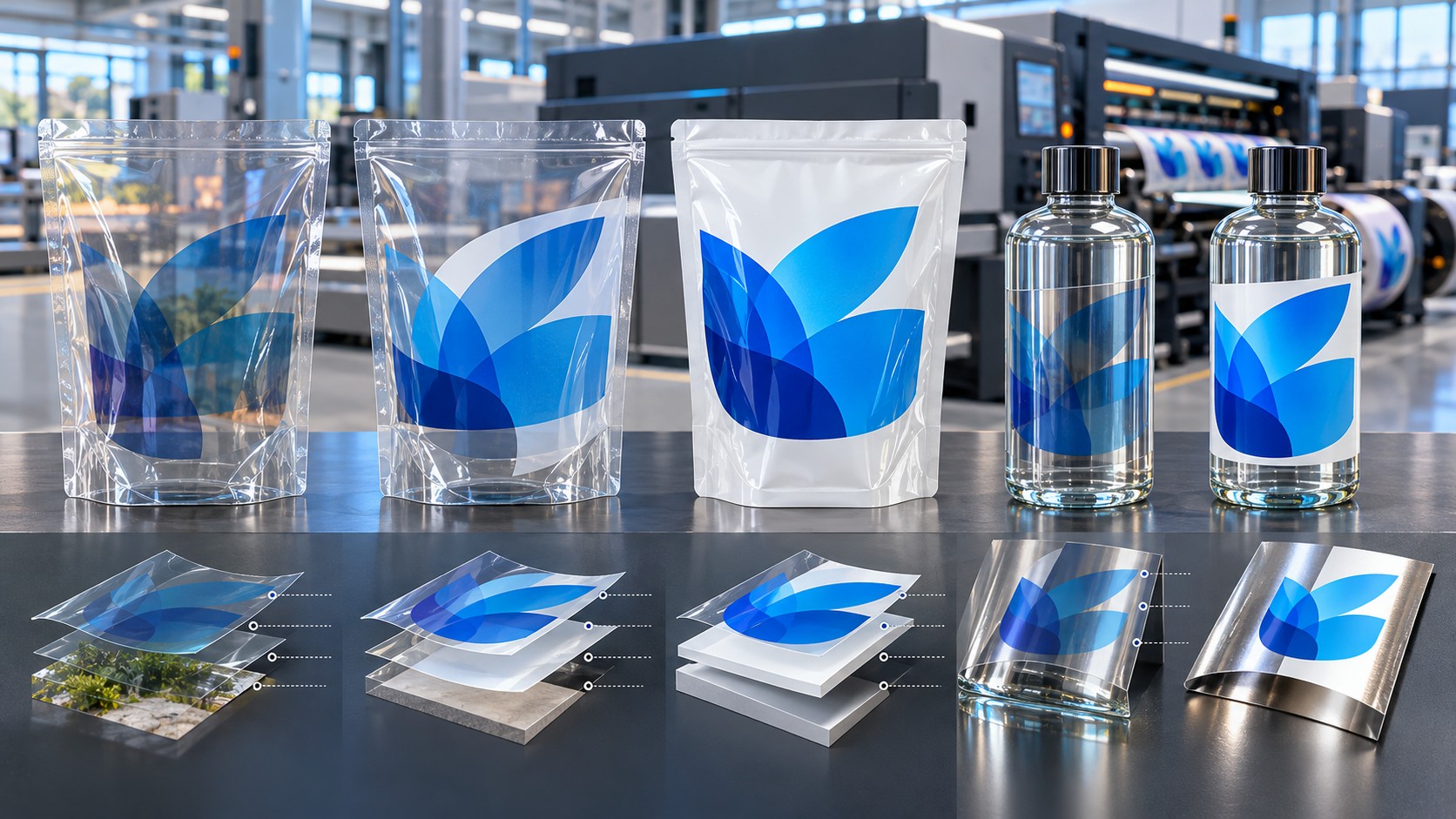
A print that passed—until the package was finished
A packaging converter receives an order for a flexible pouch printed on transparent PET using liquid electrophotographic printing (LEP). The customer wants to reproduce an established brand blue that was previously approved on coated white board printed by offset. The digital press is calibrated, the selected ICC profile represents the documented print condition, and the initial color measurements appear close to target. On the press, the result looks convincing.
Then the printed PET is laminated to PE. Some areas of the blue appear less substantial, certain transitions look different, and the gap becomes more noticeable after the pouch is formed and filled. The color team naturally returns to the ICC profile, calibration curves, and CMYK recipe. But comparing different backings suggests another plausible mechanism: the white ink behind the process image may not isolate the printed colors sufficiently from the laminate and the product behind it.
The white layer might be too translucent, locally uneven, discontinuous at small defects, or poorly registered to the colored image. It may also be stable on its own, while the measurement backing used at press approval fails to represent the final product. A change in the film, adhesive, or laminate may be contributing instead. These possibilities must be tested, not assumed.
This is an illustrative production scenario, not a report of measured trial results. It leads to a practical principle: on transparent and metallic substrates, white ink is not simply another separation. In many constructions, it is the optical foundation on which the apparent color depends.
1. What opacity really means
Opacity describes how effectively a printed layer limits the influence of what lies behind it. Hiding power describes how effectively a material conceals a contrasting background at a specified application rate or layer thickness. The two concepts are related, but they are not interchangeable with the visual impression of a bright white.
Whiteness is a colorimetric description of a white surface under a defined evaluation method. Brightness has more specialized standardized meanings—particularly in paper testing—and should not be substituted for opacity. Light scattering describes light redirection inside the layer. Ink-film thickness describes the physical film, not wet or dry coating weight per unit area. Contrast ratio compares the luminous reflectance of the same coating or printed construction over defined black and white backings.
The distinctions matter in production. A white patch can show high L* when measured over white and still allow a dark bottle, colored fill, or metallic web to modify the final printed color. A single white-point measurement, by itself, cannot demonstrate sufficient hiding power.
The core white pigment in many opaque printing inks is titanium dioxide (TiO₂). Its ability to scatter visible light depends strongly on its refractive-index contrast with the surrounding binder, as well as particle size, shape, particle-size distribution, and dispersion quality. More pigment does not automatically mean more efficient opacity: agglomeration and excessive particle crowding can reduce scattering effectiveness. These pigment-science principles are well supported in the coating literature, but every ink formulation requires its own print-specific validation [3, 4].
Increasing ink-film weight can improve opacity, particularly while the layer is still relatively translucent. However, the gain is not unlimited. Heavier films can also alter image transfer, registration, adhesion, flexibility, drying or curing, blocking, lamination performance and cost. The engineering objective is not the thickest possible white; it is a sufficiently opaque, uniform and durable white layer at a controlled and economically practical film weight.
2. Five printing technologies, five different control mechanisms
White ink serves a similar optical purpose across technologies, but each process builds and transfers the white film differently. As a result, an observation made on one press architecture cannot be translated directly into a setting for another.
Liquid electrophotographic printing (LEP)—the digital reference point
In LEP, an electrostatic latent image is created on a photoconductive imaging surface. Charged pigment-bearing particles dispersed in a liquid carrier develop that image, and the resulting separations are transferred through an intermediate blanket to the substrate under controlled conditions. The specific sequence of separation building and image transfer depends on the press architecture; LEP should not be described as inkjet or as a direct droplet-deposition process.
For white ink, the central questions are the stability of development and transfer, achievable coverage, uniformity over the printed area, layer order, and the available means of increasing white coverage. Some configurations allow additional white impressions or layers; that possibility, and the distinction between additional color separations and actual transfer cycles, must be verified for the installed press configuration.
White ink in an LEP workflow must be regarded as part of the characterized print condition. Changing white coverage after an ICC profile has been built can change the reflective support for overlying colors even if the nominal CMYK values remain unchanged. A production profile created for a particular white strategy is therefore not automatically valid after that strategy changes.
The practical sequence for color-critical transparent packaging is to select and qualify the film and surface preparation, stabilize the white ink configuration, verify opacity and local continuity, prove lamination compatibility, and only then characterize or refine the process colors against the intended finished appearance. This is a recommended engineering workflow, not a universal machine-specific instruction.
Inkjet—droplets, pigment stability and curing
Inkjet creates images by depositing individual drops onto the substrate. White opacity depends on drop formation, jetting reliability, deposited volume, wetting, film coalescence, and the dry or cured film structure. Because titanium dioxide particles are relatively dense, white ink can be especially sensitive to sedimentation and poor dispersion stability. Appropriate circulation, agitation, filtration, and maintenance strategies depend on the design and ink.
Missing or deflected jets, drop-volume variation, and nozzle-related banding can produce local openings in the white support. In UV-curable inkjet systems, heavier highly pigmented white films may also complicate curing through the full layer because the pigment changes the distribution of incident radiation. A surface that feels dry does not prove adequate conversion throughout the film. Water-based or other inkjet chemistries demand different drying and performance checks; not every inkjet process uses UV curing.
Flexography—anilox, transfer and drying
In flexography, white film build depends on the anilox cell volume and geometry, actual ink-release efficiency, the doctor blade, plate, impression, ink viscosity or rheology, and the selected film. The rated anilox volume is not equal to the dry white coating weight transferred to the substrate.
Higher ink delivery or an additional white station can help, but poor wetting, foam, cell contamination, or an unstable solvent or water balance may create pinholes, mottle, or uneven opacity. Drying capacity must be considered alongside the desired coating weight. Any approved configuration should be demonstrated at production speed rather than judged from a single laboratory drawdown.
Offset—the substrate may supply the white
In conventional offset on white coated board, the paper or board already supplies an optically reflective background beneath the process inks. No separate opaque-white impression is normally required. Moving the same color build to transparent PET removes that optical foundation.
Specialist offset configurations can print white on dark, colored or metallic stocks, including suitably configured UV-curable routes. But you can't assume every offset press, ink system, or substrate can produce a continuous opaque white film in one impression. The comparison with LEP must therefore include the difference between a naturally white board and a transparent film backed by a printed white layer.
Screen printing—a useful benchmark for heavy white deposits
Screen printing, including flatbed and suitably designed rotary-screen applications, is particularly relevant to opaque whites on selected labels, decorated products and specialized packaging. Ink is forced through image openings in a mesh-and-stencil assembly, allowing relatively substantial ink deposits when the process is configured for that purpose.
The wet deposit is influenced by mesh count, thread diameter and open area, stencil thickness and emulsion-over-mesh (EOM), screen tension, off-contact, squeegee hardness, edge condition, angle, pressure and speed, as well as ink rheology and substrate wetting. Mesh designation alone is not a reliable specification for the deposited and cured white thickness [8].
Its potential advantage is strong white coverage in targeted areas or relatively heavy films. Its limitations may include production speed, fine-detail reproduction, layer relief, curing requirements, registration, flexibility, and integration into a given converting workflow. Heavy white deposits can also increase lamination-interface demands. Screen printing is therefore not intrinsically the best white for every package: it is a separate physical solution whose suitability must be qualified.
For a digital printing professional, screen printing provides a useful contrast: a heavy white layer may achieve opacity through a different deposition mechanism, while LEP must balance its own imaging, transfer, layered construction, color characterization and production economics. Equivalent apparent opacity does not imply equivalent film chemistry, mechanical performance or production behavior.
What the 2022 gravure study demonstrates—and what it does not
An original study published in the Journal of Print and Media Technology Research by Robert J. Eller and Gregory S. D'Amico of Rochester Institute of Technology investigated the effect of white ink coating weight and print-film type on the chromaticity of reverse-print constructions representative of gravure flexible packaging. Six experimental series examined Cyan, Magenta, Yellow, Orange, Violet, and Black, using three white coating weights and three print-film types [1].
The investigators found statistically significant effects of white coating weight and film type. Over the measured white coating-weight range of 0.49 to 1.95 g/m², chroma responded consistently to weight changes in the tested arrangements. Reducing white coating weight from 1.95 to 0.98 g/m² produced a reported color difference of approximately ΔE00 2.5 for Magenta, Cyan, and Orange, while Yellow was more sensitive. These figures are research results from the specified gravure experiment—not production tolerances, targets, or universal predictions for other technologies [1].
The tested assemblies represented reverse-print optical structures; they do not demonstrate the behavior of an actual completed laminated pouch under adhesive curing, filling, or end-use conditions. Above all, they do not establish equivalent quantitative results for LEP, flexography, inkjet or screen printing. Their real value is the experimentally demonstrated principle: the white underlayer is an active color variable, and white consumption reductions should not be approved on cost alone.
3. Surface versus reverse printing: describe the light path in words
In a typical surface-print construction on clear film, viewed from the printed side, the observer encounters the process-color inks first, then the printed white backing (if used), then the clear substrate, and ultimately the background or product. This is a functional description: exact layer sequence depends on the press and the intended surface-print architecture.
In a representative reverse-printed PET/ink/white/adhesive/PE structure, the observer first encounters the outer PET film, then the colored image, then the white ink backing, followed by the lamination adhesive, PE, and whatever lies behind the package. The image is viewed through the clear PET. White can scatter and return a proportion of incident light through the color inks and PET; insufficient hiding lets other layers and the background contribute to the final appearance.
This verbal layer description replaces a cross-section drawing. It also clarifies why "white underneath CMYK" may be physically misleading unless the observation side and printing direction are stated. In reverse print, the white is often deposited after the color separations while ending up optically behind them from the consumer's viewpoint.
The same color patch can therefore look different in these three cases: transparent film without white, transparent film with a partially hiding white, and transparent film with a more opaque and continuous white. Against a dark background, the first construction will often show stronger background dependence; the second will reduce that influence to a degree; and the third will generally isolate the overlying colors more effectively. These are qualitative optical expectations, not invented measured color values.
4. Transparent films, metallic films and real product backgrounds
PET, BOPP and PE can all feature in flexible-packaging constructions, subject to the press, ink, surface treatment and finishing qualifications. Their optical clarity, haze, surface condition, coatings and dimensional behavior differ. Even where two films are described as clear, they should not be assumed to be optically or mechanically interchangeable.
A white backing is often used to prevent the color of the filled product, bottle, or store shelf from altering the intended brand image. Yet a label or package design may deliberately omit white behind windows or transparent details. The design file must distinguish full white coverage, reduced coverage, no-white areas, registration compensation, and any intentionally exposed background.
Metallic substrates add directional reflection and often strong gloss effects. An opaque white backing can suppress part of the metal's contribution, making process color behave more like ink over a white support. Leaving white absent or reduced can preserve intended metallic effects. Neither design is inherently more correct: the finished-package color target must specify what should remain visibly metallic.
Distinguish a colorimetric shift from appearance changes caused by directionality, gloss, or specular highlights. A single measurement geometry may capture a useful controlled aspect of the metallic sample without describing every viewing angle. If the angle-dependent effect is essential, structured multi-angle observation or appropriate measurement may be needed.
5. Lamination changes the optical system—and may expose interface failures
Lamination creates a new construction, not merely a mechanical attachment. The clear film, colored inks, white backing, adhesive, second film, interfaces and final background all influence the paths by which light is reflected, scattered or transmitted. Adhesive wet-out, trapped microvoids, haze, gloss and refractive-index differences can change apparent color even when the press-side image has not been altered.
For that reason, compare samples representing the same controlled production history at three meaningful stages: the printed web before lamination; the laminate after the specified conditioning or cure time; and the converted and, where appropriate, filled product. A loose film over a white measurement tile is not optically equivalent to a laminated pouch with a colored fill. If the apparent shift evolves after lamination, compare samples at controlled and documented times before inferring a cure-related mechanism.
The laminate must also be mechanically sound. In reverse-printed structures, white ink can lie at or near a bonding interface. If peel strength is inadequate or delamination occurs, locate the failure plane. Separation at the film-to-ink interface, within the white layer, between color and white, or between white and adhesive can require entirely different corrective actions. A generic diagnosis of "poor ink adhesion" is not enough.
All peel, tape, or bond tests must follow an agreed method suitable for the specific structure. Do not use an initial attractive color appearance as evidence that adhesion, flex resistance, blocking or food-packaging suitability has been validated.
6. Measuring white opacity and printed color correctly
To examine hiding power, prepare a consistent white printed patch and measure it over defined white and black backings. Where appropriate, calculate the contrast ratio using the relevant luminous-reflectance values from those two backing conditions. The method shows how strongly the background continues to influence the measured sample, but the exact procedure must be declared and shown to be suitable for the print construction.
ISO 6504-3 offers established hiding-power concepts for paints and coatings tested on black and white surfaces; it is not automatically a pass/fail standard for a given white printing ink. ISO 13655 and CIE colorimetry provide essential principles for controlled graphic-arts measurement, including spectral evaluation, geometric conditions, measurement backings and standardized colorimetric computation [5–7].
An operational test should identify the spectrophotometer geometry, aperture, measurement condition, illuminant and observer used in computation, backing, film orientation, sample age and stage of manufacture. It should also define measurement points across and along the web. Local pinholes or white-registration defects may be invisible in the average of a few large-aperture readings.
M0, M1, and M2 should be recorded where applicable. M1 is particularly relevant when optical brighteners or fluorescent behavior contribute to the sample; M2 reduces the ultraviolet component. Changing the measurement condition does not correct opacity—it changes what measurement condition is being controlled. This article treats those conditions briefly because the principal issue is white ink, not a general review of color standards.
For a clear label applied to a bottle, consider three distinct observations: the flat sample on a defined backing; the actual laminated or adhesive construction; and the label on the intended filled container. Bottle-wall thickness, contents, headspace, curvature, and background can all enter the optical response. Measurement of one state should not be presented as full qualification of the others.
7. White opacity, color gamut and ICC profiling
An ICC profile characterizes the relationship between digital values and measured appearance under a specified print condition. On a clear film, that condition includes the white backing configuration. Altering white ink coverage or continuity can change L*, chroma, hue, and the effective printable gamut of the overlying process colors. The direction and magnitude depend on color, ink, substrate, and background; no universal shift applies to every printed patch.
This is why automatically modifying CMYK values can be counterproductive when the physical white support is unstable. A color recipe may be made to match one sample on one backing, only for the product to diverge after lamination or when the fill changes. An ICC adjustment cannot reliably compensate for pinholes, white-to-color misregistration, spatial variation, or an unqualified laminate interface.
First stabilize the substrate and white process. Then characterize process color on representative, finished or appropriately simulated constructions. Retain a controlled print-side reference for process monitoring, but establish acceptance against a qualified finished-product reference. The correct CMYK build may differ from the prior offset recipe on coated board without compromising brand intent.
8. Troubleshooting white ink in production—twelve practical checks
The following diagnostic entries replace a four-column troubleshooting table with live text suitable for copying into an online article. "Possible cause" is a hypothesis to verify, not a universal diagnosis.
1. White ink pinholes
Possible cause: poor wetting, surface contamination, unstable ink transfer, foam, or localized failure to deposit ink. What to check: surface treatment and cleanliness, defect distribution under magnification, and deposition-specific settings. Recommended action: eliminate the mechanism creating uncovered points before increasing total white coverage.
2. Uneven opacity
Possible cause: variable film weight, unstable pigment dispersion, or inconsistent image transfer. What to check: a cross-web and down-web opacity map, ink condition, transfer-system stability, and retained good samples. Recommended action: restore uniformity and verify repeatability at production speed.
3. White banding
Possible cause: technology-specific imaging or transfer fluctuation, or missing/deflected inkjet nozzles. What to check: repeat distance, orientation, and location of the bands, along with the relevant press or nozzle diagnostic. Recommended action: correct the responsible imaging or delivery mechanism rather than treating all banding as an ICC issue.
4. Pigment settling
Possible cause: inadequate ink circulation or dispersion stability during storage and operation. What to check: approved ink handling, circulation, filtration, and dwell periods. Recommended action: follow the ink-system operating limits and avoid unqualified additions or changes to the formulation.
5. Poor white adhesion
Possible cause: unsuitable surface preparation, incompatible primer, contaminated film or insufficient film integrity. What to check: treatment history, adhesion test method, and the actual plane of separation. Recommended action: correct the identified interface and requalify later processing.
6. White-to-color misregistration
Possible cause: separation alignment error or an incorrect white mask. What to check: halo edges, exposed colored background, choke/spread definitions, and web-position stability. Recommended action: correct registration or white-mask geometry without compromising intentional clear windows.
7. Blocking in the roll or stack
Possible cause: inadequate dry/cure state, excessive tack, heavy film build, heat, or winding pressure. What to check: dry/cure evidence, roll temperature, tension, and contact surfaces. Recommended action: establish a qualified process window and verify roll/storage behavior.
8. Ink picking or film removal
Possible cause: excessive mechanical stress, weak adhesion, or cohesive failure in a deposited ink layer. What to check: removed material, contact conditions, and failure plane. Recommended action: repair the interface or process weakness demonstrated by the evidence.
9. Color shift after lamination
Possible cause: optical change due to films, adhesive wet-out, haze, backing influence, or evolving interfacial contact. What to check: matched samples before and after lamination at controlled backing and conditioning times. Recommended action: isolate the contributing laminate variable before changing color separations.
10. Incomplete drying or curing
Possible cause: excessive deposited white weight or insufficient effective drying/curing conditions for the ink chemistry. What to check: validated process-specific drying/curing indicators and later-use resistance. Recommended action: restore the qualified operating range; surface feel is not sufficient evidence.
11. Excessive white ink consumption
Possible cause: use of maximum white coverage where the artwork requires less, inefficient transfer, or an unoptimized white strategy. What to check: actual white coverage map, layer settings, opacity performance, and cost per approved product. Recommended action: optimize for the minimum robust film weight that meets finished-product requirements.
12. White-layer delamination
Possible cause: weak bonding to the adhesive, cohesion loss inside white, or failure between colored ink and white. What to check: peel-test fracture surfaces and chemical/mechanical compatibility across the exact structure. Recommended action: correct the failing interface and repeat full construction qualification.
9. A text-only decision path when brand color changes after lamination
Step 1—Confirm that the comparison is valid. Match the printed lot, measurement backing, instrument settings, sample orientation, stage of manufacture, and conditioning time. If the conditions are not matched, repeat the comparison before deciding that the color has changed.
Step 2—Test white opacity and continuity separately from process color. Compare white patches on controlled black and white backings, sample several locations, and inspect under magnification. If the white is nonuniform or doesn't hide enough, identify and stabilize that condition first.
Step 3—Check white geometry. Verify the white mask, registration, spread/choke logic, and intentionally transparent areas. If the local brand-color shift tracks a white edge, it is not primarily a CMYK-formulation problem.
Step 4—If the printed white is stable, examine the printed web before lamination. Compare the same colored patches on representative backings. Check substrate lot, film haze, receptive coating, surface treatment, ink-transfer state, and calibration consistency.
Step 5—Isolate lamination and finishing. Use controlled sample sequences to compare film grades, adhesive conditions, lamination settings, cure/conditioning intervals, and any microvoids, haze, adhesion, or gloss differences. Then compare converted, filled product samples.
Step 6—Only after physical stability and end-use performance have been established should the team decide whether the finished construction requires revised characterization, ICC profiling, spot-color emulation or a process-color recipe adjustment. Document the new approved white strategy as part of the color condition.
10. Food packaging: opacity is not a migration barrier
White ink in a reverse-printed food package must be evaluated not only optically but also as part of the entire chemical and functional construction. Optical opacity does not guarantee an effective migration barrier. Printing-ink substances may present migration or set-off risks during winding, storage, or intended use, depending on the full structure and processing history.
Consider ink-supplier documentation, the suitability of film and adhesive systems, residual or evolving chemistry, non-intentionally added substances, and the relevant intended use and regulatory requirements. Claims about a white ink being "food safe" cannot be inferred from pigment identity or from the fact that the ink is buried in a laminate. The finished package must be assessed and qualified through the appropriate supply-chain documentation and testing [9, 10].
11. What digital printing should take away from this
For digital printing, particularly LEP, the critical shift in thinking is to treat white ink as a controlled part of color reproduction rather than an optional visual underlay. Digital presses can maintain precisely specified image data and repeatable nominal separations, yet the optical result will still vary if the white transfer, coverage, film, or final laminate is not stable.
The strongest workflow begins with the intended finished package, works backward through film, surface preparation, white layer, process colors and lamination, and only then locks the color characterization. An approved ICC profile is useful only as long as the physical condition it represents remains valid. Screen printing, flexography and offset provide instructive comparisons, but their white-layer deposition mechanisms do not redefine the requirements or process controls of LEP.
The final engineering question is not simply whether the digital press can print the target CMYK values. It is whether the complete digital-print construction will retain the intended brand appearance after conversion, lamination, filling, and real-world viewing.
When a brand color changes on a transparent or metallic substrate, don't automatically start by changing the recipe. Prove first that the printed white has the opacity, continuity, registration, adhesion, and stability required by the finished product. Only then decide whether a new profile or color build is necessary. In industrial digital printing, white is not outside color management: it is one of the conditions that makes reliable color management possible.
References and source notes
Research findings, technical standards and engineering recommendations are distinguished throughout the article. In particular, the 2022 gravure results support the importance of white ink coating weight, but should not be treated as direct performance data for LEP, flexography, inkjet or screen printing.
[1] Eller, R. J., and D’Amico, G. S. (2022). "Characterizing the influence of white ink coating weight and print layer film type on chromaticity in gravure printed flexible packaging." Journal of Print and Media Technology Research, 11(3), 183–193. DOI: 10.14622/JPMTR-2212. Original gravure research; not a LEP qualification study. https://www.jpmtr.org/index.php/journal/article/view/50
[2] Journal of Print and Media Technology Research. Full issue containing the original 2022 study. https://jpmtr.org/jpmtr_11%282022%293_web.pdf
[3] Thiele, E. S., and French, R. H. (1998). "Light-Scattering Properties of Representative, Morphological Rutile Titania Particles Studied Using a Finite-Element Method." Journal of the American Ceramic Society, 81(3), 469–479. Pigment-science research; not a direct press specification. https://doi.org/10.1111/j.1151-2916.1998.tb02364.x
[4] Liang, Y., Qiao, B., Wang, T.-J., Gao, H., and Yu, K. (2016). "Effects of porous films on the light reflectivity of pigmentary titanium dioxide particles." Applied Surface Science, 387, 581–587. Pigment and coating study, with limited transferability to printing ink formulations. https://doi.org/10.1016/j.apsusc.2016.06.131
[5] ISO 13655:2017. Graphic technology — Spectral measurement and colorimetric computation for graphic arts images. https://www.iso.org/standard/65430.html
[6] CIE 015:2018. Colorimetry, 4th edition. International Commission on Illumination. https://www.cie.co.at/publications/colorimetry-4th-edition
[7] ISO 6504-3:2019. Paints and varnishes — Determination of hiding power — Part 3. An established concept for coatings, not an automatic acceptance standard for printed white ink. https://www.iso.org/standard/70903.html
[8] DeFelsko. "Screen Printing — Measurements (mesh, emulsion, stencil thickness)." Technical guidance on mesh and emulsion-over-mesh measurement. https://www.defelsko.com/resources/screen-printing-measurements-mesh-emulsion-stencil-thickness
[9] European Printing Ink Association (EuPIA). "EuPIA principles" — food-contact-material inks, transparency, compliance and good manufacturing practice. https://www.eupia.org/key-topics/food-contact-materials/eupia-principles/
[10] European Printing Ink Association (EuPIA). "Risk Assessment & Migration" — guidance on migrants, NIAS and packaging-system assessment. https://www.eupia.org/key-topics/food-contact-materials/risk-assessment/
[11] Fogra. "Measurement backings" — practical definitions and discussion of standardized white and black backing conditions. https://fogra.org/en/downloads/work-tools/measurement-backings
More professional articles: https://ronendolev.com