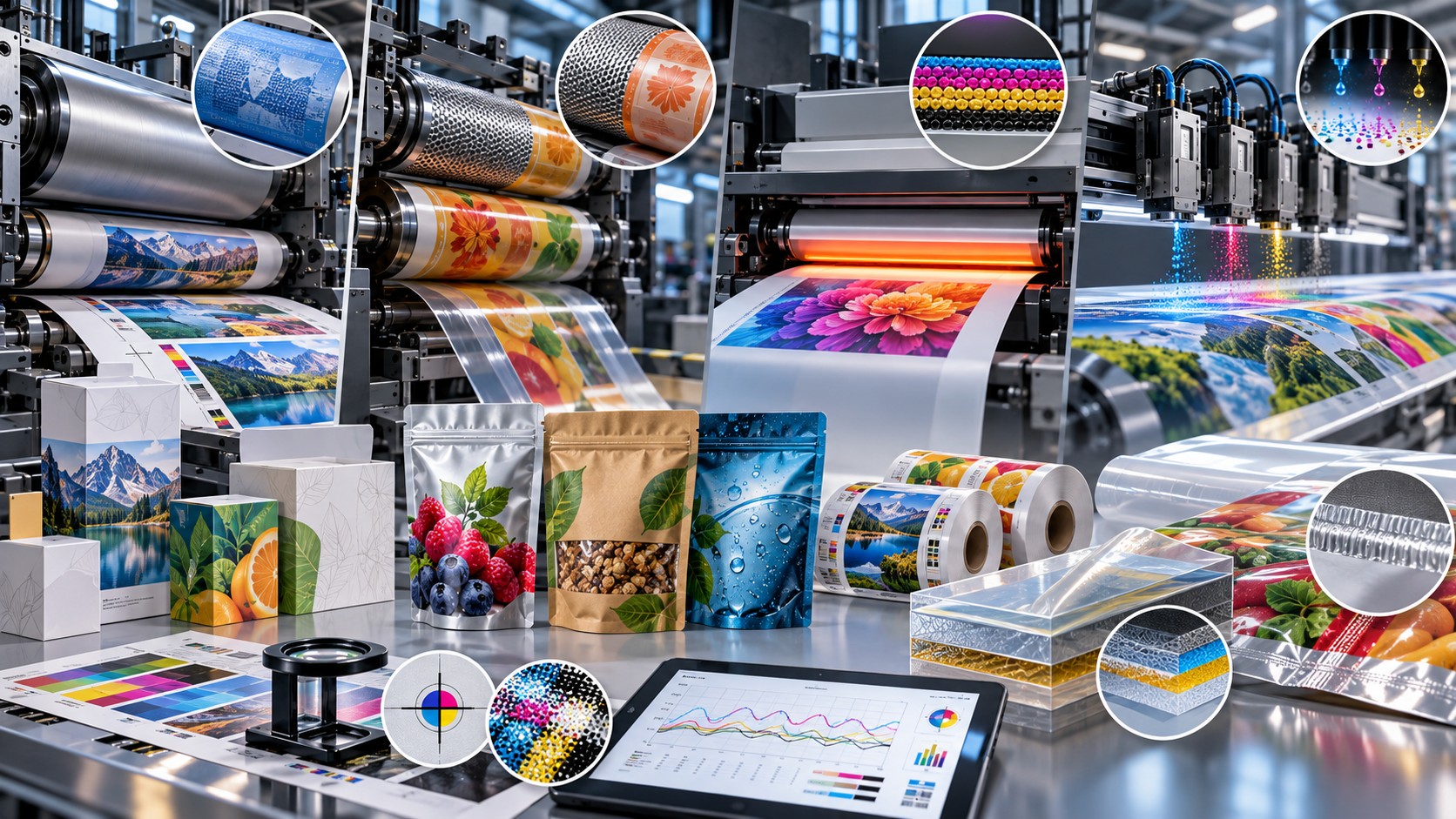
An engineering comparison of offset lithography, flexography, liquid electrophotography and industrial inkjet—covering imaging, registration, substrate preparation, thermal resistance, lamination, converting, food-packaging compliance and recyclability.
Ronen Dolev | 2026
Introduction — A Quality Print Is Only the Beginning
When printing technologies are compared, the discussion often begins with resolution, productivity, color accuracy, and production cost. These are important measures, but they do not fully describe what a press can deliver.
A manufacturer may produce a sharp, well-registered print only to discover that the construction fails at the next stage. A flexible package can pass print inspection but delaminate after converting. A folding carton can look excellent until the ink or coating cracks at the crease. A label can meet its color and adhesion targets yet deteriorate after exposure to heat, moisture, or cleaning agents.
Color-to-color registration can also become decisive. A comparatively stable paper sheet does not present the same challenges as a thin polymeric film, which can stretch under web tension or change dimensions as its temperature rises and falls.
Offset lithography, flexography, liquid electrophotography (LEP) and industrial inkjet form and transfer an image in different ways. These differences influence dimensional stability during printing, the physical structure of the ink film and its response to downstream production.
A meaningful engineering comparison must therefore follow the entire manufacturing chain: substrate preparation, image formation, registration, coatings, lamination, cutting, sealing, durability, regulatory compliance and the finished product's intended end of life.
Reading the press correctly: the four routes are printing mechanisms, not interchangeable machine sets. A press for commercial coated paper does not automatically qualify for flexible-film reverse printing; a digital label press may use an entirely different marking technology from an industrial inkjet press. The descriptions below distinguish what is intrinsic to the imaging principle from what must be verified for an actual press and package.
1. Offset Lithography — Indirect Transfer from a Printing Plate
Operating principle
Offset lithography forms the image on a plate with distinct image and non-image surface characteristics. In conventional wet offset, a dampening system prevents ink from adhering to non-image areas, while an inking train supplies the image areas. Waterless offset uses a different plate-surface mechanism rather than the same dampening process.
The ink passes from the plate to a compliant rubber blanket and then to the substrate under controlled impression. This intermediate transfer supports consistent contact on suitable paper and paperboard surfaces.
The complete image-formation sequence
Prepress and plate creation. The digital artwork is rasterized, separated into the required inks, and converted into a screened dot pattern or other suitable imaging data. A plate-imaging system exposes the required image onto a lithographic plate, usually by laser. Plate processing may involve chemical development or a qualified process-free plate system. In either case, the result is a plate with image regions receptive to ink and background regions that resist ink through the appropriate lithographic mechanism. Each ink separation requires its own registered printing form.
Preparing the print units. The plates are mounted on their respective cylinders in the correct rotational and lateral positions. Ink is introduced through the ink-fountain and roller train, where repeated splitting and recombination distribute a thin, reasonably uniform film. In conventional wet offset, a dampening system simultaneously supplies a controlled amount of fountain solution. The balance between ink supply, water, and roller condition helps determine whether image regions carry ink cleanly without background tinting or excessive emulsification.
From plate to blanket. At the plate–blanket nip, the inked image is transferred to a compliant intermediate rubber surface. The blanket carries a reversed version of the image and compensates for some microscopic substrate unevenness. At the blanket–impression nip, the image transfers again, this time onto the moving sheet or web. Transfer pressures, packing, cylinder geometry, and substrate surface all influence dot shape, solids, and sharp edges; excess pressure cannot be substituted for correct inking or substrate condition.
Building a multicolor image. The substrate advances through separate color units and receives one separation per unit. The press must maintain register between those impressions while the ink films are superimposed. Following printing, the ink sets, dries, or cures by the mechanism appropriate to its formulation. The resulting state—not merely a dry-looking surface—determines when the sheet or web is ready for coating, folding, lamination or handling in piles.
Process chain: digital artwork → raster separations → imaged plates → ink/dampening control → plate-to-blanket transfer → blanket-to-substrate transfer → interunit registration → setting or cure.
Press architecture and color registration
In a multicolor offset press, each printing unit transfers a separate color separation. In sheetfed systems, grippers and transfer cylinders carry the sheet from one station to the next. Register accuracy depends on precise sheet transport, plate positioning, cylinder geometry, and closed-loop controls.
Modern presses use inspection and automatic register adjustments to detect and correct deviations during production. High registration accuracy is achievable on dimensionally stable paper and board. Nevertheless, because separations reach the substrate in different stations, changes in sheet dimensions or position between units can affect color-to-color register.
Thin, extensible polymer films require press and substrate-handling configurations specifically designed for them; they should not be treated as interchangeable with ordinary sheetfed stock.
Ink systems, strengths and limitations
Offset inks are typically more viscous than flexographic and inkjet inks. Depending on formulation, they may set or cure through absorption, oxidation, evaporation, or radiation-initiated reactions. The fixing route is important because an image that feels dry is not necessarily ready for lamination or an overprint varnish.
Offset's strengths include fine detail, mature mechanical register control, well-developed coating options and proven manufacturing routes for commercial print and folding cartons. Its constraints include physical printing plates, the complexity of the ink-transfer system, supported formats, and the need to qualify the ink/substrate combination for the intended finishing operations.
2. Flexography — Direct Transfer from a Flexible Relief Plate
Operating principle
Flexography uses a flexible relief plate with raised image areas. A cellular anilox roller meters ink to the plate, while a doctor blade removes excess ink from the anilox surface. The plate transfers the image directly to the substrate under controlled impression; no image-carrying blanket sits between the plate and substrate.
The complete image-formation sequence
From digital artwork to relief. The file is separated, screened, and sent to plate imaging. In a common photopolymer route, an imaged mask controls ultraviolet exposure; exposed regions polymerize into durable raised printing areas, while unexposed areas are removed by the selected washout or thermal-plate-processing method. Post-exposure and finishing treatments may be needed to bring the plate to the intended physical state. Alternative direct-imaging plate technologies also exist. The essential result is a relief surface that carries ink only where the image is meant to print.
Plate mounting and repeat. A finished plate is attached to a plate cylinder or sleeve, often with engineered mounting tape. Repeat length, plate thickness, mounting accuracy, and compressibility influence image geometry. A plate that is imaged accurately but mounted poorly may create register or impression defects when run at speed.
Metering the ink. Ink is supplied to an enclosed chamber or another appropriate inking arrangement. The anilox roller rotates through the ink supply; its engraved cells fill with ink. A doctor blade meters the surface by removing excess liquid, leaving a controlled volume within the cells. Anilox cell volume, line count, shape, cleanliness, and blade condition all affect the quantity available for transfer. Cell volume is not the same as the final dried ink thickness: transfer efficiency and the ink formulation intervene.
Relief transfer onto the web. The raised image areas of the plate contact the metered anilox and receive ink. At the printing nip, the plate touches the substrate and transfers part of the ink film. Impression should be sufficient to achieve continuity without unnecessarily squeezing ink sideways or deforming delicate halftone features. The flexible plate is advantageous for packaging films, but its compliance makes mechanical setup a meaningful variable.
Between colors and at the end of the press. After each station, the film may enter an interstation dryer or radiation-curing unit, depending on the chemistry and line design. Solvent or water removal must match web speed, air exchange, and film temperature; radiation-curable systems require a suitable curing window. The web then passes to subsequent stations, coating or rewinding. Registration is controlled while the substrate remains in motion, and total production speed may ultimately be limited by drying or cure rather than cylinder rotation.
Process chain: digital artwork → screened relief plate → accurate plate mounting → anilox cell metering → plate-to-web transfer → interstation drying or cure → register control → winding or inline converting.
Why central-impression architecture matters
Two principal press architectures are used. In inline flexography, successive print units are arranged along the web path. In central-impression (CI) flexography, the print units are positioned around one large common impression cylinder.
In a CI press, the film remains supported on the cylinder as it passes the color stations. This reduces the influence of uncontrolled web movement and tension variation between print stations and is particularly valuable with thin PE, PP and other extensible films.
However, a CI press does not transfer all color separations to the substrate simultaneously. Each color is still printed by its own unit at a distinct position along the cylinder. Registration therefore depends on plate mounting, cylinder geometry, thermal stability, servo synchronization and the performance of the register-control system. Automated camera systems, register marks and controlled cylinder temperature can help maintain performance across a production run.
Ink systems and packaging suitability
Flexography accommodates water-based, solvent-based and radiation-curable inks. Packaging printers can choose formulations developed for reverse printing, lamination and demanding thermal processes. Some high-performance formulations use polyurethane-based binder systems selected to withstand stresses encountered in heated or retorted structures.
Flexography's major strengths are stable continuous-web processing and a mature range of packaging-specific ink systems. Its limitations include plate preparation, anilox condition, impression settings, drying capacity, and the need to control web tension and dimensional behavior.
3. Liquid Electrophotography — Electrostatic Imaging and Consolidated Ink Transfer
Operating principle
In liquid electrophotography, the image is formed on a photoconductive surface through controlled charging and optical exposure. Electrically charged pigment and resin particles develop in a liquid carrier and transfer to a heated intermediate blanket.
On that blanket, most of the liquid carrier is removed, while the resin and pigment particles consolidate into a thin ink film. The image is then transferred to the substrate by contact and solidifies rapidly. Unlike aqueous inkjet, it is not deposited on the substrate as wet droplets awaiting a conventional drying stage.
The complete electrophotographic imaging cycle
Rasterization and charging. The digital front end turns the image file into device-specific raster data for each separation. A charging unit then applies a controlled electrostatic potential to the reusable photoconductive imaging surface. At this point no visible printed image exists: only a uniformly prepared electrical surface.
Optical writing of the latent image. A laser-based optical array—or, in a differently engineered imaging architecture, an LED writing system—selectively exposes the photoconductor according to the raster data. Exposure changes the local electrical charge, creating a latent electrostatic image. This is the precise point at which the digital file becomes an addressable physical image. Imaging resolution, spot shape, charging condition, and optical alignment limit the finest detail that can be written; high-definition optical writers can support exceptionally small text and complex variable linework.
Liquid development. The selected color-developing unit presents charged pigment-and-resin particles dispersed in an insulating carrier liquid. The electrostatic field draws the dispersed particles to the appropriate imaged regions while suppressing development in background regions. The developer leaves a patterned deposit of colorant and binder on the photoconductor—not a set of airborne inkjet droplets. Development conditions, dispersion stability and electrical properties influence background cleanliness, image uniformity and dot integrity.
First transfer and carrier removal. The developed separation is transferred from the photoconductor to a heated intermediate blanket with electrical assistance. On that surface, most of the carrier is removed, while the binder-rich particles soften and merge into a coherent, tacky image film. Carrier management is integral to the printing engine. From a practical perspective, a press-ready transferred film is essentially dry for subsequent printing operations, but this does not prove that every residual carrier constituent is analytically absent.
Constructing the multicolor image. In a one-shot configuration, each developed separation is written and transferred sequentially onto the same blanket. Accurate geometric accumulation establishes most of the color-to-color alignment before the substrate enters the final transfer nip. In a multi-shot configuration, separations are transferred to the substrate in separate imaging/transfer cycles; the registration behavior therefore differs. Neither architecture should be inferred from the term LEP alone.
Final image transfer and reset. The consolidated image is transferred to the moving substrate by the designed combination of contact, temperature, and film tack. The layer cools and solidifies rapidly. The photoconductor is cleaned and electrically reset for subsequent cycles. The blanket, developer units, electrical fields, imaging surface, and cleaning system must all operate within their specified conditions to maintain image quality.
Process chain: raster data → photoconductor charging → selective optical exposure → liquid-toner development → electrically assisted blanket transfer → carrier removal and resin coalescence → one-shot or multi-shot image transfer → imaging-surface cleaning and reset.
Color-to-color registration: the one-shot advantage
In a one-shot LEP architecture, color separations are created sequentially and accumulated on the same intermediate blanket. Once the multicolor image is complete, the entire image is transferred to the substrate in one contact event.
This is fundamentally different from processes in which each separation is printed onto the substrate at a different color station. The substrate does not have to retain identical dimensions across several separate color-impression events; the relative color geometry is largely established on the blanket before the substrate receives the image.
The benefit is especially relevant to thin synthetic films that are sensitive to web tension, elongation, or thermal dimensional change. A one-shot transfer removes an important source of between-color error associated with substrate behavior between color stations.
It does not, however, imply literally zero registration error under every condition. The system must still build the separations accurately on the blanket, maintain imaging and transfer stability, and place the resulting image correctly relative to the web edges, the reverse side, die-cut registration, or a sealing location. Registration within the printed image and positioning of that image for converting are separate specifications.
Other LEP architectures transfer separations in a different sequence; do not attribute the one-shot advantage indiscriminately to every LEP press.
High-definition imaging and variable security features
High-resolution optical writing can reproduce small details, fine lines, and microtext. When combined with variable imaging, it supports serialization, individual identifiers and security graphics. The optical writer creates the electrostatic image; it is not an inkjet printhead. Actual feature legibility depends on the press, media, imaging condition, and final construction.
Substrate receptivity and ink-film chemistry
A qualified receptive interface between the transferred ink film and the substrate is important. The substrate may arrive with an approved receptive coating, or an appropriate primer may be applied inline or offline. That layer can also influence varnish adhesion and subsequent lamination performance.
Although LEP transfers a nearly dry consolidated layer, some formulations contain thermoplastic resin systems, including ethylene-based copolymers. The ability to soften and consolidate during imaging can matter when the finished product is reheated under pressure. This is a formulation-and-construction issue, not proof that every LEP print fails at a particular temperature.
4. Industrial Inkjet — Droplet-Based Imaging Without Printhead Contact
Operating principle
Inkjet converts digital image information into instructions for nozzles that eject droplets directly onto the substrate. Piezoelectric drop-on-demand heads generate the pressure pulse by deforming an actuator. Thermal drop-on-demand heads use a rapidly formed vapor bubble to eject the droplet. Each mechanism imposes its own requirements on ink fluid properties and printhead design.
In a single-pass press, arrays of printheads cover the printing width, and the substrate travels underneath them once. The process can deliver high industrial productivity, but maintaining image quality requires control over nozzle health, droplet trajectory, head alignment, and the timing of each color.
How the printheads create and position an image
Rasterization and firing instructions. The raster image processor converts artwork into color-channel data and, where applicable, variable-drop commands. Controller electronics map each pixel or firing position to individual nozzles while compensating for the physical placement of the printheads. Unlike lithographic plate or electrostatic latent-image processes, the image does not first exist on a physical image-carrying intermediate: it emerges when liquid drops reach the media.
Ink supply and meniscus control. A printhead is fed by a precisely controlled fluid system incorporating reservoirs, filtration, pressure or vacuum management and, in certain designs, recirculation. Suitable negative pressure at the nozzle maintains a stable meniscus without dripping; fluid viscosity, surface tension, pigment stability and dissolved gas behavior are part of the working window. Recirculation near the nozzle may reduce sedimentation or drying problems, but it cannot eliminate every clogging or misfire mechanism.
Piezoelectric drop generation. In a piezoelectric drop-on-demand head, a voltage waveform deforms an actuator adjacent to an ink chamber. The resulting pressure pulse forces liquid through the nozzle. As the jet emerges, it stretches into a ligament that pinches off into a droplet. The waveform and fluid characteristics affect drop volume, velocity, tail formation, and satellite droplets. Some systems place multiple drops into one imaged dot to achieve selected density levels; actual functionality depends on the head and waveform.
Thermal drop generation. A thermal drop-on-demand head energizes a miniature heater for a very short interval. Localized heating creates a rapidly expanding vapor bubble that propels liquid through a nozzle; after the pulse, the bubble collapses and the chamber refills. The fluid must tolerate this operating cycle. Industrial thermal inkjet is a real production-press architecture, particularly with suitable aqueous systems; it should not be omitted just because piezoelectric heads dominate packaging applications.
Flight, landing and dot formation. Ejected drops cross an air gap, so their velocity, direction, flight time, and substrate motion determine the landing coordinates. Once a drop reaches the medium, it may wet, spread, penetrate, be immobilized by a receptive chemistry, or begin curing. Adjacent drops can merge or interfere before stabilization. This makes drop placement, dot gain, edge sharpness and solids uniformity functions of both head operation and ink–substrate interaction.
Fixing the deposited image. With aqueous pigment inkjet, a primer or pretreatment may immobilize colorant and limit coalescence; controlled heat, air movement and exhaust then remove water and other required volatiles and permit the binder film to develop. With radiation-curable inkjet, a suitable light source initiates a chemical reaction in the deposited layer. Fast pinning exposures may be used to hold the dots before a later full cure. Cure depth and surface conversion depend on chemistry, spectral match, exposure, and actual substrate condition; visual hardness is not universal proof of cure.
Single-pass, multipass and defect control. A single-pass system spans the media width with fixed head arrays. A multipass system builds the image through repeated relative passes, which changes productivity and error averaging. Printhead stitching at array boundaries, missing or deflected nozzles, and drift in firing timing can produce visible bands. Industrial systems may use onboard inspection, calibration targets, and nozzle substitution or compensation, but you must verify the selected press's correction capability.
Process chain: raster/variable-drop data → fluid pressure and nozzle conditioning → electrical firing → drop formation → flight and landing → wetting/pinning → drying or cure → register and nozzle-quality feedback.
How industrial inkjet controls registration
Although the substrate may pass once through the overall printing zone, colors in a typical single-pass system are produced by separate printhead arrays at different positions along the transport path. Single-pass therefore does not mean all color separations are transferred in one shared image-to-substrate contact.
Registration depends on electronic firing synchronization, head placement, substrate speed, and dimensional stability. On flexible films, variations in web tension or temperature between color arrays can shift droplet landing positions relative to one another. Aqueous systems may introduce additional substrate movement or surface effects through wetting and drying; radiation-curable systems can stabilize droplets quickly, but web handling remains important.
Advanced industrial presses use sensors, calibration patterns, image inspection, and electronic corrections to control registration. Inkjet can reach very high accuracy; the engineering distinction is how that accuracy is achieved, not an assumption that all inkjet presses are inherently less accurate.
Aqueous and radiation-curable inkjet are different process families
With aqueous inkjet, the liquid carrier must be removed to the required degree after deposition. On low-absorption films, a pretreatment fluid, receptive coating or primer may be necessary to control wetting, droplet spread, pigment immobilization and adhesion.
In radiation-curable inkjet, a chemical reaction creates a polymer network in the deposited film. Cure quality, flexibility, adhesion and suitability for food-packaging applications depend on the complete formulation and processing conditions.
The term industrial inkjet does not imply one universal ink chemistry, heat-resistance level or suitability for lamination. An aqueous commercial press designed for absorbent paper should not automatically be treated as a flexible-packaging press.
The route from digital data to physical image is now clear. Offset and flexography begin with a durable printing form; LEP writes a fresh electrostatic image for each transfer cycle; and inkjet constructs the image from individually ejected droplets. The following sections compare what those differences mean once printing begins on a real web or sheet.
5. Color Registration — The Critical Difference in Imaging Architecture
Color-to-color registration describes the relative position of the separations forming the image. Poor registration can produce colored edges, white gaps, apparent loss of sharpness, or defects in very small text. The impact is often greater when printing on dimensionally sensitive materials.
Polymeric films do not all behave the same way. A relatively dimensionally stable PET film may respond very differently from a thin, extensible PE film. Orientation, thickness, temperature, formulation, and winding history influence how a given film responds to tension and heat.
When colors are printed in separate stations, dimensional change or web movement between applications can influence the resulting register. CI flexography reduces the problem by keeping the film supported on a common cylinder. Inkjet uses precise synchronization between head arrays and the substrate transport. One-shot LEP largely establishes color-to-color positioning on the blanket before transferring the image. Sheetfed offset relies on precise sheet transfer and mechanical/electronic register controls across printing units.
The distinction is not simply which technology can achieve the lowest registration-error measurement in a specific test. It is which physical error sources exist in each architecture, and how the press controls them.
Registration architectures compared
Technology | How colors reach the substrate | Principal registration dependency |
|---|---|---|
Sheetfed offset | Separate units, successive sheet transfers | Grippers, plate/cylinder geometry, substrate dimensions and control system |
Inline flexography | Separate color stations along the web | Web tension, stretching, transport, plate mounting and station synchronization |
CI flexography | Separate units while the web is supported on a central cylinder | Cylinder/plate geometry, thermal control, register correction and synchronization |
One-shot LEP | A complete multicolor image transfers from one blanket | Registration while accumulating separations on the blanket and transfer stability |
Single-pass inkjet | Separate color head arrays along one moving-substrate path | Head alignment, droplet firing timing, web transport and substrate dimensional change |
Even excellent color-to-color register does not guarantee correct alignment to a die-cutting tool, window, slit, fold or heat-seal zone. Those downstream positional tolerances must be specified and verified separately.
A useful distinction is between intrinsic image geometry and substrate-related register error. One-shot LEP reduces the latter by establishing the relative color image on a common blanket; it does not abolish writer-to-writer error, blanket deformation, or transfer-placement error. Conversely, CI flexography and calibrated inkjet can achieve excellent measured registration even though they apply colors at separate positions. The appropriate claim is a structural advantage against one source of error—not a universal numerical ranking of all presses.
6. Substrate Preparation and Primer — Chemical Compatibility Beyond Wetting
The print process needs a suitable interface between ink and substrate. Coated paper and board may already have a surface compatible with offset inks. Polymeric films, particularly low-surface-energy substrates, often require surface preparation or a functional interlayer.
In flexography, corona treatment is common on films; some applications also use specific primers. In LEP, a compatible receptive coating or primer is particularly important to ink-film transfer and anchorage. In aqueous inkjet, receptive chemistry may additionally control droplet spreading and pigment immobilization. Radiation-curable inkjet systems vary: some specified ink/media combinations work without additional primer, while others require one.
Corona and primer are not interchangeable. Corona modifies the outermost chemistry of the existing surface; primer deposits a material layer. A surface-energy or dyne result can help assess wetting, but cannot by itself prove ink adhesion, laminate bond strength, or end-use durability.
Whenever a primer is applied, it becomes an additional interface in the finished structure. You must verify its compatibility with the substrate, ink, varnish, or laminating adhesive rather than assume it.
7. Thermal Resistance — How the Ink Film Responds to Heat
The temperature used to form or fix an ink film during printing is not necessarily the temperature that the finished print can withstand during later converting. Resistance depends on resin chemistry, pressure, exposure time, the surrounding layers, and the actual temperature reached by the ink.
LEP thermoplastic films
Some LEP inks use thermoplastic resin systems based on ethylene copolymers. Those resins may soften again on reheating, which can affect mechanical strength, surface appearance or local ink-film movement under pressure. This is not the same as complete melting or failure at a single universal temperature. Lamination, suitable protective layers, and qualified construction can substantially alter thermal exposure and final performance.
Flexographic high-temperature formulations
Flexible-packaging producers have access to flexographic ink systems specifically formulated and qualified for challenging heat-processing routes, including selected retort applications. Their performance depends on binder chemistry and the complete laminate construction rather than the relief-printing mechanism alone.
Offset and inkjet formulations
Offset heat resistance varies with formulation and with the setting or curing route. In aqueous inkjet, the binders and receptive layer are key. In radiation-curable inkjet, a chemically formed network may support demanding service, but excessive rigidity can also cause cracking under strain or folding. No technically defensible temperature ranking applies to every ink family or press.
For heat-sensitive synthetic films, thermal engineering also concerns web temperature in the press itself. Some water-based inkjet dryers must introduce and remove substantial thermal energy, whereas the effective thermal load on a one-shot LEP substrate depends on the final transfer conditions rather than repeated passage through separate aqueous drying zones. A UV-inkjet system has a different curing-energy profile. These observations describe process mechanisms, not a claim that any one press always heats the substrate less; actual film temperature and dimensional change should be measured.
8. Heat Sealing and Lamination — Evaluating the Entire Construction
A reverse-printed flexible pack may contain an outer film, treatment or primer, ink, laminating adhesive and an inner sealant film. The ink is therefore part of a multilayer structure, not an isolated decorative coating.
During heat sealing, heated jaws apply pressure for a defined dwell time. The ink may lie inside the laminate and never touch the jaws directly. Jaw temperature is not necessarily equal to ink-film temperature: actual exposure depends on the layer structure, thermal conductivity, dwell time, and pressure.
Retort processing imposes a different set of conditions, often exposing the whole package to heat, moisture and pressure for much longer. Passing a brief jaw-contact trial does not qualify the construction for retort, and a strong heat-seal seam does not prove that ink or laminate adhesion remains acceptable.
Three separate outcomes must therefore be tested: the integrity of the printed ink film, the bond strength between laminated layers, and the mechanical/sealing integrity of the heat-seal seam. Peel testing should identify the failure interface rather than report only a force value. A substrate–primer failure demands a different corrective action from ink–adhesive or cohesive adhesive failure.
Heat-seal performance also requires a seal-strength and leak-integrity evaluation of the sealant structure. A printed overvarnish may need to withstand momentary jaw contact without transfer, discoloration or blocking, but that resistance is not the same property as the ability of an inner sealant to form a hermetic seam. In retort applications, post-process peel strength, visible ink movement, interlayer bubbles, pouch deformation and seal integrity should all be assessed after the specified thermal cycle.
9. Varnishing, Die Cutting and Folding — Converting Determines Performance
An overprint varnish contacts the exposed ink film, not necessarily the underlying substrate. Compatibility depends on ink chemistry, the state of setting or curing, surface additives, wetting, and the varnish's properties.
High abrasion resistance does not guarantee flexibility. A hard coating may withstand rubbing but crack when the board is creased and folded. Folding-carton results also depend on board moisture, grain direction, caliper and crease geometry. Labels undergo different stresses during die cutting, matrix stripping, rewinding, dispensing and application to curved containers. Shrink sleeves introduce further dimensional change.
Consequently, coating adhesion, abrasion resistance, fold integrity, glueability and thermal response require distinct acceptance tests. A single good-looking flat sample is insufficient to qualify all downstream processes.
For folding cartons, a critical verification sequence is printed sheet → coating → die cutting → creasing → folding → gluing → packed-carton assessment. For pressure-sensitive labels, it is printed web → overprint protection → die cutting → matrix stripping → rewinding → dispensing and application. The sequence is intentionally application-specific: a good rub value cannot substitute for a crease-crack test, and a strong label-face adhesion result cannot substitute for successful matrix stripping or dispensing.
10. Food Packaging — Regulatory Suitability Is Not a Dryness Claim
Food-packaging suitability depends on the chemical composition of the complete construction, potential migration pathways, and the specified conditions of contact and storage. An ink being dry, aqueous, or radiation-cured does not automatically confer food-contact approval.
In LEP, removal of most carrier liquid during the blanket stage materially changes the printed film; it should not be described as though the original liquid volume remains on the substrate. Nevertheless, residual carrier constituents or other formulation substances may remain and require evaluation. A formulation that excludes one particular mineral-oil ingredient is not thereby proven free of all hydrocarbons or migration risks.
For solvent-based flexography, assessment may include residual solvents and mobile ink constituents. Offset requires appropriate assessment of its binder, carrier, additives and setting or curing chemistry. Aqueous inkjet requires review of pigments, binders, additives and relevant residuals. Radiation-curable inkjet additionally needs attention to relevant unreacted components, photoinitiators and reaction products, as applicable to its chemistry.
Depending on the material and use, transfer pathways can include migration through packaging layers, volatile transport and set-off from the printed face to the food-facing side during reel or sheet storage. The complete structure—substrate, primer, ink, varnish, adhesive and films—must be evaluated.
Within the European Union, Regulation (EC) No 1935/2004 provides the general food-contact framework; Regulation (EC) No 2023/2006 establishes good manufacturing practice; and Regulation (EU) No 10/2011 sets specific rules for plastic food-contact materials. Other national or material-specific measures may apply. Labels such as "low migration" cannot replace product-specific compliance assessment.
The EU good-manufacturing-practice rules explicitly address printing inks on the non-food-contact side and the risk of transfer through a substrate or by set-off in reels or stacks. Suitability must therefore be assessed for the complete intended configuration and storage history. The term "mineral-oil free" or the exclusion of a particular carrier component must not be interpreted as proof of zero migration or permission for direct food contact.
11. Recyclability — The Printed Layer Is Part of Package Design
Recyclability depends primarily on the package structure and the collection, sorting and recycling route available for that structure. Yet inks, primers, varnishes and adhesives can influence sorting, recycled-polymer color and odor, melting behavior and the properties of the recyclate.
An ink containing a resin from a particular polymer family is not automatically compatible with recycling of that polymer. Likewise, aqueous ink is not necessarily more recyclable solely because water was its carrier. Radiation-cured layers must be assessed in the context of their chemistry and the whole package.
Designs centered on one principal polymer family may improve compatibility with certain established recycling streams, but barrier layers, adhesive chemistry, coatings and print coverage still matter.
The European Packaging and Packaging Waste Regulation, Regulation (EU) 2025/40, became generally applicable in August 2026. Its recyclability and design-for-recycling obligations are introduced through staged requirements and implementing measures. Package development must therefore consider the intended recycling route as an engineering requirement, not a final marketing description.
A recyclable package and recycled plastic authorized for a new food-contact application are distinct concepts with different safety and regulatory requirements.
12. Consolidated Engineering Comparison
The following table brings the principal differences into one view. It describes typical engineering characteristics and constraints; it is not an absolute ranking of quality, uptime, or durability.
Criterion | Offset | Flexography | LEP | Industrial inkjet |
|---|---|---|---|---|
Image creation | Lithographic plate | Flexible relief plate | Electrostatic optical imaging | Ejected ink droplets |
Ink transfer | Indirect via blanket | Direct plate-to-substrate | Heated intermediate blanket | Direct droplet deposition |
Color registration | Separate units, controlled sheet transport | Separate stations; CI supports web on common cylinder | One-shot configuration transfers accumulated separations together | Separate head arrays synchronized electronically |
Sensitive polymer films | Requires appropriate press architecture | CI offers strong web support | One-shot reduces inter-color sensitivity to web dimensional change | Depends on head timing and web handling |
Variable content | Normally new plates | Normally new plates | Digital | Digital |
High-definition detail | Very high capability | High capability with suitable configuration | Fine detail and microtext with suitable HD imaging | Fine detail with advanced heads and control |
Ink fixing | Formulation-dependent | Drying or curing | Thermal consolidation; nearly dry transfer | Drying or curing |
Primer/receptive layer | Selected special applications | Treatment and sometimes primer | Qualified receptive surface is central | Depends on ink and substrate |
Lamination | Requires qualified system | Established packaging-specific systems | Verify ink/primer/adhesive interfaces | Verify fixing chemistry and adhesive compatibility |
Heat performance | Formulation-dependent | Dedicated high-temperature ink systems available | Thermoplastic film may soften; construction-dependent | Aqueous versus radiation-cured behavior differs |
Die cutting and folding. | Established carton production routes | Established label and packaging routes | Verify printed-layer behavior | Verify printed-layer behavior |
Food packaging | Evaluate full construction | Evaluate full construction | Evaluate relevant carrier residuals and all layers | Evaluate constituents and fixing chemistry |
Recyclability | Structure-dependent | Structure-dependent | Structure-dependent | Structure-dependent |
13. Choosing the Production Route by Application
For labels, narrow-web flexography offers an established route combining printing and integrated converting. Digital methods are especially valuable for versioning, variable information and fine security-related elements. Offset remains relevant in appropriately configured label processes.
For flexible packaging, CI flexography combines supported-web registration with established ink systems for reverse printing, lamination and selected thermal applications. One-shot LEP provides a distinctive registration advantage on substrates sensitive to elongation and dimensional change, together with digital imaging flexibility. Packaging-specific inkjet can also deliver high quality and productivity, provided its head arrays, ink chemistry, receptive surface, web handling and finishing route have been qualified.
For folding cartons, sheetfed offset has a mature production and converting ecosystem. Suitable digital presses can also produce qualified carton structures, but the printed layer must survive coating, die cutting, creasing, folding and gluing.
For commercial printing, offset and industrial digital presses offer different combinations of format, throughput, changeover and variable-data capability. Performance comparisons must be based on the intended job and full production route.
14. How to Validate the Complete Production Route
A useful comparative trial uses the same specification for all candidate routes but does not impose identical equipment settings on physically different processes. Define the intended print side, material, print coverage, finishing sequence, and minimum acceptable product properties before producing test samples. Each press must first run at a qualified state using the correct plate, primer, ink, dryer or curing conditions; unqualified experiments are not proof of intrinsic process capability.
First, check imaging performance: fine lines, small type, multicolor edge alignment, solid-area uniformity, and the difference between color-to-color register and register to die-cut or seal features. Sample at start-up, at steady state, and later in the run rather than relying on a single selected demonstration sheet.
Second, qualify every interface. Examine substrate condition, treatment history, receptive coating, ink adhesion, and the wetting of any overprint varnish or laminating adhesive. Use peel or other suitable tests after the defined adhesive-cure interval, and record the actual failure location. A high nominal peel force with the wrong failure mode may still be unacceptable.
Third, reproduce end-use stresses: hot sealing at specified jaw settings and verified layer temperature where practical, retort where applicable, abrasion, chemical exposure, creasing and folding, label dispensing or shrink. Verify that protective coatings, ink films, bonds and seals all remain acceptable after the sequence, not merely before it.
Finally, establish regulatory and circularity evidence as separate release gates: migration and set-off risk for the intended food-contact construction, traceability of all formulations, and recyclability of the entire package in the relevant collection and processing stream. Only after these gates are satisfied should production comparisons of uptime, waste, speed and economics determine the preferred route.
Technical scope and selected normative basis
This discussion reflects established lithographic, relief, liquid-electrophotographic and drop-on-demand imaging principles, together with published industrial research on lamination stress and the regulatory framework for food-contact packaging. Relevant regulatory references include Regulations (EC) No 1935/2004 and 2023/2006, Regulations (EU) No 10/2011, 2022/1616 and 2025/40, and application-appropriate print-resistance, adhesion and seal-strength test methods. The manufacturing and legal applicability of any specific material combination must be verified against its current declarations, test reports, and jurisdiction.
Conclusion — An Engineering Advantage Is Not Universal Superiority
No printing technology leads every application or every performance measure. Offset is especially established for precise paper and board printing. Flexography is highly suited to continuous flexible-web production and offers a mature range of inks designed for lamination and demanding thermal processing.
LEP combines high-definition digital imaging with transfer of a consolidated ink film through an intermediate blanket. In one-shot configurations, the entire multicolor image is transferred together, reducing a fundamental source of between-color registration error on dimensionally sensitive substrates. Inkjet enables noncontact imaging and high-throughput, single-pass production, achieving precision through coordinated control of head arrays, droplet placement, and web transport.
Registration is not the whole product specification. Exceptional microtext and color-to-color alignment do not by themselves establish resistance to heat, pressure, folding or chemical migration. Conversely, a formulation qualified for retort is not necessarily the most suitable choice for highly variable short-run production.
The right comparison therefore has three dimensions: image quality and registration; process stability and operational reliability; and the finished construction's ability to meet its mechanical, thermal, regulatory, and recycling requirements.
The press determines how the image is formed and how its colors are registered. The ink chemistry determines how the printed film behaves. The finished product establishes whether that combination was right for the application.