The Surface Beneath the Ink
Why Paper and Paperboard Can Accept LEP Ink Without Primer— and Why Adhesion May Fail Months Later
Ronen Dolev
Liquid electrophotographic (LEP) printing on paper and paperboard is often described in simple terms: a substrate is either compatible with the ink, or it requires primer. In practice, the boundary is much less stable. A coated board may print successfully for months without additional priming, yet a later delivery of the same commercial grade may fail an ink-adhesion test. Increasing blanket temperature or second-transfer force may restore performance in one case; in another, only a compatible primer will produce a reliable result.
The engineering question is not whether the substrate is called paper, paperboard, coated or uncoated. It is what chemical and physical surface the ink actually contacts at the moment of transfer—and whether that surface and the process window remain consistent over time.
This article focuses on publicly documented interfacial mechanisms, paper-coating chemistry, surface aging, transfer conditions, and practical root-cause investigation. It does not disclose or purport to identify the current proprietary formulation of any commercial LEP ink. The illustrative production scenario is a diagnostic example, not a reported customer failure.
1 | Ink transfer is not the same as ink adhesion
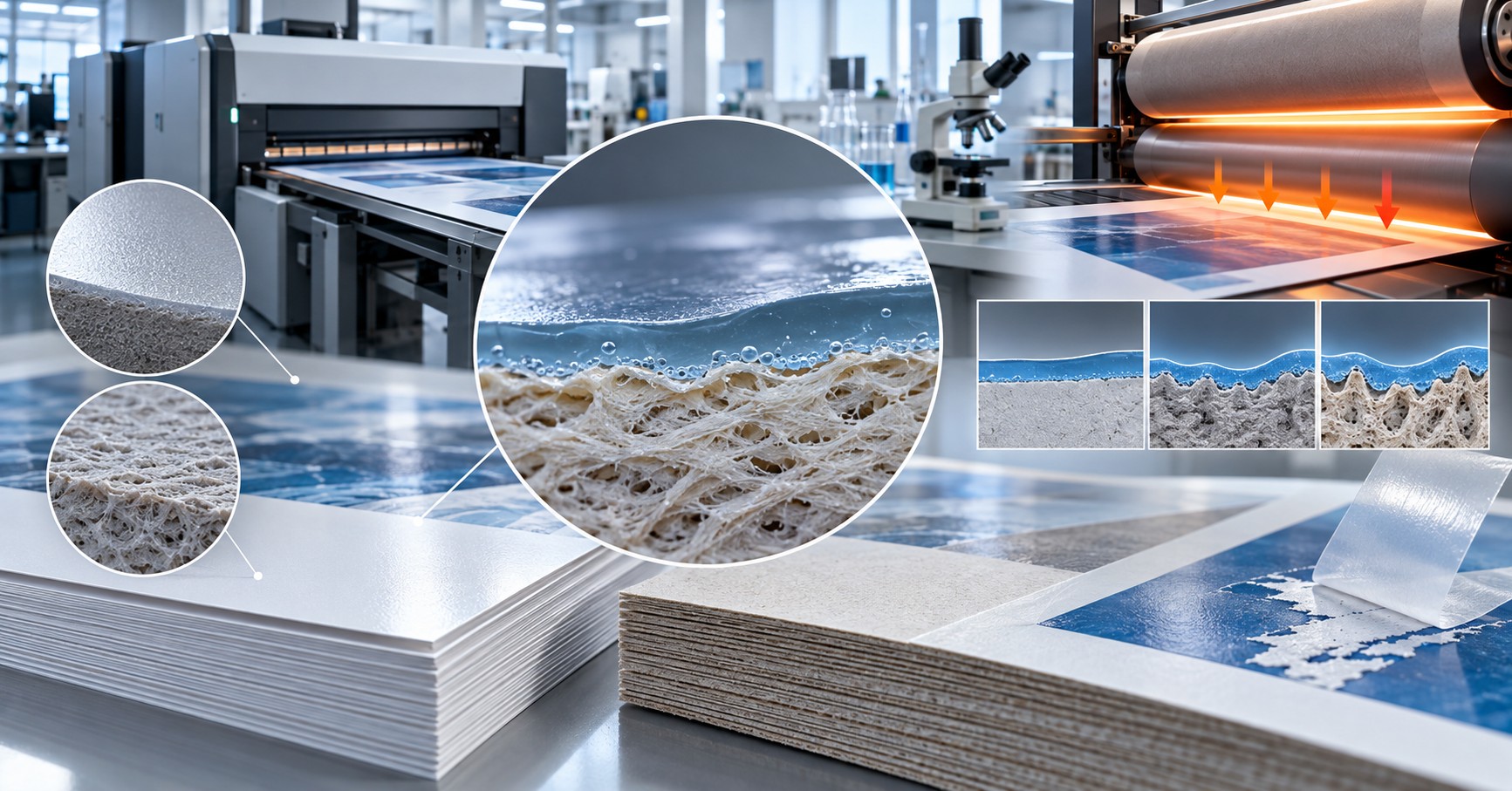
LEP develops an electrostatic image with a liquid electrophotographic ink and transfers the image to a heated intermediate blanket. Public descriptions of thermal-offset LEP explain that the carrier fluid is largely removed and the dispersed resin-containing particles coalesce into a concentrated polymeric image layer before transfer to the final substrate [1]. A thin, largely consolidated polymeric film therefore meets the paper surface; it does not behave like a water-based ink whose liquid vehicle must penetrate deep into a fibrous sheet.
Two different outcomes must be evaluated. Transfer efficiency concerns whether the image separates from the blanket and forms a complete, uniform layer on the substrate. Adhesion strength concerns whether that deposited layer resists removal or damage after transfer, handling, and converting. A visually excellent solid area can still fail a tape test. Conversely, isolated ink patches may bond strongly where they reach, even when overall image transfer is incomplete.
Direct LEP research published in 2009 correlated time-dependent ink–paper adhesion with the substrate's polar character and acid–base interactions at the interface [2]. A follow-up study on four paper grades associated differences in LEP adhesion with the chemistry of the paper coating [3]. These findings explain why surface composition cannot be replaced by a single roughness or wettability specification.
2 | What chemistry at the interface contributes to Adhesion?
Published LEP research examined interactions involving polar functional groups in ink-related polymers and groups available at paper surfaces. The investigators identified acid–base and van der Waals interactions and used surface-sensitive spectroscopy to examine the ink–paper interface [2, 3]. In the systems discussed in open scientific literature, carboxyl-containing groups are relevant to interactions with suitable polar sites on the substrate. This describes a published scientific mechanism—not the exact, current composition or component percentages of any commercial ink.
Cellulose and some common coating ingredients, including starch and polyvinyl alcohol (PVOH), present hydroxyl-rich chemistry. Suitable functional groups can support hydrogen bonding or other intermolecular interactions, but their mere presence somewhere inside a sheet does not guarantee Adhesion. They must be accessible at the immediate interface, the polymeric ink layer must contact them, and the surrounding film and coating must withstand subsequent mechanical stress.
A topcoat dominated by less compatible components can conceal otherwise useful polar sites in the underlying fiber network. Two substrates with similar whiteness, gloss and smoothness can therefore yield different Adhesion. Equally, low apparent water wettability does not, by itself, prove poor LEP adhesion: the test liquid in a water contact-angle experiment is not the transferred LEP polymer film.
3 | Paper coating is a chemically engineered surface
Pigment-coated paper and paperboard generally combine mineral particles—commonly calcium carbonate and kaolin—with polymeric or polysaccharide binders. Pigments contribute to optical appearance and microstructure. Binders connect particles to one another and to the fibrous base, while simultaneously contributing to the chemistry exposed at the surface.
A 2010 LEP study examined four commercially available papers, analyzed extracted coating materials using methods including FTIR, proton NMR, and LCMS, and reported that variations in styrene–butadiene binder composition were associated with different adhesion outcomes. PVOH or starch used as co-binders was also associated with good Adhesion in some samples; certain uncoated papers likewise adhered well [3]. Those observations are not universal recipes for a binder ratio or a guarantee that every PVOH-containing coating will be compatible with every LEP process.
Coating formation matters as much as the nominal formulation. As water evaporates during drying, the binder distribution and local coating microstructure can change. Laboratory studies have shown different redistribution behavior for latex and starch under particular drying conditions [4, 5]. Another controlled investigation reported no appreciable latex migration across a broad range of tested conditions, while observing starch migration [6]. Accordingly, binder migration must be treated as a mechanism to investigate—not an automatic diagnosis for every substrate-lot change.
For a print operation, the key material question is not simply 'How much binder did the mill add?' It is 'What binder and functional-group environment is actually presented to the ink after coating, drying, calendaring and storage?'
4 | Why the same grade may pass in January and fail in July
The phrase 'same substrate' can conceal several distinct histories. If two deliveries carry the same commercial grade designation, they may still come from different manufacturing lots, coating formulations, or process settings. If material from the very same lot was stored for six months, its exposed surface or moisture condition may have changed with time. A third possibility is that substrate chemistry did not change materially at all: the press or substrate condition drifted enough to expose a process that had always been close to its adhesion limit.
Different manufacturing lot. Suppliers may adjust pigments, binder packages, sizing chemistry, coating solids, drying or calendaring while still meeting ordinary grade specifications for grammage, thickness, shade, gloss and roughness. These changes can affect adhesion-sensitive interfacial chemistry without creating an obvious visual difference. A change in lot identity is not proof that the mill changed the formulation; the change must be verified through records or comparative analysis.
Aging within one lot. A peer-reviewed study measured apparent water contact angles on coated papers during weeks after production and observed increasing hydrophobicity in the specific systems examined. The researchers proposed ongoing latex-particle spreading as one possible explanation; they did not prove that every coated sheet behaves this way or demonstrate a six-month LEP failure [7]. Separately, XPS imaging demonstrated that alkyl ketene dimer (AKD) sizing material can spread along paper surfaces during storage, including at room temperature in the experiment [8]. These results establish plausible routes by which the surface encountered by ink can evolve over time.
Changes in condition or press window. Paper moisture, equilibration temperature, handling contamination, blanket condition, and the thermal–mechanical transfer setting can influence whether a borderline material passes. Before attributing a new failure to chemistry, print a qualified reference substrate under documented baseline conditions.
A critical distinction follows: a grade that printed well six months ago does not prove the same physical surface exists now. Equally, a change observed six months later is not proof of aging unless the same-lot history has been controlled.
5 | Which paper ingredients may interfere with an LEP interface?
Styrene–butadiene or acrylic binders. The chemistry and distribution of binder at the outermost coating surface may affect how the polymeric image interacts with the substrate. Different copolymer compositions can behave differently; one should not label an entire binder family as compatible or incompatible [3].
Sizing agents. AKD, ASA, and other sizing systems are used to control liquid interaction with fibers or the coating. Hydrophobic moieties may modify available surface chemistry, and research supports AKD migration in particular test structures [8]. A water-shedding response is, however, not itself a measurement of LEP adhesion. Sizing is a plausible variable, not a proven cause in a particular failure.
Waxes, release aids and functional barrier coatings. Packaging boards may contain components deliberately selected for water resistance, grease resistance, slip or blocking control. Such formulations can change the surface layer a printing process sees. A coating engineered for package protection is not automatically engineered for LEP adhesion. The exact composition and interface must be verified before blaming a particular additive.
Dispersants and surfactants. Small amounts of surface-active components may affect coating formation and the final interfacial environment. Their direction and magnitude of influence depend on the formulation. A measured change in Adhesion should not be assigned to a named class of additives without analytical or controlled formulation evidence.
6 | Why uncoated paper or board can be difficult without primer
Uncoated does not mean untreated, and it certainly does not mean always unprintable without primer. Cellulose can present useful polar groups; the 2010 LEP investigation included uncoated papers that exhibited good Adhesion under the studied conditions [3]. Yet uncoated material introduces several independent challenges.
First, a comparatively open fiber texture can limit intimate image contact, particularly across valleys, loose fibers, and localized surface defects. Second, if an aqueous primer is applied, capillary uptake can leave less material at the exposed surface than expected from the wet application amount. Third, weakly anchored fibers or surface debris can detach with ink during a peel test: this is a failure of the paper structure, not necessarily of ink chemistry. Finally, internal or surface sizing can make an apparently uncoated grade chemically different from untreated cellulose.
These mechanisms require different responses. Where the main issue is contact geometry, adjustments within the approved transfer window may help. Where the main issue is a weak or highly absorbent surface, primer coverage or a different paper grade may be necessary. If the failure originates inside the fiber network, strengthening the ink–surface bond may not be the solution.
7 | Is paperboard inherently harder to print than paper?
No. Well-engineered coated paperboard can offer an exceptionally smooth, uniform print side. Thin papers can also have weak coatings or incompatible surface chemistry. Thickness or grammage alone does not rank LEP printability.
What makes some board applications demanding is the simultaneous requirement for print quality, bending stiffness, crease performance, internal bond, barrier behavior, and converting durability. A carton topcoat may be optimized for offset appearance, mechanical strength, wet resistance or packaging performance rather than LEP chemistry. A bulky multi-ply structure may respond differently at the contact nip, and successful initial Adhesion still must survive folding, varnishing or lamination.
The correct comparison is therefore coating-to-coating and finished-application-to-finished-application, not a broad assertion that 'board rejects ink'.
8 | When can the press run without primer—and when is primer justified?
Three conditions that are routinely grouped together must be separated:
Substrate condition | What 'no inline primer' really means |
|---|---|
Untreated but compatible surface | The existing surface and approved transfer process satisfy Adhesion and finished-product requirements. |
Mill-treated or pre-primed surface | A receptive layer or other treatment already exists, although the press-side primer station is not used. |
Surface requiring inline primer | Without a compatible interfacial layer, the demonstrated adhesion margin is inadequate. |
A suitable primer may supply a chemically compatible interface, improve coverage over local surface variation, or both. But it cannot reliably repair every substrate. If the underlying coating separates from the board, the image and primer may remain bonded to a layer that simply detaches from the fibers. If the primer wets or anchors poorly to a specialty topcoat, the new interface may fail instead. An absorbent, uncoated sheet may also require sufficient coating holdout to leave a functional primer layer at the surface.
The need for primer should be determined by qualification of the whole system: press process, substrate lot, primer compatibility where applicable, Adhesion at a defined test interval, and final converting durability. Public equipment-support literature likewise treats substrate preparation, second-transfer conditions and adhesion testing as linked troubleshooting considerations [9].
9 | Blanket temperature: when should the trial go upward or downward?
Thermal-offset LEP is strongly influenced by the state of the concentrated polymeric image at transfer. The blanket is heated to produce a cohesive transferable layer and to promote transfer onto the substrate [1]. Polymer mobility and contact conformity are therefore reasonable mechanisms through which blanket temperature can influence transfer quality and Adhesion. That does not make an increased blanket setpoint a universal cure.
Direction to test upward. If the image appears insufficiently transferable or the contact with an irregular surface is incomplete, and the blanket temperature is at the lower portion of the *approved* operating window, a controlled increase may improve the polymeric layer's ability to conform and develop effective surface contact. Better contact may enable existing interfacial groups to interact more fully. This is a process hypothesis to be verified with a dedicated adhesion test, not a guaranteed chemical improvement.
Direction to test downward or back to baseline. If transfer deteriorates after heating, blanket contamination or abnormal release behavior appears, or the substrate shows thermal sensitivity, further heating is unjustified. Restore the qualified baseline and, where authorized, investigate whether a lower setting improves the result.
Never transfer a published temperature from a patent, a different press generation, or a post-fusing experiment into a production setting. Material contact time, imaging-layer formulation, blanket architecture, and temperature measurement location all matter. Public LEP research and patents explain the mechanism, but do not establish a universally optimal blanket temperature for all paper and board [1, 2, 9].
10 | Second-transfer force: when should the trial go upward or downward?
Pressure is important because the true microscopic contact area of a rough substrate can be much smaller than its apparent geometric area. Within a validated press system, increased second-transfer force may help the blanket and ink layer reach valleys or textured regions, improving the uniformity of the deposited image. When compatible chemical sites are already present, better contact can also improve Adhesion.
Direction to test upward. Where poor solids transfer, isolated voids or missed image areas suggest insufficient contact—especially on textured or relatively rigid surfaces—trial a modest force increase within the machine's approved range, changing only one factor at a time.
Direction to test downward or return to baseline. If a force increase coincides with undesirable compression, image distortion, surface disruption, or worsening transfer, restore the baseline and investigate whether excessive loading contributed. Picking alone is not proof of over-pressure: weak coating cohesion and other causes must be considered.
A displayed second-transfer 'force' setting is not necessarily a direct measure of local nip pressure. Contact width, blanket compliance, roller geometry and substrate compressibility contribute to the actual pressure distribution. Consequently, absolute force values cannot be generalized from one press configuration to another.
11 | Temperature and force operate together—but do not replace chemistry
Temperature influences the state of the polymeric image; force influences its physical contact with the substrate. Their interaction creates a useful experimental question: might a board with acceptable surface chemistry fail only because the ink is not achieving enough microscopic contact? If so, optimization inside the approved thermal–mechanical window may make inline primer unnecessary. If not, primer or a different grade may still be required.
Observed symptom | Initial diagnostic direction | What a positive result would suggest |
|---|---|---|
Missing transfer on a textured board | Test a controlled increase in transfer force | Contact geometry may be limiting. |
Incomplete transfer with suspected low thermal mobility | Test a controlled increase in blanket temperature | Polymer state may be limiting transfer/contact. |
Visually good print but weak tape-test Adhesion | Examine Temperature and force separately; compare with primer | Distinguish contact limitations from interfacial compatibility. |
Degradation after force increase | Return to approved baseline; investigate lower force if appropriate | Added loading may be detrimental. |
Degradation after temperature increase | Return to approved baseline; investigate lower Temperature if appropriate | Thermal transfer window may have been exceeded. |
Weak Adhesion across approved conditions but improvement with compatible primer | Investigate chemistry and primer holdout | Original interfacial compatibility may be insufficient. |
A process that passes only at an extreme corner of its operating window may also lack a useful production margin. A primer may widen the practical adhesion window—but only after its own anchorage, drying, coverage and downstream durability have been proven. The optimum is not 'as hot and as much force as possible'; it is a stable window in which transfer, Adhesion, dimensional control and converting performance all meet their requirements.
12 | A small but important variable: optical brightening agents (OBA/FWA)
Optical brightening agents, also called fluorescent whitening agents (FWAs), absorb ultraviolet radiation and emit light in the blue region, increasing the perceived whiteness of paper. They may be introduced in papermaking or during surface sizing, often as part of a chemical package rather than as isolated molecules.
The studies reviewed provide no direct evidence that OBA itself is a general cause of poor LEP adhesion. Many FWA types are relatively polar, and it would be incorrect to label every optical brightener as an ink-repellent hydrophobic contaminant. The important variable may instead be the associated carrier and sizing system, its distribution at the exposed surface, and whether the coating formulation changed between lots.
A 2017 study of surface-sized papers found that the choice of carrier chemical affected the optical effectiveness of fluorescent whitening agents: carboxymethyl cellulose (CMC) and PVOH did not perform identically across different FWA types [10]. Another investigation of a specifically engineered polymeric brightener reported improved paper surface strength and smoothness in its tested system [11]. Neither study demonstrates LEP adhesion improvement or deterioration caused by OBA alone.
If an OBA-rich grade becomes adhesion-sensitive, compare old and new lots for fluorescence and whiteness under defined measurement conditions, and also examine starch, PVOH, CMC, sizing chemistry, coating strength, and surface composition. M1/M2 color-measurement differences can flag fluorescence changes; they cannot identify the chemical cause of a peel failure. To establish causality, change the OBA package independently while holding the base paper, carrier, coating, and transfer conditions constant.
13 | Read the failure interface before changing the press
A failed tape test establishes that the tested structure separated under the chosen method. It does not identify the location or mechanism of separation. The most useful first question is: what material came away with the ink?
Observation | Plausible failure location | Next evidence to gather |
|---|---|---|
Ink separates while primer remains. | Ink–primer interface or image-layer cohesion | Confirm process window, ink/primer compatibility, and test timing. |
Ink and primer release together. | Primer–topcoat interface or weak upper coating | Inspect primer coverage, surface chemistry, and detached residue. |
Ink remains bonded to detached mineral coating | Coating cohesion or coating–fiber interface | Inspect pigment/binder layer and substrate surface strength. |
Fiber fragments follow the ink. | Cohesive failure within fibrous base | Compare fiber bonding, dusting, surface strength and conditioning. |
Initial adhesion passes but converting causes failure | Stress at ink, coating or lamination interfaces | Inspect crease geometry, coating flexibility and finished-product test. |
Where appropriate, a primer-sensitive indicator may help determine whether primer remains on the board after a tape test. The interpretation must be validated for the primer chemistry actually used; no single indicator replaces microscopic or chemical examination of a complex laminate or coated board.
14 | Which surface measurements are useful—and which are not interchangeable?
Paperboard suppliers often report grammage, caliper, gloss, brightness, roughness, and moisture. None alone is an LEP adhesion certificate. Three different properties are frequently confused: topography, porosity and absorbency.
Ra describes an arithmetic mean of absolute height deviations within a defined profile evaluation and filtering scheme. It is a profile-texture parameter, not a universal measure of ink wetting; standardized terminology is included in ISO 21920-2 [12].
PPS / Print-surf characterizes roughness by an air-leak method under defined conditions and can be especially relevant to a compressed contact interface; the measurement is specified in ISO 8791-4 [13]. Bendtsen is a different air-leak method specified in ISO 8791-2 and commonly reports airflow-related output [14]. Ra, PPS, and Bendtsen cannot be converted by a generic multiplier.
Porosity describes open volume and pathways in the sheet or coating. Absorbency results from a particular liquid interacting with the pore network and surface chemistry. A sized sheet can have pores yet resist water uptake. Conversely, a smooth coating can still be mechanically weak or incompatible with the transferred LEP polymer layer.
ISO 3783 offers an accelerated-speed approach to resistance to picking in paper and board, especially relevant to conventional high-tack printing [15]. It is useful context for surface strength, but it does not directly establish LEP ink–substrate bond strength. XPS and ATR-FTIR can provide complementary surface-chemistry information; dynamic contact-angle measurements require caution on absorbing, textured surfaces.
15 | A six-month adhesion failure: how to investigate without guessing
Consider a hypothetical teaching case: a coated folding board passes LEP adhesion qualification without primer. Six months later, a delivery of the same nominal grade gives poor peel resistance. A compatible inline primer apparently restores performance.
Start by collecting objective identifiers: substrate producer lot, production date, sheet or reel orientation, print side, coating version (if available), storage temperature and humidity, paper conditioning, press health checks, ink and blanket history, and the exact time between printing and peel testing. Preserve unprinted samples of both the original and suspect lots whenever possible.
First, run a known-qualified reference medium. Next, compare old and new board at identical baseline settings on the same press. Then isolate blanket temperature and second-transfer force as separate variables inside authorized limits. Finally, add a compatible primer reference. Do not mix all changes in one run and then credit the last adjustment for success.
Trial | Substrate lot | Inline primer | Transfer condition | Purpose |
|---|---|---|---|---|
A | Previously approved | No | Qualified baseline | Confirm historical performance, if retained stock exists. |
B | Suspect lot | No | Qualified baseline | Reproduce the difference. |
C | Suspect lot | No | Temperature-only approved change | Test thermal contribution. |
D | Suspect lot | No | Force-only approved change | Test mechanical contribution. |
E | Suspect lot | No | Combined approved condition | Examine temperature–force interaction. |
F | Suspect lot | Yes | Qualified baseline | Establish whether compatible primer improves the system. |
For robust conclusions, repeat the runs, randomize where practical, record thermal stabilization, and measure both image quality and Adhesion at defined intervals. Public application guidance notes that adhesion and rub performance can continue to develop after printing; a fixed test interval is essential for comparison [9]. If an aged sample and a fresh sample were produced in different lots, their differences cannot, by themselves, establish an aging mechanism.
When a difference persists, compare surface composition using appropriate laboratory methods. A stronger OBA fluorescence signal, a shift in water contact angle, or a change in PPS is a clue, not proof of the causal mechanism. The aim is to identify the failing interface and a repeatable explanatory variable—not merely to discover a machine setting that hides the symptom.
16 | Qualification should establish a process margin, not one passing sample
A single acceptable tape test on one day is not sufficient for a long-run substrate decision. A useful qualification plan defines the supplier grade and lots tested, the acceptable press window, the presence or absence of pre-treatment, the test timing, the relevant failure modes and the end-use converting stresses.
For unprimed applications, repeatability across representative lots matters. For primed applications, primer coverage, Adhesion to the existing topcoat, ink anchorage, and converting resistance all matter. Packaging products may subsequently undergo creasing, folding, varnishing or lamination, and these operations can reveal weak internal interfaces even if the flat print looked excellent.
If a grade passes only near the extreme of its allowable thermal–mechanical window, the production margin may be narrow. That observation can justify a more compatible grade, a validated primer, or closer incoming-lot control. It does not justify operation beyond press specifications.
Conclusions | Adhesion is a system property
LEP ink does not adhere to a grade name or nominal grammage. Published LEP research connects Adhesion with interfacial chemistry [2, 3], while independent paper studies demonstrate changes in coating wetting and sizing-material distribution over time without proving LEP failure causation [7, 8].
Blanket temperature and transfer force govern polymer state and contact quality. Where contact is limiting, approved optimization may remove the need for primer. Where chemistry or coating cohesion is limiting, primer or substrate changes may be needed. More heat and force are not automatically better.
Optical brighteners belong on the investigation checklist as part of the coating package—not as proven LEP adhesion inhibitors [10, 11].
The correct question is not simply, 'Does this paper need primer?' It is: 'Which surface is the ink contacting, what limits adhesion in this process window, and will that interface remain robust across lots, storage, and converting?'
RESEARCH & TECHNICAL SOURCES
[1] Composite Coating and Substrate Used in Liquid Electrophotographic Printing and Method. Public patent EP2310915A1.
[2] Bhattacharyya, M. K., et al. (2009). Investigation of Ink-Substrate Adhesion in LEP Printing. NIP & Digital Fabrication Conference, 25, 561–565.
[3] Bhattacharyya, M. K., et al. (2010). Adhesion in LEP and its Correlation to Paper Surface Chemical Makeup. NIP & Digital Fabrication Conference, 26, 499–502.
[4] Ikeda, A., Enomae, T., & Onabe, F. (2001). Interaction between Latex and Starch in Coatings during Drying. Journal of the Japan Technical Association of the Pulp and Paper Industry, 55(2), 236–243.
[5] Starch-based Bio-latex Redistribution during Paper Coating Consolidation (2017). Progress in Organic Coatings, 106, 155–162.
[6] Groves, R., et al. Binder Migration in Paper Coatings—A New Perspective. Fundamental Research Symposium in Papermaking.
[7] Lidenmark, C., et al. (2010). Changes with Aging in the Surface Hydrophobicity of Coated Paper. TAPPI Journal, 9(5), 40–46.
[8] Shchukarev, A. V., Mattsson, R., & Ödberg, L. (2003). XPS Imaging of Surface Diffusion of Alkylketene Dimer on Paper Surfaces. Colloids and Surfaces A, 219, 35–43.
[9] Public Technical Support: Primer Application Procedures and Substrate Testing for Liquid Electrophotographic Printing.
[10] Kim, E. H., Lee, J. Y., Kim, C. H., & Park, T. U. (2017). Effect of Carrier Chemicals on the Optical Properties of Paper Surface-Sized with Fluorescent Whitening Agents. BioResources, 12(2), 2982–2990.
[11] Zhang, G., et al. (2016). Synthesis of Polymeric Fluorescent Brightener Based on Coumarin and Its Performances on Paper as Light Stabilizer, Fluorescent Brightener and Surface Sizing Agent. Applied Surface Science, 367, 167–173.
[12] ISO 21920-2:2021. Geometrical Product Specifications—Surface Texture: Profile—Terms, Definitions and Surface Texture Parameters.
[13] ISO 8791-4:2021. Paper and Board—Determination of Roughness/Smoothness—Print-Surf Method.
[14] ISO 8791-2:2013. Paper and Board—Determination of Roughness/Smoothness—Bendtsen Method.
[15] ISO 3783:2006. Paper and Board—Determination of Resistance to Picking—Accelerated Speed Method.
Evidence and intellectual-property note. This article paraphrases findings from public scientific papers, published patent literature, and publicly accessible technical guidance. It uses an original narrative, tables, and conceptual interpretations. A research finding concerning a published LEP system must not be interpreted as a disclosure of any present commercial ink formulation. Thermomechanical parameter directions are hypotheses for controlled assessment within approved machine limits—not press-specific service instructions. No proprietary performance thresholds or unpublished customer cases are reproduced.