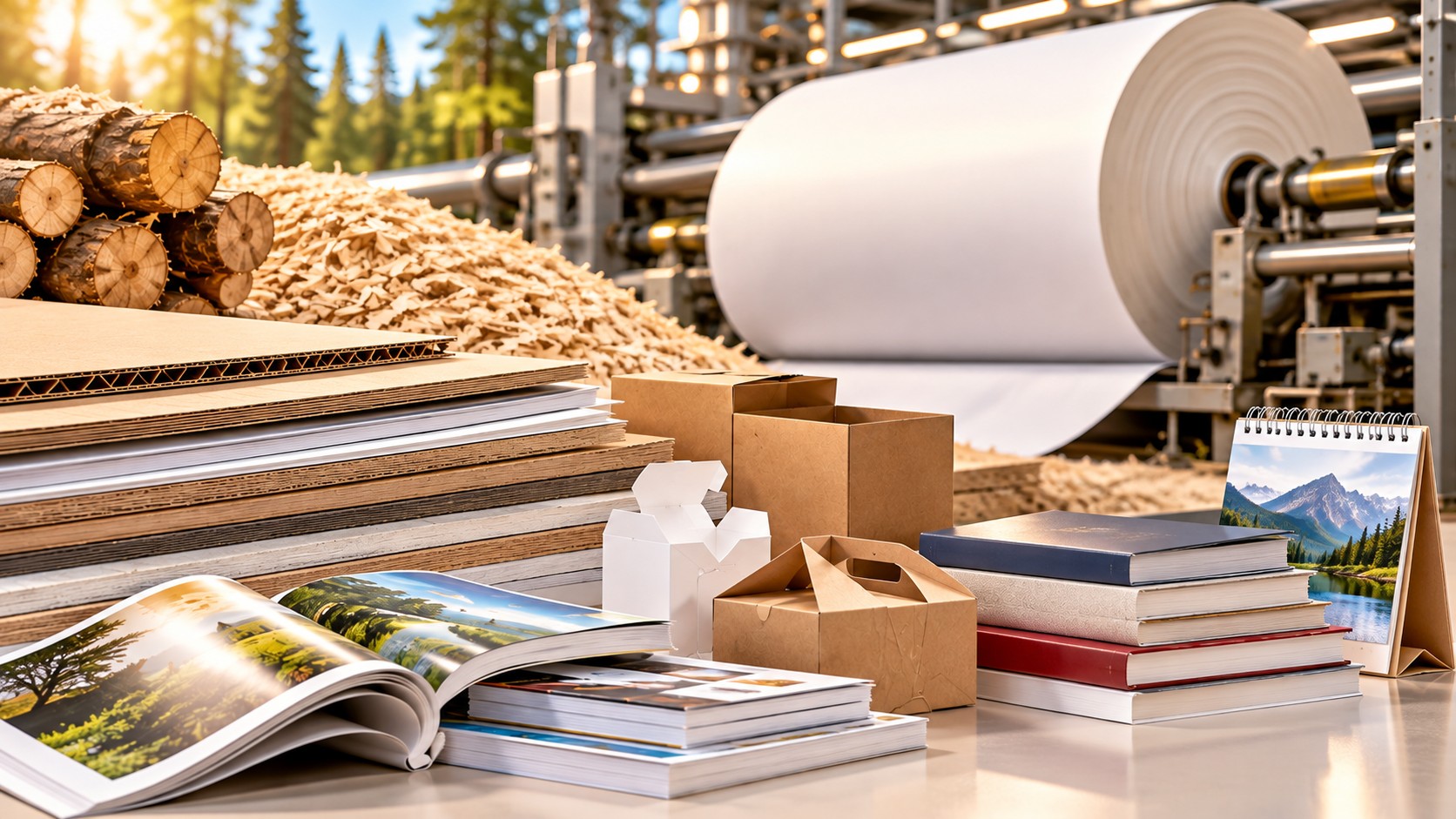
From Fiber to Finished Product
Engineering Paper and Paperboard Substrates for Printing, Packaging, and Commercial Applications
By Ronen Dolev | 2026
Introduction — The Material Behind the Print
When evaluating a printed product, attention naturally turns to color fidelity, image sharpness, gloss, and finishing quality. Yet underneath the ink lies a component that influences virtually every stage of production: the substrate. Paper and paperboard are not merely carriers for an image. They are engineered fiber networks with internal structures that determine how the material runs through a press, accepts ink or coating, responds to cutting and folding, and performs throughout its service life.
A text-paper sheet, a premium coated photographic paper, a pharmaceutical carton, a corrugated shipping box, and the thick board inside a hardcover album may all be cellulose-based. Their performance requirements, however, differ profoundly. Fiber composition, layer construction, density, thickness, grain direction, surface treatment, and moisture history all influence the final result.
Substrate selection should therefore begin with the finished product: the loads it must withstand, the printing process it will encounter, the converting operations that follow, the environmental conditions during distribution and use, and the expected service life. Selecting by basis weight or visual appearance alone risks avoidable failures in print, folding, binding, gluing, and end use.
This article follows the paper substrate from raw fiber to finished product, with special attention to folding cartons, paper-based flexible packaging, books, book covers, photo albums, calendars, and other commercial applications.
1. Paper as an Engineered Fiber Network
The primary structural component of most paper is cellulose, a naturally occurring polymer that forms a major part of plant cell walls. Paper manufacture separates plant fibers, disperses them in water, and consolidates them into a sheet. As water is removed, adjacent fibers form a network of physical interactions and bonds, especially hydrogen bonds between accessible cellulose surfaces.
Three wood components are particularly relevant. Cellulose provides the main fibrous framework; fiber length, integrity, flexibility, and bonding ability influence strength. Hemicellulose helps create accessible bonding surfaces and contributes to inter-fiber bonding. Lignin is part of wood's natural rigid structure; retaining or removing it affects color, aging behavior, and several mechanical and optical properties.
The strength of a paper sheet is not simply the sum of the strengths of individual fibers. It depends on fiber length distribution, contact area, fiber flexibility, bonding quality, orientation, sheet formation, porosity, and density. Consequently, two papers with identical grammage may display quite different tensile strength, tearing behavior, fold endurance, and stiffness.
2. Pulp Families and Their Contributions
Chemical pulp — Clean fibers and strength potential
Chemical pulping separates fibers by removing a substantial part of the lignin that holds the wood structure together. The Kraft, or sulfate, process is a major industrial example. Wood chips are cooked with suitable chemicals, then washed and screened; bleaching may follow where high brightness or whiteness is required.
Chemical pulp can provide long, relatively intact fibers with strong bonding potential. It is widely used in printing papers, kraft papers, packaging grades, and the outer plies of quality paperboard. Unbleached pulp is appropriate where strength and a natural appearance are priorities; bleached pulp supports brighter papers and boards. Actual performance still depends on wood species, pulping and refining conditions, furnish composition, and the finished sheet structure.
Mechanical pulp — High yield and useful bulk
Mechanical pulping separates fibers principally through mechanical energy, sometimes aided by heat or steam. A greater proportion of the original wood remains in the yield, including much of the lignin. Mechanical pulps can produce useful bulk and opacity and are found in various publication papers and in the middle plies of folding boxboard.
These advantages come with trade-offs. Depending on the pulp and subsequent treatment, strength and long-term optical stability may be lower than those of suitable chemical-pulp grades. Lignin-containing papers may yellow more noticeably with aging or light exposure. That difference is important when choosing a substrate for a publication intended to survive for decades rather than months.
Recycled pulp — Resource efficiency with variable fiber history
Recycled pulp comes from collected paper and board that are repulped, screened, cleaned, and, where appropriate, deinked. Its obvious benefit is reusing fiber resources. However, recycled fibers carry a processing history: repeated drying and reuse can alter bonding behavior, some fibers become shorter, and contaminants or fine particles may enter the furnish.
Recycled content is therefore neither an automatic weakness nor an assurance of identical performance. A well-engineered recycled-fiber board can be excellent for its intended application. Its tensile properties, layer bonding, surface cleanliness, odor, and suitability for sensitive products must nevertheless be verified against the actual technical specification.
3. How Paper and Paperboard Are Manufactured
Paper manufacture is a continuous conversion of a fiber-water suspension into a controlled, comparatively dry web. Each stage leaves a recognizable signature in the finished substrate.
Pulping, cleaning, and stock preparation
Fibers are obtained through chemical, mechanical, or recycled-fiber processing, then screened and cleaned. During stock preparation, different fiber types may be blended with fillers, strength agents, sizing chemicals, and other functional additives. Refining changes fiber surfaces and flexibility, improving contact and potential bonding. More intense refining is not universally better; it can also change drainage, porosity, bulk, and production behavior.
Sheet forming
Diluted stock is delivered to a forming section where water drains through a moving fabric and fibers consolidate into a web. Fiber distribution, flocculation, layer uniformity, and orientation develop here. The emerging grain direction results from the forming process. Multi-ply board may be formed from several stocks, enabling a smooth, high-quality printing face, a bulky central ply, and a back layer with different functional properties.
Pressing and drying
Mechanical pressing removes water and increases fiber contact. Subsequent thermal drying reduces moisture to the target level and develops much of the sheet's final bonding and dimensional behavior. Pressing and drying must be balanced: excessive densification reduces bulk, while nonuniform drying and moisture profiles increase the risk of curl or dimensional change.
Sizing and coating
Sizing adjusts interactions between the sheet and water or other liquids. It may be introduced within the stock or applied at the surface. The intended goal is controlled liquid response, not necessarily zero absorption. Pigment coating produces an engineered surface with selected smoothness, brightness, whiteness, gloss, opacity, and print-related properties. The coating's binder strength matters just as much as its visual quality when a material will undergo high-tack printing, creasing, lamination, or varnishing.
Calendering, winding, and sheeting
Calendering passes the web through controlled rolls to modify smoothness, gloss, caliper profile, and density. The degree of densification can influence both optical finish and bending stiffness. The finished web is wound into rolls and either supplied as reel stock or slit and cut into sheets. Cutting does not change the grain direction established on the paper machine; it only changes how that direction is described relative to the sheet dimensions.
4. Why Grammage Does Not Define Strength
In commercial printing, paper is frequently identified by grammage or basis weight, expressed in grams per square meter (g/m² or gsm). This information is essential, but it is not a complete mechanical specification.
Grammage describes mass per unit area. Caliper describes thickness, usually in micrometers. Bulk relates thickness to grammage and is commonly expressed as specific volume. Density describes mass per unit volume. Bending stiffness describes resistance to bending under a defined test method and direction.
Two boards weighing 300 g/m², for example, may have different calipers and internal structures. A board with a thicker, bulkier core can achieve greater bending resistance at the same grammage, provided the ply modulus and bonding support it. In simplified plate mechanics, thickness strongly influences bending stiffness, but a real multi-ply paperboard must also be evaluated for its elastic properties, layer arrangement, and fiber direction.
This distinction matters most for folding cartons. The designer wants enough stiffness to maintain a box's geometry and withstand handling, yet also enough foldability to avoid cracking. In book production, high-bulk paper can yield a thicker spine without a proportionate increase in book weight, but you still need to check opacity, print appearance, page turning, and binding performance.
5. Grain Direction: MD/CD in Reels, Long Grain/Short Grain in Sheets
Paper is anisotropic: its properties differ according to the direction of measurement. During sheet formation, fibers tend to orient preferentially in the direction of web travel, although the degree of orientation varies by forming conditions and grade.
Terminology used during manufacture and for reel-fed material
Machine Direction (MD) is the direction in which the web travels through the paper machine. Cross Direction (CD) runs across the web, perpendicular to MD. In many machine-made papers, tensile strength and bending stiffness are higher in MD than CD. Moisture-related dimensional change, on the other hand, is generally greater in CD.
These effects influence web tension stability, registration, wrinkles, curl, converting, and the final product's response to humidity. MD and CD are the fundamental manufacturing directions and remain relevant even when the web is subsequently converted into sheets.
The standard terminology for cut sheets
When paper or board is supplied as sheets, the trade normally refers to Long Grain (LG; Grain Long) and Short Grain (SG; Grain Short). These terms locate the grain relative to the sheet dimensions; they do not describe the physical length of an individual cellulose fiber.
Long Grain: the prevailing grain direction runs parallel to the sheet's longer edge. For a 700 × 1,000 mm sheet, grain parallel to the 1,000 mm edge is long Grain.
Short Grain: the prevailing grain direction runs parallel to the shorter edge. For the same 700 × 1,000 mm sheet, grain parallel to the 700 mm edge means Short Grain.
Manufacturing/supply context | Term | Practical meaning |
|---|---|---|
Paper machine or reel | MD | Along web travel; predominant grain orientation |
Paper machine or reel | CD | Across web travel; perpendicular to MD |
Cut sheet | Long Grain (LG) | Grain parallel to the sheet's longer dimension |
Cut sheet | Short Grain (SG) | Grain parallel to the sheet's shorter dimension |
Neither LG nor SG is inherently superior. The correct choice depends on the eventual folding lines, spine direction, box geometry, press-feeding requirements, and finished-product loads. Supplier notation can vary, so a purchase specification should explicitly state the required grain direction rather than rely only on the order of listed sheet dimensions.
Why Grain affects bending, folding, and creasing
A sheet generally resists stretching and bending differently along and across its dominant fiber orientation. A fold line parallel to the Grain commonly folds more readily and can reduce the risk of surface cracking when other factors are appropriate. A fold line across the Grain may require more force and put more tensile stress on an outer coating.
For thick or coated board, creasing must deliberately deform the material locally to create a predictable hinge. Crease channel dimensions, rule geometry, board thickness, coating flexibility, and grain-to-crease relationship all contribute. A single universal rule for every fold is therefore inappropriate; the carton layout must balance folding quality against the stiffness needed in loaded panels.
Bookbinding: Grain must be parallel to the finished spine
For most conventional books, the paper grain should run parallel to the finished spine. This helps pages open naturally and reduces unwanted stresses and waviness near the binding edge. Grain perpendicular to the spine can make the opening stiffer and contribute to distortion as ambient humidity changes.
Crucially, this does not mean every book must be printed on Long Grain press sheets. A sheet purchased as Short Grain may be correct if imposition, folding, and trimming result in finished pages with grain parallel to the spine. The finished page geometry, not the pre-print sheet label, governs the choice. Hardcover production also requires attention to the Grain of cover board and wrap materials.
Folding cartons and sheet-fed printing
In carton engineering, grain direction affects compression behavior, panel stiffness, crease performance, and folding-gluing reliability. It should be considered during dieline design and imposition, not discovered after printing. In sheet-fed presses, the anisotropic sheet stiffness and moisture response can also influence feeding, transport, registration, and re-feeding. Press guidance and the finished-product requirement must both inform sheet orientation.
Identifying the direction
The preferred method is to obtain an explicit grain-direction designation from the mill or supplier. When that information is unavailable, controlled comparative bending and folding checks or suitable laboratory measurements can help identify the direction. For critical cartons or binding jobs, verify the result before production release.
6. Main Paper Families for Commercial Printing
Uncoated papers
Uncoated papers preserve more of the underlying fiber-surface character. They range from relatively smooth, well-sized grades to deliberately textured papers. Typical strengths include a natural tactile quality, diffuse light reflection, and suitability for extended reading. Applications include novels, textbooks, notebooks, stationery, manuals, and selected promotional materials.
Print behavior depends on the ink technology and surface treatment. Excess or uneven ink penetration may produce loss of edge definition, mottling, or differences in color appearance. Uncoated paper does not, by itself, mean it is unsuitable for high-quality printing; inkjet-receptive and other engineered uncoated grades show why coating chemistry and process compatibility matter more than an overly broad label.
Coated papers
A pigment coating creates a more engineered printing surface, often supporting fine image detail, controlled ink interaction, and consistent appearance. Common finish descriptions include Gloss, Silk/Satin, Semi-Matte, and Matte, though trade terminology is not universally standardized.
Coated grades are common for art books, photographic books, brochures, catalogs, magazines, and premium marketing materials. However, very smooth coatings are not automatically compatible with every printing process. Coating strength, ink anchorage, varnish adhesion, score resistance, and subsequent lamination must be validated.
High-bulk and book papers
High-bulk grades provide greater thickness for a given grammage. They can create a substantial-feeling book while limiting total mass, which is useful for literary titles, premium editions, and long-format publications. Designers must still verify show-through, opacity, page flexibility, spine swelling, and binding method.
Kraft papers
Kraft papers are commonly made from chemical pulp, often unbleached when a natural color and strength-oriented construction are required. They are used for shopping bags, wrapping, sacks, envelopes, and paper-based packaging. The brown substrate color becomes part of the optical system: transparent process inks cannot reproduce the same appearance that they would on a white base. Color-sensitive work may require a dedicated separation strategy or a suitably opaque underlayer.
Specialty papers
Glassine is processed to achieve a dense, smooth sheet, often with partial translucency and functional release or protective characteristics depending on the grade. Greaseproof papers are engineered to resist grease penetration. Wet-strength papers are modified to retain more mechanical integrity when wet. Other specialties include textured stocks, label papers, security papers, and papers with engineered barrier or ink-receptive coatings.
No single designation should be treated as a blanket performance guarantee. Grease resistance, oxygen barrier, water-vapor barrier, and heat sealability are distinct functions and require separate verification.
7. Paperboard Grades: Structure, Strengths, and Applications
Unlike a simple notion of "thick paper," folding carton board is frequently a layered material whose faces and core have different functions. The printing face may be optimized for smoothness and color, the core for bulk and stiffness, and the reverse face for appearance, gluing, or end-use requirements.
Board family / common grades | Typical construction | Characteristic advantage | Typical applications |
|---|---|---|---|
SBS / SBB / GZ | Bleached chemical pulp; often coated | Whiteness, clean appearance, fine print surface | Pharma, cosmetics, premium cartons |
FBB / GC1 | Chemical-pulp faces with bulky mechanical-pulp core; white reverse | High stiffness-to-weight with improved back appearance | Food, healthcare, cosmetics |
FBB / GC2 | Similar layered concept; cream reverse | Bulk and efficient bending stiffness | Consumer folding cartons |
SUB / SUS / CUK | Predominantly unbleached chemical pulp; coated or uncoated variants | Mechanical integrity and strength-oriented construction | Beverage and robust consumer packaging |
WLC / GD / GT | Multi-ply board using substantial recycled fiber content | Resource efficiency and competitive specification | General consumer cartons |
Greyboard | Often recycled-fiber, structural board | Thickness and structural support | Rigid boxes, hardcover books, albums |
SBS / SBB — Solid bleached board
This family uses bleached chemical fibers and generally provides a bright, clean visual appearance. Appropriate coatings can support fine-detail printing and consistent color reproduction. It is widely used in cosmetics, pharmaceutical cartons, and high-value packaging where the inside of the carton may also be visible.
The bleached chemical fiber furnish provides a solid basis for mechanical performance, but successful folding is not guaranteed by the grade name alone. Caliper, Grain, crease design, coating stretch, and conditioning must remain compatible with the finished carton.
FBB — Folding boxboard, including GC1 and GC2
Typical FBB combines chemical-pulp outer plies with a mechanically pulped, bulky center. This design offers efficient bending stiffness relative to grammage. GC1 typically has a white reverse, while GC2 is commonly identified with a cream reverse. Reverse-side appearance matters for openable packs, inside printing, and product presentation.
Boards carrying the same weight and both described as FBB should not automatically be substituted. Mill-specific structure, moisture, coating, and stiffness in each direction can influence register, folding, and gluing outcomes.
SUB / SUS / CUK — Solid unbleached board
These boards are generally built from unbleached chemical fibers, sometimes with a printing coating or contrasting top layer. Their main value is mechanical durability and suitable performance in demanding packaging structures. Natural brown coloration may be a deliberate design feature, but it affects process-color appearance unless an appropriate opaque base is used.
WLC — White-lined chipboard
WLC grades generally incorporate recycled fibers in a multi-ply structure. A coated printing face can be paired with functional or cost-efficient inner plies. Variations in back color, surface cleanliness, absorption, ply bonding, and odor must be considered. For food or pharmaceutical uses, technical suitability is not enough on its own: the intended contact scenario, migration risk, and applicable legal requirements need separate assessment.
8. Corrugated Board and Rigid Cover Board
Corrugated board
Corrugated board is made from flat liners and one or more fluted mediums. Its geometry permits good stiffness and compression performance at relatively low material mass. Flute profile, board combination, liner strength, adhesive quality, and humidity all influence end-use behavior.
Corrugated packaging is widely used for transport, e-commerce, protective packaging, and displays. A flat-sheet measurement alone cannot establish the compression strength of the erected box. The finished box must be considered under expected stacking loads, impacts, storage humidity, and transport conditions.
Rigid board and greyboard
Rigid board is used in hardcover books, photo albums, premium boxes, game boards, and products requiring a stable core. The board is commonly wrapped with printed paper, cloth, or another cover material. Important variables include caliper, flatness, stiffness, cutting quality, glue absorption, grain direction, and moisture balance.
An imbalance between cover materials, adhesive moisture, and the board can produce warping after the product appears complete. The cover is a bonded composite, and its final behavior cannot be predicted from the board datasheet alone.
9. Mechanical, Surface, and Optical Properties to Specify
Tensile strength measures response to pulling forces and matters in reel-fed operations and converting. Tear resistance describes resistance to continued tearing and is important for bags and repeatedly handled products. Burst strength characterizes resistance under a particular pressure-loading method but should not replace carton-compression or bending tests.
Bending stiffness governs a carton panel's resistance to flexing and a cover's feel. Internal bond or ply bond measures susceptibility to internal splitting or delamination. Surface strength addresses the ability of fibers and coatings to resist forces during printing, coating, and converting. Roughness affects contact and ink transfer, while porosity and absorption influence liquid and gas movement through the structure.
Opacity limits show-through in books and double-sided printing. Brightness, whiteness, and gloss describe different optical characteristics, all of which can affect print perception. Optical brightening agents (OBAs) add fluorescence and can create differences in appearance under differing illumination. Color-critical workflows should define suitable measurement conditions, including M1 where applicable, rather than compare instrument readings obtained under incompatible measurement modes.
These metrics must be tied to a grade, manufacturing tolerance, test method, grain direction where relevant, and the actual use case. A generic claim that a board is "strong" or "premium" is not an engineering specification.
10. How the Substrate Influences Printing
Offset lithography
In offset, coating strength, surface uniformity, ink-component absorption, and interaction with fountain solution can influence picking, mottling, density, and image uniformity. A mechanically weak top layer may release particles under print forces even when its visual finish initially appears excellent.
Flexographic printing
In flexography, surface texture, ink wetting, substrate uniformity, and impression conditions jointly determine transfer efficiency and detail. Rough or absorbent paper can perform well when the ink system and anilox/plate choices are adapted to the material; poor compatibility can create missing print or uneven solids.
Inkjet printing
Inkjet print quality depends on droplet behavior, spreading, absorption, and drying or curing. A properly engineered ink-receptive surface can retain small dots and sharp edges. Untreated or poorly matched paper may show feathering, coalescence, mottling, or unacceptable dry time.
Electrophotographic printing
In electrophotographic processes, surface chemistry, coatings, electrical and thermal behavior, and the transfer/fixing mechanism determine compatibility. Some systems require optimized stocks or an appropriate primer. The exact requirement depends on the press and ink technology, not paperboard nomenclature alone.
Substrate color and visual consistency
The same print file can look different on a high-whiteness gloss board and a warm-tone matte stock. Substrate shade, OBAs, surface scatter, gloss, and ink interaction affect perceived saturation and contrast. Before changing a profile or press setting to correct a color shift, determine whether the substrate supplier, grade, coating, lot, or storage conditions changed.
11. Converting: Where Hidden Material Problems Appear
Creasing and folding
A proper crease forms a controlled hinge in the board. Crease rule and channel dimensions must suit caliper and structure. Grain orientation, coating strain capacity, and local ply response influence cracking and fold recovery. A carton can print beautifully and still fail at the first commercial folding operation.
Lamination
Lamination can increase rub resistance, durability, and moisture protection, or create a desired tactile or visual finish. It also introduces a second material with its own thermal and moisture response. Unbalanced strain, adhesives, and coating structure can lead to curl or cracking, especially in tightly folded covers.
Varnishing and other coatings
Overprint varnishes protect or modify the surface. Their flexibility, adhesion, drying or curing, and compatibility with subsequent glue areas are critical. A hard coating that works well on a flat sheet can crack across a crease. Surface gloss alone does not indicate conversion resistance.
Gluing and binding
Adhesive performance depends on wetting, the surface treatment, the strength of the coated layer, cure conditions, and the stresses encountered in use. For books, tests should include repeated opening, spine integrity, and page pull. In hardcover production, both grain orientation and the board and wrap's moisture response contribute to a stable result.
12. Selecting Paper and Board by End Application
Novels and general-interest books
A suitable text stock offers comfortable reading, manageable book weight, adequate opacity, an appropriate surface feel, and predictable folding and binding. Uncoated papers are commonly chosen for their diffuse reflection and tactile quality. Grain in the final pages should be parallel to the spine.
Photo books and fine-art publications
These applications prioritize tonal detail, color reproduction, surface uniformity, and the intended visual finish. Coated papers often work well, but specialist uncoated fine-art papers can be equally deliberate design choices when compatible with the printing process. The final decision should include page stiffness, opacity, durability, and binding type.
Softcover and hardcover books
Softcovers need a controlled balance between board stiffness, repeated flexing, and score performance. Hardcovers are composite constructions of structural board, adhesive, printed wrap, and possibly protective lamination. Each component's grain direction and expansion response matters.
Photo albums and lay-flat products
Photo albums need print fidelity, repeated-opening durability, layer adhesion, flatness, and appropriate hinge or lay-flat behavior. Evaluate the album after lamination, mounting, trimming, and final binding, not solely by comparing printed sheets.
Calendars and display products
Calendars require stable flatness, adequate stiffness, resistance to surface abrasion, reliable drilling/punching, and suitability for spiral or hanging assembly. One-sided coating or environmental imbalance can cause curling, which is especially visible in large-format sheets.
Folding cartons
Folding carton selection must balance mechanical stiffness, crease behavior, glueability, graphics, the packed product's weight, automated filling, and shipping conditions. Approve a carton grade after converting trials on the intended dieline, not merely after press qualification.
Paper-based flexible packaging
Paper may serve as a primary web or a layer within a flexible pack. Its tactile and graphic advantages are useful, but untreated paper generally does not provide the moisture, oxygen, or heat-sealing performance many sensitive products require. Functional coatings or laminations may be needed, and their effects on folding, package durability, and recyclability must be tested.
13. Testing and Standards: From Datasheet to Validation
A good substrate specification identifies the property, test method, conditions, and acceptance criterion. Representative standards include the following:
Reference | Property/purpose | Typical engineering use |
|---|---|---|
ISO 536 | Paper and board grammage | Verify mass per unit area |
ISO 535 | Water absorptiveness (Cobb method) | Assess controlled water absorption |
ISO 5628 | Bending stiffness | Compare stiffness under a stated method |
ISO 187 | Standard atmosphere for conditioning and testing | Control the effect of temperature and humidity |
Other relevant tests include tensile strength, tearing resistance, burst strength, surface strength, ply bonding, caliper, roughness, optical measurements, and carton compression where appropriate. Select the required method and acceptance criteria for the product rather than copying them from an unrelated application.
Laboratory data on incoming flat stock are a starting point, not final approval. A folding carton should be tested after scoring and gluing; a book after binding and repeated opening; an album after mounting and finishing; and a paper-based pouch after conversion under realistic conditions.
14. Troubleshooting: Read the Material Before Changing the Press
Curl or dimensional instability: review moisture content, conditioning, Grain, coating balance, printing and drying temperatures, and storage history. The press may reveal an upstream imbalance.
Cracking at folds: inspect the crease rule/channel, board caliper, grain-to-fold direction, coating formulation, print or varnish brittleness, and conditioning. Determine which layer actually cracked before modifying the process.
Poor ink adhesion or picking: distinguish ink release from the coating, coating release from fiber, and internal fiber failure. Fiber or coating debris attached to a removed ink layer suggests a different root cause from clean ink delamination.
Color variation between lots: compare substrate shade, whiteness, brightness, fluorescence, gloss, coating, and absorption before changing profiles or press calibrations. Color management cannot eliminate a physical material change on its own.
Ply separation: locate the failure interface. In multi-ply board or laminated commercial stock, weak internal bonding, unsuitable adhesive interaction, or mechanical stress can be responsible.
Warped covers or albums: inspect grain orientation, asymmetric wrap materials, adhesive water input, drying, and board equilibrium moisture. A flat incoming board can become warped when assembled into an unbalanced structure.
The general rule is to isolate the failing layer and interface, then test one variable at a time. Adjusting press settings without understanding the substrate often hides symptoms temporarily instead of correcting the cause.
15. Sustainability and End-of-Life Design
Paper and paperboard are produced from fiber resources that can often enter established recycling systems. However, fiber origin and actual recyclability are different questions. Polymer barrier layers, lamination, metalized components, adhesives, special wet-strength treatments, and difficult-to-remove coatings can change how well a product sorts, repulps, or releases contaminants.
A paper-based package is not necessarily recyclable in every local facility. Conversely, a functional coating does not automatically make a fiber product unrecyclable. End-of-life evaluation must consider the complete construction, intended collection stream, regional infrastructure, and results of relevant testing.
Designers should also account for the product protection that a package provides. Reducing material or removing a barrier without preserving adequate protection can increase product loss and undermine the intended environmental benefit.
Conclusion — Select for Function, Not for the Grade Name
Paper and paperboard are engineered systems. Their behavior is built from fiber selection, pulping, formation, pressing, drying, sizing, coating, calendering, and converting. Grammage is not synonymous with strength; caliper alone does not determine stiffness; a smooth surface is not automatically compatible with every ink; and excellent printing does not ensure a successful fold or binding.
Grain direction is fundamental to these decisions. MD and CD describe the production directions on the machine and in reel-fed material, whereas Long Grain and Short Grain describe how the prevailing Grain lies relative to the dimensions of a cut sheet. The correct orientation supports the finished product's spine, crease layout, press path, and mechanical function.
There is no universally best grade. SBS/SBB may offer the desired clean visual presentation; FBB may deliver efficient stiffness-to-weight; recycled-fiber boards may provide appropriate performance with resource advantages; and specialty papers may supply tailored functional properties. The engineering task is to define the requirement, select the material construction, verify its properties, and validate the finished application.
The true quality of a substrate is not measured only by how good it looks when it leaves the printing press. It is demonstrated by how consistently the completed product performs throughout its intended life.
Source and standards framework
Based on the supplied folding-carton, paper manufacturing, and substrate/priming resources. Standards discussed: ISO 536, ISO 535, ISO 5628, and ISO 187; verify editions before using them in specifications.