Ronen Dolev | Industrial Color Engineering Series | October 2026
One brand blue, three different printing routes
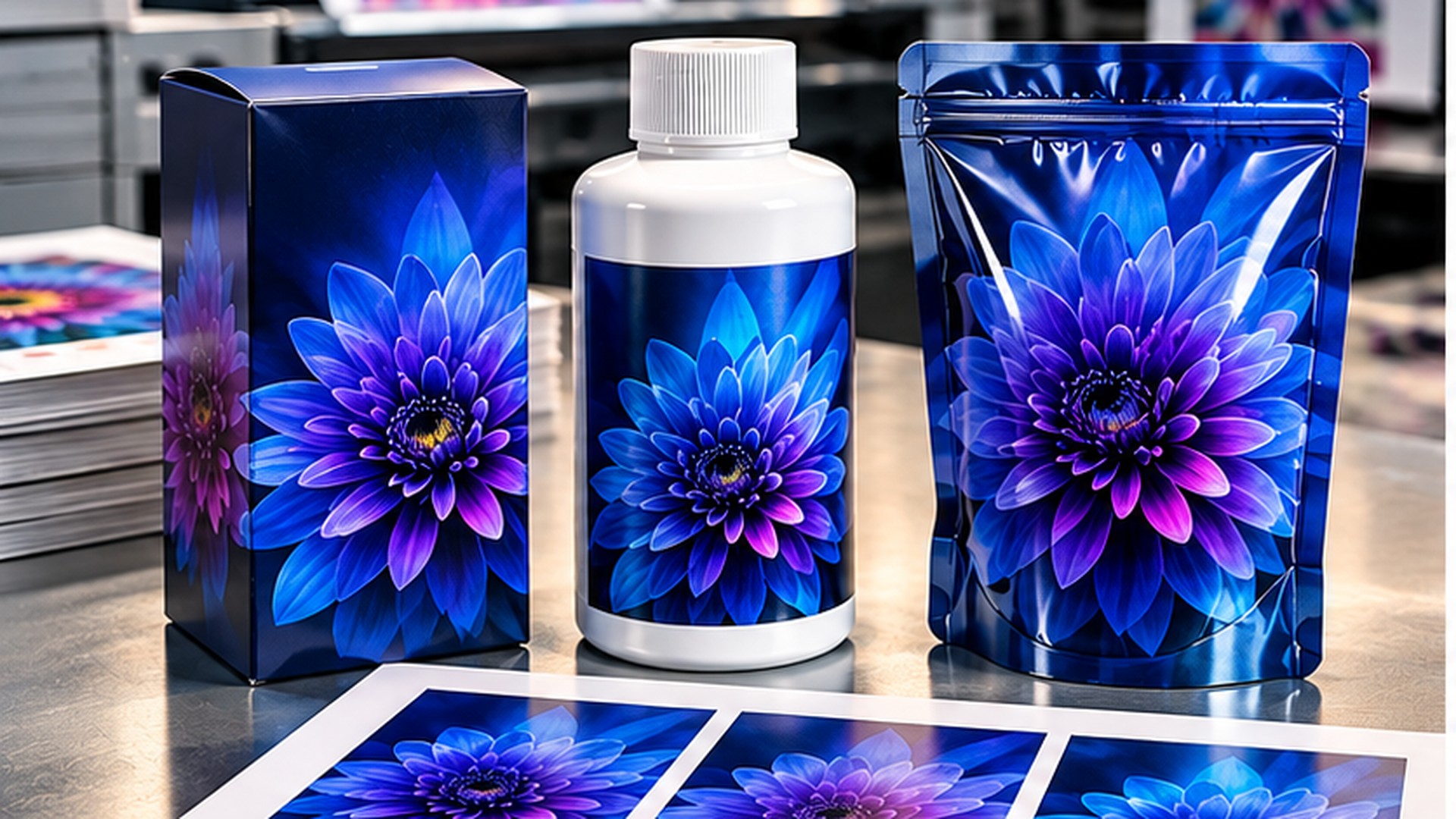
A global personal-care brand is launching a product family. Its principal color is a deep blue with a restrained violet undertone. The folding carton is printed on coated board using sheetfed offset; regional labels are produced with liquid electrophotographic (LEP) digital printing; and refill pouches are printed by flexography on film, then laminated. The customer supplies one approved physical reference and a common color aim. Each producer submits samples that comply with the agreed CIEDE2000 (ΔE00) tolerance under the declared reference condition.
The numbers agree. The products do not. Under the retailer's LED lighting, the digital label looks more violet, the offset carton remains relatively subdued, and the laminated flexographic pouch looks cleaner and more visually active. Back in the controlled viewing booth, the differences shrink, though they don't vanish entirely. Each production team has an explanation based on its own technology: change the digital spot recipe, reformulate the offset ink, or change flexographic ink transfer. These may all be valid interventions. None should be the first action until the mechanism has been established.
This is not an argument about which printing technology is more accurate. It investigates how different pigment combinations, substrates, white supports, ink films, and protective structures return light to the observer. The central engineering question is whether the mismatch is colorimetric, spectral, related to surface appearance, or a combination of those mechanisms.
A blue that looks matched under one light can diverge under another. Consider a digital LEP label, an offset spot-color carton, and a flexographic pouch that appear similarly blue under the controlled D50 reference condition. Under one retailer LED, the digital blue may appear more violet while the offset remains comparatively subdued and the flexographic sample shifts in another direction. The point is not that any specific technology always behaves this way: the description is a constructed visual scenario and does not represent measured press samples.
A low ΔE00 value does not describe the entire spectrum
A spectrophotometer can capture a sample's spectral response and calculate colorimetric coordinates for a declared illuminant and standard observer. A ΔE00 result compares two calculated color positions. It is an essential industrial control, but it does not disclose every difference between the spectral reflectance curves that produced those coordinates.
Two prints can reach nearly the same colorimetric destination by taking different spectral routes. One blue may rely on a dedicated spot-color pigment mixture. Another may be constructed from cyan, magenta, and violet channels. The resulting curves can differ despite their close Lab values under D50. Under another illuminant, wavelength regions are weighted differently, and the two samples may separate in perceived color. This is illuminant metamerism: a match under one specified illuminant that breaks under another.
A small numerical difference is not proof of spectral equivalence. Conversely, different spectra are not automatically a product failure. Many commercially acceptable cross-technology color matches are metameric to some degree. The question is whether the separation becomes objectionable under the lighting conditions relevant to the customer's product and market.
Different spectral paths can produce a similar visual destination. Imagine three reflectance curves across the visible spectrum. They are not identical: the relative contribution of shorter and longer wavelengths changes because the digital process mixture, the offset spot formulation, and the flexographic ink differ. The curves may yield a close colorimetric match under one declared light, yet separate when another illuminant weights the wavelengths differently. The curves originally used to explain this principle were synthetic teaching examples, not measured spectra and not evidence of identical Lab coordinates.
Not every visual mismatch is metamerism. Gloss, texture, opacity, backing, fluorescent whiteners, layer thickness, curvature, and specular reflection may all change appearance. If the pair already disagrees under the approved reference illumination, first investigate the ordinary color mismatch. If the numerical match remains acceptable but the products look different at particular angles, study their surface characteristics. Only after these alternatives have been considered should a lighting-dependent difference be attributed to spectral metamerism.
Digital printing: a fixed ink set must reproduce someone else's spot color
Liquid electrophotographic printing forms an image from charged colorant particles in a liquid carrier, develops the image, transfers it through an intermediate surface, and anchors it to a receptive substrate under controlled conditions. In production, brand colors are commonly reconstructed from a fixed family of process inks. The printer can adjust separations, digital front-end (DFE) recipes, calibration, and color-management settings; it usually cannot create a newly formulated pigment for each spot-color job.
A CMYK process can reach a large practical color range, but not every spot color. A characterized CMYKOVG configuration adds orange, violet, and green process channels and can enlarge selected regions of the printable gamut. These extra channels do more than extend the outer boundary. They also allow alternative channel combinations for some colors that were already printable. A saturated violet-blue, for example, may be reproduced through different feasible combinations of cyan, magenta, black and violet, depending on the system.
That flexibility matters because multiple separation recipes can achieve a close D50 match. Yet the spectral behavior of the alternatives may differ. An extended-gamut recipe that improves ΔE00 under one illuminant may make the match worse under a particular retail LED. Equally, another recipe may improve the multi-illuminant relationship without producing the absolute lowest single-illuminant ΔE00 number. Selection should therefore take account of the reference, the actual ink set, available gamut, reproducibility, and critical viewing environments.
An ICC profile describes a characterized printing condition and supports transformations into its output space. It does not change a cyan pigment into the offset spot pigment that the digital system is asked to imitate. Conventional ICC conversions using colorimetric targets alone cannot guarantee minimum spectral difference. Where spectral optimization tools are available, a candidate recipe can be assessed against a fuller dataset. Where they are not, controlled physical trials under relevant lights remain indispensable.
Not all digital printing systems behave the same way.
LEP, aqueous inkjet, UV inkjet and dry-toner systems differ in pigment chemistry, deposited film, binder, curing or fixing mechanism, optical texture and substrate interaction. A conclusion established for an LEP press on a prepared paper labelstock should not automatically be transferred to UV inkjet on synthetic film. Even two LEP presses using different ink sets, media definitions or calibration histories may not produce identical appearance. The phrase "digital color" is too broad to act as a material specification.
Offset: a formulated spot ink offers another degree of freedom
Sheetfed offset provides an important option: a brand spot color can often be formulated from a dedicated pigment recipe. When a color is metameric to a digital label, the ink supplier may be able to explore pigment combinations whose reflectance profile more closely matches the approved master. This is a different adjustment from simply adding or removing ink on press.
Changing ink film thickness can shift density, Lab, and overprint behavior, but it does not give the operator unrestricted control over the pigment reflectance curve. In fact, increasing film thickness to repair a D50 difference may worsen a mismatch under another illuminant. The supplier should first determine whether the candidate recipe, not the ink key, is the appropriate variable.
The finished offset construction is not neutral. Coated and uncoated board, absorption, ink setting, UV curing where applicable, optical brighteners, varnish, and soft-touch finishes change appearance. A dedicated spot formulation may be spectrally close to the master on a laboratory drawdown yet diverge once it is run on production board and covered by its approved finish. The correct proof of success is the qualified finished carton, not only a hand-pulled ink sample.
Offset CMYK reproduction is different from offset spot ink. When a brand color is built from process inks, the available colorants are fixed again. The statement "offset can reformulate the spot" applies only when a dedicated ink formulation is actually part of the job.
Flexography: pigment formulation meets a moving ink-transfer system
Flexographic printers may also use dedicated spot colors, but their behavior depends on the complete ink-transfer path. Anilox cell condition and effective volume, doctoring, plate characteristics, transfer efficiency, ink viscosity or rheology, drying or cure, and substrate surface all contribute to the printed film. An anilox roll with the same nominal specification does not guarantee identical ink transfer on two presses.
An apparent spectral problem can therefore be masked by process instability. Before asking the ink supplier to reformulate a spot, confirm that the press can repeatedly deliver an accepted solid under stable, documented conditions. Otherwise, the recipe may be optimized to compensate for a transient error.
Flexible packaging adds another critical complication: reverse-printed film may be laminated before it becomes the product that customers see. The outer web, adhesive, internal white layer, and backing alter the optical path. A flexo blue matched to an offset carton on an unlaminated web can move after lamination. Correcting the printed web to a final-carton reference without accounting for the qualified finished construction may be a method error rather than an ink error.
Three routes, three kinds of engineering control. In fixed-ink digital LEP, the main levers are channel separation, calibration, DFE/ICC settings, media selection and image-transfer consistency. In offset spot printing, you can adjust or qualify pigment formulation, deposited ink film, substrate, tone behavior, and varnish. In flexography, the ink formula works together with anilox condition, viscosity, plate, transfer efficiency and the eventual laminate. Interventions are therefore not interchangeable: an ICC correction cannot create a missing pigment response, and a new spot-ink recipe will not cure an unstable film or laminate.
Digital versus conventional: a practical comparison
Digital LEP / fixed-ink digital. Brand-spot reproduction: Process-channel build; optional expanded gamut. Pigment reformulation by job: Generally not within normal fixed-ink production. Main controls: DFE spot recipe, calibration, media profile, transfer condition. Characteristic spectral challenge: Process mix differs from the physical master. What an ICC profile alone cannot resolve: Missing spectral behavior of absent colorants. Appropriate approval state: Qualified finished label or package.
Offset. Brand-spot reproduction: Dedicated spot formula or CMYK process build. Pigment reformulation by job: Often yes for a dedicated spot. Main controls: Formula, film weight, TVI, substrate, finish. Characteristic spectral challenge: Pigment substitution or formula differs from the master. What an ICC profile alone cannot resolve: Unstable ink/substrate/finish conditions. Appropriate approval state: Finished coated/varnished carton.
Flexography. Brand-spot reproduction: Dedicated spot formula or process build. Pigment reformulation by job: Often yes for a dedicated spot. Main controls: Formula, anilox, ink condition, transfer, laminate. Characteristic spectral challenge: Pigment formula and laminated structure differ. What an ICC profile alone cannot resolve: Unstable ink transfer or unqualified laminate. Appropriate approval state: Finished laminated and converted pouch.
Lighting: "LED" is not a sufficient viewing specification
Two nominally warm-white LEDs, even at the same correlated color temperature, may have different spectral power distributions. A high general color-rendering rating is not a guarantee that a particular pair of industrial inks will match under that lamp. Product reviews should therefore include the controlled graphic-arts reference light and a limited set of important real-use illuminants agreed with the customer. A color approved only under a favorable lamp is not robustly qualified.
ISO 3664:2025 defines controlled graphic-arts viewing conditions. Its P1/P2 conditions match M1 measurement for relevant printed products; P3/P4 are designed for low-UV viewing and align with M2 measurement when applicable. This distinction matters on papers containing optical brightening agents (OBAs). OBAs can fluoresce under UV-rich light, making the unprinted stock appear bluer or brighter. A film label on a different support will not necessarily respond in the same way.
An M1/M2 difference is not itself proof of metamerism between two ink recipes. It may reveal fluorescence-related changes in the substrate or printed construction. The second article in this series addresses the correct measurement-reference relationship in greater depth; the practical point here is that the evaluation light and instrument setting must be deliberately chosen and recorded.
Case study 1: digital blue versus a formulated offset spot
The customer's approved offset spot and a digital label are both within the D50 target tolerance. Under one representative store LED, the digital blue appears more violet. A controlled investigation confirms the backing, physical product state, measurement geometry, and most surface-appearance factors. Spectral review then indicates that the two colorant combinations differ materially.
The digital specialist tests a small, reproducible series of alternate channel recipes, including feasible violet-channel variants. Each candidate is measured under the reference condition and evaluated under the agreed LED set. The winning candidate is not selected solely because it has the smallest D50 ΔE00. It must maintain the agreed reference tolerance, demonstrate less unacceptable movement under the market lights, and remain stable through an extended production run.
If none of the digital recipes can meet the requirement, the team reviews the offset spot formula or negotiates a documented route-specific compromise. The physical master remains the master; one printer's recipe does not become the brand's universal definition.
Case study 2: flexographic blue shifts after lamination
A printed flexographic web matches a coated offset carton at the press-side inspection table. After lamination to the final film structure, the blue deepens and warms. An operator proposes reducing ink strength on press. Before acting, the team retains paired pre- and post-lamination samples, confirms lamination stability, and defines the acceptance target for the finished pouch.
The web may need to print to an intentionally different intermediate appearance so that the final pouch matches the family. This is not a failure of flexographic color control. It is a controlled compensation for the qualified downstream optical construction. The digital label and the carton are then compared with the completed pouch, not with a loose intermediate web.
Case study 3: the digital clear label changes after application
The same digital label printed on transparent film is examined first over a white laboratory backing and later on a translucent bottle filled with colored liquid. Its appearance changes. The instrument may characterize each setup correctly, but the setups are different optical objects. White ink opacity, adhesive, bottle wall, product fill, curvature, and reflections alter the result. No amount of aggressive digital spot tuning on a white tile can establish the final bottle appearance if the intended use construction is not represented.
This is principally an appearance and construction problem. Metamerism should not be claimed without evidence that a match actually breaks under a defined illuminant change.
A repeatable qualification pathway
From brand master to finished-product approval. First, define one common reference with a physical master and spectral target where available. Next, establish stable conditions on each press and substrate before creating or revising a profile. Then measure candidate colors using a declared method under the reference illuminant. Compare those candidates under the additional retail or use-environment lights that matter. Finally, approve the printed, finished and applied article—not merely an intermediate sheet or loose web. Keep every transition traceable to the same brand target.
First, freeze the brand target: physical master, spectral data where available, the colorimetric aim, tolerance, illuminant, observer, and sample state. Second, stabilize each production route before building or revising profiles. Third, characterize the exact ink, substrate, and finishing condition. Fourth, measure candidate output with a documented instrument setup and compare it to the correct finished state. Fifth, test the small set of relevant illuminants and investigate any material differences in hue, chroma, or lightness. Finally, verify that the chosen recipe survives normal process variation and subsequent finishing.
The approval record should identify the reference version, source and destination conditions, ink recipe or digital build, press calibration status, sample location, backing, instrument, measurement condition, final finishing state, and alternate-light observations. Traceability is more valuable than a single favorable pass value.
Troubleshooting: what to examine before changing the recipe
ΔE00 fails under reference light. Diagnostic question: Is this a routine color error?. First engineering action: Verify target, calibration, media, ink state, and measurement.
Passes D50, disagrees under another LED. Diagnostic question: Illuminant-dependent spectral mismatch?. First engineering action: Collect spectra; compare under declared illuminants.
Digital appears too violet versus offset. Diagnostic question: Channel mixture or white support?. First engineering action: Compare alternate digital builds and qualified backing.
Flexo shifts after lamination. Diagnostic question: Was the wrong production stage approved?. First engineering action: Measure paired web and final laminate.
Similar Lab, different gloss. Diagnostic question: Is the surface appearance different?. First engineering action: Measure gloss and observe at controlled angles.
Paper and film differ under UV changes. Diagnostic question: Is fluorescence involved?. First engineering action: Compare OBA contribution under appropriate M/viewing conditions.
Flexo spot varies across run. Diagnostic question: Is transfer stable?. First engineering action: Check anilox, viscosity/rheology, plate, and repeatability.
Offset drawdown matches, but carton fails. Diagnostic question: What did the production finish change?. First engineering action: Test qualified board and post-varnish state.
Digital recipe changes improve one lamp but hurt another. Diagnostic question: Was optimization one-dimensional?. First engineering action: Define multi-illuminant acceptance before selecting a recipe.
The engineering conclusion
Digital, offset and flexographic presses need not use the same pigments or recipes to reproduce a coherent brand. They need controlled, independently qualified routes that converge toward an approved appearance in the conditions that matter. Offset and flexo can often reformulate a dedicated spot pigment system; fixed-ink digital equipment generally must optimize the channels already installed. Neither route has an automatic advantage in every color region.
A ΔE00 pass is valuable evidence under a specified measurement condition, not a promise of universal visual equality. Diagnose metamerism, don't presume it. Gloss, opacity, finishing and the geometry of the final object deserve equally disciplined investigation. Successful cross-technology color engineering combines spectral reasoning with physical production reality, and approves the object the customer will actually hold.
Sources and further reading
ISO 13655:2017. Graphic technology — Spectral measurement and colorimetric computation for graphic arts images. https://www.iso.org/standard/65430.html
ISO 3664:2025. Graphic technology and photography — Viewing conditions. https://www.iso.org/standard/83759.html
CIE 080-1989. Special metamerism index: change in observer. https://www.cie.co.at/publications/special-metamerism-index-change-observer
PRINTING United Alliance. GRACoL reference profiles and datasets. https://www.printing.org/library/standards/specifications-for-print-production/gracol
Fogra. Characterization data and print-condition references. https://fogra.org/en/downloads/work-tools/characterisation-data
Fogra. ProcessStandard Digital (PSD). https://fogra.org/en/certification/digital-printing/psd
Technical note: All case studies and descriptive color scenarios in this article are constructed educational examples. No production-specific measured spectral curves, ΔE results, or customer trials are claimed. Explanations of hypothetical spectral differences should not be mistaken for measurements of industrial inks.