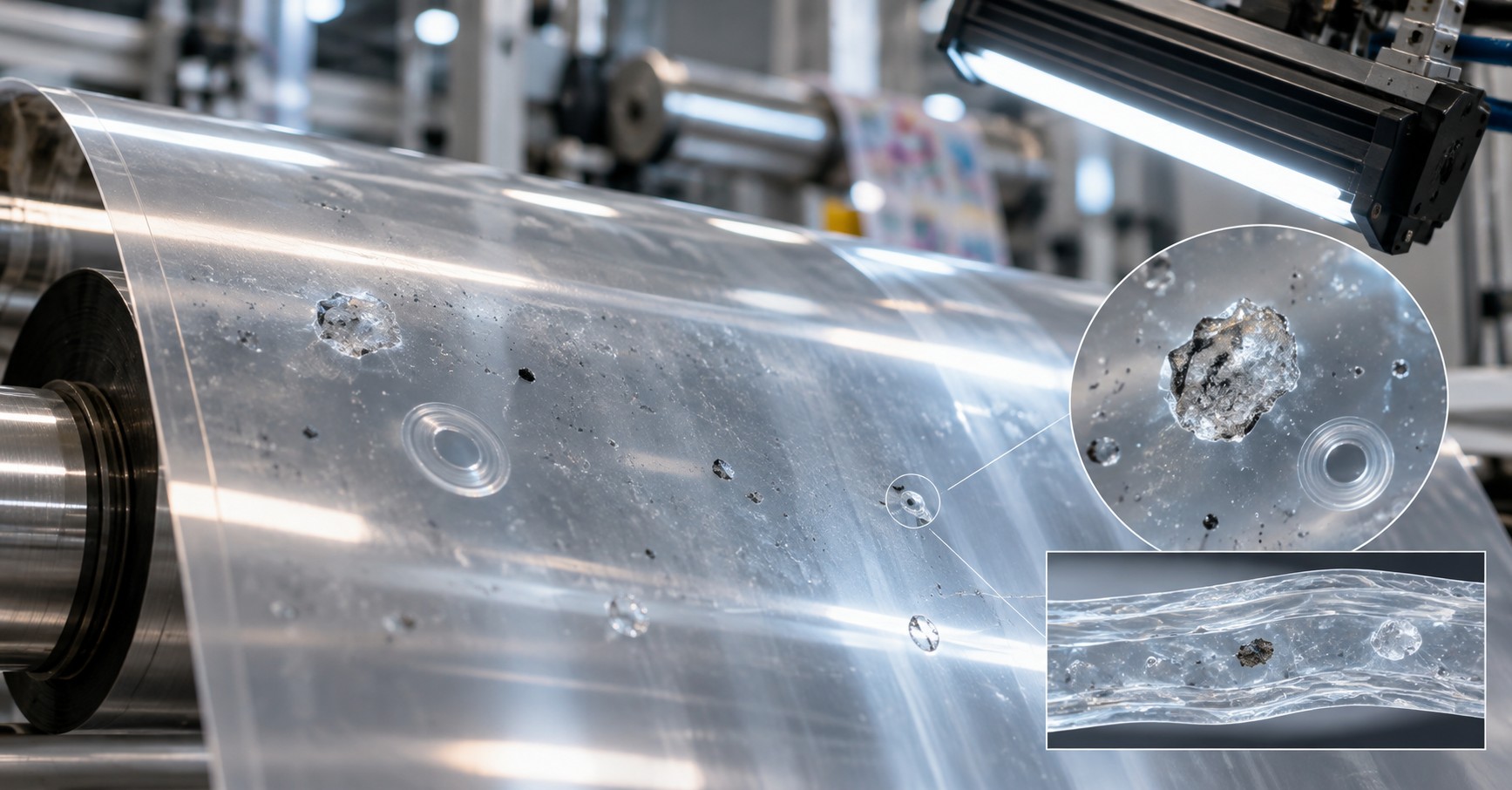
Introduction — Not Every Printing Defect Begins at the Press
A printing plant runs a polyethylene film supplied by an established manufacturer. The incoming material is accompanied by a conforming technical specification: nominal thickness is within tolerance, and the surface treatment is appropriate for the printing process.
Production starts normally. After a new roll is introduced, however, isolated defects begin to appear. Some look like missing ink; others resemble tiny protrusions or areas where the ink film is no longer uniform. The operator checks ink transfer. Quality control looks for surface contamination. The application specialist reviews surface energy, press settings, and ink–substrate compatibility.
But what if the defect originates neither in the ink nor in the press? What if it was already embedded in the film during extrusion?
Polymer films can look completely homogeneous to the naked eye while containing small regions of different composition, poorly dispersed material, thermally altered polymer, or foreign particles trapped within the melt. Industry often describes such imperfections as polymer gels, fish-eyes, black specks, or inclusions. These terms sometimes refer to similar appearances but not necessarily to the same failure mechanism.
Some defects are polymeric; others are contaminants. Some stem from insufficient melting or mixing, while others arise from chemical changes in the polymer. Their consequences for printing, lamination, web strength, and sealing can differ substantially.
To understand these defects, we must return to the stage at which the film was produced—long before it reached the printing press.
1. A Polymer Film Is Not Necessarily Homogeneous
Printing and packaging films are made from several polymer families, including polyethylene (PE), polypropylene (PP), polyester (PET), and purpose-designed multilayer combinations. PE films are commonly made by blown-film or cast-film extrusion. Biaxially oriented polypropylene (BOPP) undergoes additional stretching processes that establish molecular orientation and influence its mechanical and dimensional properties.
Successful film manufacturing requires control of more than average thickness. Resin composition, melt temperature, residence time, shear history, additive dispersion, cooling, and subsequent orientation all influence the resulting structure.
A PE formulation may contain polymer chains with a broad range of molecular weights, processing aids, functional additives, pigments or masterbatches, and sometimes recycled material. If a component does not melt, mix, or disperse adequately, it can form a local region that behaves differently from the surrounding matrix.
When the molten polymer is drawn into a thin film, that region may deform differently from the neighboring material. The result can be a protrusion, a change in transparency, a local thickness variation, or—under particular loading conditions—a point where damage begins.
These effects must not be generalized. Not every visual nonuniformity is a gel, and not every gel meaningfully affects package performance. Some are predominantly cosmetic; others become critical only when their size, chemistry, or position interacts with end-use demands.
2. What Is a Polymer Gel—and Why Can the Name Mislead?
In film extrusion, gel is an industrial umbrella term for several classes of local defects. The material inside the defect is not necessarily a gel in the strict chemical sense. Studies of polyethylene films identify mechanisms that include crosslinked polymer, high-molecular-weight material, unmelted polymer, additive agglomerates, and foreign inclusions.
The visible appearance is therefore not an adequate chemical diagnosis. A meaningful investigation must distinguish the physical and chemical structures that can produce a similar spot on the film.
Crosslinked Gels
During production and reprocessing, polymers may undergo chemical reactions resulting from heat, oxygen exposure, or other aspects of their processing history. Under certain conditions, molecular chains can become chemically connected, creating a crosslinked structure.
Such material may no longer flow like the surrounding thermoplastic polymer when reheated. A crosslinked particle can survive processing as a local inclusion and distort the film as it is drawn down. Severe thermo-oxidative degradation can also produce yellow, brown, or black material, but color alone cannot identify a particle as crosslinked polymer.
High-Molecular-Weight Gels
A different kind of defect can arise from an unusually high-molecular-weight fraction or from polymer that has not dispersed sufficiently. Very long chains may exhibit substantial entanglement, creating locally different melt-flow behavior without requiring chemical crosslinking.
This distinction matters. Highly entangled polymer and chemically crosslinked polymer can behave differently during heating and shearing. Hot-stage observations may show some inclusions softening or deforming while others retain their structure. That behavior can help classify the defect, but it is not, by itself, conclusive chemical identification.
Unmelted Material
Unmelted particles can originate from insufficient melting, incomplete mixing, inappropriate material combinations, or inadequate residence time under the relevant conditions. Such regions may produce a visible irregularity in the film.
Increasing extrusion temperature is not an automatic solution: a change intended to improve melting could also increase polymer degradation. The process response has to be evaluated as a system.
Agglomerates and Foreign Inclusions
Fillers, pigments, additives, and masterbatch components can form agglomerates if dispersion is inadequate. Foreign matter—including cellulose fibers, adhesive residues, different polymers, and inorganic particles—may also become trapped in the melt.
The consequences depend on chemistry, shape, size, location, and mechanical compatibility with the surrounding polymer. A stiff inclusion that cannot deform with the film can act as a local stress concentrator. Whether that translates into product failure must be established experimentally.
3. Fish-Eyes: A Visual Description, Not a Chemical Diagnosis
A fish-eye generally describes a lens-like local imperfection, sometimes with a small central point surrounded by a region of changed transparency or thickness. Its appearance may be distinctive, but multiple mechanisms can produce it.
Possible origins include an unmelted particle, a foreign inclusion, a polymer fraction with different flow characteristics, or another disturbance during film formation. Calling something a fish-eye does not establish whether the source was resin quality, melt mixing, processing history, or contamination.
Some fish-eyes involve a genuine surface protrusion; others are mainly internal and become visible under suitable transmitted lighting. This difference matters for printing: a protrusion may alter contact with a plate or blanket, whereas an internal optical defect may have little direct effect on ink transfer.
The visual signature should begin the investigation, not end it.
4. Why Do These Defects Form During Extrusion?
Extrusion is not simply melting followed by cooling. A polymer melt experiences shear, pressure gradients, mixing, flow through mechanical components, residence-time distributions, and a temperature history. These conditions can change both molecular structure and constituent dispersion.
One potential source is material retained longer than expected in low-flow or stagnation regions. Polymer exposed to a different thermal and oxidative history may degrade or change chemically, later re-entering the main melt stream as an inclusion.
Another source is insufficient dispersion of components with different rheological characteristics. Blends with different melt viscosities, or combinations of poorly compatible polymers, do not necessarily become homogeneous merely because they pass through the same extruder.
Melt filtration affects which particles can pass into the die and the film-forming section. Yet filtration is not a universal remedy. Small or deformable particles may pass through the screen, while defects can form downstream. A finer filter may also increase pressure drop and alter processing conditions.
The correct corrective action depends on identifying the defect mechanism. Selecting a finer screen without understanding why the inclusion formed can create additional problems rather than solve the original one.
5. Recycled Polymers: Similar Specifications, Different Behavior
Post-consumer recycled polymers (PCR) are becoming increasingly important in packaging. From an engineering perspective, however, a recycled resin is not necessarily equivalent to a virgin resin of the same polymer family and nominal melt-flow rating.
PCR has experienced a previous life cycle that may include processing, use, collection, sorting, washing, and mechanical recycling. Its molecular structure can change during those stages, and residues from the original product stream may remain.
For example, a polyethylene recycling stream may contain small amounts of polypropylene, polyamide, adhesives, cellulose fibers, pigments, and other materials. Even after sorting and washing, composition can vary between batches.
Two PCR batches can therefore meet the same nominal density and melt-flow specifications while differing in inclusion counts, defect-size distributions, or final film performance. Melt Flow Rate (MFR) is a useful indicator under specified test conditions, but it does not fully describe molecular-weight distribution, chemical composition, or contamination.
What Did the 2026 Research Show?
A paper published in Packaging Technology and Science in July 2026 investigated polyethylene films with recycled content and examined gel formation, antioxidants, compatibilizers, film quality, and sealing performance.
The work included commercial multilayer PE-based films with recycled material in the core and virgin material in the outer layers. Structures with 30% and 50% PCR content were investigated. The researchers reported differences between batches obtained from the same recycled-material supplier, with corresponding differences in visual film quality and sealing behavior under the study conditions.
This matters because a generic incoming-resin specification may not adequately predict how a material will behave in a demanding printed or converted product.
In separate laboratory trials involving films prepared from 100% PCR PE, one compatibilizer reduced the reported gel count from 432 to 375 per 9 cm² and reduced the measured gel-covered area from 0.81% to 0.67%. Under these trial conditions, adding antioxidants did not deliver a comparable reduction in existing gels.
One interpretation discussed in the research is that certain crosslinked or otherwise persistent structures had formed before the later processing stage. Antioxidants added afterward cannot be assumed to reverse structures already present.
These findings are study-specific. They do not justify a universal recommendation to add compatibilizers or antioxidants to all recycled PE. The outcome depends on resin composition, contaminants, additives, equipment, processing conditions, and product requirements.
6. How Can an Internal Film Defect Become a Printing Defect?
The press operator sees the result on the printed substrate, not necessarily the film's microscopic structure. If an inclusion produces a local protrusion, depression, or change in surface uniformity, it can affect ink transfer under certain conditions.
In flexography, ink passes from the anilox to a flexible printing plate and then to the substrate. A local topographical disturbance may change contact or ink distribution around the defect, depending on its geometry, plate compliance, impression settings, and film structure.
In liquid electrophotography (LEP), printing on synthetic substrates also requires attention to the film's physical condition. A defect that changes local contact with the image-transfer surface may contribute to a localized image disturbance. But finding a gel in the material does not, by itself, establish it as the cause of a particular print defect.
A similar contact-related issue may occur in offset printing on suitable synthetic substrates, depending on the press and material configuration.
Across these processes, three situations must be distinguished: a defect already present before printing; a defect generated during printing; and a pre-existing defect that becomes more visible after ink is applied.
Where practical, examining and registering the same substrate location before and after printing provides strong evidence. Transmitted light, magnification, and complementary inspection methods may be required, because an internal defect can exist before printing without being visible under ordinary front lighting.
7. Why Corona Treatment and Primer Cannot Repair Every Adhesion Problem
Corona treatment changes surface characteristics through controlled electrical discharge and can improve wetting and compatibility for printing, coating, and bonding on low-surface-energy polymers. A properly selected primer may improve compatibility between the substrate and the next layer in a particular application.
Neither process is designed to rebuild a polymer film's internal structure.
Corona treatment does not dissolve an embedded crosslinked particle. Primer does not necessarily restore a surface distorted by a trapped inclusion. Neither treatment can be assumed to eliminate a stress concentration created by foreign material inside the film.
A satisfactory dyne-test result reflects a surface characteristic under the test conditions. It does not establish that the film's bulk structure is homogeneous or that its mechanical strength is adequate. Furthermore, appropriate surface-energy values alone do not guarantee satisfactory adhesion: chemistry, contamination, treatment aging, ink formulation, and downstream conditions can also matter.
When an adhesion problem is localized, recurrent, and unresponsive to a controlled change in approved pretreatment conditions, investigating the film's internal structure can be justified. The purpose is not to dismiss a surface-treatment problem, but to avoid assuming every adhesion failure originates at the surface.
8. Lamination: When a Small Defect Changes an Interface
Lamination combines two or more layers to create a structure with specified functional properties. Bond quality depends on the materials, surface properties, adhesive system, application conditions, and the required curing or development process.
If a film contains a local imperfection, its significance depends on where it lies relative to the bonding interface. A substantial protrusion near the surface can interfere with layer contact or adhesive distribution, potentially creating a local visual or structural defect under the relevant conditions.
An inclusion confined to an internal core layer, with no meaningful effect on the bonding surface, may have little influence on laminate strength. Therefore, it would be incorrect to claim that every gel produces a bubble or delamination.
When a defect is observed after lamination, compare its location with imperfections identified in the incoming film whenever possible. If a peel or separation test is performed, identify the actual failure plane: within the adhesive, at the adhesive–ink interface, at the ink–substrate interface, or cohesively within the film.
Failure-plane analysis can distinguish a bonding-system problem from a weakness associated with the material structure. The measured peel force is useful, but the separation mechanism can be equally important.
9. Film Strength and Heat Sealing: When Location Matters More Than Count
An embedded particle, void, or region with different mechanical properties can disturb the stress field when a film is stretched or loaded. Depending on geometry and local material properties, the imperfection may act as a stress concentrator and contribute to damage initiation.
The total number of gels therefore does not predict film strength. Size, shape, chemistry, through-thickness position, and the loading conditions all matter. In a very thin film, an inclusion large relative to film thickness may have a stronger local effect than a much smaller particle in a thick structure.
What About Sealing?
Heat sealing of PE structures depends on sealant-layer composition, heat transfer, temperature, pressure, dwell time, and material behavior during seal formation and cooling.
A multilayer construction may incorporate recycled content in a core layer and a suitably designed virgin-polymer sealant layer. In some applications, this approach can preserve good sealing performance even when the core material has greater variability. But core variability can still affect the mechanical response of the entire laminate under load or temperature.
The 2026 PCR-film study reported differences in hot-tack behavior between commercially produced films incorporating different PCR batches, including differences in observed failure modes under test conditions—not merely a single seal-strength value.
For packaging developers, the important issue is not only peak force. It is also the usable sealing window and the way the structure fails at relevant production speeds and temperatures. A material that meets one laboratory strength target may still require additional qualification before it is considered robust on an industrial packing line.
10. Identifying the Material, Not Merely Describing the Appearance
Begin by determining whether the imperfection lies on the surface or inside the film. Reflected light can reveal surface topography; transmitted light can highlight optical disturbances within a transparent or translucent film. Optical microscopy can then characterize location, size, shape, and surrounding morphology.
If these observations do not establish a mechanism, select further analyses based on the specific question being investigated.
Hot-Stage Microscopy
Controlled heating under a microscope lets you observe whether an inclusion softens, changes shape, or retains its structure. The response may help distinguish defect classes, but thermal behavior alone should not be treated as definitive chemical identification.
FTIR and Micro-FTIR
Infrared spectroscopy can identify characteristic chemical groups and compare the inclusion with the polymer matrix. Micro-FTIR may reveal a different polymer or an organic contaminant when the particle can be accessed or mapped. Results depend on particle dimensions, concentration, sampling, and spectral overlap.
SEM-EDS
Scanning electron microscopy provides detailed morphology, and energy-dispersive X-ray spectroscopy can reveal elemental composition. SEM-EDS is particularly helpful when inorganic contamination is suspected. It is not, by itself, a complete method for identifying every organic polymer.
DSC and Other Thermal Analyses
Differential scanning calorimetry can provide information on melting, crystallization, and other thermal transitions. It can support resin characterization but may not detect or identify an individual defect whose mass is negligible relative to the sample.
The most sophisticated laboratory method is not always the most useful one. The right method can confirm or reject a defined hypothesis with adequate resolution and confidence.
11. Diagnostic Guide: From Visual Signature to Material Mechanism
Observation | Possible material mechanism | Appropriate verification |
|---|---|---|
Transparent or translucent spot | Unmelted material or poorly dispersed polymer | Microscopy and controlled heating |
Dark inclusion inside the film | Thermally altered polymer or foreign contamination | Microscopy; FTIR or SEM-EDS according to composition |
Fiber-like embedded structure | Cellulose, another fiber, or a foreign polymer | Microscopy and micro-FTIR where applicable |
Local surface protrusion | Trapped particle or localized structural distortion | Surface examination and cross-section |
Defect counts vary between batches. | Raw-material variability or extrusion-process variation | Controlled batch comparison and defect characterization |
Local loss of strength or sealing performance | Stress concentration, structural variation, or another mechanism | Functional tests combined with failure-site analysis |
This guide identifies directions for investigation, not definitive diagnoses. Neither a particle's color nor its visible shape proves its composition, and a correlation with a printing or packaging defect is not sufficient to establish causation without an appropriate test.
12. Building a Meaningful Film-Quality Specification
Film specifications commonly cover thickness, thickness tolerance, tensile strength, elongation, optical characteristics, and surface properties. For products sensitive to local defects, these parameters may not be enough.
ASTM D7310-21, Standard Practice for Defect Detection and Rating of Plastic Films Using Optical Sensors, provides a framework for detecting and rating defects using optical inspection systems. An important qualification is that counts reported by different inspection systems may not be directly comparable.
The detected number of imperfections depends on both the film and the system's resolution, sensitivity, illumination, classification thresholds, and inspection method. Two suppliers could therefore report different gel counts even for otherwise similar material.
A useful acceptance specification must identify the inspection method and reporting conditions. Depending on the application, it may include defect density per unit area, size classes, fraction of area affected, and additional criteria for functionally critical zones.
No universal gel-count limit fits every product. A thick industrial bag and a thin printed film intended for lamination or stringent sealing performance may require very different acceptance criteria.
The specification should therefore connect to the final package's function, not just the number of detectable imperfections.
13. What Should a Printing Plant Ask Its Film Supplier?
When purchasing polymer film, the printing plant needs material characteristics relevant to both the press and the end-use application. If the product is sensitive to internal defects, it is reasonable to discuss gel counts, defect-size distribution, and batch-to-batch variation with the supplier.
For PCR-containing materials, traceability of the recycled-resin batch and the supplier's contamination-control approach may be particularly useful. This does not mean every supplier must run FTIR, SEM, and advanced microscopy on every production batch. The appropriate inspection plan should follow the application risk.
For recurring problems, a joint investigation involving the film producer, printer, converter, and packaging developer is often more effective than isolated troubleshooting.
The printing plant can provide information on where defects appear, how often they occur, and their effect on printing and converting. The film producer can contribute evidence about resin composition, extrusion conditions, melt filtration, and incoming-material controls.
Together, these datasets can reveal relationships that neither organization would readily see on its own, especially when the problem appears intermittently or varies between rolls and batches.
14. How Can Gel Formation Be Reduced?
The corrective action must match the identified mechanism. For foreign contamination, examine sorting, cleaning, handling, and melt filtration. For poor dispersion, examine the extrusion configuration, mixing conditions, and material compatibility. For degraded or crosslinked material, consider the thermal history, residence-time distribution, and process conditions associated with unwanted reactions.
Formulation changes and suitable additives may help in particular situations. Compatibilizers can improve compatibility between some polymer constituents; antioxidants may reduce further degradation during processing. Neither is a universal cure.
An antioxidant cannot necessarily reverse an existing crosslinked structure. A compatibilizer cannot replace sound material sorting or be expected to eliminate metallic, cellulosic, or other foreign particles. Filtration cannot be assumed to remove every class of polymer gel. Raising melt temperature can improve one mechanism while worsening another.
In October 2026, the Institute for Plastics Processing (IKV) at RWTH Aachen described a research project focused on reducing gels in recycled polyethylene through melt-filtration strategies. The work highlights the interaction between filtration efficiency, pressure drop, and material behavior as it passes through the filtering system.
The engineering challenge is not simply choosing a finer filter; it is understanding and optimizing the combined material and processing system.
15. Quality Control Must Look Beyond the Surface
On the shop floor, attention naturally turns to measurements that can be obtained quickly: thickness, surface energy, optical density, color registration, and adhesion. They are indispensable, but they do not describe everything about a polymer film's internal structure.
A substrate can meet its nominal thickness and surface-treatment requirements while containing local defects caused by resin composition or prior processing history.
This does not imply that every roll needs a complete polymer-characterization study. It means unexplained, batch-dependent defects may justify moving the investigation upstream, beyond the printing press.
Not every localized print defect comes from an embedded particle, and not every embedded particle produces a product failure. When the evidence does point inside the film, however, changing impression pressure, ink supply, or pretreatment intensity may not address the actual mechanism.
The objective is to determine where the imperfection formed, what material mechanism caused it, and whether it matters to the requirements of the finished product. Understanding how resin formulation, extrusion, film structure, printing, and converting interact makes it possible to write better incoming-material specifications and avoid corrections directed at the wrong stage.
Conclusion — Sometimes the Problem Was Created Long Before Printing
Print quality depends on more than the press, the ink, or the operator. It depends on the structure of the material being printed.
Polymer gels, foreign inclusions, and locally nonhomogeneous regions can form during resin production or extrusion and remain embedded in a film through printing and converting. Some predominantly affect appearance; others can change local contact conditions, mechanical response, or product performance under specific circumstances.
As recycled materials become more common, characterizing batch variability and internal film quality becomes increasingly relevant. But the engineering response must avoid two oversimplifications: recycled materials are not inherently defective, and not every defect in a PCR-containing film is caused by its recycled content.
Equally, meeting a generic material specification does not automatically establish suitability for every printing, lamination, or sealing application. Qualification requires material characterization, process control, and a clear understanding of the finished product's needs.
When a print defect appears, it is reasonable to begin with the visible result. If the evidence points elsewhere, the investigation should move backward through the production chain—possibly all the way to film formation.
Not every printing defect begins with printing. Sometimes the defect is already built into the film, long before the first drop of ink reaches it.
Technical References
- Spalding, M. A., Garcia-Meitin, E. I., Kodjie, S. L., Campbell, G. A., & Womer, T. W. (2018). Troubleshooting and Mitigating Gels in Polyethylene Film Products. Journal of Plastic Film & Sheeting, 34(3), 300–323. Published online in 2017.
- Ilhan, I., Bezzina, D. S., Gentiluomo, S., Vanhouttem, M., Ortiz Avila, C., Knoben, N., & ten Klooster, R. (2026). Effect of Antioxidants and Compatibilizers on Gel Formation and Film Quality of Polyethylene Films With Recycled Content. Packaging Technology and Science. Published July 25, 2026.
- Effect of Processing Condition and Antioxidants on Visual Properties of Multilayer Post-Consumer Recycled High Density Polyethylene Films. Waste Management (2021). Research on defects in recycled HDPE films using microscopy and thermal/analytical methods.
- Development of an Online Optical Prototype for the Simultaneous Analysis of Defects or Gels in Industrially Synthesized Polypropylene Films. Part 1 (2024). Optical detection and quantification of defects in PP films.
- ASTM International. ASTM D7310-21: Standard Practice for Defect Detection and Rating of Plastic Films Using Optical Sensors.
- Institute for Plastics Processing (IKV), RWTH Aachen (2026). Reduction of Gel Formation in Polyethylene Film Recyclates. Research project on melt filtration and gel reduction in recycled polyethylene.