Ronen Dolev | Industrial Color Engineering Series | October 2026
A seven-color job that creates a pattern nobody designed
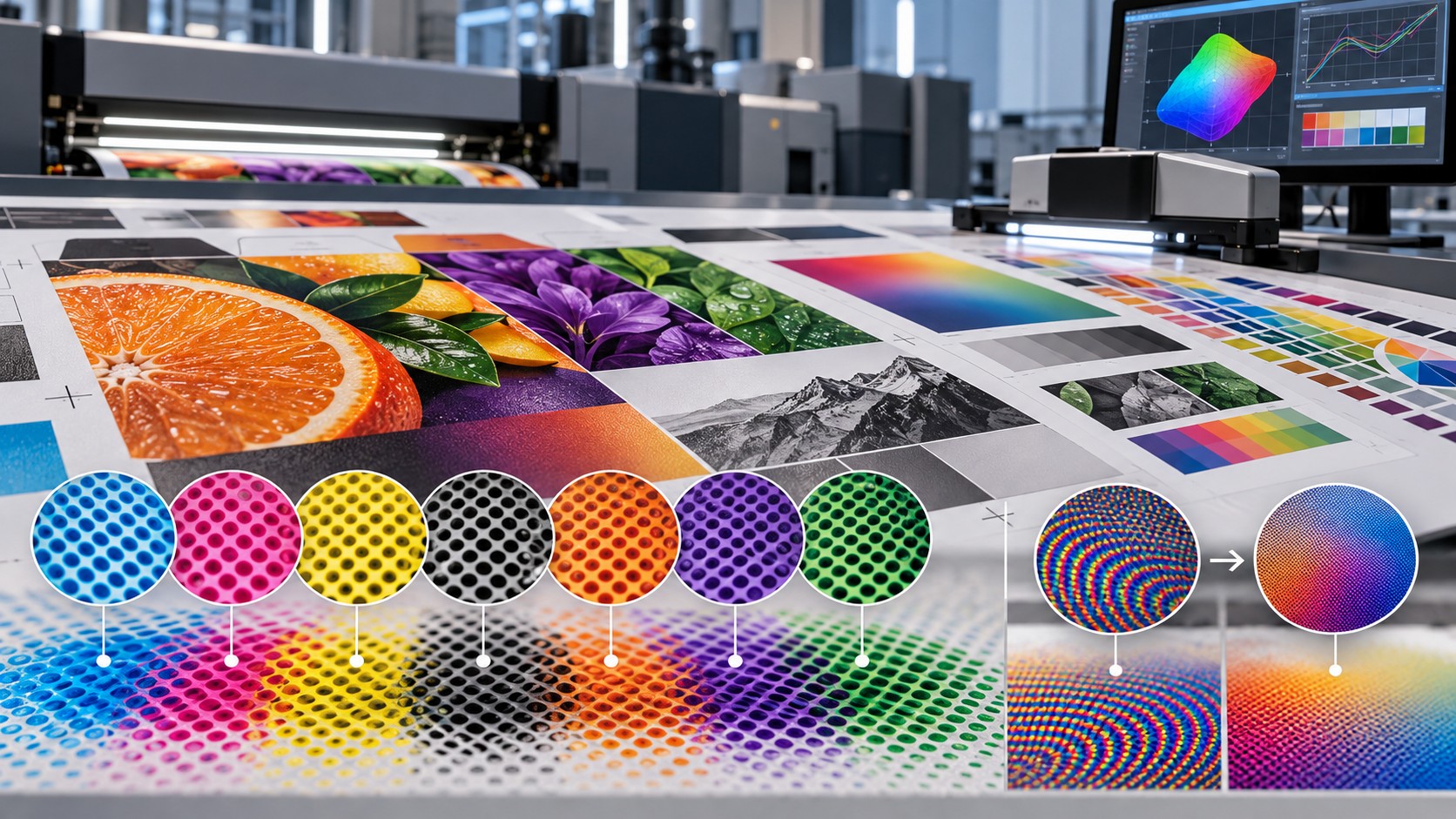
A digital label converter moves a premium design from a four-color process build to an extended set of cyan, Magenta, yellow, black, orange, violet, and green. The expanded gamut improves a vivid orange and gives the brand's deep blue-violet a more promising match. But a previously quiet neutral background now shows a faint repetitive texture. On magnification, the pattern aligns with the overlap of different halftone separations.
The press is not automatically out of color calibration. The problem may be a geometric interference arising from how periodic screens interact. A team focused only on measured Lab values or solid OD can miss it because the structure becomes most visible in overprints and midtones. This is a constructed example to illustrate the distinction between color accuracy and halftone-image integrity.
Expanded gamut is an attractive capability, but its successful implementation requires a complete color-management and imaging strategy. The additional process channels expand the range of possible color recipes. They also increase the number of interacting separations, calibration states, registration relationships, and screen patterns to manage.
What orange, violet and green actually add
Conventional CMYK makes a practical range of print colors by combining four process colorants. Its boundary is imposed by the absorption, reflection, and overprint behavior of those pigments and the chosen substrate. Orange, violet, and green can expand different regions of the output gamut. Orange tends to strengthen parts of the warm-orange and red region; violet can extend blue-violet territory; green can help in selected green and turquoise regions.
The important result is not only an enlarged outer shape. Additional channels offer alternative separation paths inside the previously printable range. Two feasible recipes for a saturated brand color may use different mixtures of process channels, with consequences for ink usage, repeatability, spectral response and halftone interaction. The best recipe is not necessarily the one with the most inks or the lowest single-condition color-difference measurement.
Whether a particular color improves depends on the installed colorants, qualified media, calibration state, profile, total-colorant control and conversion algorithm. A seven-color system is not a guarantee that every named spot is in gamut. The aim is broader, better-governed capability with acceptable production margin.
Screen geometry belongs to color engineering.
In amplitude-modulated (AM) halftoning, dots occupy a regular grid and tone changes primarily through the printed area of the dots. Different process-color screens typically use selected angular relationships to reduce visible interference and produce a controlled composite texture or rosette. These relationships are part of the imaging method; the designer usually does not draw the rosette or specify each dot.
Adding process separations increases the challenge. A finite family of usable AM angles may have to serve more inks, and not all superimpositions are equally benign. Repeated alignments, near-equal angular relationships, and interactions with periodic artwork can generate Moiré—a larger unwanted pattern arising from overlapping periodic structures.
Moiré is not a synonym for color mismatch. An overprint can have acceptable mean Lab values and still be visually objectionable because of its spatial structure. Raising the solid ink strength, modifying the ICC destination profile, or increasing line ruling without further analysis may shift the symptom rather than remove it.
Where a secondary magenta separation can help
In expanded-gamut printing, adding process colors such as Orange, Violet, and Green (OVG) increases halftone-screening complexity. Each color separation must be assigned a suitable screening angle to minimize interference between overlapping dot structures. However, when the number of color separations exceeds the number of sufficiently distinct screening angles available within a conventional halftone configuration, certain colors may be assigned identical or closely spaced angles.
One possible conflict occurs between Magenta and an extended-gamut separation when their screening angles create an unfavorable interaction in overlapping image areas. Depending on the screen ruling, dot geometry, relative screen frequencies, and tonal coverage, this interaction can generate visible Moiré patterns, irregular dot structures, or unwanted texture in otherwise smooth color transitions. The effect may be particularly noticeable in saturated brand colors, secondary-color combinations, and image regions containing substantial contributions from multiple process channels.
To address this limitation, certain Raster Image Processor (RIP) configurations support an auxiliary Magenta separation, sometimes designated Extra Magenta. Rather than introducing another physical ink color, the RIP redistributes selected Magenta image information between two logical separations with different screening angles. The auxiliary separation is used in regions where the original Magenta screening angle would interfere with the screening geometry of an overlapping extended-gamut color.
This approach lets the screening engine adjust the spatial relationship between halftone structures while preserving the intended overall Magenta contribution. However, dividing the Magenta information between two separations requires careful control of tone reproduction and screening behavior. The combined result must maintain consistent tonal coverage without introducing discontinuities, density variations, or unintended changes in overprint appearance.
Distinguish a logical screening separation from a physical printing channel. The designation Extra Magenta does not necessarily indicate an additional ink station, an eighth physical color, or a separate Magenta ink formulation. Its implementation depends on the RIP's capabilities, the screening architecture, and the printing system's configuration. The actual screening angles and separation rules must therefore be documented and qualified for the specific production environment rather than treated as universal settings.
Screening-angle optimization must also be evaluated beyond the individual color combination that originally revealed the problem. A configuration that successfully reduces Moiré in a saturated orange or violet area may affect neutral reproduction, smooth gradients, skin tones, or complex multicolor images. Qualification should include representative neutral patches, saturated overprints, tonal ramps, and actual production graphics to confirm that the modified screening structure maintains both visual uniformity and color accuracy.
The objective is not merely to eliminate Moiré in one problematic image region, but to establish a stable screening configuration that supports consistent tone reproduction, predictable overprint behavior, and reliable image quality throughout the expanded-gamut printing condition.
AM, FM, and hybrid strategies are different choices.
Frequency-modulated (FM) screening builds tonal variation mainly through the population and distribution of many small dots, rather than scaling regularly spaced AM cells. It can avoid some interference patterns associated with periodic grids. That advantage comes with demands on imaging precision, transfer, contamination control, dot retention, and media suitability. Theoretical fine detail is not a production benefit if the smallest elements cannot survive the run.
Hybrid screens combine ordered and nonperiodic behavior across specified parts of the tonal range. Their strengths and failure modes depend on implementation. A screening architecture chosen for a coated smooth labelstock is not automatically appropriate for rough paper or a difficult film, nor does the label 'stochastic' guarantee freedom from all repetitive artifacts.
The right choice is the one demonstrated to preserve tone, detail and color under representative process conditions. When the screening strategy changes, its impact on calibration LUTs and characterization should be evaluated; a profile built for one screen should not silently govern a materially different one.
Fingerprinting a multicolor system
In digital printing, a Media Fingerprint establishes a measurable color reference that represents the printing system's response on a specific substrate under defined operating conditions. Its primary purpose is to capture and preserve the press's color characteristics at a particular point in time, creating a reference that can be used to maintain consistent reproduction throughout subsequent production.
Unlike routine calibration, which adjusts the press toward established color targets, fingerprinting records the actual response of the calibrated printing system. Depending on the implementation, the resulting measurements may be used to generate characterization data, support color-profile creation, and establish a baseline for future color corrections.
Establishing the correct press condition before fingerprinting
The accuracy and long-term value of a Media Fingerprint depend directly on the operating condition of the press when the reference measurements are performed.
Fingerprinting should therefore be carried out only after the press has reached a stable and properly maintained condition. Complete preventive maintenance, verify critical components, and confirm consumables are within their recommended operating limits.
Where practical, components approaching their replacement intervals should be renewed before establishing the reference. Newly installed consumables must be properly conditioned and stabilized before measurement. The objective is to characterize the press under optimal yet representative production conditions rather than capture a temporary response influenced by component wear, unstable ink behavior, or unresolved print-quality defects.
Before the fingerprinting procedure begins, the operator should verify solid optical density, tonal response, print uniformity, ink stability, and the relevant environmental and operating conditions. Any significant deviation should be corrected before the characterization chart is printed.
This preparation is particularly important because an inaccurate initial reference may lead subsequent calibration procedures to reproduce an undesirable color condition rather than the intended production baseline.
Preserving and recovering the original color reference
Once the Media Fingerprint is complete, the measured color response can be stored and associated with the specific substrate, ink configuration, screening parameters, and calibrated press condition.
This stored information serves as a reference for subsequent production runs. As the press operates, gradual changes in consumable performance, environmental conditions, or mechanical behavior may influence its color reproduction.
By periodically measuring the current printing response and comparing it with the stored reference, the color-control system can identify deviations and, where supported, calculate corrective adjustments that bring the press back toward its previously characterized color condition.
An initial ink-installation or commissioning calibration can provide an additional baseline for the installed ink system. When its measurement data are retained, they may support later verification or recovery of the established reference condition, provided that the relevant ink configuration and operating parameters remain compatible.
However, recovering the original color response does not necessarily mean restoring the exact mechanical or electrical settings that existed during fingerprint creation. The objective is to reproduce the established colorimetric behavior within the defined tolerances. Significant changes in substrates, ink formulations, components, or printing performance may require additional qualification or a new characterization.
Fingerprinting in expanded-gamut printing
The distinction between Media Fingerprinting and complete multichannel characterization becomes especially important when additional process colors are introduced.
A conventional four-color characterization describes the measured behavior of Cyan, Magenta, Yellow, and Black under a specific printing condition. It cannot independently describe the full color-reproduction capabilities of a seven-color system incorporating Orange, Violet, and Green (OVG).
These additional channels extend the achievable color gamut but also introduce more complex relationships between individual ink responses, tonal combinations, overprints, and color-separation limits.
Depending on the printing system architecture, Media Fingerprinting may primarily establish the CMYK color reference, while the additional channels are controlled through separate calibration or multicolor characterization procedures.
Complete expanded-gamut characterization requires appropriate multichannel test charts, reliable color measurements, and a color-conversion model that describes the relevant combinations of all active process colors.
The Digital Front End (DFE) must therefore apply a validated separation strategy that considers the installed ink set, the substrate characteristics, and the achievable color gamut rather than treating the additional colors as simple extensions of an existing CMYK profile.
FOGRA55: A reference for expanded-gamut color exchange
FOGRA55 is a seven-color characterization dataset and color-exchange reference developed for Expanded Color Gamut (ECG) workflows using CMYKOGV.
It provides a common colorimetric reference for preparing, exchanging, and proofing multicolor print data across different printing technologies. Its CMYK component and substrate white point are aligned with the FOGRA51 reference condition, while the additional Orange, Green, and Violet channels extend the reference color space.
FOGRA55 does not define the actual gamut of every seven-color printing system and does not replace press-specific calibration or Media Fingerprinting.
It can also serve as a reference for evaluating multicolor contract proofs. Compliance with the relevant FOGRA55 targets is assessed separately through established proofing certification procedures based on ISO 12647-7.
Maintaining color consistency over time
The long-term effectiveness of fingerprinting depends on maintaining the relationship between the stored reference and the actual printing condition.
Routine calibration should compensate for normal variations in printing behavior, while periodic verification should confirm that solid colors, tonal reproduction, overprints, and neutral balance remain within the established tolerances.
If the press can no longer reproduce its reference condition through normal calibration, the underlying cause must be investigated. Repeatedly increasing correction values without addressing mechanical instability, consumable deterioration, or changes in substrate characteristics may conceal the problem rather than resolve it.
When the printing configuration has changed significantly, a new fingerprint may be required to establish a valid reference for the updated condition.
The fundamental purpose of Media Fingerprinting is therefore not simply to measure the press once, but to establish a reliable colorimetric baseline that remains meaningful throughout the production lifecycle. With proper maintenance, stable consumables, controlled measurement conditions, and appropriate multichannel characterization, this reference enables predictable color reproduction across production runs and over extended periods of operation.
A useful test form must challenge the screen, not only the solids
Solid process patches are needed but insufficient. Include screened ramps, fine neutral backgrounds, combinations involving Magenta and orange or violet where applicable, repeated graphic patterns, gradients, small reverse text, and representative photographs. Examine at normal viewing distance and under magnification. Search for unwanted low-frequency waves, unstable tints, graininess, registration errors, and differences between one part of the web and another.
Then measure the selected color patches under defined conditions. Both image-structure approval and colorimetric approval are required; neither substitutes for the other. A low ΔE00 result on a uniform patch says nothing conclusive about how a high-frequency graphic pattern will interact with the RIP's screen structure.
Before release, record the color set, physical ink order when relevant, screen family, angles or supported selection scheme, optional auxiliary separations, calibration state, and DFE strategy. The operator should not have to reverse-engineer these settings when the job is rerun next season.
How to diagnose a suspected Moiré defect
First verify that the objectionable waves are not in the source image or its resampling. Compare the original artwork and the rasterized separations. Then identify which channels participate in the affected region. Review their screen structures, angles, and interaction with the design. Print a controlled set that isolates the suspect color pairs without changing density, curve, or profile.
If a supported auxiliary-magenta or alternative screen scheme is available, qualify it through measured and visual comparisons. If not, adjust the approved separation and screening approach within the system's capabilities. Reassess color characterization if the change alters tone or overprint behavior. Reject any 'solution' that merely makes the pattern harder to see under one lamp while worsening image quality elsewhere.
Engineering conclusion
OVG is not simply an ink expansion. It changes the space of possible color recipes and the geometry of overlapping printed dots. A calibrated seven-color press can make a strong brand match while still showing a defective halftone structure. Conversely, a visually smooth image can remain outside the customer's approved color target.
For LEP production, successful expanded-gamut printing requires stable color channels, qualified screening, traceable DFE separations, and a fingerprint or characterization that reflects that configuration. The best color is not only the closest measured patch. It is a repeatable, structurally clean print that remains acceptable in the finished product.
Sources and technical references
Fogra — Characterization Data. Official characterization datasets, including the FOGRA55 CMYKOGV multicolor exchange space, supporting standardized color exchange and expanded-gamut workflows.
International Color Consortium (ICC) — ICC Profile Specifications. Technical specifications for color profiles, color transformations, device characterization, and multichannel color-management workflows.
Fogra — ProcessStandard Digital (PSD). Guidelines and certification resources for digital printing process control, color consistency, output verification, and image-quality assessment.
LEP Technical Guidance for Special Inks. Document TS4OM-00011 (2023). Technical material supplied for review. Specific ink installation, calibration, separation, and screening mechanisms are implementation-dependent and may vary by system configuration.