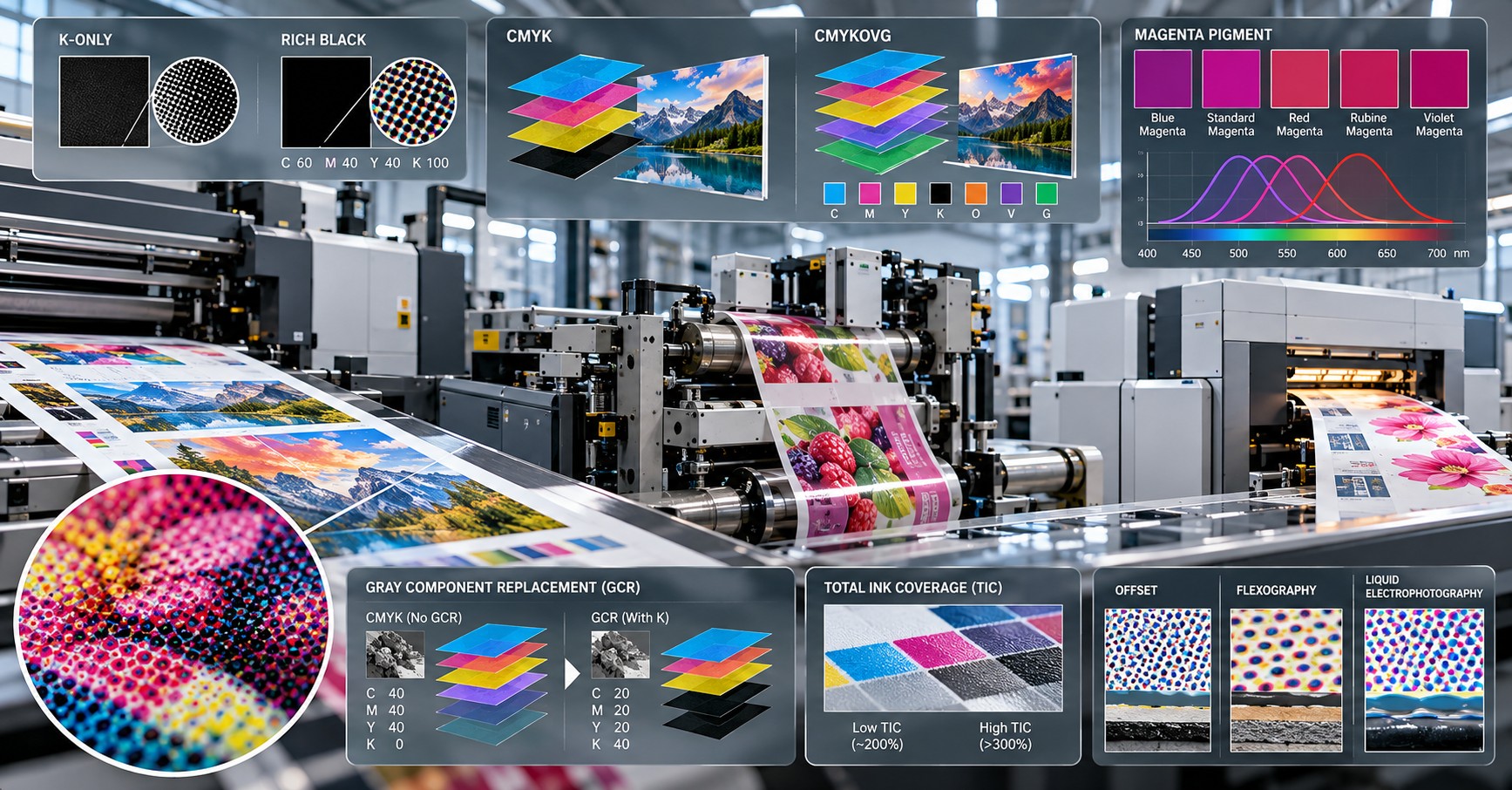
BLACK IS NOT JUST BLACK
How Pigment Chemistry and Color Separations Shape Print Quality in Offset, Flexography, and LEP
By Ronen Dolev
Black Generation, GCR/UCR, CMYKOVG, Magenta Pigments, Total Ink Coverage & Production Troubleshooting
A packaging plant produces a design on an offset press. Brand colors are accurate, the grays are neutral, and the shadows are deep and rich. The same design is then reproduced by flexography and, later, on a digital press using Liquid Electrophotography (LEP). All three presses are calibrated; the samples are measured under controlled conditions; the calculated color differences are within the agreed tolerance. Yet the prints do not look identical.
On one version, a neutral gray carries a slight magenta cast. On another, shadows appear darker but lose fine detail. On a third, a brand color meets the numerical target while a red area looks subtly different from the reference. The first reaction is often to check calibration, optical density, color profiles, and press condition. Those are essential checks, but they do not answer every question.
The three technologies may use different pigments and fundamentally different methods of forming the ink film. Even within one CMYK system, the same measured color can result from different combinations of cyan, magenta, yellow, and black. The chosen combination affects stability, texture, total ink coverage, and sensitivity to production variation.
A reliable color match requires three things to work together: ink chemistry, separation strategy, and the printing process's physical capabilities.
1. One Measured Color, Several Possible Ink Builds
Consider a neutral gray. It can be built from carefully balanced cyan, magenta, and yellow; from predominantly black; or from black with smaller chromatic corrections. Different builds may achieve similar CIE L*a*b* values under defined viewing conditions. They do not necessarily behave alike on press.
A CMY gray depends on keeping three channels in balance. A small shift in magenta can produce a reddish cast; additional cyan can produce a bluish cast. A black-dominant build relies less on that three-way balance, although excessive black in highlights or skin tones can produce visible grain. No single recipe is optimal for every image, substrate, and technology.
2. Why Offset, Flexography, and LEP Begin with Different Ink Chemistry
Offset: a viscous ink transferred through a blanket
Conventional sheetfed offset inks typically disperse pigments in resins, oils, and functional additives. Ink setting may involve penetration of certain components into the substrate followed by oxidative development; UV-offset inks instead rely on radiation-curable chemistry. Viscosity, tack, splitting behavior, water–ink interaction where applicable, and transfer through the inking train affect the applied film. Ink performance therefore depends on more than pigment identity alone.
Flexography: a low-viscosity ink metered by an anilox
Flexography generally uses lower-viscosity formulations, commonly solvent- or water-based for flexible packaging, as well as specialized radiation-curable systems. Ink is metered by the anilox, transferred to the printing plate, and then to the substrate. Anilox volume, viscosity, plate geometry, impression, drying conditions, binder selection, and substrate wetting determine how the color is delivered and stabilized. Two flexographic ink series using the same pigment designation may still print differently.
LEP: charged pigment–polymer particles and an intermediate heated blanket
In Liquid Electrophotography, pigment is incorporated into polymer-containing particles dispersed in an electrically suitable carrier liquid. An electrostatic image is developed on a photoconductive surface; the ink image transfers to a heated intermediate blanket, where the particles consolidate into a polymeric film before transfer to the substrate. This differs from distributing viscous offset ink across a plate and from transferring a fluid flexographic film that dries or cures on the substrate.
LEP formulations must meet requirements associated with pigment dispersion, polymer compatibility, electrical charging, and film transfer. These considerations can lead to pigment selections or pigment combinations that differ from conventional inks. They do not justify claiming that LEP always produces a thinner film, broader gamut, or better color stability: those outcomes are formulation-, press-, substrate-, and mode-dependent.
Property | Offset | Flexography | LEP |
|---|---|---|---|
Typical ink system | Pigment in viscous resin/oil or radiation-curable vehicle | Pigment in solvent-, water-, or radiation-curable binder system | Pigment–polymer particles in carrier liquid |
Main image transfer | Plate → blanket → substrate | Anilox → plate → substrate | Photoconductor → heated blanket → substrate |
Film development | Setting/oxidation or curing, depending on ink | Drying or curing, depending on ink | Particle consolidation and polymer-film transfer |
Key color variables | Tack, ink/water balance if used, transfer, film weight | Anilox volume, viscosity, transfer, drying, substrate | Development/transfer, film formation, calibration and separations |
What not to assume | An offset target will transfer unchanged | An equal tone value gives equal film weight | A digital color value gives identical pigment response |
3. Magenta Is Not Necessarily the Same Pigment Across Technologies
Magenta is one of the four process-color labels, not a unique chemical composition. Different pigment families, crystal forms, blends, particle sizes, and binder systems may create different spectral reflectance curves, hue, strength, transparency, lightfastness, and overprint behavior. Consequently, magenta ink from an offset, flexographic, and LEP process should not be assumed to be spectrally identical.
Publicly documented electrostatic-ink formulations include examples using Pigment Violet 19 (PV19), Pigment Red 122 (PR122), Pigment Red 177 (PR177), Pigment Red 208 (PR208), and pigment combinations. Conventional magenta systems may use Pigment Red 57:1 (PR57:1), while Pigment Red 52 (PR52) has also been examined in flexographic process-ink research. These references demonstrate possible chemical differences; they do not identify the confidential formulation of every commercially supplied ink.
Pigment family | Relevant technical consideration |
|---|---|
PR52 | In certain studied formulations, produces a warmer, more yellow-red magenta response. |
PR57:1 | An established process-magenta pigment; may deliver a cooler hue than PR52 in comparable ink systems. |
PR122 | A quinacridone pigment used in bluish-red and magenta formulations. |
PV19 | A quinacridone pigment with crystal forms and properties that vary by grade. |
PR177 | A red pigment considered in some higher-performance or electrostatic-ink formulations. |
PR208 | Another pigment documented in red/magenta formulation research. |
Pigment choice involves more than matching a solid-patch color. Formulators must consider dispersibility, interaction with binders and carriers, optical transparency, strength, durability, and in LEP, compatibility with the electrostatic and film-forming process. A pigment that performs well in solvent-based flexography cannot automatically be transferred unchanged into a liquid electrophotographic ink.
4. How a Magenta Pigment Change Can Alter the Entire Gamut
The published 2022 industry study often referred to as "The Magenta Conundrum" compared process-magenta formulations based on PR52 and PR57 for flexographic printing. It examined not only the full-tone magenta patch but also its interaction with other process colors and its effect on the reproducible color gamut.
The study reported representative hue angles of approximately 12° for a warmer PR52-based magenta and 357° for a cooler PR57-based magenta. In the L*C*h° color representation, 0° corresponds to the positive red direction, 90° to yellow, 180° to green, and 270° to blue. These angles describe specific printed formulations, not immutable properties of pure pigments.
The investigated pigment change yielded approximately 4% more gamut volume in a modeled comparison and approximately 7% in the reported press trial. Improvements were not uniform: certain blue, violet, green, and magenta regions expanded, while the warmer pigment retained advantages in parts of the red/orange region. The study also considered hue hooking: a change in hue direction as ink strength or concentration changes.
Those percentage values belong to the particular flexographic study. They are not LEP performance figures and cannot be applied to another process without comparable measurements. The transferable lesson is that magenta chemistry can affect the whole color system, not just solid magenta.
A small shift in the pigment response can change red and violet overprints even when full-tone magenta appears acceptably close to the target.
5. GCR and UCR: Two Ways of Controlling the Gray Component
Gray Component Replacement (GCR)
GCR replaces part of the neutral component otherwise built from cyan, magenta, and yellow with a corresponding black contribution. The neutral component exists in many chromatic colors as well as in grays. A dark brown, for example, may contain both a chromatic part that establishes the hue and a neutral component that can be carried by K.
This is not a simple arithmetic operation of subtracting an identical percentage from each of C, M, and Y. A characterized printing condition and color model must determine the revised values if the final color is to remain acceptably close.
Under Color Removal (UCR)
UCR reduces CMY under the black component mainly in dark neutral regions. Compared with GCR's broader reach, UCR is usually associated with shadows and near-neutral darks. In appropriate workflows, it can help control total coverage and the behavior of dark areas.
Feature | GCR | UCR |
|---|---|---|
Application | Neutral component in a wider range of colors and tonal levels | Predominantly dark and neutral areas |
Primary purpose | Control neutrality and CMY dependence through K | Reduce CMY in shadow builds and replace part with K |
Possible advantage | Better neutrality stability or lower CMY requirement | Lower dark-area coverage in suitable processes |
Possible downside | Visible black grain or changed gradation if excessive | Altered shadows if the replacement is not well characterized |
The concepts are general color-separation strategies. A specific color-management system may offer "black generation" as a preset, as part of a profile, or as a conversion policy without exposing independent GCR and UCR controls. The setting must not be assumed to exist just because the underlying color theory is relevant.
6. Minimal Black Versus Maximal Black
Minimal Black
A minimal-black strategy uses relatively little K, often concentrating it in deeper tones while relying on CMY for more of the image. It can reduce isolated dark dots in light subjects and skin tones, where small amounts of K may appear as peppering. The trade-off is increased dependence on the relative stability of the three chromatic channels. If magenta strengthens, a previously neutral gray may become warm or reddish.
Maximal Black
A maximal-black strategy uses as much K as the chosen color conversion permits in place of part of the neutral CMY component. It can reduce sensitivity to CMY imbalance and, in some cases, reduce total area coverage. In highlights, smooth gradients, or skin tones, however, prominent black dots may damage perceived texture even when colorimetric error remains low.
Neither setting is intrinsically superior. Image content, substrate, screen structure, transfer behavior, and profile design determine the appropriate balance. Moreover, in some color-management workflows these settings control spot-color conversion specifically; CMYK process objects may follow a different conversion route. Before changing a black-generation policy, determine which objects and separations it actually affects.
7. K-Only, Rich Black, and Neutral Gray Are Different Production Problems
K-Only for small text and fine rules
Small text, fine lines, and high-precision details are generally easier to control when built with the K separation alone. In offset and flexography, adding CMY raises the risk of colored edges if registration varies. Digital registration may be highly accurate, but extra channels can still introduce unnecessary texture, coverage, or conversion complexity. K-only is not necessarily the darkest black available.
Rich Black for large, deep-black areas
Rich black combines K with one or more chromatic channels to increase perceived depth or adjust neutrality. There is no universal rich-black recipe. A combination suitable for coated-paper offset may behave differently in flexible-packaging flexography or LEP. Film formation, registration, ink limits, substrates, and finishing must all be considered.
Black Point Compensation (BPC)
When a job characterized for one printing condition is reproduced by a press with a different black range, shadow detail can be clipped. Black Point Compensation adjusts mapping between source and destination black ranges to preserve tonal relationships where possible. It does not create a darker pigment or extend a press's physical black capability. Its availability and behavior depend on the profile and conversion pipeline.
8. Total Area Coverage (TAC): What the Number Does—and Does Not—Mean
Total Area Coverage, also called Total Ink Coverage, is the sum of nominal channel coverage percentages at a location. For example, C 60% + M 50% + Y 50% + K 100% yields a TAC of 260%. That does not mean 260% of the physical surface is covered; it is the sum of channel values, not a direct measurement of combined dry-film thickness or mass.
In offset, excessive coverage can contribute to setting, drying, set-off, dimensional stability, transfer, and finishing problems. In flexography, the physical consequences also depend on anilox volume, ink viscosity, solids, drying, and substrate. In LEP, nominal separations must be distinguished from the polymeric ink film that consolidates and transfers through the process. A TAC limit from one process must not be copied to another without characterization.
For this reason, the article does not recommend a universal percentage limit. The approved output profile and qualified printing condition should define the practical boundary for the press, ink set, and substrate.
9. From CMYK to CMYKOVG: More Available Inks, More Separation Decisions
A seven-color CMYKOVG system adds orange, violet, and green to the four conventional process channels. This can extend the achievable gamut, especially in saturated color regions where CMYK alone cannot reach the target. But having seven inks available does not mean all artwork is converted through all seven channels.
Three common spot-color conversion policies
- Generate All Channels: permit the conversion to use the supported expanded-gamut channels.
- Generate Only CMYK: restrict the spot-color recipe to the CMYK portion of the output profile.
- Generate Preferably CMYK: use CMYK if the result meets a defined color-difference tolerance; otherwise allow the additional channels.
In one documented implementation, CMYK process objects are converted to the destination CMYK channels, while spot-color objects may be handled using the extra channels. This is a workflow-specific behavior, not a universal law of expanded-gamut printing. The prepress team must distinguish the physical ink set from the color strategy selected for the job.
A brand color can therefore be reproduced by a dedicated premixed conventional spot ink, a CMYK recipe, or an expanded-gamut recipe with OVG. Similar measured results can conceal markedly different ink builds and different sensitivities to screening, registration, dot variation, and pigment response.
10. Why the Lowest ΔE Is Not Always the Best Production Recipe
A documented color-separation example compares three recipes for a single brand-color target. The numerically closest expanded-gamut result includes 3% K. A slightly less accurate version removes that sparse black component and converts an almost-solid magenta layer to a full solid. The printed appearance can become more uniform even though the measured color difference increases.
Conversion approach | Illustrative separation build | Reported color difference |
|---|---|---|
CMYK-only | 89% M + 81% Y; no K | ΔE = 10.6 |
Lowest measured error with expanded gamut | 98% M + 84% Orange + 3% K | ΔE = 2.3 |
More printable expanded-gamut build | 100% M + 96% Orange; no K | ΔE = 3.1 |
A few isolated black halftone dots can be visible as peppering in an otherwise smooth spot color. An almost-solid 98% layer may also preserve tiny unprinted holes. Eliminating a very low K percentage and making the dominant magenta separation solid can improve the visual texture in the documented scenario.
This example does not mean a larger ΔE is always preferable. It illustrates the need to evaluate a printable build against both agreed color tolerance and visible texture. Its suitability depends on the printing condition and the acceptance criteria.
The best production color recipe is not necessarily the mathematical minimum ΔE. It must also be repeatable, visually smooth, and suited to the press.
11. Printing Black Without a Black Separation
Some digital printing workflows offer a CMY-only mode that replaces K with combinations of cyan, magenta, and yellow. On supported press architectures, eliminating the black separation may reduce printing cycles and increase throughput. Such benefits are system- and mode-specific and must not be generalized to all LEP configurations.
There are color limits. Three chromatic inks cannot always produce the same deep black as dedicated K, and a dark neutral made from CMY depends heavily on their balance. One technical workflow also documents different historical CMY substitution ratios across software generations, underscoring why a saved job must retain its defined color strategy.
The decision should be based on actual content: bright photographic work may tolerate CMY-only reproduction better than packaging that demands deep blacks, finely controlled dark details, and tightly neutral near-blacks. Testing must evaluate the printed result, not merely the ability to create numerically dark Lab values.
12. Is the Difference Caused by Pigment Chemistry, Separations, or the Press?
Test 1 — Full-tone magenta
Print a 100% magenta solid under qualified conditions on a suitable comparison substrate. Measure spectral reflectance, CIE L*a*b*, and L*C*h°. A persistent difference in the spectral curve can indicate a difference in pigment system or ink-film optics. Spectrophotometry alone does not identify a pigment's Color Index number; supplier evidence or chemical analysis is needed.
Test 2 — A tint scale
Measure, for example, 25%, 50%, and 75% magenta. If the hue difference changes across tone values, investigate dot reproduction, film effects, and tone response in addition to pigment chemistry. A full-tone match does not guarantee a tint-scale match.
Test 3 — Overprints
Compare magenta overprints with cyan and yellow. Pigments that look similar as solids may interact differently in red, violet, and blue builds. Include actual printed combinations, not just predicted Lab coordinates.
Test 4 — Two builds for the same target
If solids are stable but a compound color differs, examine the separation channels and their percentages. The issue may be the color strategy rather than the magenta pigment.
Test 5 — Time and repeatability
Determine whether the difference is present from the first approved sheet or develops during the run. A stable difference between two technologies may reflect ink composition, film optics, or a characterized profile. Drift within one press is more consistent with a process-control problem. Avoid changing the ICC profile before establishing press stability.
13. Practical Troubleshooting Cases
Case A — A neutral gray becomes reddish during production
First establish which of C, M, and Y drifted, using process-control patches and tone measurements. Recover the qualified printing condition before experimenting with GCR. Then assess whether a more black-dominant neutral build would provide better tolerance to the expected variation.
Case B — Skin tones appear peppered.
Inspect the separations and magnified print for sparse K dots. Compare a suitably qualified lower-black or stabilized recipe. Evaluate visible smoothness and ΔE together; removing K can reduce grain but may reduce numerical accuracy.
Case C — Deep blacks lose shadow detail
Compare the source and destination black ranges, the tone reproduction curve, and the actual shadow patches. Where appropriate, investigate black-point mapping rather than reflexively increasing K or density.
Case D — A red brand color matches in offset but differs in flexography
Verify matching targets and measurement conditions. Compare full-tone magenta, full-tone yellow, and their overprints. A pigment or film-response difference may explain the result; a separation difference may also be responsible. Identify which before changing the ink.
Case E — LEP magenta looks cooler than conventional magenta.
Don't start by increasing optical density. Check full-tone hue, chroma, spectral reflectance, and tint-scale behavior. If the difference is consistent, assess ink chemistry and characterize the achievable match. Profile changes can compensate for some appearance differences but cannot necessarily create the exact reflectance curve of a different pigment.
Case F — CMYKOVG delivers lower ΔE but a rougher brand-color patch
Check for low-percentage dark channels, near-solid channels with residual holes, and undesirable screen overlaps. Evaluate stabilized color builds or a controlled reduction in participating channels through the approved workflow. Retain both colorimetric and visual acceptance criteria.
Observed defect | Possible origin | First test | Action direction |
|---|---|---|---|
Reddish gray | CMY imbalance | Trend each process channel | Stabilize the process before changing the recipe |
Peppering in skin tones | Sparse black dots | Magnified print + channel build | Assess black-generation / stabilization policy |
Shallow black | Gamut or CMY-only limit | Black solid + shadow scale | Evaluate dedicated K and suitable conversion |
Blocked shadows | Black-point or tonal mapping | Shadow step wedge | Review black-point compensation and tone calibration |
Different magenta hue | Pigment, ink film, calibration | Full-tone spectral reflectance | Identify formulation vs process source |
Red/violet overprint mismatch | Pigment interaction/separation | Secondary-color patches | Compare overprints and channel recipe |
Good ΔE but grainy brand patch | Low-percentage extra channels | Separation values + microscope | Stabilize print build with approved rules |
Change after profile switch | Different conversion policy | Color-strategy comparison | Restore qualified setup and validate change |
Variation after substrate swap | Different optical and tonal response | Compare substrate white + print tests | Recharacterize the printing condition |
14. A Practical Procedure for Selecting a Color-Separation Strategy
Establish the production objective.
Define whether the job is dominated by skin tones, fine details, large brand-color solids, neutral grays, or deep blacks. Record the substrate, finishing route, reference condition, and any requirement to match offset, flexography, and LEP outputs.
Stabilize the press first.
Confirm substrate definition, primary-color calibration, tone response, and repeatability before modifying a profile or separation. A fluctuating press cannot provide reliable evidence about a new recipe.
Characterize the achievable color.
Measure process primaries, secondary overprints, grays, and shadows under one agreed measurement condition. When matching another technology, explicitly define the source profile and target tolerance.
Select a black strategy deliberately.
Decide where K-only must be preserved, where rich black is useful, and whether the job would benefit from a lower- or higher-black separation. Keep this as a documented color-strategy decision, not an undocumented operator correction.
Inspect actual channels
For sensitive areas, review the output separations rather than relying only on a composite preview. In CMYKOVG, pay particular attention to sparse dark channels, almost-solid channels, OVG combinations, and potentially problematic screening interactions.
Run an A/B production test.
Produce equivalent control samples from two qualified strategies. Assess ΔE00, tonal behavior, grain, shadow retention, and consistency over time. Repeat a sample after a defined interval when the job requires repeatability evidence.
Approve, version, and retain
Lock the approved profile, color strategy, relevant output channels, print mode, substrate, and acceptance limits. Reassess the workflow when pigments, ink series, substrate, or printing mode change. The goal is not merely one successful proof but a reproducible commercial process.
15. The Engineering Insight: The Color Measurement Is the Result, Not the Recipe
A CIE L*a*b* measurement reports color under specified observation conditions. It does not identify the pigments, describe how a polymeric or liquid ink film was formed, or reveal how much of the color was created through K rather than CMY. It does not fully describe grain, rosette texture, gloss, or stability through a production run.
Two recipes may match spectrally or colorimetrically in one condition yet differ in repeatability. A CMY-neutral gray may be highly sensitive to a small magenta shift; a black-dominant gray may be more stable but more granular. Two magenta inks may match closely as solids yet diverge in secondary overprints because their spectral responses and formulations differ. An expanded-gamut recipe may reduce ΔE while introducing tiny dark dots that impair visual smoothness.
Professional color management therefore links chemistry, conversion strategy, and printability. If one is unsuitable, increasingly precise color numbers alone will not solve the problem.
The color we see is the result. Pigment chemistry and the chosen separation determine how we reach it—and whether we can reach it again tomorrow.
Terminology and Abbreviations
Term | Definition |
|---|---|
LEP | Liquid Electrophotography — liquid electrostatic printing with an intermediate heated-blanket ink-film transfer. |
CMYK | Cyan, Magenta, Yellow, Black — four process-color channels. |
CMYKOVG | CMYK plus Orange, Violet, and Green — seven-color expanded-gamut process. |
GCR | Gray Component Replacement — replacing a neutral CMY component with black. |
UCR | Under Color Removal — reducing CMY in dark neutral regions and replacing parts with black. |
K-Only | Color build using only the black process separation. |
Rich Black | Black built with K plus one or more chromatic process separations. |
TAC | Total Area Coverage — sum of nominal channel coverage percentages. |
ΔE00 | CIEDE2000 color-difference formula. |
Hue angle | Angular position of hue in a color space such as CIE L*C*h°. |
Chroma | Magnitude of chromatic colorfulness in CIE L*C*h°. |
Gamut | Set of colors a defined printing condition can reproduce. |
OD | Optical Density. |
TVI | Tone Value Increase — difference between nominal and printed tonal response. |
ICC profile | Characterization used in color conversion under defined printing conditions. |
BPC | Black Point Compensation — mapping between source and destination black ranges. |
Overprint | Optical result of overlapping ink separations. |
RIP | Raster Image Processor — converts graphic information into printing data. |
PR / PV | Pigment Red / Pigment Violet — Color Index pigment-family identifiers. |
Professional References and Source Notes
- "The Magenta Conundrum" (2022), published flexographic industry research on PR52-versus-PR57 hue behavior and gamut volume. Its reported percentage changes are specific to the tested conditions.
- European patent publication EP3152265A1, "Electrostatic Ink Compositions" (2017), public technical examples of pigment systems for liquid electrostatic inks; patents do not certify commercial formulas.
- Digital color-management user guide (2018 edition), sections on CMYK conversion, black generation, pure colors, spot-color conversion, and multichannel separations; principles paraphrased, not reproduced.
- Labels-and-packaging color-management user guide (2015 edition), sections on expanded-gamut strategies, stabilizing color builds, CMY-only modes, and spot-color refinement; data examples paraphrased.
- ISO 12647 series, process control for production of printed color separations, proofs and prints.
- ISO 13655, spectral measurement and colorimetric computation for graphic arts images.
- ISO 20654, measurement and calculation of spot-color tone value.
Engineering qualification: These principles and numerical examples describe particular published investigations and documented conversion strategies. They are not universal press settings, supplier approvals, or claims about proprietary commercial pigment formulations. Critical parameters must be validated against current process and material documentation.