When the Print Is Perfect, but the Package Starts to Separate
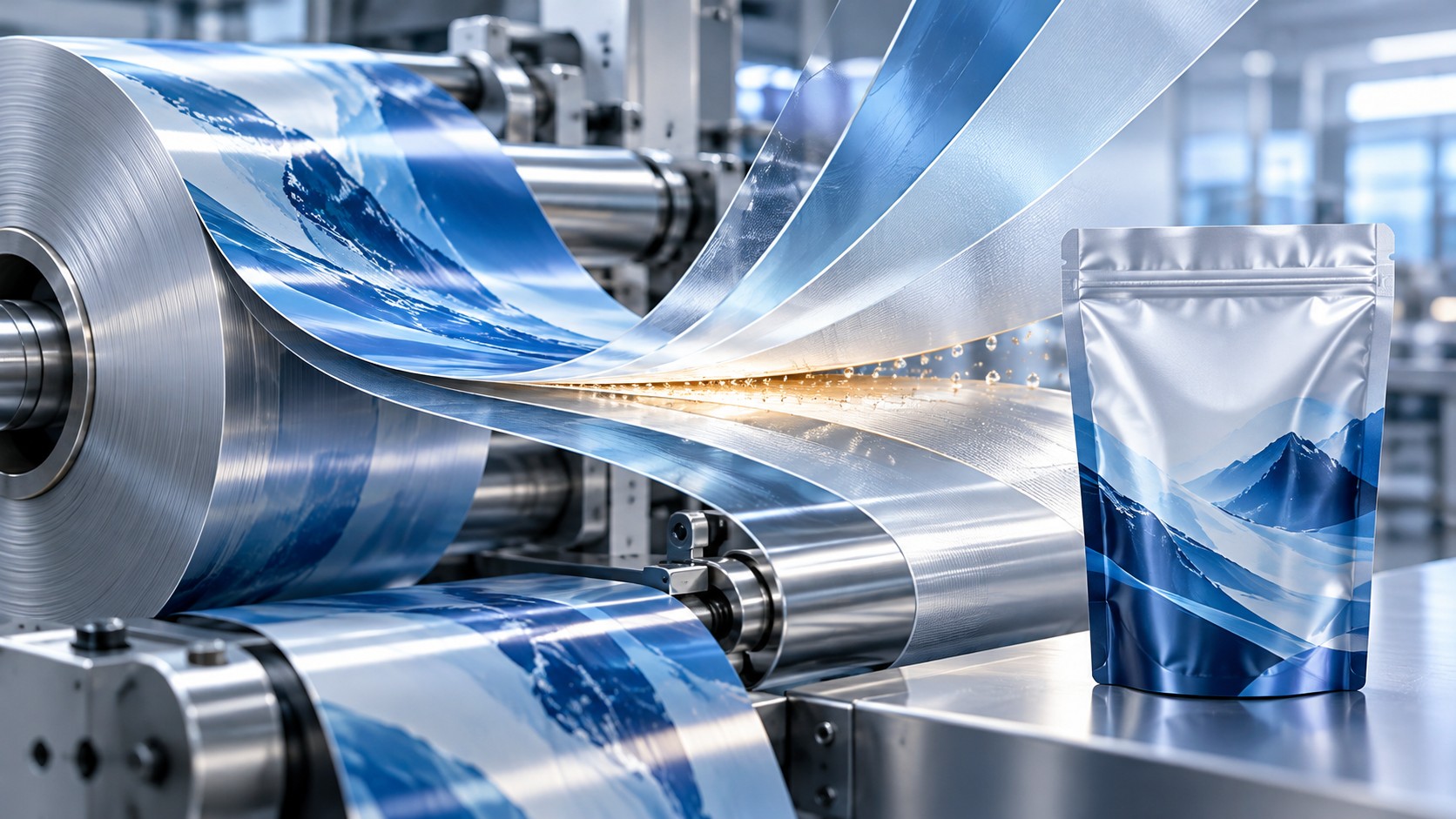
A printed roll leaves a digital printing press. The colors are accurate, ink adhesion to the substrate has been tested and found acceptable, the image is uniform, and the material passes the quality checks defined for the printing stage. The roll moves to a laminating machine, where a printed PET film is bonded to a PE film using a polyurethane adhesive.
After lamination, the product looks excellent. No visible bubbles or wrinkles appear, and the films look firmly bonded. An initial bond test shows that a bond is developing, and the roll proceeds to the specified curing period.
Several days later, the laminate is tested for Lamination Bond Strength (LBS). Some areas meet the required value, while areas with high ink coverage exhibit lower results. After slitting, folding, and pouch conversion, localized separation begins to appear—particularly around the gussets and near the heat seals.
The first conclusion on the production floor is that the adhesive is unsuitable. Perhaps more adhesive is needed. Perhaps the mixing ratio is wrong, the cure time is too short, or a different adhesive chemistry is needed.
Closer examination, however, reveals a more complicated picture. On some samples, the ink remains attached to the outer film. On others, part of the ink transfers with the adhesive to the inner film. Elsewhere, the ink layer itself appears to split.
The same external symptom—delamination—may therefore represent several different failure mechanisms.
This is one of the central challenges in flexible packaging lamination: the adhesive is only one part of the bond. Performance depends on the entire construction, including the substrate, surface treatment, primer, ink, adhesive, second film, and processing conditions.
The useful technical question is not simply whether an adhesive is strong enough. It is where the bond forms, how it develops over time, and what happens when the package is folded, sealed, stored, distributed, and used.
Why Flexible Packaging Needs Lamination
Modern flexible packaging must perform several functions simultaneously. It must protect the product, carry attractive graphics, withstand mechanical stresses, support reliable filling and sealing, and sometimes provide a controlled barrier to oxygen, water vapor, light, oils, or volatile compounds.
A single polymer film rarely delivers every required property.
PET, for example, can provide dimensional stability, useful stiffness, printability, and thermal resistance in many applications. On its own, however, it does not necessarily provide the heat-seal behavior required on the packaging line.
PE may offer flexibility and useful sealing performance, but its mechanical, optical, and barrier properties differ from those of PET. Other options include BOPP, CPP, oriented polyamide (OPA), aluminum foil, metalized films, and films carrying functional barrier coatings.
Lamination combines materials with different functions so each contributes to the finished structure. In a basic PET / INK / ADH / PE structure, PET is the outer layer, the ink provides the graphics, the adhesive bonds the plies, and PE commonly serves as the inner sealant and product-contact layer.
More complex structures may include aluminum foil, EVOH, inorganic barrier coatings, or purpose-designed barrier films. Their selection depends on shelf-life targets, the packed product, filling technology, storage conditions, and relevant regulations.
Yet package performance is not simply the sum of the properties listed on each film's technical data sheet. An unsuitable adhesive, a weak interface, or local stress at a fold or seal can cause the entire structure to fail even when each material meets its own specification.
Successful lamination means that different layers continue to behave as one functional construction throughout the intended life of the package.
The Ink Layer Is Part of the Lamination System
In reverse printing, the ink is generally located between the outer film and the lamination adhesive. This position protects the image from external rubbing and handling. At the same time, it places the printed layer directly within the mechanical bond path.
When the adhesive is coated onto the printed web, it may not encounter the original PET film or even the primer below the ink. It encounters the outermost printed ink surface.
Adhesive qualification must therefore address more than compatibility with PET and PE. It must include compatibility with the actual ink surface separating the two films.
This is especially important in liquid electrophotographic printing, or Liquid Electrophotography (LEP). In this technology, electrically charged ink particles containing colorants and polymeric resin are dispersed in a liquid carrier. The printing process produces a polymer-based ink film with thermoplastic characteristics.
That structure differs from conventional ink systems that rely primarily on carrier evaporation, and from radiation-curable inks that form a chemically crosslinked network during UV curing. The ink resin influences mechanical and thermal behavior, surface chemistry, and interaction with lamination adhesives.
Depending on the formulation and printing conditions, components associated with the ink film or its processing history may affect adhesive wetting and the bond that subsequently develops.
A 2019 study published in the Journal of the Imaging Society of Japan examined how dispersing components in a liquid electrographic ink affected image adhesion to PET and interactions with isocyanate-containing lamination-adhesive components. It illustrates why ink chemistry can influence peel behavior even when the overall process is described simply as bonding two films.
The conclusion is not that every LEP ink behaves in the same way. It is that the ink's chemical and mechanical properties must be included in the lamination qualification.
Primer, Ink, and Adhesive: Several Interfaces, Not One
Many printed structures contain a primer between the substrate and ink. The primer helps establish wetting and adhesion conditions appropriate for the printing process. However, a primer that enables acceptable print adhesion does not automatically guarantee the bond strength required after lamination.
When the adhesive transfers mechanical load into the ink film, that load can continue through the ink into the primer and then the substrate. Failure will tend to occur wherever the complete system has insufficient resistance under the test conditions.
The adhesive-to-ink bond may be strong while the ink-to-primer interface is weak. In another structure, the ink may remain strongly attached to the primer, but its own cohesive strength may be inadequate for the peel load.
This distinction separates adhesive failure, a separation along an interface, from cohesive failure, a fracture within a material. Failure can also be mixed, with more than one plane appearing across the same sample.
If the printed ink stays on the original film during a peel test, separation may have occurred between the adhesive and ink. If ink transfers to the second film, examine the interfaces beneath it as well as the possibility of internal ink splitting. Visual inspection is not always sufficient to identify the exact failure plane; microscopy or analytical tests may be justified in complex cases.
This is why a laminate bond report should contain more than a force value. It should record what separated from what, and how consistently the failure mode appeared.
Heavy Ink Coverage and the Special Role of White Ink
In reverse printing on transparent film, a white ink layer often forms an opaque background for the graphics. Depending on the print sequence, it may be the last ink applied and the surface the lamination adhesive contacts.
High white coverage, multiple white layers, or combinations of dense process colors with white create a more substantial and complex printed polymer structure. These conditions can affect surface uniformity, ink-film thickness, adhesive wetting, and behavior during folding and heating.
This does not mean that white ink inevitably causes poor lamination. It means that heavy-white designs deserve representative testing rather than being treated as equivalent to an unprinted film or low-coverage color patch.
In development trials, I prefer to compare an unprinted area, a low-coverage printed area, a high-coverage area, and a representative white-ink area. Where possible, include overlapping colors and the heaviest realistic image build. Keep the other production variables controlled.
If differences appear, the experiment can indicate whether coverage, ink-film structure, adhesive interaction, or another process variable requires closer investigation.
Changing white-ink strategy or ink sequence is not merely a graphic-design decision. It can change the surface that the adhesive contacts and, consequently, the lamination behavior.
Lamination Technologies: The Difference Goes Beyond Adhesive Cost
Flexible packaging uses several major lamination routes. Each has a different bonding mechanism, equipment configuration, and process-control requirement. No single route is automatically appropriate for every ink system or packaging application.
Technology | Bonding principle | Main process controls |
|---|---|---|
Solventless lamination | Reactive adhesive, often two-component polyurethane, applied without a significant carrier solvent. | Mix ratio, temperature, viscosity, coat weight, nip conditions, cure time |
Solvent-based lamination | Adhesive applied from solvent solution; carrier evaporates, with chemical curing where specified. | Dry coat weight, drying efficiency, residual solvent, viscosity, cure |
Water-based lamination | Adhesive applied in an aqueous carrier, then dried and consolidated | Wetting, water removal, web temperature, coat weight |
Thermal lamination | Purpose-designed thermoplastic tie layer activated by heat and pressure | Compatible film, nip temperature, pressure, speed |
Extrusion lamination | Molten polymer used as a bonding layer between materials | Melt temperature, surface treatment, polymer thickness, nip and cooling |
Selection must be based on package performance, ink and film chemistry, available machinery, operating speed, food-contact requirements where applicable, and the final converting route.
Solventless Lamination
Solventless systems are widely used in contemporary flexible packaging. Many are two-component polyurethane adhesives in which isocyanate-functional species react with suitable hydroxyl-functional or other reactive components, depending on the formulation.
The components are mixed at a specified ratio, the adhesive is applied to one web, and the second film is brought into contact through the laminating nip. Because these systems have no significant solvent carrier to evaporate, they generally do not require a drying oven between coating and lamination.
No drying oven, however, does mean no curing time. The adhesive continues to react, and the joint's mechanical properties develop during curing. Early bond strength can differ substantially from the final value.
Key controls include mixing ratio, component temperature, viscosity, applied adhesive weight, nip conditions, and curing time. An incorrect ratio can change the chemical balance and ultimate properties. Inadequate mixing can create areas of nonuniform composition. Temperature changes both viscosity and reaction rate.
A related term is pot life: the period after mixing during which the adhesive remains suitable for its intended application. Pot life and the time required to reach the specified final bond are different concepts.
For LEP printing, the adhesive must be qualified against the ink and the films, including the stresses that develop as the bond cures.
Solvent-Based Lamination
Solvent-based systems apply an adhesive containing a carrier solvent. The coated web passes through drying zones so that the solvent can be removed before it meets the second web. Some systems then undergo additional chemical curing after lamination.
These technologies offer a broad range of formulations and performance options, including demanding mechanical and chemical applications. Their process window, however, depends heavily on drying efficiency and residual solvent control.
Insufficient drying can leave residual solvent in the construction. Depending on the chemistry, this may affect adhesive behavior, ink-film properties, bond development, odor, and regulatory suitability.
With a thermoplastic polymeric ink layer, compatibility between the carrier solvent, the dried ink resin, and the exposed ink surface deserves particular attention. The objective is not to assume all solvents are harmful, but to establish which chemistry and drying conditions perform reliably on the actual print.
Water-Based Lamination
In water-based systems, water is the principal adhesive carrier. After application, water must be removed, and the adhesive layer must develop the structure needed for reliable bonding. Some formulations also use additional crosslinking chemistry.
Performance is influenced by the substrate and ink surface, wetting, applied weight, water-removal capacity, web temperature, and the speed of the laminator.
When joining low-permeability materials, complete and controlled water removal before the structure closes may be particularly important. Residual moisture can affect the bond or finished construction, depending on the adhesive formulation.
The fact that the carrier is water does not, by itself, establish regulatory suitability or superior sustainability. Raw materials, additives, processing, and the finished package still require evaluation.
Thermal Lamination
Thermal lamination employs a purpose-designed tie layer activated by heat and pressure. Compatible thermoplastic film systems can bond to a printed polymeric ink surface through controlled nip conditions.
A potential advantage is an immediately useful bond without waiting for the prolonged reaction of a two-component chemical adhesive. This benefit applies only to compatible, validated film-and-ink combinations—not to every film sold as a thermal laminate.
Nip temperature, contact pressure, dwell time, and speed must remain within a qualified operating window. Excessive heat or pressure can alter the thermoplastic printed layer or the substrate's dimensional stability.
Extrusion Lamination
Extrusion lamination uses molten polymer as a layer between substrates. The method can be effective for suitable constructions but presents its own thermal and mechanical demands.
Where the structure includes thermoplastic ink, the process must evaluate the effect of molten-polymer temperature and the interaction between that polymer and the printed surface. A laminate validated with an adhesive system cannot be assumed to perform identically when converted to extrusion lamination.
These bonding mechanisms differ and must be qualified accordingly.
Corona Treatment: Improve Wetting Without Confusing It with Adhesion
Flexible packaging uses polymer films extensively, many of which have relatively low surface energy. On such surfaces, a primer or adhesive may struggle to wet the material consistently.
Corona treatment can modify a polymer's outermost surface chemistry and typically increase its surface energy, improving wetting. This is especially relevant to PE, PP, and some BOPP film grades, though the need for treatment depends on the precise material and its treatment history.
The critical question is which surface is actually being treated. If adhesive is applied directly to a PE or BOPP film, treatment is directed at the film. If adhesive is applied over printed ink, the relevant interface is the ink surface. An additional corona treatment before lamination may improve wetting in some systems, but it must be qualified for the ink, primer, and adhesive involved.
Excessive treatment can modify or damage an existing ink or coating layer. Treatment on metalized materials or films with functional coatings likewise requires appropriate evaluation. It is entirely possible to introduce a new failure while attempting to eliminate the original one.
Surface treatment also ages. A dyne result measured immediately after film manufacture may not represent the condition after weeks or months of storage. Roll side, contamination, additives, storage, and time all matter.
A dyne test can provide useful information about a liquid's wetting behavior, but it does not measure cured adhesive bond strength or prove that the complete laminate will survive its intended use.
The aim is not the highest possible dyne reading. The aim is a qualified surface-condition window for the actual material system. Wetting supports bond formation; it does not prove the bond has formed.
Adhesive Coat Weight: More Material Does Not Always Mean a Stronger Bond
When bond strength is low, a common first response is to increase adhesive. This can be justified if coverage is incomplete or if the applied layer is too thin to create sufficient contact. But more adhesive is not a universal remedy.
Excessive adhesive can impair coating uniformity, complicate drying or curing, alter the laminate's mechanical behavior, and contribute to defects under certain process conditions.
Distinguish wet coat weight from dry adhesive weight. In solvent-based and water-based systems, much of the material initially applied is a carrier that must subsequently leave the web. A nearly 100%-solids solventless adhesive behaves differently: most of what is applied remains in the laminate as it reacts.
Two adhesives cannot be compared meaningfully by grams per square meter unless solids content and the resulting dry bonding layer are understood.
Likewise, the nominal volume of a gravure roller does not, by itself, guarantee the amount of adhesive transferred to the substrate. Viscosity, temperature, speed, wetting, and transfer conditions may all change the actual laydown.
The reliable approach is to measure and document the applied adhesive weight and compare it with a validated window for that formulation and laminate structure.
Viscosity, Mixing Ratio, and Temperature Must Be Controlled Together
Adhesive viscosity affects transfer uniformity, wetting, and bond-layer formation. Viscosity that is too high may obstruct transfer or leveling; viscosity that is too low may change coating weight or promote undesirable flow.
Temperature has a particularly strong effect in many solventless systems. Controlled heating of the components can be part of normal operation, but it must follow the adhesive manufacturer's specification. A temperature increase may improve flow but also accelerate the reaction and shorten usable working time.
In a two-component system, the mixing ratio is a chemical control, not merely a viscosity adjustment. Deviation changes the proportions of reactive groups and may affect final cure and performance.
Metering and mixing equipment must therefore be verified, component temperatures controlled, and mixing quality documented. When a bond problem appears, I first want to know whether the adhesive was mixed and delivered under controlled conditions before deciding that the formulation itself is unsuitable.
The Nip and Web Tension: Where Adhesive Becomes a Construction
The laminating nip is where the webs come together. Pressure, temperature, contact conditions, and web presentation help the adhesive establish effective contact between the two surfaces.
Too little pressure may leave poorly contacted areas or trapped air. Excessive pressure can distort sensitive films, disturb the surface, or create unwanted marks. In certain systems, nip temperature improves adhesive flow and wetting; in thermal lamination, it may also activate the tie layer.
When the print contains thermoplastic ink, temperature and pressure must not create an unacceptable change in the printed layer.
But nip conditions are only part of the mechanical system. Each film responds differently to tension. PET and PE may elongate by different amounts even under comparable web loads. If they are joined in different states of extension, they may try to recover differently after lamination.
The result can be curl or tunneling—long, localized channels of separation between the plies. Rewind tension, taper tension as roll diameter increases, and storage conditions can also contribute.
Lamination is consequently both a chemical and a mechanical operation: two distinct materials must continue moving and deforming together after they leave the machine.
Cure Time: Why Moving Too Quickly to the Next Process Can Be Costly
In reactive adhesive systems, initial bond strength is not necessarily final bond strength. Chemical reaction can continue for hours or days, depending on formulation, temperature, adhesive laydown, and the laminated construction.
During that period, cohesive strength within the adhesive and interface characteristics continue to develop. A roll can look satisfactory immediately after lamination while still being unsuitable for slitting, folding, or sealing.
If subsequent converting applies significant mechanical load before the adhesive has developed the required performance, a local failure may occur even though the laminate appeared acceptable when first produced.
An early bond test is useful process information, but it does not automatically release the product for downstream conversion. Bond measurements should be taken at qualified curing stages, and the construction should be evaluated after realistic finishing stresses.
No universal curing interval applies to all adhesive systems. Some processes may require a period ranging from roughly one day to several days, but only validated formulation and application requirements can define the actual minimum.
Release criteria should reflect demonstrated material properties, not simply the number of hours elapsed since lamination.
LBS: The Number Matters, but the Failure Plane Matters More
Lamination Bond Strength (LBS) is a central measure of the resistance of bonded plies to separation. In a peel test, the layers are pulled apart under defined conditions, and their resistance is recorded.
Values may be reported in N/15 mm, N/25 mm, or other specified units. No reading is complete without the specimen width, peel geometry, test speed, conditioning, specimen preparation, and cure state.
Care is also needed when comparing different constructions. Film stiffness and stretching during the peel test may affect the recorded force; samples with substantially different thickness and bending behavior are not automatically comparable.
ASTM F904-22 addresses techniques for separating plies for laminate bond-strength evaluation; it does not establish one universal acceptance value for all flexible packages.
Beyond the force result, the failure location must be documented. Separation at the adhesive/ink interface suggests one investigation; failure between ink and primer suggests another. Failure within the adhesive points toward cohesive strength and cure. Mixed failure requires mapping rather than forcing the result into a single simple label.
If the film tears before the interface separates, the observed result may indicate a bond strong relative to the film under those test conditions, but it does not necessarily provide a precise bond-strength number.
A useful test report therefore includes a description of the failed sample, not just Pass or Fail.
When Failure Appears Only After Folding or Heat Sealing
A laminate can pass routine bond tests and still fail during pouch conversion. Often, a laboratory peel sample does not replicate the stresses created by the final package geometry.
At a gusset, several layers fold together and are subjected to local bending, pressure, and differential motion. Around a zipper, additional thermal and mechanical loads may be introduced to attach the closure. Heat-seal areas may experience short periods of significant temperature and pressure.
If the adhesive does not meet the required performance, or if the construction is unsuitable for the thermal or mechanical exposure, localized separation can occur.
The ink film itself can also respond to heat and pressure. With thermoplastic inks, evaluate whether softening or other mechanical changes affect the adhesive or primer interfaces.
Distinguish failure of the inner sealant layer or the seal itself from lamination failure. Both may be visible near the same seam, but they are different physical mechanisms and require different tests.
Lamination Bond Strength Is Not Seal Strength
Keep these two terms separate in technical qualification.
LBS assesses the bond between laminated plies. Seal Bond Strength (SBS) assesses the strength of the heat seal joining package surfaces. Hot tack is another distinct property: seal strength while the seal is still hot, before it cools and stabilizes.
A construction may have excellent LBS and still produce weak seals because the PE sealant or sealing conditions are inadequate. Conversely, the heat seal may be strong while the lamination immediately beside it fails under thermal or mechanical stress.
The qualification plan should therefore include separate LBS, seal-strength, hot-tack where appropriate, and package-integrity evaluations.
ASTM F88/F88M is widely used for flexible-package seal strength, while ASTM F1921/F1921M addresses hot-tack testing. Their methods do not provide a single acceptance limit for all package constructions. Acceptance criteria must match the product, sealing geometry, machine conditions, and functional requirements.
Troubleshooting Lamination: Find the Mechanism, Not Just the Symptom
When a lamination defect appears, I begin with three questions: Where did it occur? When did it develop? What process most recently acted on that area?
The location and timing often provide better clues than the general defect name.
Symptom | Possible mechanisms | First diagnostic direction |
|---|---|---|
Low LBS | Poor wetting, unsuitable adhesive laydown, incomplete cure, ink or primer failure | Peel testing, fracture-plane identification, bond development over time |
Delamination | Adhesive incompatibility, weak interface, heat, moisture, mechanical stress | Determine exactly which layers separated and at which stage. |
Tunneling | Differential web tension, unsuitable rewind, adhesive weight, insufficient early bond | Check web tension, taper, and cure condition. |
Bubbles/microbubbles | Trapped air, poor wetting, outgassing, improper nip | Check coating, flow, nip contact, and volatile components |
Haze/mottling | Nonuniform adhesive layer, optical change, wetting or drying defect | Compare before and after lamination; inspect adhesive uniformity |
Ink split | Insufficient ink-film cohesion or excessive interfacial stress | Examine print coverage, primer, adhesive, and fracture plane |
Color/gloss shift | Optical changes after lamination, heat, pressure, material stack | Measure the finished construction under defined conditions |
Delamination after sealing | Inadequate heat resistance, incomplete cure, folding and seal conditions | Compare LBS before/after sealing and evaluate SBS window |
Curl/wrinkles | Differential web tension, nip and rewind settings | Check tension profile and elongation of both films |
This is a starting map, not an automatic diagnosis. A production correction should follow evidence from the actual failed area and be tested by changing one major variable at a time.
Tunneling: When Two Films Try to Recover Differently
Tunneling appears as narrow, elongated regions in which the laminate plies separate into channel-like shapes. One possible cause is a difference in film extension during lamination. When tension is released, the films attempt to return to their original lengths by different amounts.
If the bond has not developed enough strength to resist the resulting stress, local separation may follow. Adhesive coat weight, curing behavior, and winding conditions can also contribute.
The corrective action is therefore not necessarily changing the adhesive. Adjusting web-tension balance, tension profiles, or rewind parameters may resolve the problem once the mechanism has been verified.
Bubbles: Not Every Bubble Is Simply Trapped Air
Bubbles can appear at the nip, after winding, or later during cure. In one case, air has not been expelled adequately when the webs meet. In another, volatile material or gas may be released from within the structure (outgassing). Poor adhesive wetting can also leave unbonded pockets that resemble bubbles.
The first useful distinction is timing. Bubbles present immediately after the nip point toward wetting, coating uniformity, contact, or trapped air. Bubbles that develop later justify investigation of volatile residues, chemical reactions, and storage conditions.
Adding more adhesive without identifying the mechanism may do nothing—or make the situation worse.
Separation After Sealing: Why Failure Appears at the Pouch Edge
When delamination is confined to heat-seal areas, map the local thermal and mechanical history. Jaw temperature, dwell, pressure, seal pattern, cooling, and fold geometry can each contribute.
I prefer a controlled comparison of a laminated specimen before sealing with an otherwise identical specimen exposed to the actual sealing cycle. If LBS decreases after exposure, investigate the adhesive, the ink interface, and the other layers to determine where the reduction originated.
Comparing high-coverage printed areas with unprinted control areas is especially useful. Reproducible differences can help establish whether the ink stack is involved in the failure.
Lamination Also Changes the Visual Appearance of the Print
When a printed roll is approved before lamination, the measurements describe one optical construction. Lamination adds another film, adhesive, and sometimes barrier layers or a surface with different gloss characteristics.
The path light takes as it enters and exits the construction changes. Specular reflection, scattering, and sometimes perceived saturation or lightness may also change. A job that matched its target before lamination does not necessarily look identical afterward.
This matters especially for critical brand colors, transparent structures, metalized films, and designs that combine white ink with transparent color layers. The ink recipe may remain unchanged even though the optical object changes.
Final color approval should therefore relate to the finished package construction, using consistent measurement and viewing conditions. The same principle applies to haze and gloss. A visible change after lamination is not automatically a printing defect; it may be a predictable optical consequence of the new layer stack or a sign of nonuniform bonding. Distinguishing between the two requires measurement and interface analysis.
Lamination and Barrier Performance: An OTR Value Is Not the Whole Package
Lamination is frequently used to create structures with defined barrier properties. Oxygen Transmission Rate (OTR) describes oxygen permeation under specified test conditions; Water Vapor Transmission Rate (WVTR) describes water-vapor permeation. They are different properties, and good performance in one does not automatically guarantee good performance in the other.
Values depend on testing temperature, humidity (where relevant), layer composition, and thickness. Even a flat film with excellent barrier data can lose practical performance after converting into a pouch.
Cracks in barrier coatings, pinholes in aluminum foil, damage at tightly folded regions, and imperfect seals can create additional permeation paths that a supplier's flat-film data do not capture.
Barrier qualification should consequently address the laminated structure and, for critical applications, the package after the expected folding, sealing, and distribution stresses. The finished pack, not a single unconverted film, is the object whose protection must be proven.
Food Safety and Migration: Adhesive Is Part of the Chemical Construction
When lamination is used for food packaging, compliance must be evaluated for the finished material under its intended conditions of use.
An adhesive marketed for food packaging is not automatically suitable for every laminate, food type, time, temperature, or processing route. Safety depends on its formulation, curing state, the other functional layers, and possible pathways by which constituents may transfer toward the food.
For reactive polyurethane adhesives, attention must be given to isocyanate chemistry, residual reactants, and relevant reaction products. Where aromatic isocyanate components are involved, the potential for formation and migration of Primary Aromatic Amines (PAA) may require assessment under relevant exposure conditions. This risk is not identical for every polyurethane system; its relevance depends on the chemistry and construction.
The evaluation should also consider Non-Intentionally Added Substances (NIAS)—impurities, by-products, or reaction and degradation products that may be present even though they were not deliberately included in the formulation.
Migration may take place through laminate layers or through unintended contact between surfaces during storage of printed rolls and packaging material before filling. The complete exposure pathway must be considered.
European Regulation (EC) No 1935/2004 and the Good Manufacturing Practice rules in Regulation (EC) No 2023/2006 establish core requirements for materials and articles intended to contact food. FEICA guidance on testing adhesives for food-contact applications emphasizes representative construction and appropriate curing conditions.
Adhesive approval cannot therefore be separated from packaging approval. Identify the food category, contact time, storage temperature, filling treatment, barrier construction, and final conditions of use before determining which tests and assessments are necessary.
Retort, Pasteurization, and Aggressive Products: A More Demanding Qualification
The requirements for a dry-food wrapper differ significantly from those for a structure that undergoes thermal processing after filling.
Retort, pasteurization, or other high-temperature processes may subject the structure to prolonged thermal exposure, moisture, pressure, and mechanical stress. The adhesive must remain fit for purpose, while the inks, primer, and film layers must also remain stable.
Some packed products contain oils, acids, salts, or other ingredients that can create additional chemical stresses. A routine room-temperature LBS result before processing is not enough to demonstrate performance under these conditions.
Testing should be conducted after the relevant thermal or chemical exposure, examining bond strength, ink appearance, package integrity, and evidence of interlayer separation.
The requirements are especially important when the print uses a thermoplastic polymeric ink. The complete printed-and-laminated structure—not merely the adhesive—must be qualified. A successful standard laminate or a brief heat-seal test must not be treated as a retort approval.
Practical Example: Laminating a Wet-Wipes Flow Pack
Consider a typical wet-wipes package based on PET / INK / ADH / PE. The outer PET provides appearance, printability, and structural stability, while the inner PE commonly provides the sealing surface and contributes to package integrity.
The packed product contains moisture and may include surfactants, fragrances, preservatives, or other formulation ingredients. The package therefore needs chemical compatibility and stable performance over the storage period.
It may also be converted on a horizontal form-fill-seal (HFFS) line that tensions, folds, seals, and cuts the web. Some products incorporate a die-cut dispensing opening and a reclosable rigid lid, adding localized mechanical demands around the opening and lid-attachment interface.
Qualification must extend beyond initial bond strength. Assess the laminate after expected storage, folding, sealing, dispensing-opening conversion, and exposure to the packed product.
If localized delamination appears near an opening or seam, investigate local geometry and stress concentration rather than assuming that the adhesive is unsuitable across the entire web.
The product and the converting machine should define the bonding requirements from the beginning of development.
Another Example: A High-Barrier Coffee Pouch
Coffee packaging may require strong protection against oxygen, moisture, and aroma loss over an extended shelf life. A representative construction can combine a printed PET film, a purpose-designed barrier layer, and a compatible sealant.
The adhesive must bond materials with different mechanical and chemical characteristics while remaining appropriate for the packed product and manufacturing conditions. Thin barrier coatings and metalized films can be sensitive to folding and localized mechanical damage, which can reduce barrier performance.
Some coffee packages also contain a degassing valve. Valve insertion adds another converting operation with local sealing and mechanical-integrity requirements.
An LBS result measured on a flat sample cannot alone approve the entire package. Evaluation should include the formed pouch, any attached components, and the integrity and barrier tests required by the application.
Lamination and Recycling: Can Multilayer Packaging Be Designed Better?
A major direction in flexible-packaging development is toward structures based as far as practical on one polymer family. All-PE and All-PP laminate concepts may better fit certain recycling routes than structures combining incompatible polymers.
That does not make a package automatically recyclable merely because the two main films belong to the same polymer family. Ink, primer, adhesive, additives, and barrier layers may affect recovered-polymer quality and the structure's suitability for the intended recycling process.
Depending on its chemistry and loading, the adhesive may remain in the recovered material, change under reprocessing conditions, or affect mechanical and other properties. Ink that is not removed during recycling may also affect color, cleanliness, or the quality of the recyclate.
Selecting solventless lamination, thermal lamination, or any particular adhesive is therefore not enough to establish a recyclability claim. The full construction must be checked against applicable Design for Recycling guidance and testing methods relevant to the intended collection and recycling system.
The environmental performance of a laminate must be evaluated both during its useful life and at end of life.
How I Would Qualify a Lamination System
When developing a new laminate, I prefer to start from the finished package and work backward toward the press.
First, define what the package must protect, its required shelf life, filling route, thermal exposure, barrier needs, storage and distribution stresses, and applicable regulations. Then define the film structure and exactly where the printed layer is located.
Next, identify the surface that the adhesive will actually meet. Is there a primer? What is the film's treatment history? What are the chemical and mechanical characteristics of the ink? Does the design rely on high ink coverage or a heavy white build?
Only then select the candidate lamination technology and adhesive formulation.
I prefer controlled trials with a retained reference and one major variable changed at a time. Compare adhesives, coat weights, nip conditions, or cure windows while keeping other variables as consistent as technically appropriate. In LEP constructions, include printed test areas representing low coverage, heavy overprints, white ink, and the actual job graphics.
Record the print condition, film identity and side, treatment history, primer, adhesive identity and lot, mixing ratio, applied adhesive weight, viscosity, temperature, laminating speed, nip pressure or loading, and web tensions.
After lamination, record storage conditions and bond development through curing. Test LBS and the failure plane, then evaluate after realistic folding and heat sealing. Also inspect visual appearance and compare color and gloss after conversion.
Food packaging needs a separate compliance and migration assessment. Barrier applications require suitable transmission and package-integrity testing. Thermally processed packages need qualification after the defined thermal exposure.
The trial is complete only when the finished construction passes the quality gates defined for its intended use. The objective is not a single machine setting that worked once. It is a reproducible operating window with clear limits, monitoring methods, and release criteria.
The Construction Card Is Part of the Engineering Solution
A strong tool for sustaining lamination quality is a documented Construction Card, or equivalent controlled process specification, that links the approved materials to the approved manufacturing route.
It should identify film types and grades, roll sides, treatment requirements, primer, ink structure, adhesive system, applied adhesive weight, and laminating and curing conditions. It should include limitations such as maximum validated ink coverage where relevant, storage constraints, and minimum conditions or waiting times before further conversion.
Just as importantly, the document should specify the required release tests and what to do when a parameter moves outside its approved window—for example, a mixing-ratio deviation, viscosity drift, change in surface condition, unexpected LBS reduction, or tunneling.
Without such a specification, a successful development trial may remain a one-off achievement that production cannot reproduce consistently. Documentation converts development evidence into a sustainable industrial process.
Lamination Does Not End at the Laminator
In industrial printing, quality is often evaluated when the web leaves the printing press. Color, adhesion, image definition, and process stability are checked, and the roll is released to downstream production.
A flexible package, however, is much more than an image on film. It is a construction that must function after bonding, curing, slitting, folding, sealing, filling, storage, and transport.
Solventless lamination is not automatically better than solvent-based lamination for every application. A high-strength adhesive is not necessarily compatible with every ink system. Corona treatment does not prove adhesion, and a satisfactory LBS value does not prove that the structure will withstand heat sealing.
With polymeric electrophotographic inks, it is particularly important not to stop at the printing properties. The printed layer becomes part of a structure subjected to mechanical, chemical, and thermal loads.
The adhesive joins the films, but the primer, ink, surface condition, temperature history, web tension, and cure all influence whether the joined construction will continue to perform.
When a lamination failure is reported, my first question is therefore not which adhesive should be replaced. I want to know exactly where the fracture occurred, when it appeared, and which interface is failing to meet the product's requirement.
Successful lamination is not merely two films staying together when they leave the laminator.
It is every layer continuing to function as one construction long after the package has been filled, sealed, delivered, and put to the use for which it was designed.
Technical References and Further Reading
- Adhesion of Liquid Electrographic Images with a Substrate in Flexible Packaging. Journal of the Imaging Society of Japan, 2019.
- FEICA. Industry Guidelines and Test Methods, including guidance on migration testing of adhesives intended for food-contact materials.
- ASTM F904-22. Standard Test Method for Comparison of Bond Strength or Ply Adhesion of Similar Laminates Made from Flexible Materials.
- ASTM F88/F88M. Standard Test Method for Seal Strength of Flexible Barrier Materials.
- ASTM F1921/F1921M. Standard Test Methods for Hot Seal Strength (Hot Tack) of Thermoplastic Polymers and Blends Comprising the Sealing Surfaces of Flexible Webs.
- Regulation (EC) No 1935/2004. Materials and Articles Intended to Come into Contact with Food.
- Regulation (EC) No 2023/2006. Good Manufacturing Practice for Materials and Articles Intended to Come into Contact with Food.
- RecyClass. Recycling Compatibility and Testing Resources.
- Ronen Dolev. Flexible Packaging Application — Technical Training, 2026. Source training material covering construction design, printing, lamination, converting, sealing, and final-package quality assurance.
Technical note: Adhesive properties, application parameters, curing times, laminate bond requirements, and resistance criteria must always be established for the specific formulation, material construction, equipment, and intended end use. The examples in this article are not universal production specifications.