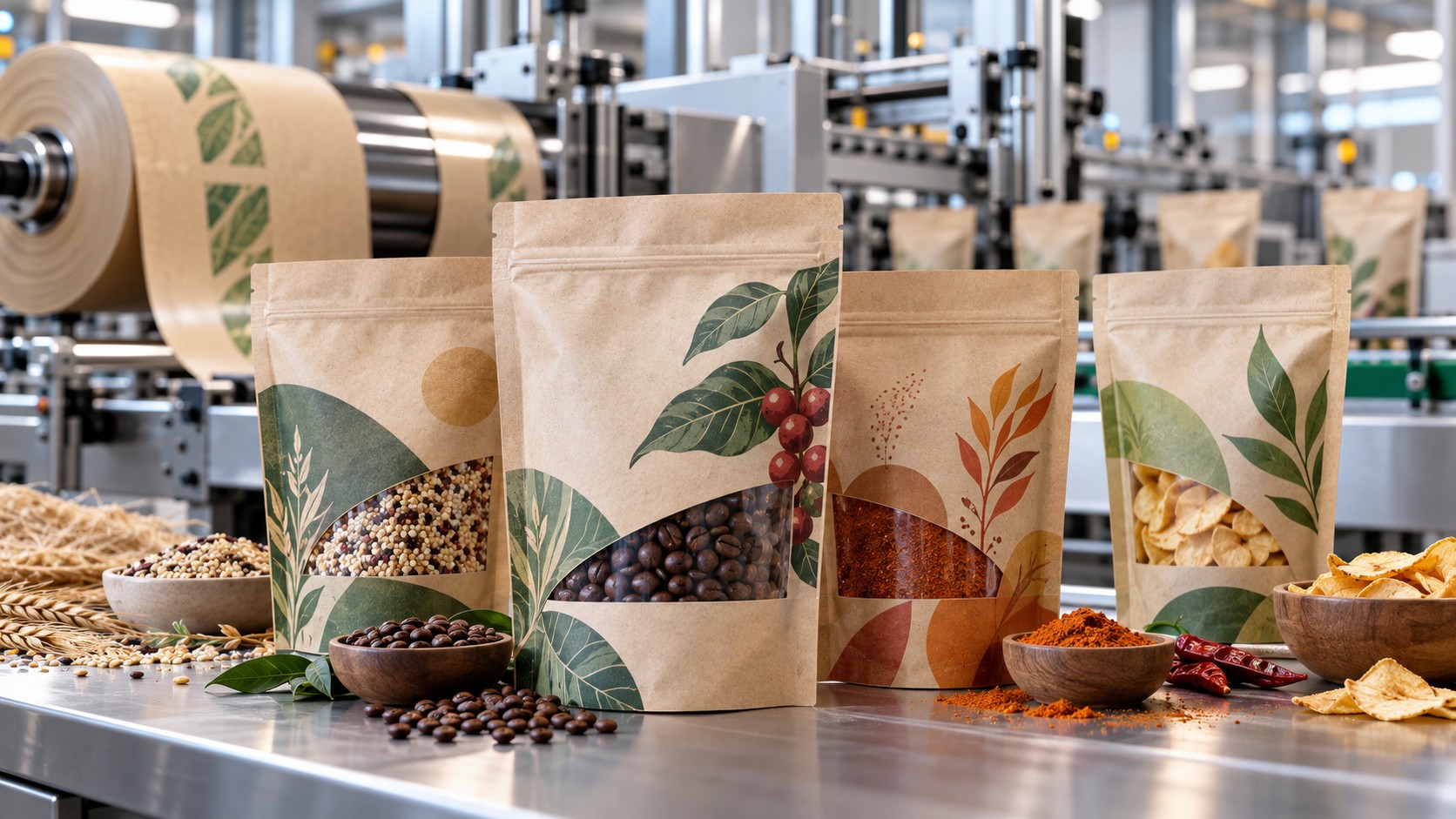
A Different Reason to Choose Paper
A food producer approaches a packaging converter with an apparently straightforward request: replace an existing flexible plastic pack with a paper-based pouch. The producer does not simply want a brown, natural-looking surface. The objective is to reduce reliance on fossil-derived materials, maintain product quality and, where feasible, create a package that can be collected and recycled in an established paper stream.
The proposed pack will hold dry food. The graphics will be digitally printed in relatively short runs, with several regional versions. The pouch must form and seal reliably on industrial equipment, and the print must survive transport, filling, handling, and contact with heated sealing jaws.
The first samples look convincing. The paper has the intended tactile character and the printed colors are attractive. But the next questions change the project. Does the paper itself provide an oxygen barrier? Does it protect against moisture? Is the inner coating genuinely heat-sealable, or is it merely a barrier? Will the printing survive the heat of pouch making? Will an added polyethylene film prevent the final pack from being processed as ordinary waste paper?
None of these questions is answered by the word paper. A reliable paper pouch must be designed as a complete packaging system. It must protect the product, run on the converting equipment, preserve digitally printed graphics, and support a carefully defined end-of-life claim. Reducing plastic content while sacrificing shelf life or introducing an unmanageable recycling structure is not a successful sustainability project.
First Define the Package: Paper Bag, Paper Pouch or Paper-Look Laminate?
The terminology matters. Conventional kraft shopping bags, satchel bags, SOS bags, and paper sacks are not automatically equivalent to sealed flexible pouches. A simple paper bag may rely on folding or gluing and may not need oxygen- or water-vapor-barrier performance. A food pouch may require hermetic heat seals, a controlled barrier, a zipper, a defined tear feature, or even a valve. Those functions add substantial engineering demands.
Likewise, a multilayer pouch with a thin outer sheet of paper may look like paper without being predominantly paper by mass or compatible with ordinary paper recycling. The composition should be described accurately, not inferred from what the consumer touches.
In this article, paper-based pouch means a flexible pack in which fiber-based material is a major component of the engineered construction. Where recyclability in a paper stream is an objective, both the actual fiber fraction and the behavior of the complete structure during collection, sorting, and repulping must be evaluated. No universal percentage makes every construction recyclable.
Begin With the Product, Not the Substrate
Dry foods are a particularly relevant starting point. Flour, rice, cereal, tea, dry confectionery, selected bakery items, seeds, seasoning blends and some pet-food products already have commercially documented paper-packaging routes. However, the term dry food does not define the required barrier. A low-fat cereal, a moisture-sensitive powder, and a roasted nut mix can require quite different packaging performance.
For oxygen-sensitive products, the relevant engineering metric is the oxygen transmission rate (OTR). For humidity-affected products, the water-vapor transmission rate (WVTR) is critical. Grease resistance, mineral-oil migration barrier, aroma retention, light protection, and seal integrity may also matter. Measurements must state the test temperature, relative humidity, differential pressure where relevant, and the exact construction. A quoted OTR without test conditions is not an adequate material specification.
The complete pack must also be tested after folding and sealing. A flat film or sheet can meet an excellent barrier target, while a finished pouch can develop coating cracks at a gusset, an imperfect corner seal, or a leakage path around a fitment. The package, not the original laboratory sheet, must meet the product's shelf-life requirements.
A paper-based pack designed for cereal or dry seasoning must not be presented as automatically suitable for wet foods, aggressive liquids, high-fat products, hot filling or retort sterilization. Such applications need separate construction and process qualification and, in many cases, a different packaging solution.
The Three Practical Construction Routes
The most relevant non-metallic routes can be grouped into three families. They should be regarded as engineering choices rather than interchangeable descriptions.
Construction | What creates the barrier and seal? | Best development fit | Main risk to resolve |
|---|---|---|---|
Paper / integrated barrier coating / heat-seal coating | Functional coatings on a predominantly paper web; barrier and sealing may be separate layers. | Dry foods and other suitable products where paper-stream recycling is a design goal | Coating integrity after folding, sealing window and recyclability of the fully printed pack |
Paper / heat-seal coating only | Thin sealant applied directly to paper; may have little or no oxygen barrier. | Secondary packaging or products with modest barrier demands | Mistaking sealability for high-barrier performance |
Paper/adhesive / PE or PLA sealant film | A separate film supplies heat sealability, with barrier contributions depending on polymer grade and any other layers. | Applications needing more mechanical flexibility or a particular sealing behavior | Fiber separation, additional non-fiber mass, curing and uncertain paper-stream recyclability |
A paper barrier and a heat-seal layer are not necessarily the same coating. A functional paper may be engineered to provide both, or the converter may need to apply an additional sealant dispersion or laminate a compatible inner film. This distinction is crucial when reviewing material suppliers' statements.
Route One: Coated Barrier Paper With an Integrated Heat-Seal Function
This is the most direct starting point when the environmental goal is to retain a fiber-dominant construction. Modern grades combine a suitable paper base with functional, generally non-metallic coatings designed to address selected combinations of oxygen, moisture, grease, mineral-oil exposure and heat sealing.
Commercial products show this category is real, not theoretical. Sappi describes Guard MS for stand-up pouches, pillow bags and block-bottom bags containing tea, seeds, flakes, flour or rice; its published specification includes mineral-oil resistance and heat sealability. Its AvantGuard S family combines functional barrier and a heat-sealable reverse-side coating for suitable pouches and sachets. Koehler publishes heat-sealable, paper-recyclable NexPlus Seal grades, while UPM describes Confidio and Confidio Pro as heat-sealable, repulpable papers for dry or frozen food applications.
These examples prove that functional papers exist, but not that every one is ready for a given liquid-electrophotographic printing process or pouch design. A supplier's recommendation for flexographic or gravure printing is not proof of adhesion or thermal compatibility with a specific digital ink. It is a reason to request representative samples and run a dedicated qualification.
The practical advantage is the ability to achieve useful packaging functions without bonding a comparatively thick plastic film to the paper. The limitation is that barrier coatings can respond to high humidity, flexing, score lines, seal-jaw pressure, and coating defects. Those risks have to be measured, not merely described.
Route Two: Paper With Heat-Seal Coating but No Dedicated High Barrier
Some heat-sealable papers are deliberately designed for products that do not need a strong oxygen barrier. They can be used for certain wraps, secondary packs, confectionery, selected dry goods, or industrial items. Adding an integrated heat-seal function does not make a paper an adequate moisture or oxygen barrier for an oxidation-sensitive food.
This category matters for sustainability because it can reduce material complexity, but only if product requirements allow it. A low-weight paper that forms an attractive and reliable pouch is an excellent solution for one product and an unsuitable solution for another. Barrier selection must therefore remain separate from sealant selection.
Route Three: Paper Laminated to PE or PLA
A thin polyethylene sealant layer can improve heat sealing, toughness and water-vapor resistance, depending on the chosen grade, thickness and construction. It does not by itself turn the package into a high oxygen barrier. Its presence can also complicate conventional repulping because polymer films, adhesives and residual coating can remain as rejects or affect fiber recovery.
PLA is sometimes proposed because it can be made from renewable feedstocks. Yet bio-based content, compostability and recyclability are different properties. PLA can be comparatively sensitive to thermal history, crystallinity and grade selection. Its moisture barrier is not automatically better than PE's, and a paper/PLA laminate is not automatically suitable for a paper mill or a composting facility. If compostability is to be claimed, the complete package must meet the applicable specification and disposal route.
The adhesive, lamination technique, and curing history must also be selected for the intended duty. Successful laminate formation on the machine does not guarantee adequate bond strength after sealing and folding, or regulatory conformity for food packaging.
Selecting the Barrier Without Overengineering the Structure
The preferred solution is not the construction with the most layers or the highest possible barrier value. It is the lightest practical structure that consistently meets the product's functional requirements, under relevant production and storage conditions. Before selecting the material, define the target shelf life, maximum acceptable oxygen and moisture ingress, filling and distribution conditions, and desired handling characteristics.
When a supplier quotes excellent OTR or WVTR results, ask whether they refer to the base barrier paper, the paper after applying the sealant coating, or the final converted and sealed pouch. Some supplier figures are measured only after a specified commercial sealant dispersion is applied. Measurements from those different stages must not be treated as interchangeable.
The preferred first development route for many suitable dry-product applications is a paper with integrated functional barrier and heat-sealable coating designed for the paper stream. A PE or PLA layer may be justified if needed for reliable sealing, durability, or product protection, but the end-of-life classification must then be revisited. The fact that the structure is technically sealable or food-safe cannot substitute for recyclability testing.
Digital Printing: The Surface-Print Challenge
A paper pouch is usually printed on the exposed outer surface. This enables short runs, variable data, and different graphics without the preparation demands of conventional printing plates. It also exposes the ink to rubbing during web handling, slitting, folding and pouch making. The challenge is greater when a heated sealing jaw touches printed regions or areas of heavy ink coverage.
Liquid electrophotographic (LEP) printing produces a pigmented polymeric image with thermoplastic characteristics. Under sufficiently severe contact temperature, pressure, and dwell, the image can soften or change its optical appearance. A visible color shift can also result from gloss modification, surface marking, or local changes in the overprint varnish, rather than a change in pigment chemistry. Different ink coverage, white underprint, paper porosity and primer condition can produce different responses.
For the development route discussed here, the project uses a nominal sealing-jaw setpoint of no more than 130°C as a working constraint. It is a project target, not a universal failure temperature for all LEP inks. Actual ink-film temperature and damage potential depend on heat transfer through the paper, jaw contact, dwell, pressure, coating thickness, and line speed. Never approve a material based on the controller setpoint alone.
Surface Preparation and Ink Adhesion
Printing suitability must be established for the exact paper grade. Depending on the grade and printing technology, a qualified primer or factory-pretreated surface may be required. Ink adhesion and print uniformity must be tested before varnishing or pouch making. A varnish cannot reliably compensate for an ink film that is insufficiently adhered to the paper.
Some coating systems require suitable surface energy on the printed image before varnishing. Where corona treatment is used, the appropriate treatment level must be qualified for the actual image area and varnish; overtreatment is not a substitute for chemical compatibility. A dyne reading can inform wetting assessment, but does not independently prove the durability of the ink/varnish interface.
Protective Overprint Varnish: Heat, Abrasion and Food-Packaging Safety
The protective overprint varnish (OPV) on a surface-printed paper pouch is functional, not merely decorative. It must protect the image from mechanical contact during converting, resist jaw marking and abrasion, and remain optically stable under approved heat-sealing conditions. It must also be selected with the intended food packaging use and migration risk in mind.
Water-based OPVs require adequate water removal and film formation; some additionally contain reactive crosslinking chemistry. UV-curable OPVs require a verified curing dose and composition suitable for the food-packaging use, with attention to residual reactive substances and potential migrants. Neither water-based nor UV chemistry is automatically superior in every situation. Coating choice must be based on tested adhesion, slip, folding performance, appearance, heat and rub resistance, and the compatibility of coating residues with fiber recycling.
The finished system must account for set-off. Even though the printing is on the non-food-contact side, an externally printed web can be wound into a reel with its image surface contacting the intended inner surface of the next wrap. Suitable ink, OPV and process controls are therefore required. A supplier statement calling a product 'low migration' is not a blanket food-contact approval for the entire printed pouch.
A protective OPV is not a thermal shield. The sealed interface must still receive sufficient heat; the ink below the OPV must remain within a safe process window. If a pouch requires a sealing temperature beyond the tested print tolerance, changing the OPV alone may not solve the problem. The sealant and jaw system must be reconsidered.
Drying, Curing and Process Release
Several independent stabilization processes may be present in the same product. LEP printing has its own transfer and film-formation characteristics. A water-based OPV requires appropriate drying; a UV varnish requires a suitable radiation cure. If a separately laminated PE or PLA sealant uses a reactive adhesive, that adhesive may need additional chemical curing before the laminate reaches its required bond and thermal resistance.
Those stages must not be assigned a universal waiting time. Document the supplier's chemistry, coating weight, temperature, humidity, and curing conditions. Measure the relevant results: varnish adhesion and rub resistance for the OPV, and lamination bond strength and failure mode where a reactive adhesive exists.
Release for slitting may be permitted earlier than release for hot pouch making or final product use, but only when the specific adhesive and construction have been qualified. A laminate that can be slit without edge separation is not automatically ready for zipper attachment, heat sealing or food-contact release. Conversely, a paper with an integrated heat-seal coating may not have a separate polyurethane adhesive-curing stage at all.
Slitting, Scoring and Pouch Formation
Paper is fibrous, absorbs moisture and usually has less capacity to elongate than many flexible plastic films. Poorly selected slitting knives or unsuitable web tension can create edge fiber, local tears or differential winding. A barrier-coated surface can also crack when forced into a tight fold. These failure modes must be examined on representative production samples.
The pouch designer must establish a complete path from web unwinding and alignment to folding, longitudinal sealing (where applicable), transverse sealing, cooling, and cutting. For premade stand-up pouches, bottom-gusset geometry, zipper flanges, tear notches, and corner seals deserve separate evaluation. A paper web may require different folding radii or line conditions than the polymer structure it replaces.
Laser scoring or other easy-open features cannot be qualified on opening force alone. The score must not create an unwanted path for oxygen or moisture or weaken the package during shipping. A valve for a dry product such as roasted coffee also adds a functional component and potential leak path; the valve and its attachment must be tested independently from the web barrier.
Heat Sealing Under a Print-Sensitive Thermal Constraint
A heat seal is formed at the mating heat-sealable surfaces, not in the paper fibers themselves. For coated paper with a heat-sealable dispersion or an inner PE or PLA grade, sufficient heat must reach that interface under controlled pressure and contact time. The seal must develop the required cooled strength, immediate hot tack where applicable, and leak-tightness after the pouch is formed.
Jaw temperature, contact pressure, dwell time, geometry, jaw surface, and cooling interact. A displayed pneumatic pressure is not necessarily the local contact pressure on the pouch. A four-layer gusset or zipper flange can require a different thermal path from a simple two-layer side seal. Increasing the temperature of every station to solve a difficult gusset can damage the printed surface of the easier seals.
Under the 120°C - 130°C nominal jaw-setpoint development constraint used in this article, the converter should first assess a suitable low-seal-initiation sealant or coated paper. If the needed seal integrity cannot be achieved at that setpoint within the required line speed and dwell, the design must be changed, or the stated constraint revisited through a documented qualification. An unacceptably weak seal is not an acceptable compromise to save the graphics.
Smooth non-stick jaw coverings, including suitable PTFE-based materials, can reduce sticking and the transfer of varnish or ink to the jaw. But they can also change heat flow and local contact; changing the covering thickness or surface means that the sealing window must be requalified. Covering the jaw does not repair an incompatible ink/OPV interface or an unsuitable sealant.
How Recyclable Is the Finished Pouch?
The description fully recyclable is easily misunderstood. A paper-recyclable pouch does not imply that every gram of its ink, adhesive, coating, or sealant emerges as recovered paper fiber. Technical fiber recovery, process rejects, and the quality of the recycled output all matter. It is more accurate to classify the verified recycling pathway than to promise 100% material recovery.
The 2026 4evergreen Circularity by Design Guideline distinguishes conventional paper recycling, recycling with flotation deinking, and specialized paper recycling. A structure that fails in one pathway may be compatible with another; this does not establish that the specialized route is locally available. The Cepi recyclability laboratory test method provides a controlled way to assess paper-based structures in a conventional recycling process, used together with the relevant evaluation protocols.
Finished pouch construction | Appropriate provisional classification | Evidence required before a claim |
|---|---|---|
Paper with a qualified functional barrier and thin heat-sealable coating | Candidate for conventional paper-stream recycling | Test of the finished printed and sealed design, including OPV and components, plus local collection/sorting route |
Paper with a coating that requires deinking or specialized processing | Potentially recyclable through a specified dedicated paper route | Verified process route, laboratory assessment and infrastructure availability |
Paper/adhesive / PE or PLA film | No automatic paper-recyclability claim | Composition, repulpability, rejects, fiber yield and assessment of the actual regional system |
Mixed paper/polymers with a zipper, valve or complex fittings | Recyclability of full configuration not established by base-web testing | Testing that includes components or justified disassembly and collection instructions |
Construction for which no recyclability evaluation exists | Not yet substantiated | Do not market it as recyclable until evidence is available |
The terms 'partial recycling' and 'not recyclable' require qualification. A specialized recycling path is not the same as incomplete recovery, and lack of evidence is not proof that no recycling process could ever accept the material. For market claims, precise route-based language is preferable to broad labels.
Renewable, Compostable and Lower-Carbon Are Different Claims
A paper base can contain renewable fibers; a bio-based polymer may be derived from renewable feedstock; a finished pack may or may not be compostable; and an LCA may or may not establish a lower greenhouse-gas footprint compared with a polymer pouch. These statements answer different questions. The presence of PLA does not prove compostability, and a paper appearance does not prove lower environmental impact.
When a brand asks for a sustainability claim, the engineering team should document material composition, evidence of recyclability or compostability, filling efficiency, packaging weight, product protection, and the relevant end-of-life infrastructure. Avoid claims that are true for a raw paper grade but were never established for the printed, coated, sealed pouch.
Case Study: A Dry-Food Stand-Up Pouch
Consider a digitally printed stand-up pouch for a dry seasoning product. The target is a premium appearance, strong seals, appropriate protection from ambient humidity, and a realistic paper-recycling pathway. Instead of starting with a paper/plastic laminate, the converter first samples a commercially documented heat-sealable paper with a grease- or moisture-barrier functional to the product.
The development sequence begins by fixing the product's target moisture intake and acceptable shelf life. A digital-print adhesion trial is carried out on the actual paper grade, across low and high ink coverage and any white-ink regions. A protective OPV is selected only after adhesion and rub screening. Heat-sealing tests then establish a feasible window under the development project's printing-temperature constraint.
After slitting and gusset formation, finished pouches are tested for seal strength, leak integrity, print appearance, folding resistance, and moisture-barrier performance. The finished printed construction is then assessed for recycling in the target paper stream. Only after these steps is the design released for commercial filling and distribution.
If the barrier-coated paper cannot protect the product, a more capable coating or another structure is considered. A PE or PLA liner is not prohibited, but it changes both the engineering validation and the sustainability case. The appropriate outcome can be a paper laminate with carefully qualified performance and a narrower recycling statement, rather than an exaggerated paper-recyclable claim.
Case Study: When a Coffee Pouch Is Not an Automatic Replacement
Roasted coffee is a useful example precisely because it is demanding. A suitable pack may need protection against oxygen, water vapor, and aroma loss, and whole-bean coffee can require a degassing valve. A visually appealing heat-sealable paper is not automatically qualified to provide these functions for the intended shelf life.
The converter should compare measured full-construction OTR, WVTR and package integrity against the brand's product-specific targets, including performance after gusset folding, valve installation and storage under the expected climate conditions. If a paper-dominant solution cannot preserve product quality, the correct decision may be to retain a better-performing structure until the paper design is technically ready. Preventing food waste is part of sustainable packaging engineering.
Troubleshooting: Print, Barrier, Seal and Recyclability
Observed issue | Plausible cause | Engineering check or corrective path |
|---|---|---|
OTR or WVTR exceeds the target | Wrong coating function, humidity sensitivity, or defects | Verify layer function and retest at specified temperature/RH on flat material and finished pouches |
Barrier drops after folding. | Coating cracking at gussets, notches or corners | Inspect flex-crack resistance; adjust fold geometry and coating structure |
Ink color changes near the seal | Heat/pressure response of LEP ink, OPV or surface optics | Compare print coverage zones, jaw condition, gloss and color before/after exposure |
Ink or OPV sticks to the jaw | Inadequate thermal resistance, surface adhesion, or worn jaw covering | Qualify OPV/ink combination, jaw surface and seal window; inspect PTFE wear |
Weak seal at 130°C setpoint | Sealant initiation too high, insufficient dwell or poor contact | Select compatible lower-temperature sealant; map heat-seal window and local geometry |
Leak at a gusset or corner | Unequal layer count, pressure distribution or folds | Test specific intersections and adjust jaw geometry, dwell, and cooling |
Delamination after sealing | Adhesive incomplete cure, interface incompatibility or heat stress | Identify failure plane and check bond strength and cure conditions |
Fiber dust or edge tearing during slitting | Tool wear, unsuitable method or web tension | Examine knife condition, edge microscopy and tension profile |
Curling during storage | Moisture imbalance or differential strain in laminate | Condition paper; compare web tensions and storage humidity |
OPV cracking at fold | Coating too brittle or high coat weight | Check coat weight and flexibility and run representative fold trials |
Food-contact suitability unclear | Missing migration or set-off evidence | Review complete printed construction and supplier compliance information |
Recyclability test fails | Adhesive, plastic liner, coating or fittings disrupt fiber recovery | Examine rejects, fiber yield and alternate authorized recycling paths |
These symptoms are not diagnoses. They define an investigation sequence. Do not increase temperature to compensate for poor sealing before checking the sealant, contact time, and actual jaw geometry. Do not extend adhesive cure time to compensate for an ink-to-paper adhesion failure. The failure mechanism must be located first.
Paper-Based Pouches Versus Polymer Pouches: A Fair Comparison
Engineering or sustainability dimension | Paper-based pouch | Polymer-based pouch |
|---|---|---|
Feedstock | Predominantly cellulose fiber, potentially from managed renewable resources | Often fossil-derived polymer, with bio-based and recycled-feedstock alternatives. |
Surface appearance | Natural tactile and print options; usually exposed surface print | Wide range of opaque, glossy or clear films; reverse print is common |
Moisture exposure | Paper requires suitable functional protection; humidity can affect dimensional stability. | Many PE or PP structures are intrinsically less water-absorbent |
Oxygen and aroma protection | Depends strongly on qualified barrier coating and finished-pouch geometry | Can be engineered with selected high-barrier polymer layers |
Mechanical behavior | Fiber fracture and coating cracks can be critical at tight folds | Many films tolerate larger deformation, depending on orientation and layer design |
Heat sealing | Depends on special coating or polymeric liner and print heat tolerance | Heat-sealable inner films and established high-speed processes are widespread |
Recycling | Potential paper-stream route if total design and infrastructure are verified | Potential polymer-stream route if mono-material design and infrastructure are verified |
Typical development fit | Selected dry goods, wrappers, sachets and qualified pouches | Broad range, including highly demanding wet or high-barrier products |
Environmental result | Must be established for the actual pack, its weight, shelf life and collection route | Same requirement; lighter weight and food protection may offset material differences |
There is no universal winner. A paper pouch engineered for an appropriate dry product can be an excellent circularity opportunity. A polymer pouch may remain the better technical and environmental choice for another product if it uses less material, protects the contents longer, or is recovered more effectively in the local system.
A Qualification Protocol Worth Using in Production
A dependable development protocol starts with the intended product and ends with the real filled package. Document product sensitivity, target OTR/WVTR, shelf-life assumptions, storage humidity, any food-contact requirements, printing ink and coating specifications, sealant chemistry, and intended recycling route.
First, qualify the blank paper or premade barrier stock for printability, ink adhesion, and dimensional stability. Next, qualify the overprint varnish for drying/cure, adhesion, rub, and heat exposure. Where a separately laminated inner film is present, validate bond strength and curing. Then define knife geometry, web tension, folds, and functional features. Finally, establish the heat-seal window and inspect seal integrity, color, and gloss after converting at representative operating speed.
Production release needs documented acceptance criteria, not a successful visual sample. Record seal strength and failure mode, leak testing, finished-pouch barrier properties, print appearance, conditioning and aging results. Where food packaging is intended, evaluate the complete printed and converted article, including possible set-off and migration. A paper-recycling claim requires testing the full package configuration and confirming the claimed collection and recycling route.
Conclusion: Sustainability Has to Survive the Production Line
Paper does not make a pouch sustainable simply by appearing on its outer surface. The real opportunity is to design a package in which fiber delivers a useful mechanical and graphic role, functional coatings deliver precisely the necessary barrier and sealing performance, and the complete construction remains compatible with a credible end-of-life route.
For digitally printed packs, the most difficult interface is often not inside the paper. It is where the exposed print, protective varnish, sealing jaw, and sealant layer must work together. The project-specific 130°C sealing constraint illustrates why material selection cannot be separated from print durability. A sealant that needs too much heat may be the wrong sealant for the design; an OPV that protects the image but defeats the recycling target may also be the wrong choice.
My starting point for suitable dry-food applications is therefore a commercially documented functional barrier paper with integrated or thin compatible heat-seal coating. I would add a PE or PLA film only where testing shows it is necessary, and would then describe the recycling consequences precisely. I would never present paper content, food-contact suitability, or repulpability of an unprinted substrate as proof that the finished pouch is fully recyclable.
The final test is not whether the package resembles paper. It is whether the product remains protected, the print remains intact, the seal remains secure, the line remains stable, and the environmental claim remains true after the package has been made.
Professional Sources and Further Reading
- Sappi — Functional Flexible Packaging Papers: commercial barrier and heat-seal grades for food pouches, wraps and bags.
View source
- Sappi — Guard MS: a commercially described heat-sealable paper for stand-up and pillow-bag applications with selected dry foods.
View source
- Koehler Paper — NexPlus Seal Coat: heat-sealable flexible packaging paper, including published paper-recycling credentials.
View source
- Koehler Paper — NexPlus Seal MOB: heat-sealable paper with mineral-oil barrier for dry foods.
View source
- UPM — Confidio and Confidio Pro: heat-sealable, repulpable barrier papers intended for dry and frozen food applications.
View source
- 4evergreen — Circularity by Design Guideline, Version 4 (2026): conventional, deinking and specialized paper-recycling pathways.
View source
- Cepi — Paper and Board Recyclability Laboratory Test Method, Version 3 (2025).
View source
- EuPIA — Principles and guidance for inks and coatings used in food-contact-material packaging.
View source
- EuPIA — Risk Assessment and Migration: guidance on NIAS and non-listed substances.
View source
- ASTM F2029 — Standard Practices for Making Laboratory Heat Seals for Determination of Heat Sealability of Flexible Barrier Materials.
View source
- ASTM F88/F88M — Standard Test Method for Seal Strength of Flexible Barrier Materials.
View source
- ASTM D3985 — Oxygen Gas Transmission Rate Through Plastic Film and Sheeting Using a Coulometric Sensor; apply only where material and test scope are appropriate.
View source
- ASTM F1249 — Water Vapor Transmission Rate Through Plastic Film and Sheeting Using a Modulated Infrared Sensor; apply only where material and test scope are appropriate.
View source
Technical qualification note: Product examples and supplier claims establish the existence of relevant paper grades, not universal suitability for liquid-electrophotographic printing or a specific food. The 130°C nominal sealing-jaw limit is a project-level development constraint, not a general LEP-ink specification. Barrier measurements, curing conditions, migration suitability, and recyclability must be validated for the complete printed, converted package and the actual end-of-life route.