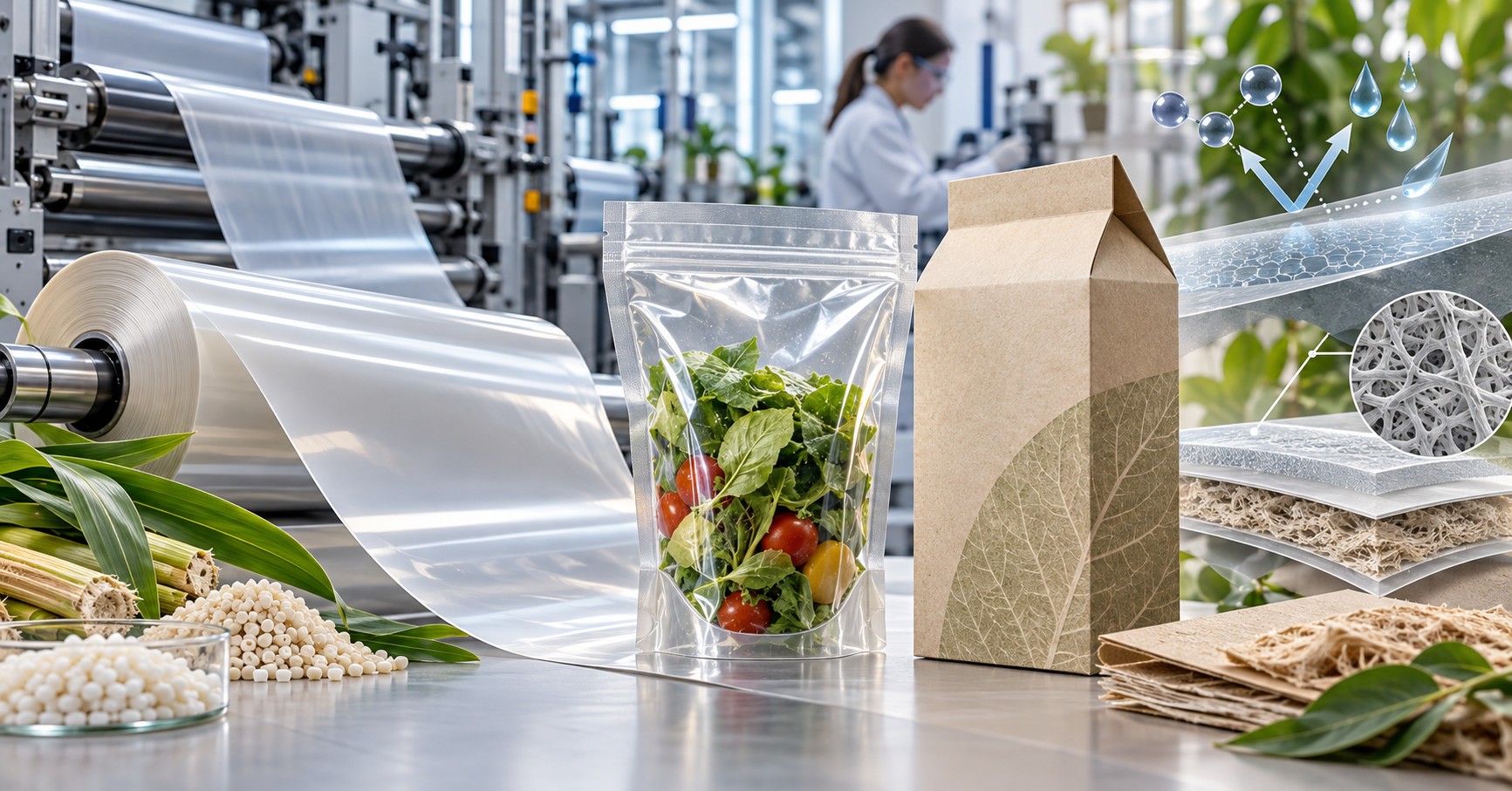
When Packaging Becomes Active
The Engineering of Active and Bio-based Packaging
Active ingredients, printing-ink compatibility, converting, food-contact safety, and verified end-of-life performance
Ronen Dolev
Industrial Printing and Packaging | Technical Article | October 2026
THE ENGINEERING QUESTION
Does the finished printed package still deliver the active function its materials were chosen for?
INTRODUCTION — Packaging Is No Longer Only a Barrier
Packaging engineering has traditionally concentrated on separating the product from its surroundings. Oxygen-barrier films, coatings designed to restrict water-vapor transfer, and multilayer structures that preserve aroma have contributed to the shelf life of many packaged foods. Yet another engineering approach is possible: the package can contain a material that actively changes the Environment surrounding the product.
An active constituent may consume oxygen, remove ethylene, collect excess moisture, or release a controlled amount of a substance intended to delay a defined spoilage mechanism. This is the principle of active packaging. Its performance cannot be judged merely from the presence of an active ingredient. The chemistry, accessible capacity, reaction or release rate, activating conditions, and shelf-life requirements must all match the actual product.
At the same time, packaging materials derived from renewable biological resources are advancing. Poly(lactic acid) (PLA), polyhydroxyalkanoates (PHA), thermoplastic starch, cellulose, chitosan, and bio-derived proteins offer different ways to create films and coatings. However, bio-based and active are distinct properties: a renewable-source film is not necessarily active, and an active package need not be bio-based.
The engineering challenge is to integrate these concepts without compromising processability, food-contact safety, or the final package. Printing and converting are part of that challenge. Ink chemistry, blanket temperature in liquid electrophotography (LEP), aqueous or solvent-based printing, UV or electron-beam (EB) curing, lamination and storage can alter a functional layer or the route by which an active compound reaches its target. This article addresses polymeric, fiber-based and hybrid packaging in a single framework, based on published research and public regulatory documents.
1. Passive, Active, Bio-based and Intelligent: Four Different Concepts
Passive packaging primarily restricts mass transfer or shields a product from external influences. Examples include polymer laminates, oxygen-barrier layers, foil, and barrier-coated paper. Key variables include permeability, structure, thickness, and seal integrity.
Active packaging contains a component designed to absorb, consume, or release a substance to improve the packaged product's Environment or condition. The mechanism may be chemical, physical or enzymatic, and the component may be dispersed in a film, placed in a coating or provided as a separate sachet or pad.
Bio-based packaging describes the origin of all or part of the material: renewable biological resources. This definition does not, by itself, say anything about active function, recyclability or biodegradability.
Intelligent packaging provides information about a product or its storage conditions, for instance through oxygen or time–temperature indicators. An oxygen indicator that changes color does not necessarily remove oxygen. Conversely, an oxygen scavenger may operate with no visual indicator. The European framework distinguishes these functions when considering active and intelligent food-contact materials [10, 11].
A PLA film carrying a chitosan-based antimicrobial surface could combine bio-based construction with an active function. Unmodified PLA, even when made from renewable feedstock, does not become active merely because it is bio-based.
2. Bio-based, Biodegradable and Compostable Are Not Synonyms
Three terms often become confused in packaging discussions. Bio-based concerns feedstock. Biodegradable concerns biological breakdown under defined conditions. Compostable concerns conformity with specified composting conditions, test criteria, and time frames. A claim must identify the conditions under which it applies [1].
For example, bio-based polyethylene may be chemically comparable to conventional fossil-derived polyethylene and is not automatically biodegradable. Conversely, some biodegradable polymers can be made partly from fossil-derived feedstocks. A package suitable for industrial composting is not automatically suitable for home composting, soil exposure or marine disposal.
This distinction becomes especially important after printing. A base film's certification cannot automatically extend to the final package if printing inks, adhesives, barrier coatings, or other constituents are added. Claims must be assessed for the finished construction and the relevant local collection and treatment route.
3. Main Families of Biological Materials Used in Packaging
Material family | Origin and general properties | Potential active-packaging role | Principal engineering limitation |
|---|---|---|---|
PLA — polylactic acid | Polyester that may be produced from renewable-resource monomers | Film or carrier for a functional coating | Thermal sensitivity and oxygen-barrier limitations in some applications |
PHA — polyhydroxyalkanoates | Polyester family produced by microorganisms | Films and active-polymer blends | Properties differ substantially among compositions and grades |
TPS — thermoplastic starch | Starch modified for thermoplastic processing | Films and bio-based blends | Moisture sensitivity and aging of properties |
Cellulose/nanocellulose | Cellulosic fibers and nanoscale structures | Dense coatings, barrier layers or active carriers | Humidity sensitivity and water interaction |
Chitosan | Polysaccharide obtained by processing chitin | Film former and potential antimicrobial functional layer | Activity depends on chemistry, microorganism, and conditions |
Alginate | Polysaccharide commonly sourced from brown algae | Films, coatings and carriers for controlled release | Water resistance and strength depend on formulation |
Protein-based films | Materials including gelatin, zein and plant proteins | Carriers for antioxidant or other active compounds | Moisture sensitivity and application-specific food-contact issues |
These entries are material-family descriptions, not performance specifications. Polymer grade, crystallinity, additives, molecular weight, processing history, and laminate construction determine final properties. A material that performs well as a functional coating may not perform well as a sealant, and vice versa.
4. PLA — A Renewable-Source Film That May Still Need a Better Barrier
PLA is one of the best-studied bio-based packaging polymers. It can offer optical clarity and industrial processability, but its natural oxygen-barrier performance does not meet every packaged-food requirement. Enhancing the barrier does not automatically turn the structure into active packaging.
A 2025 study in RSC Sustainability investigated ultra-thin, fully bio-based oxygen-barrier coatings on PLA, assembled from chitosan, DNA and cellulose nanocrystals. Depending on coating design and humidity, the researchers reported oxygen-transmission reductions of up to approximately 30-fold at coating thicknesses around 120 nm. The effect of humidity depended strongly on the coating formulation [4]. This demonstrates the importance of surface engineering, but the reported result applies only to the tested PLA grades, humidity conditions, and layer-by-layer coatings; it is not a universal value for PLA packaging.
A barrier layer slows oxygen entry. An oxygen scavenger, by contrast, removes oxygen through a separate mechanism. An engineer may combine both functions, but each must be evaluated individually: transmission through the structure, oxygen-scavenging capacity and rate, and functionality after printing and converting.
5. PHA — Biologically Produced Polymers, Not One Standard Material
PHA denotes a family of polyesters that can be synthesized by microorganisms. Different monomer compositions and molecular structures produce differences in flexibility, crystallinity, thermal response and mechanical performance. Accordingly, it is misleading to specify a universal sealing temperature, oxygen-transmission rate, or stretching behavior for 'PHA'.
Published research identifies potential applications for PHA films, coatings and blends, including systems intended to carry active additives. Yet such integration raises additional questions. Does the active ingredient survive polymer processing? Does it remain available at the interface where it must act? Does the final film have the required sealing strength and shelf-life stability? Qualification must be performed on the actual PHA grade and construction, not simply on the polymer-family name.
6. Thermoplastic Starch - Renewable Feedstock, Complex Moisture Behavior
Starch is renewable and abundant, and under appropriate processing conditions it can be converted into thermoplastic materials. Nevertheless, starch is highly sensitive to water. Moisture content influences mechanical properties, dimensional stability, and barrier behavior, and it can change during storage.
In an active package, this creates a two-sided problem. Water can help activate certain scavenging reactions, yet water uptake can also alter the carrier film or coating. For a moisture-control package, the available absorption capacity must therefore be evaluated together with its influence on structural strength and package integrity. A material's renewable origin is not a substitute for moisture-conditioning tests over the expected distribution conditions.
7. Cellulose and Nanocellulose - Beyond Structural Fibers
Cellulose gives paper and paperboard their fundamental fiber network, but its functionality can be extended by converting it into nanoscale fibrils or crystals. Cellulose nanofibrils (CNF) and cellulose nanocrystals (CNC) can be used to produce dense coatings or composite structures that create a more tortuous path for diffusing gases.
Under suitable conditions, a closely packed nanocellulose layer may improve oxygen-barrier performance. However, its hydrophilic character makes humidity a major variable. An excellent result under dry test conditions does not guarantee the same result under high relative humidity. The PLA coating study discussed above illustrates this sensitivity [4].
Nanocellulose can also act as a carrier for other functional constituents. When antimicrobial or antioxidant components are integrated, engineers must distinguish between the structural barrier contribution and the actual active function. The latter requires evidence of activity, sufficient accessibility, controlled release where applicable, and safe behavior in the finished package [5].
8. Chitosan - A Film-Forming Material with Potential Biological Activity
Chitosan is produced from chitin and can form films and coatings. A substantial body of literature examines its antimicrobial potential. However, this activity depends on molecular weight, degree of deacetylation, ionic charge, pH, the target microorganism, and the surrounding medium [2, 5]. Not every chitosan coating provides the same effect.
Chitosan can be used on paper, in biodegradable polymer structures, or as a carrier for another active agent. In some research, immobilized or surface-bound antimicrobial approaches have been explored to avoid depending on uncontrolled migration from the packaging into the food [6]. This concept is promising, but effectiveness and the absence of relevant migration must still be demonstrated under specific construction and use conditions.
An antimicrobial result measured on a coating in laboratory culture is not, by itself, evidence that a printed food package will achieve the desired shelf-life extension.
9. Essential Oils and Plant-Derived Compounds - Biological Activity with Engineering Limits
Essential oils and plant-derived phenolic compounds have attracted attention because some exhibit antioxidant or antimicrobial activity. They may be blended into coatings, polymer films, or delivery systems engineered for controlled release. However, their performance depends on concentration, preservation of the active constituents, and how quickly they reach the relevant region.
Too little available active compound may provide inadequate performance. Too much—or release that is too rapid—may adversely affect aroma, taste, film properties or food-contact compliance. Many essential oils contain volatile constituents, which makes drying and lamination conditions especially relevant.
Reviews of chitosan- and cellulose-based active systems emphasize the importance of release kinetics and testing with the intended food rather than relying solely on laboratory activity [2]. Work on Pickering-emulsion delivery systems further illustrates attempts to stabilize and control plant-derived active compounds within bio-based packaging [7].
10. Integrating Active Functions into Fibre-Based Packaging
Paper and paperboard offer printability, stiffness and useful mechanical performance, but their porous fiber network and moisture sensitivity pose special challenges for active functions. A coating may contain cellulose, chitosan, or another polysaccharide; a laminate may instead place a functional polymer film over the fiber base; or the active component may be a separate pad or sachet.
A conceptual structure is Paper / Functional Biopolymer Coating / Sealable Layer. The paper provides structure and a print surface, the functional coating performs a specified barrier or active role, and the sealable layer closes the package. This description is illustrative, not an approved commercial construction.
Every interface introduces a potential limit. A sealant can slow access to the active material. An adhesive can influence compatibility. A crease may damage coating continuity. Moisture can soften a hydrophilic layer or change reaction conditions. Testing must therefore be performed after printing, creasing, folding and sealing—not only on a flat laboratory coupon [5, 6].
11. Hybrid Packaging - Combining Paper, Biopolymers and Active Constituents
Hybrid structures assign different functions to different materials. The fiber-based layer can provide stiffness, a graphic appearance, and a stable printing surface, while a biopolymer layer may provide sealing, barrier performance, or a carrier for a functional compound. One conceptual example is Paper / Adhesive / PLA-Based Functional Layer; another is paper coated with a nanocellulose–chitosan formulation. Neither is a universal recipe or a regulatory-approved specification.
Combining materials also creates interfaces that must survive the whole production process. Differential thermal response or moisture uptake can change dimensional stability; tight folds may crack coatings; and adhesive or sealant layers may delay access to an oxygen scavenger or the release of an active agent. Assess the finished pack's repulpability or compostability separately from the components' individual claims.
The engineering advantage of a hybrid structure comes from function allocation, not from assuming that adding 'bio' materials automatically makes a package more sustainable. A design is successful only if mechanical performance, active function, food-contact safety, manufacturability, and end-of-life claims all hold for the finished structure.
12. Ink Technology Is Part of Active and Bio-based Packaging Design
The printing ink contributes chemical constituents to the package and is applied in a process involving liquid contact, heating, solvent removal or curing. Its selection therefore has two different consequences: possible effects on the active layer during manufacture, and possible transfer of ink-related substances towards the food. Printing technology and ink chemistry are not interchangeable: flexography, for example, can use water-based, solvent-based, or radiation-curable ink systems.
Printing system | Main interaction to investigate | Typical validation concern |
|---|---|---|
LEP — liquid electrophotography | Heated blanket, nip contact and polymeric ink transfer | Thermal/mechanical compatibility and food-contact assessment |
Water-based flexography | Water exposure, wetting and drying | Sensitivity of hydrophilic coatings and active compounds |
Solvent-based flexography | Solvent interaction and drying | Chemical compatibility, residual solvent and migration |
Conventional offset | Absorption, oxidative or other setting/drying mechanisms | Set-off and migration in printed paperboard |
UV-curable systems | Radiation curing, photoinitiators where used, residual species | Cure completeness, migration and degradation products |
Electron-beam curing | Radiation-driven polymerization and substrate exposure | Stability of functional layer and full migration assessment |
LEP. Liquid electrophotographic printing transfers a concentrated ink layer via a heated blanket under contact force. For temperature-sensitive biopolymers, the combined thermal and mechanical exposure needs to be examined for the specific polymer grade and structure. An active coating or scavenging component should be tested before and after printing. There is no basis for claiming that every PLA or PHA film is damaged by LEP; equally, a short contact time does not prove that no effect is possible. Ink adhesion and package safety must be evaluated for the intended construction, not inferred solely from the label 'LEP'.
Water-based flexography. Water in the ink can contact hydrophilic layers before drying. On starch-, cellulose-, or chitosan-based coatings, evaluate changes in wetting, swelling, coating continuity, and active performance. A coating's good laboratory barrier result does not prove suitability for direct aqueous printing.
Solvent-based flexography. Solvent exposure can affect some polymer or coating systems; the outcome depends on solvent chemistry, contact duration, drying conditions, and the construction's constituents. Residual solvent and migration also form part of food-contact evaluation. The printing method alone does not define whether the outcome is acceptable.
Conventional offset. Setting and drying depend on the ink formulation and may include absorption or oxidative reactions. Paperboard applications require particular attention to set-off, possible migration from the non-food-contact print side, and contaminants that may already be present in recycled fibers.
UV and EB. Radiation-curable inks require assessment of the final degree of cure and of migrating substances. Some UV systems include photoinitiators; research has identified photolysis products and their potential migration from printed food-contact packaging [8]. Certain EB systems can avoid the photoinitiators used by particular UV formulations, but EB is not automatically migration-free. A full material- and process-specific assessment remains necessary.
Neither a renewable-source substrate nor a nominally low-migration ink provides a blanket food-contact approval. Placement of the image layer, barriers, temperature and duration of food contact, intended food type and set-off risks determine what must be tested [10–12].
13. How Printing and Converting Can Affect Active Performance
The printing and converting sequence can modify the accessibility, activity, or stability of a functional ingredient. It can also create new routes for undesirable migration.
Access to the functional layer. An additional ink, coating, adhesive, or sealant layer can change how quickly oxygen, moisture, or a released compound reaches the active material. A functional layer buried behind a highly restrictive barrier may operate too slowly even when its theoretical capacity is ample.
Thermal exposure. Blanket heating, hot-air drying, extrusion coating or lamination may alter temperature-sensitive constituents. Enzymes and volatile plant-derived substances are especially important examples to assess, though their actual response must be tested for the conditions used.
Chemical interaction. Water, solvents, adhesives, and reactive coating ingredients may be incompatible with a particular functional system. These are potential mechanisms, not claims that such interactions occur in every package.
Premature activation. Certain active systems consume capacity as soon as they encounter oxygen, moisture or light. A roll held in storage for weeks or months may therefore behave differently from a freshly produced roll, depending on how the active chemistry is protected.
A practical qualification sequence is to measure active performance on the supplied material, after printing, after lamination and converting, after representative material storage and finally in the filled package. Without this sequence, the observed shelf-life result cannot reliably be attributed to one production stage.
14. Edible Films and Coatings Require a Separate Assessment
Edible films and coatings may be formed from alginate, chitosan, proteins, or other polysaccharides and applied directly to a food surface. They represent a different exposure scenario than a conventional externally printed package. Their components may be deliberately ingested, so material selection, safety and legal requirements cannot be inferred from those for an outside laminate.
In particular, biodegradable does not mean edible. An industrially compostable material is not necessarily appropriate for ingestion. Nor should a printing ink qualified for the outside of a package be assumed suitable for printing on an edible coating. Each component requires assessment under the rules governing its intended use.
15. Food-Contact Safety and Migration in Biological Packaging
Renewable biological origin is not a safety classification. Bio-based polymers and coatings may contain residual monomers, oligomers, processing aids, additives, reaction products, or contaminants derived from feedstocks. The same applies to natural active ingredients: a botanical source does not establish acceptable migration or safe use at a particular concentration [9].
The European framework includes Regulation (EC) No 1935/2004 on general food-contact principles, Regulation (EC) No 450/2009 for active and intelligent food-contact materials, and Regulation (EC) No 2023/2006 on good manufacturing practice, as amended [10–12]. Specific rules also apply to relevant plastic layers, including amendments to Regulation (EU) No 10/2011. Whether an active constituent is deliberately released affects its regulatory evaluation.
The printed package must be assessed as a whole. Important pathways include diffusion through layers, set-off from the printed side to the food-contact side during winding or stacking, and relevant gas-phase transport. A laminate or varnish is a functional barrier only when demonstrated to fulfill that function for the migrating substances and intended conditions. The ink, coating, adhesive and active substance should all be included in the risk assessment.
Documenting a substance in a scientific publication is not a regulatory authorization to use it commercially in food-contact packaging. Suitability is application- and market-specific and must be confirmed through current requirements and appropriate evidence.
16. Is a Compostable Film Still Compostable Once Printed?
Suppose an unprinted PLA structure has been shown to meet a specific industrial-composting specification. The converter then adds an ink layer, overprint varnish, adhesive and additional film. The final construction cannot automatically inherit the earlier qualification.
Inks and coatings can influence disintegration, biodegradation, compost quality and the concentration of substances left after treatment. Claims concerning industrial or municipal composting require evidence for the finished item under the relevant standards. Depending on the product and jurisdiction, standards such as EN 13432 and ASTM D6400 may be relevant [13, 14]. Their conditions must not be presented as proof of home, soil, or marine biodegradation.
In the European Union, Regulation (EU) 2025/40 on packaging and packaging waste establishes a framework that distinguishes specified compostable applications from broader recycling objectives. Implementation and applicable dates depend on the packaging category and market [13]. Design a package for a realistic waste-management pathway, not merely for an attractive environmental label.
17. Is Bio-based Packaging Necessarily Better for the Environment?
Not necessarily. Renewable feedstock can reduce dependence on fossil-derived raw materials, but total environmental performance also depends on land use, energy, processing chemistry, transport, product protection and end-of-life treatment.
A replacement film with inadequate oxygen or water-vapor performance could shorten shelf life and increase food waste. In some product systems, the resulting environmental impact can outweigh the benefits of the packaging material itself. Life-cycle assessment (LCA) therefore needs consistent system boundaries and functional units. Studies of PLA products show that conclusions depend on production, use and end-of-life assumptions [15].
The meaningful question is not simply whether the package contains a bio-based polymer. It is whether the total system protects the food as required, meets legal and technical obligations and demonstrates an environmental advantage under a credible scenario.
18. Qualification: Testing the Material, the Process and the Final Package
Qualification should begin with a clear product requirement. Engineers need to identify the relevant spoilage pathway, specify what the active component is expected to do, define storage and distribution conditions, and establish acceptance criteria before testing starts.
A useful program separates structural properties, barrier properties, active kinetics, printing compatibility, migration, and finished-pack performance. Tests should be repeated after the actual manufacturing sequence. When comparing alternatives, retain consistent product loading, headspace, storage time, temperature and humidity so the role of the active package can be isolated.
Test group | What must be demonstrated? |
|---|---|
Structural | Strength, elongation, dimensional stability, coat/laminate adhesion and thickness |
Barrier | OTR, WVTR and response to relevant humidity conditions |
Active function | Available capacity, uptake/release rate and activation conditions |
Printing | Wetting, ink adhesion, drying/curing compatibility and effect on active function |
Converting | Integrity after lamination, creasing, folding, slitting and sealing |
Food-contact safety | Relevant migration, NIAS, intended-use restrictions and documentation |
Shelf life | Real changes in the packed food's defined quality/safety indicators |
End of life | Recycling or compostability of the final construction in the intended system |
For example, an oxygen scavenger should not be validated by a single terminal oxygen reading. You must measure its oxygen concentration profile over time, along with product quality. Antimicrobial coatings need product-specific testing; activity on an isolated laboratory film does not prove equivalent performance once the film is printed, laminated, and used with food.
19. Two Engineering Case Studies
Case A — PLA-based package for an oxidation-sensitive food. Consider a hypothetical package built around a PLA film. A bio-derived coating is introduced to reduce oxygen transmission. A separate active constituent is then proposed to remove residual oxygen. Three distinct questions must be answered: does the coating lower transmission under the actual humidity conditions; does the active constituent remove oxygen at a suitable rate; and do printing, lamination, and storage preserve both functions? If the PLA base has a compostability claim, that claim must be reassessed for the printed and converted structure. This is an illustrative design study, not an unreported production trial.
Case B — Paperboard carrying an active chitosan-based coating. Consider a hypothetical carton that receives a functional chitosan-containing layer and then undergoes printing, creasing and folding. The team must test whether the active surface remains effective, whether the coating stays bonded to the fiber substrate, and whether creasing creates discontinuities. The food-contact arrangement must also be specified: is the layer exposed to food or separated by another barrier? Laboratory antimicrobial activity needs to be checked against relevant shelf-life outcomes in the intended packed food. Again, this is an engineering example, not a claim about a specific commercial case.
Conclusion — An Engineered System, Not a New Material Label
Active and bio-based packaging expands the range of design choices available to printing and packaging engineers. Renewable-source polyesters, microbial polymers, cellulose, chitosan, and plant-derived active substances can support useful new films and coatings. Yet replacing a conventional polymer with a bio-based one does not guarantee equivalent food protection; incorporating an antimicrobial ingredient or oxygen scavenger does not guarantee longer shelf life.
A functional package is an integrated system. The structural material, barrier layers, active chemistry, ink, adhesives, and converting sequence must work together. The active component must remain accessible to the substance it is designed to control, but it must not create unacceptable migration. Its performance must survive printing and lamination, and its environmental claims must apply to the final package, not only to an isolated input material.
The most advanced package is not necessarily the one with the newest biopolymer or the largest quantity of active ingredient. It is the one in which every layer has a defined function, and the complete system delivers that function throughout the product's intended life.
Scientific and Regulatory References
[1] European Commission. EU Policy Framework on Bio-based, Biodegradable and Compostable Plastics (2022). |
[2] Casalini, S., and Giacinti Baschetti, M. The Use of Essential Oils in Chitosan or Cellulose-Based Materials for the Production of Active Food Packaging Solutions: A Review. Journal of the Science of Food and Agriculture (2023). |
[3] Bio-based Active Food Packaging Materials: Sustainable Alternative to Conventional Petrochemical-Based Packaging Materials. Food Research International. |
[4] Fisher, S. G., et al. Fully Biobased and Biodegradable Oxygen Barrier Coating for Poly(lactic acid). RSC Sustainability 3, 557–564 (2025). |
[5] A Review of Advancements in Chitosan–Essential Oil Composite Films. International Journal of Biological Macromolecules (2024). |
[6] Antibacterial Active "Non-Migrating" Food Packaging Based on Chitosan-Containing PLA Films. Food Packaging and Shelf Life 52, 101670 (2025). |
[7] Biobased Food Packaging Systems Functionalized with Essential Oil via Pickering Emulsion. ACS Omega (2025). |
[8] Arfan, M., et al. Oxygen Scavengers as Active Food Packaging: A Systematic Literature Review and Network Analysis. Food Chemistry Advances (2026). |
[9] Chemical Safety and Risk Assessment of Bio-Based and/or Biodegradable Polymers for Food Contact: A Review. Food Research International (2025). |
[10] European Food Safety Authority (EFSA). Active and Intelligent Materials. |
[11] Commission Regulation (EC) No 450/2009. Active and Intelligent Materials and Articles Intended to Come into Contact with Food. |
[12] Commission Regulation (EC) No 2023/2006. Good Manufacturing Practice for Food Contact Materials, as amended. |
[13] Regulation (EU) 2025/40. Packaging and Packaging Waste Regulation. |
[14] ASTM D6400. Standard Specification for Labeling of Plastics Designed to be Aerobically Composted in Municipal or Industrial Facilities. |
[15] Life Cycle Assessment of PLA Products: A Systematic Literature Review. Sustainability (2023). |
[16] Surface Properties and Ink Adhesion Behavior of PLA/PCL Blends. Polymers (2026). |
Technical Scope, Intellectual Property and Use of Sources
This article is independently written from publicly available scientific studies and regulatory texts. It does not reproduce proprietary ink formulations, unpublished production data, source diagrams, or extended extracts. The published studies describe specific materials and test conditions; they should not be interpreted as universal press settings, commercial qualifications, or regulatory approvals. Food-contact compliance, migration, recyclability, and compostability must be assessed for the actual finished package and the jurisdiction of intended use.