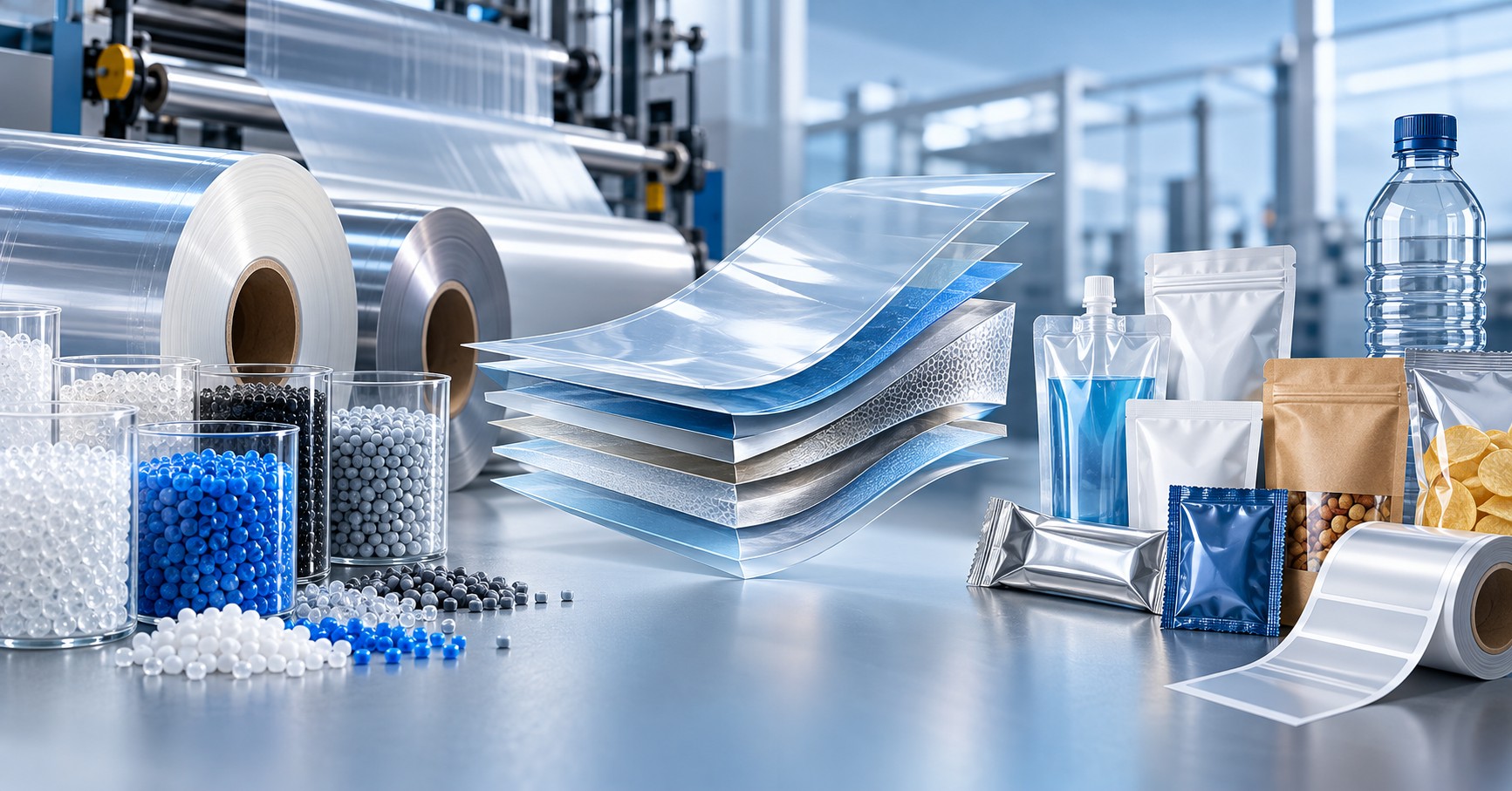
Introduction — Similar-Looking Films Can Behave Very Differently
Two clear films may have the same nominal thickness, appear almost identical on the unwind stand, and even belong to the same polymer family. Yet one may run with excellent dimensional stability on a printing press while the other elongates under web tension. One may provide an efficient sealing layer; the other may be designed for stiffness, high-temperature processing, or oxygen protection. A substrate selected only by its abbreviated polymer name is therefore an incomplete engineering specification.
The practical question is not simply whether a film is PE, PP, or PET. It is which resin grade, morphology, manufacturing route, orientation, additives, surface treatment, thickness, and layer arrangement are needed for the finished package. The relevant choices depend on printing, converting, packing-line conditions, distribution, shelf life, consumer use, and end-of-life requirements.
This article reviews the major polymers and film constructions used in industrial packaging. It compares mechanical, thermal, barrier, and sealing behavior, explains the functional division between layers, and identifies important distinctions between polymer properties and finished-film performance. Numerical ranges are indicative and never replace the manufacturer's technical data sheet or the intended test conditions.
1. Strength, Stiffness, Flexibility and Puncture Resistance Are Different Properties
Tensile strength describes a material's response to an applied tensile stress under a defined test method. Tensile modulus describes resistance to elastic deformation and is therefore related to stiffness. Elongation at break, impact behavior, tear resistance, puncture resistance, and flex-crack performance provide additional—and sometimes conflicting—information. A highly oriented film may be strong and stiff in tension but less forgiving at a notch or sharp fold. A relatively compliant sealant film may offer valuable puncture and deformation tolerance without being the strongest material in a tensile comparison.
For web-fed materials, report properties separately along MD (Machine Direction) and CD (Cross Direction). Film stretching, blown-film orientation, and biaxial orientation can produce directional differences in shrinkage, modulus, tensile strength, and tear behavior. Sheet-fed converting requires distinguishing between sheet travel direction and, for paperboard, long-grain versus short-grain orientation. All comparisons need a stated thickness, conditioning history, and test method; nominal labels such as "strong," "flexible," or "retort-capable" are not adequate engineering specifications.
2. Polyethylene: LDPE, LLDPE, MDPE and HDPE
Polyethylene is not a single material with a single set of properties. Chain branching, comonomer content, molecular-weight distribution, crystallinity, and manufacturing history influence density, modulus, seal performance, and resistance to environmental stress cracking (ESC). Density is a useful classification parameter but does not independently predict the performance of a commercial grade.
LDPE — Low-Density Polyethylene
LDPE contains significant chain branching, including long-chain branches. Its comparatively low crystallinity often produces soft, flexible films with useful melt strength, good processability, and a relatively accessible heat-seal function. A typical crystalline melting region is approximately 105–115°C, with grade-dependent variation. It is widely employed in bags, overwrap, shrink applications, sealant layers, and extrusion coating. Its drawbacks include limited stiffness and relatively poor oxygen barrier compared with specialized barrier polymers. It usually provides more useful moisture resistance than oxygen resistance.
LLDPE and mLLDPE — Linear Low-Density Polyethylene
LLDPE has a more linear backbone with controlled short-chain branching introduced by comonomers such as butene, hexene, or octene. Commercial grades can deliver improved toughness and puncture performance while preserving high flexibility. Metallocene LLDPE (mLLDPE) refers to specific catalyst-derived distributions, not a blanket guarantee of superior performance in every application. Typical melting peaks for many LLDPE grades fall around 120–130°C, but plastomers, copolymers, and specialty sealants can differ. LLDPE is common in stretch films, industrial bags, and sealant layers. In blends with LDPE, engineers balance mechanical performance, bubble stability, extrusion rheology, and sealing needs.
MDPE — Medium-Density Polyethylene
MDPE occupies an intermediate density range, often approximately 0.926–0.940 g/cm³. It offers a useful balance of stiffness and compliance for selected containers, industrial films, and chemical-packaging applications. Melting behavior is typically in the 120–130°C range, depending on grade. However, a specific MDPE does not necessarily outperform every HDPE in environmental stress-crack resistance: branching architecture, molecular weight, molecular-weight distribution, and processing-induced residual stresses remain important.
HDPE — High-Density Polyethylene
HDPE normally contains less branching and greater crystalline organization than LDPE. Typical density is around 0.941–0.965 g/cm³, while melting peaks for many grades are near 130–138°C. It offers good stiffness, chemical resistance, and moisture-barrier characteristics and is widely used for detergent bottles, milk bottles, rigid containers, caps, and certain oriented or unoriented films. It is generally less flexible than LDPE at comparable geometries, and its oxygen barrier remains limited. Consider environmental stress cracking, particularly in containers exposed to detergents, surfactants, oils, or sustained local stresses.
Comparative reference: polyethylene family
Polymer | Typical melting region* | Relative mechanical character | Common packaging role | Main limitation |
|---|---|---|---|---|
LDPE | 105–115°C | Soft, compliant, high elongation | Bags; sealing; extrusion coating | Low stiffness; limited oxygen barrier |
LLDPE / mLLDPE | Frequently 120–130°C | Flexible, tough; good puncture resistance in suitable grades | Pouches; stretch films; sealants | Processability and seal response depend strongly on grade |
MDPE | Approximately 120–130°C | Intermediate stiffness and compliance | Industrial films; selected containers | Properties cannot be inferred from density alone |
HDPE | Frequently 130–138°C | Stiffer and more crystalline | Bottles; caps; rigid and semi-rigid packaging | ESC risk in unsuitable grades; limited oxygen barrier |
*The quoted ranges are illustrative peak or crystalline melting regions—not heat-seal initiation temperatures, maximum service temperatures, or automatic printing compatibility limits.
3. Polypropylene: Resin PP Is Not the Same Thing as CPP or BOPP Film
Polypropylene (PP) offers low density, useful chemical resistance, and good potential stiffness. A typical isotactic homopolymer melts near 160–165°C, whereas random copolymers, impact copolymers, and specially formulated seal layers behave differently. What matters in printing and converting is not simply the PP family but how the resin is converted into film.
CPP — Cast Polypropylene
CPP is typically made by cast-film extrusion and is not subsequently subjected to the large biaxial stretching used for BOPP. It can therefore provide useful elongation, conformity and heat-seal behavior, depending on its coextruded skin layers and formulation. It is commonly used as the inner sealant layer in laminates, flexible pouches, lidding systems and certain retort-qualified structures. Easy-seal grades and dedicated retort CPP grades exist; do not assume ordinary CPP is retort-capable. Likewise, CPP does not have one universal seal-initiation temperature simply because its base polymer is PP.
BOPP — Biaxially Oriented Polypropylene
BOPP is stretched in both MD and CD, producing orientation that typically increases tensile modulus, tensile strength, and optical uniformity. It is commonly used as an outer print carrier for dry-food wrappers, confectionery, snacks, and labels. It often offers an attractive cost-to-performance ratio and favorable moisture-barrier behavior for its thickness. Its limitations include temperature-dependent relaxation or shrinkage, behavior at tears or sharp creases, and the fact that an ordinary non-sealable BOPP face cannot be treated as a heat-seal layer. Coextruded heat-sealable BOPP exists and must be specified separately.
The orientation process, not a change in PP's chemical identity, explains much of the difference between BOPP and CPP. Some supplier comparison charts show BOPP tensile values substantially above those of CPP or LDPE. Such values are grade-, thickness-, direction- and method-specific; they must not be presented as universal material constants.
4. PET, BOPET and PETG: The Difference Between Melting and Service Behavior
PET belongs to the polyester family. Crystalline PET generally melts around 250–260°C, while its glass-transition region is commonly near 70–85°C. These two temperatures describe different physical transitions. Mechanical response, dimensional stability, and film shrinkage can change at temperatures well below the crystalline melting point.
BOPET is a biaxially oriented polyester film. It commonly offers high tensile strength, modulus, thermal endurance relative to many commodity polyolefin films, dimensional stability, and a versatile surface for printing and barrier coatings. It is widely used as an outer layer in laminates for coffee, powders, dry foods, and demanding converting applications. It is not automatically a sealant: it normally requires a sealable coextrusion, coating, or separate PE/CPP layer. Orientation, heat setting, gauge, and coating determine process stability in practice.
PETG is a modified copolyester, often with suppressed crystallization compared with conventional PET. It is widely used in shrink-sleeve systems for complex bottle shapes. For PETG, the relevant variables often include glass transition, shrink onset, shrink curve, shrink force, solvent-seaming compatibility, and bottle deformation—not an assumed single crystalline melting point. PETG sleeve selection must also consider sorting and recycling compatibility with the container material.
5. Polyamide (PA, Nylon), BOPA and EVOH
Polyamide films—including PA6 and biaxially oriented BOPA—can offer excellent puncture resistance and useful toughness. PA6 typically melts around 215–225°C, while PA66 generally melts at a higher temperature, often about 255–265°C. These materials are selected for demanding vacuum packs and products with sharp or irregular edges. Their mechanical behavior and oxygen-barrier performance are sensitive to moisture because polyamides absorb water. BOPA is frequently combined with a PE sealant and, when needed, a dedicated oxygen-barrier layer.
EVOH (ethylene vinyl alcohol copolymer) performs a different job. It is chosen mainly for high oxygen-barrier efficiency under suitable humidity conditions, not as the general-purpose sealing layer. Its melting region depends on ethylene content, with commercial grades spanning roughly 155–195°C. EVOH is hydrophilic: oxygen-barrier performance normally deteriorates as relative humidity rises. This corrects a misleading statement in one of the supplied barrier worksheets. In coextrusions, EVOH is often embedded between protective PE or PP layers and joined using compatible tie resins, such as PE/tie / EVOH / tie / PE. Layer position and the product's moisture exposure are design variables, not minor details.
6. PVC, PVDC, PLA, PS and Other Special-Use Materials
Unplasticized PVC can be rigid while properly plasticized PVC can be flexible; the additive package fundamentally changes material behavior. PVC is predominantly amorphous and should not be assigned a conventional sharp crystalline melting point comparable to PE or PP. Rigid PVC often shows a glass transition near 75–90°C. Relevant applications include selected shrink sleeves, pharmaceutical blister structures, and thermoformed packaging. Its chlorine-containing chemistry imposes processing, additive-compliance, and recycling considerations.
PVDC is used in high-barrier coatings and specific film structures when oxygen and moisture resistance are important. It can be effective but brings chemistry-specific processing and end-of-life considerations. PVOH is a hydrophilic polymer used in functional coatings and can offer high oxygen resistance in dry conditions, but performance can be severely affected by moisture unless the coating is protected or modified.
PLA has potential in selected rigid and flexible packaging, often offering stiffness but with thermal limitations tied to glass transition around 55–65°C. Crystalline PLA grades may melt at approximately 150–175°C, but the presence of a melting peak does not mean that an amorphous PLA article can tolerate temperatures near that point. Compostability must be demonstrated for the finished construction and its designated end-of-life environment. Polystyrene (PS) is principally amorphous, with Tg commonly near 95–105°C; conventional PS can be brittle, while HIPS is impact-modified. Both are used for selected thermoformed and rigid structures.
7. Comparing Materials Properly: The Thermal and Mechanical Selection Matrix
The reference table guides tendencies rather than qualifying products. "Thermal behavior" deliberately distinguishes melting, glass transition, and orientation-related shrinkage. No number below automatically specifies seal initiation, retort suitability, or maximum web temperature.
Material/film | Mechanical tendency | Key thermal behavior | Typical role/caution |
|---|---|---|---|
LDPE | Very flexible, low stiffness | Tm ~105–115°C | Sealant and bag film; limited hot dimensional stability |
LLDPE | Flexible, tough in selected grades | Grade-dependent Tm, often ~120–130°C | Puncture-resistant sealant and industrial film |
MDPE | Intermediate stiffness | Tm often ~120–130°C | Balanced film and container grades |
HDPE | Stiffer, relatively crystalline | Tm often ~130–138°C | Bottles and structural layers; check ESC |
CPP | More compliant than typical BOPP | Heat-seal behavior depends on skins/grade | Sealant; selected retort grades only |
BOPP | Stiff and strong in tension | Oriented-film shrink/relaxation well below PP melting | Print carrier, dry-food wraps, labels |
BOPET | Strong, high modulus, stable when heat-set | PET Tm ~250–260°C; Tg ~70–85°C | Print carrier; not ordinarily self-sealing |
PETG shrink film | Tunable shrink behavior | Tg / shrink curve more relevant than Tm | Shrink sleeves; check shrink force and recyclability |
BOPA / PA6 | Tough, high puncture resistance | PA6 Tm ~215–225°C; moisture sensitive | Vacuum packages, mechanical reinforcement |
EVOH | Functional high oxygen barrier | Grade-dependent Tm ~155–195°C | Protected internal barrier layer |
PVC | Rigid or flexible by formulation | No simple sharp crystalline Tm | Blister, shrink, forming; chemistry controls |
PLA | Often stiff; some brittle grades | Tg ~55–65°C; crystalline Tm ~150–175°C | Qualified specialty packages; heat sensitivity |
PS / HIPS | Rigid; toughness varies | Amorphous Tg ~95–105°C | Thermoformed packaging |
MD - for polyolefin films - refers to machine direction, not MDPE density class. The same symbol can carry different meanings; technical documentation should state it explicitly.
8. Oxygen Barrier Is Not a Water-Vapor Barrier
Packaging barrier design starts with which species must be controlled, at what rate, under what conditions, and for what shelf life. Oxygen transmission rate (OTR) and water-vapor transmission rate (WVTR) are distinct properties. Polyolefins often provide useful moisture resistance but only modest oxygen resistance. EVOH, by contrast, can provide a strong oxygen barrier at suitable humidity but may lose much of that advantage at high humidity. PET and PA occupy different positions, depending on grade, orientation, moisture and thickness. Aluminum foil, metalized films, and engineered coatings offer additional design choices.
An OTR value requires clear units and test conditions, for example cm³/(m²·day) at stated temperature, oxygen partial-pressure conditions, and relative humidity. A WVTR value is commonly in g/(m²·day), at defined temperature and humidity gradient. OTR and WVTR are transmission rates for tested constructions; intrinsic permeability and thickness-normalized material properties are not identical quantities. For homogeneous films, idealized thickness dependence may be useful, but it should not be generalized to multilayer, coated, oriented, or defective structures.
Two uploaded worksheets contain illustrative OTR figures such as 85 for PET and 2,000 for OPP, and list a zero value for aluminum foil. Those values are not carried into this article as validated comparative performance because the relevant gauges and environmental conditions are missing. Nor is "zero" a defensible unconditional claim for all converted foil packages: pinholes, flex cracking, edge effects, and defects in the finished construction can compromise the barrier. Methods such as ASTM D3985-24 and ASTM F1249-25 provide appropriate frameworks for measuring oxygen and water-vapor transmission; full-package performance and shelf-life validation may require additional tests.
9. Comparing Barrier Layers and Functional Coatings
Barrier performance depends on coating continuity, grade, substrate, thickness, environmental exposure, and mechanical damage. The descriptions below are qualitative design tendencies—not ranked numerical specifications.
Barrier technology | Oxygen barrier | Moisture barrier | Primary advantage | Limitation requiring qualification |
|---|---|---|---|---|
Aluminum foil | Very high when intact | Very high when intact | Oxygen, moisture and light protection | Pinholes, flex damage, dead-fold and recycling issues |
Metalized PET / BOPP | Moderate to high in engineered grades | Moderate to high in engineered grades | Very thin metal layer; lower metal use | Vacuum-deposition quality, metal adhesion, flex damage |
AlOx- or SiOx-coated film | High in appropriate grades | Grade/construction dependent | Transparent barrier option | Cracking or coating defects in converting |
EVOH layer | Very high at suitable low/moderate humidity | Usually not a stand-alone moisture barrier | Outstanding oxygen protection per thin layer | Moisture sensitivity; protective layers and tie resins |
PVDC coating or layer | Useful high barrier in suitable grades | Useful high barrier in suitable grades | Combined oxygen/moisture resistance | Processing, composition and recyclability considerations |
PVOH-based coating | High under suitably dry conditions | Highly formulation-dependent; not inherently a high moisture barrier | Transparent oxygen barrier | Water sensitivity unless protected/modified |
Aluminum foil is a discrete metal layer, not a polymer. Metalized PET and metalized BOPP carry nanometer-scale deposited metal and are fundamentally different constructions from full foil. Likewise, transparent oxide coatings are brittle inorganic layers supported on polymer films, while EVOH and PVDC are polymeric barrier technologies. The choice must consider whether printing, lamination, folding, retort, microwave heating, and recyclability can be supported by the qualified finished structure. It is unsafe to infer universal "microwave safe" or "retort safe" status from a single coating family.
10. Multilayer Packaging: Each Layer Must Earn Its Place
No single polymer simultaneously maximizes stiffness, sealability, puncture resistance, oxygen barrier, moisture barrier, optical performance, and recyclability. Multilayer design assigns different functions to different layers. A print carrier helps preserve registration and appearance; a barrier layer protects the contents; a structural or puncture-resistant layer carries mechanical loads; and a product-facing layer provides sealability and chemistry appropriate for the contents. Laminating adhesive and tie layers are themselves functional parts of the construction.
Illustrative structure | Why the layers are combined | Candidate application/qualification point |
|---|---|---|
PET / PE | PET print carrier and dimensional stability; PE sealant | Dry goods and pouches; confirm shelf-life needs |
PET/aluminum foil / PE | Printable PET; foil oxygen, moisture, and light barrier; PE sealant | Sensitive powders and other products; verify foil integrity and food-contact compliance |
PET / BOPA / PE | Stable print carrier; puncture-resistant BOPA; sealing PE | Vacuum packs and sharp-edged contents; check barrier requirement separately |
BOPP / CPP | BOPP stiffness and printing; CPP sealability | Snacks and flexible packs with appropriate grades |
BOPP / metalized BOPP | Print carrier plus metalized barrier film | Dry-food wrappers; validate OTR/WVTR after converting and sealing |
PE / tie / EVOH / tie / PE | PE surface/seal functions, EVOH oxygen barrier, tie-layer adhesion | High oxygen-barrier PE-family constructions; check humidity and recycling qualification |
PET/aluminum foil / retort-grade CPP | Outer film, high barrier foil, qualified high-temperature sealant | Retort-capable designs only if complete construction passes process validation |
Paper / PE or paper/aluminum foil / PE | Paperboard or paper mechanical/print function plus moisture, foil or sealing layers | Wraps, sachets and specialty packs; check crease performance and product contact |
A slash notation describes nominal layer order, not automatically the manufacturing method. In adhesive lamination, separately produced webs are bonded with a qualified adhesive system and the required curing period. Extrusion lamination bonds layers using a molten extrudate. Coextrusion creates compatible layers together, often requiring tie-layer resins when chemical affinity is insufficient. Each method has its own process window, interlayer adhesion requirements, and potential failure mechanisms.
The layer adjacent to food is not necessarily the only food-contact concern. Migration assessment, functional barriers where applicable, inks, coatings, adhesives, recycled content, and the expected contact conditions must all be considered. A functional structure is not inherently compliant merely because its component polymer names are familiar.
11. How to Match a Structure to the Packaged Product
For dry snacks, sealable BOPP or BOPP/CPP can provide a lightweight combination of print presentation, controlled sealing and moisture management; metallization or another barrier may be needed for oxidation-sensitive products. For coffee, powders, sensitive spices and other aroma-sensitive products, a PET carrier with foil or a qualified transparent barrier laminate may offer substantially different shelf-life performance. Barrier choice requires measured OTR, WVTR, aroma retention, light protection and package integrity—not generic descriptions of "high barrier."
For vacuum-packed meat and products with hard edges, BOPA/PE-based constructions can provide useful mechanical tolerance, while EVOH or another suitable layer may be added if oxygen protection requires it. For rigid detergent bottles, HDPE selection should consider chemical compatibility, residual stresses, drop impact, and environmental stress-crack resistance. For retort pouches, qualify every layer, coating, adhesive, ink, and seal for the full retort profile, including post-process seal strength and delamination resistance. A generic PET/CPP label is not enough.
For shrink sleeves, the choice between PETG, PVC and appropriate polyolefin shrink grades depends on bottle geometry, shrink curve and force, distortion control, seam chemistry, print performance and the intended recycling system. For paper-based packaging, consider the mechanical function of the fiber-based layer separately from the oxygen, grease, moisture, or seal functions introduced by its coating or laminate. Material simplification can be valuable, but not at the expense of food safety or functional shelf life.
12. Surface Wetting and Dyne Level: Useful Data, Not Universal Targets
A film may have suitable mechanical properties and still require surface modification for a particular printing, coating, or laminating system. PE and PP commonly have low surface polarity, and corona or other approved pretreatment methods can improve wetting and retention of inks, coatings, and adhesives. But wetting tension does not equal complete surface-energy characterization or proven adhesion.
The uploaded dyne worksheet gives 36 to 46 dyn/cm for PP, PVC, and PE, and 42 to 52 dyn/cm for PET and metalized polyester. These figures are historic example values used for a specific refresh/treatment procedure; they must not be adopted as universal thresholds. ASTM D2578-23 was developed specifically for wetting-tension measurements on PE and PP films. It expressly states that wetting tension alone is not a completely acceptable measure of ink, coating, or adhesive adhesion; the user must establish the test's applicability to other polymer families.
The correct practical specification depends on the exact substrate surface (including skin, treatment side and additives), the ink or primer chemistry, application method, line speed and the time elapsed since treatment. Surface contamination, slip-additive migration and treatment decay can also matter. Printing qualification therefore combines an appropriate wetting assessment, process trials and application-specific adhesion or conversion tests. In LEP, specifically, distinguish substrate surface preparation from the electro-photographic image-formation and blanket-transfer mechanisms. Do not use dyne measurements as a substitute for approved press and material qualification.
13. Environmental Stress Cracking: A Delayed Failure Mechanism
A polymer package may pass a conventional short-duration tensile or drop test but develop fine cracks during storage or service. In environmental stress cracking (ESC), mechanical stresses and a particular chemical environment interact with the polymer structure to promote cracking, often without the bulk polymer simply dissolving. Residual stresses from molding, blowing, cutting, or assembly can contribute. For HDPE detergent packaging, factors such as molecular-weight distribution, tie molecules, product chemistry, and local stress concentrations can have substantial effects.
ASTM D1693 evaluates the susceptibility of ethylene plastics to ESC under defined test conditions. Such data are comparative; they do not directly predict the precise shelf life of every finished package. Likewise, resistance to one detergent or oil cannot be generalized to all cleaning formulations. Material-selection validation should include package geometry, contents, temperature history, closure design, distribution, and realistic aging conditions.
The mechanism should not be confused with superficial cracking of an ink or lacquer, solvent attack on a shrink sleeve, flex cracking of a barrier coating, or cracking in folded paperboard. Diagnosing the actual failure plane before selecting a corrective action prevents expensive changes to the wrong layer.
14. What These Differences Mean on Offset, Flexography and LEP Presses
In web-fed flexography, low-modulus films, orientation and residual shrink stress can influence web tracking, register stability and behavior through the drying and converting path. A flexible film does not automatically provide the dimensional stability required for every speed, tension and color-registration demand. For sheet-fed conventional offset on synthetic substrates, feeding behavior, ink/film compatibility, contact conditions and downstream curing or finishing need qualification.
For LEP, the substrate interacts with a heated blanket-transfer system; the exact thermal and mechanical history depends on press model and configuration. The melting point alone is insufficient to approve a material. A biaxially oriented film may shrink or relax well below its polymer's crystalline melting point, and surface treatment performance can differ independently of dimensional stability. Press-specific approved material lists, technical handbooks, testing, and authorized process windows should govern the final selection. No universal PE, PP, or PET approval can be inferred from the family name.
The most useful engineering matrix is therefore multidimensional: thermal stability under actual press exposure, dimensional response in MD/CD, print wetting and adhesion, coefficient of friction, static and feeding behavior, downstream lamination or coating, intended seal properties, and product-use conditions. A good film specification links those functions rather than listing thickness and dyne alone.
15. The Material Specification Must Follow the Application
Material qualification should focus on the finished package, not just the incoming polymer grade. At minimum it should define: polymer grade and layer construction; film gauge and tolerances; MD/CD mechanical characteristics where relevant; dimensional stability and shrink behavior; sealing window; critical OTR/WVTR limits at agreed test conditions; surface treatment and retention method; coefficient of friction when important for handling; puncture, fold and flex requirements; and functional aging or chemical resistance where appropriate.
The same document should define which properties require incoming-material checks, which are validated at first production, and which must be monitored on the fully converted package. When recycled content is introduced, grade-to-grade and lot-to-lot changes need appropriate controls for impurities, processing stability, barrier behavior, and regulatory fitness. Simplified mono-material design can improve compatibility with certain recycling streams, but "recyclable" is a system-specific claim that requires consideration of inks, coatings, adhesives, closures, and local collection and sorting—not a property that automatically follows from PE or PP alone.
For food-contact applications in the EU, the governing plastics regulation is Commission Regulation (EU) No 10/2011 as amended. The consolidated EUR-Lex text available as of July 2026 should be consulted with relevant current amendments and the provisions covering multilayer materials, migration testing, authorized constituents and declarations of compliance. An apparently food-compatible base polymer does not automatically make the entire printed laminate compliant.
Conclusion — Choose a Polymer for the Job, Not for Its Name
LDPE, LLDPE, MDPE, and HDPE belong to the same chemical family but differ in branching, crystallinity, processing, and application strengths. CPP and BOPP are both polypropylene films, but orientation turns them into substantially different engineering products. PET and BOPET offer print stability, PA provides selective mechanical resistance, EVOH adds a powerful but moisture-sensitive oxygen barrier, and PVC, PETG, PVOH, PVDC, and other materials support specialized functions. Aluminum foil and transparent oxide coatings add further barrier options, each with conversion and integrity constraints.
The final choice is not the polymer with the highest melting temperature or the highest nominal tensile strength. It is the resin grade and layer architecture that together meet the package's requirements for printing, sealing, protection, mechanical survival, processability, compliance, and end-of-life performance. A well-designed package is a controlled compromise among these requirements, validated on the finished article—not a collection of impressive numbers from unrelated material data sheets.
Technical References and Standards
- ExxonMobil Product Solutions — Polyethylene materials and technical data sheets.
- Chevron Phillips Chemical — Polyethylene families and applications.
- Toray Films — Lumirror polyester film technical and thermal properties.
- Kuraray — EVAL EVOH oxygen-barrier polymer documentation.
- Jindal Nylon Films — BOPA film portfolio.
- Eastman — Embrace copolyester shrink-film resins.
- ASTM D3985-24 — Oxygen gas transmission through plastic film and sheeting using a coulometric sensor.
- ASTM F1249-25 — Water-vapor transmission through plastic film and sheeting using a modulated infrared sensor.
- ASTM D2578-23 — Wetting tension of polyethylene and polypropylene films.
- ASTM D1693-21 — Environmental stress cracking of ethylene plastics.
- European Commission, Commission Regulation (EU) No 10/2011, consolidated text available July 14, 2026.
- Supplied internal technical comparison worksheets: Barrier.xlsx; Flexible packaging - Barrier characteristics.xlsx; Flexible packaging - substrate structure.xlsx; Flexible packaging - substrate types.xlsx; dyne_level_per_substrate.xlsx. Used to identify topics and illustrative structures; unqualified numerical OTR/WVTR and universal dyne targets intentionally excluded.