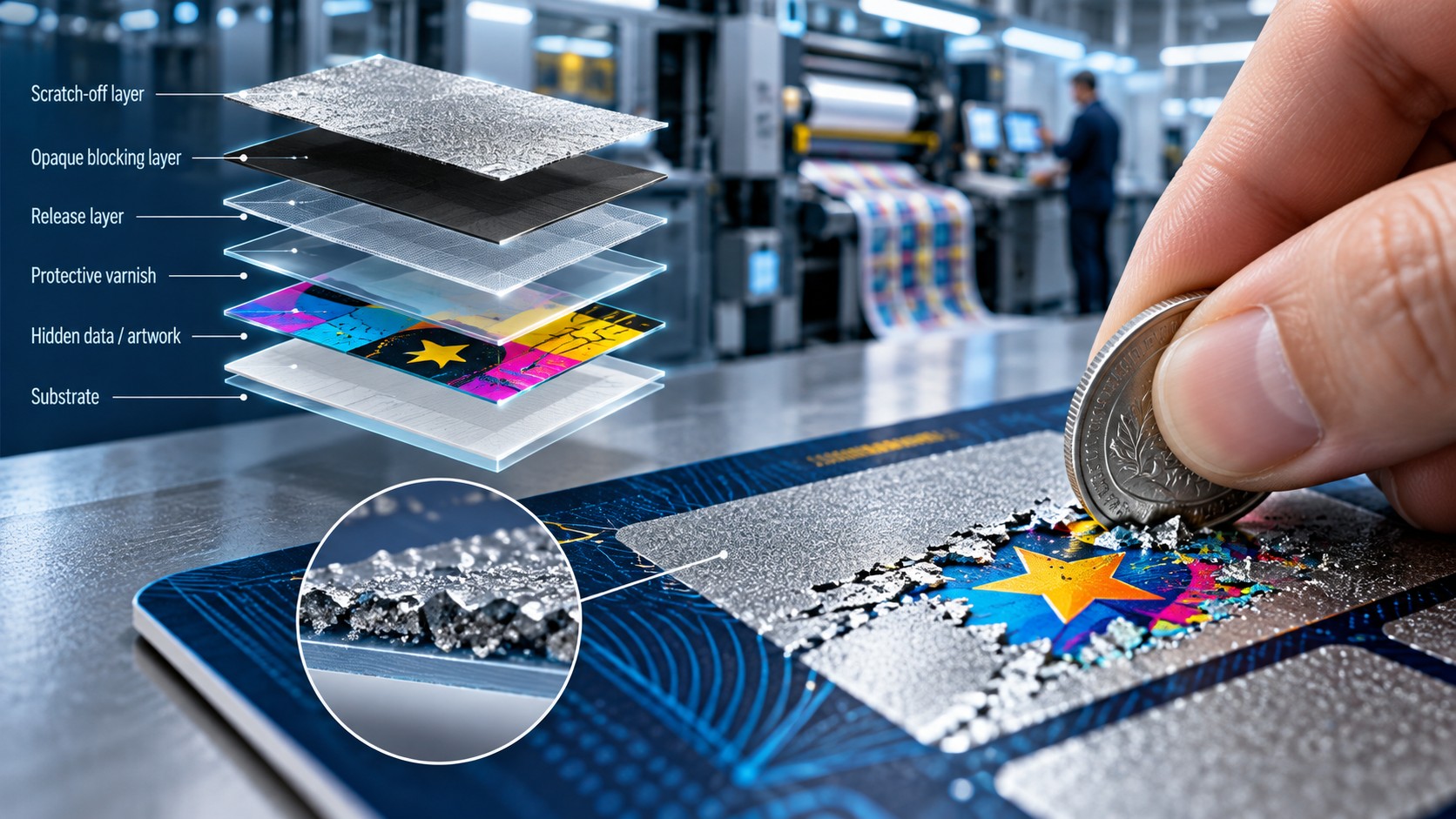
A printed product designed to reveal what it protects
In conventional industrial printing, adhesion is usually a measure of success. Once ink has been deposited on a substrate, the expectation is that it will remain in place through finishing, shipping, and use. Ink picking, delamination and premature separation are generally regarded as defects. A scratch-off card reverses part of that familiar principle. One printed structure must remain securely attached to the card, while another, carefully engineered structure above it is intended to be removed when the user deliberately scratches the designated area.
The distinction is fundamental. The colored image, number, code, or message to be revealed is printed beneath the removable scratch-off construction. It must remain legible and undamaged after the covering layers have been removed. The covering construction can itself carry another full-color design, but that design belongs to the removable layer, not to the protected information. The application succeeds only when these different functions are achieved simultaneously: the hidden content stays protected, the cover survives normal handling, and the consumer can remove it without excessive force.
This makes scratch-off production an exercise in controlled adhesion and controlled release. Paperboard, inks, protective varnish, functional release material, opaque security layers, and visible artwork are assembled into one precisely registered structure. The apparent simplicity of scratching a card conceals a highly coordinated manufacturing process.
Where scratch-off applications are used
Scratch-off technology is associated with lottery tickets, but its commercial reach is much broader. Promotional cards use hidden discounts, prizes, or short messages to create a moment of interaction. Activation and gift cards protect a code until the intended user reveals it. Loyalty programs can distribute individualized offers, while educational products use concealed answers or instructions. Event organizers, subscription providers and consumer brands can use the same mechanism for tickets, vouchers and campaigns with variable information.
Not all applications need the same level of protection. A purely decorative reveal may emphasize visual quality and the tactile experience. A financial-value ticket or an activation code may require rigorous access control, serialization, auditability, and validation that the hidden content cannot be read before its authorized reveal. The performance specification must therefore begin with the intended use and the sensitivity of the information.
Application | Concealed content | Principal engineering requirement |
|---|---|---|
Lottery and prize cards | Winning symbols, numbers or game results | Controlled reveal, confidentiality and secure production |
Promotional coupons | Discounts, offers and prizes | Consistent scratchability and attractive graphics |
Activation and gift cards | PINs and activation codes | Protection against premature disclosure |
Loyalty and personalized cards | Individualized rewards or messages | Reliable variable-data association |
Educational cards | Answers, clues and learning content | Clear, legible reveal and convenient use |
Events and entertainment | Messages, game elements and admission details | Graphic flexibility and durable handling |
A suitable specification should state which information must be protected, the required appearance before and after scratching, the expected distribution conditions, the anticipated shelf life, and the consequences of unauthorized disclosure.
Construction matters more than the silver appearance.
A familiar scratch-off card has a silver or gold panel. Yet the metallic appearance is only one possible visual outcome. The central engineering feature is a release interface that separates a removable cover from permanent information. Depending on the manufacturing route, the top of this cover may be a conventional opaque coating or a digitally printed, full-color graphic.
The architecture must deliberately separate the durable side from the removable side. The base image or confidential data should bond firmly to the substrate. A protective overprint varnish provides a functional shield over that image. A dedicated release layer is placed above this protective surface. Additional opaque, disruptive, or blocking layers can then prevent premature viewing, while visible CMYK artwork completes the external design. Each interface has its own task; maximizing adhesion everywhere would defeat the product's purpose.
The layer structure, from the substrate outward
A typical functional LEP scratch-off construction can be described from bottom to top. The construction shown below is an example, not a universal recipe: particular products may omit, combine, or add layers to meet their security and durability requirements.
Layer | Purpose | Critical qualification question |
|---|---|---|
Paperboard or suitable synthetic substrate | Mechanical support for the complete card | Is it flat, printable, opaque, and stiff enough for scratching? |
Hidden artwork / confidential data | Information or colored image to be revealed | Does it remain intact and readable after scratching? |
Protective overprint varnish | Protects the hidden ink against abrasion | Can it survive scratching while accepting the release print? |
Functional easy-release layer | Creates the controlled separation interface | Does it release when scratched without premature peeling? |
Security noise / blocking layers | Reduces premature recognition of the hidden content | Does the complete construction prevent unauthorized viewing? |
Opaque black and white backing layers | Build opacity and support visible cover colors | Are opacity and layer flexibility sufficient? |
Visible CMYK artwork | Graphic that the user sees before the reveal | Does it remain attractive and stable before scratching? |
Optional protective top coating | Adds surface durability if the system permits | Does it improve handling without making scratching too difficult? |
The crucial distinction is between the protective varnish and the release layer. The varnish is intended to remain on the protected information. The release system is intended to permit separation of the layers above it. Confusing these functions is one of the most common conceptual errors in designing scratch-off products.
Substrate selection: print quality and information security
Coated paperboard is often chosen for scratch-off cards because it combines surface smoothness, stiffness, print quality, and useful opacity. For some sheetfed systems, coated and glossy grades in the approximate range of 225–350 g/m² and 160–270 micrometers have served as application starting points. Such values are machine- and product-specific examples, not universal limits. A different card format, production technology, or security requirement may call for a different substrate.
Surface smoothness matters because it influences the uniformity of the confidential print, protective varnish, and functional covering layers. An irregular surface can produce local differences in coating thickness and release performance. Stiffness matters because the consumer should be able to scratch the designated panel without permanently bending, tearing, or crushing the card. Dimensional stability matters because the hidden image and the removable cover are commonly produced in separate manufacturing stages.
Opacity deserves special attention. A card can appear completely concealed from the front while still allowing significant light to pass through the rear. In sensitive applications, the substrate must be assessed as part of the complete optical security system. A thicker sheet is not automatically more opaque than every thinner sheet, and a dark visible cover is not automatically proof against disclosure. Qualification must examine the finished construction in representative conditions.
The two graphics that must register to one another
Unlike an ordinary printed card, the scratch-off product has at least two graphic states. Before scratching, the customer sees the cover design; after scratching, the customer sees the protected content. These states must be engineered together. The hidden image and the outline of the removable area must share one defined coordinate system, with deliberate coverage margins and appropriate tolerances.
Prepress should therefore manage the hidden image, the cover artwork, the functional release separation and each security separation as distinct objects. Digital workflows can assign functional layers their own spot-color or special-separation definitions, allowing operators to verify the content of each production pass. Registration marks should be consistent across the separate files or jobs that are ultimately aligned on press.
The result must also be checked in both states. Attractive cover artwork is not enough if hidden information becomes visible around its edge. Equally, a perfectly hidden code is not sufficient if scratching destroys a character or makes a barcode unreadable.
Variable-data printing: opportunity and responsibility
Liquid Electrophotography (LEP) is particularly useful when each card requires different content. The confidential area may contain a variable number, PIN, symbol, word, 1D barcode or 2D code, or a combination of them. The surrounding visible design may remain constant or also change between records.
Variable-data printing creates flexibility, but it introduces an information-control obligation. A system must verify that every intended record was produced, that no duplicate or missing record passes unnoticed, and that the code or prize assigned to one physical card remains associated with the correct production and fulfillment record. For security-sensitive applications, rejects, reprints, test sheets, and spoiled product must be accounted for under a controlled process. Test files should not unnecessarily expose live confidential data.
A small card can have a sophisticated graphical design while carrying data that cannot be disclosed before sale or activation. Printing accuracy and information security are therefore inseparable aspects of its production.
Concealment is not the same as simple opacity.
An opaque coating can hide information during ordinary viewing, but more demanding applications must address the possibility of optical or tactile differences being detected without authorized scratching. The engineering goal is to prevent the hidden information from being recognizable through the complete structure before deliberate removal.
One approach is to add security noise: a disruptive pattern that reduces the relationship between the shape of hidden characters and any optical signal transmitted through the structure. Another approach is to reduce detectable contrast by controlling gray-level differences or adding appropriately designed blocking layers. Opaque material and backing layers can complement these techniques. None of these measures should be considered sufficient on its own in a high-security product. Their performance depends on the substrate, layer arrangement, coverage, registration and the particular threat model being addressed.
This is why confidentiality must be verified in the finished card rather than inferred from the nominal opacity of a single ingredient.
Black blocking, white backing and colored cover artwork
A security-oriented cover often uses additional dark layers to suppress light transmission. These layers improve concealment, but they also change the optical background on which the external design is printed. A white backing layer may therefore be needed between the dark blocking structure and the visible CMYK artwork.
The sequence matters. Dark layers assist concealment; white layers create a light background for cleaner external color reproduction; the cover artwork delivers the visual identity. All must remain part of the removable construction. Their cumulative thickness and mechanical flexibility affect scratching performance, so the number of layers cannot be increased without limit.
The functional design challenge is to provide enough concealment and a satisfactory printed appearance without turning the removable cover into a rigid, excessively thick or poorly releasing composite.
Why a two-pass LEP process is used
A functional LEP scratch-off product can be produced in two distinct printing stages with protective coating in between. During the first printing pass, the press produces the confidential information and the artwork intended to remain permanently visible after scratching. The reverse side may also be printed with instructions, commercial information, or identifiers.
The first-pass sheet then leaves the printing stage and receives a protective, overprintable varnish over the relevant image area. After the varnish has reached a suitable processing state, the sheet is returned for a second printing pass. This pass builds the easy-release interface, concealing structure, white backing where needed, and visible cover design. Finishing and cutting follow the completion of the functional print.
The two-pass architecture enables the protective interface, but also introduces challenges. A sheet may change dimensionally due to temperature, moisture, or coating. The second-pass separations must remain precisely aligned with the printed hidden information. A registration error is therefore potentially an information-exposure problem, not merely an aesthetic defect.
The first pass: permanent information and the reverse side
First-pass printing must create an image that remains readable under the protective coating. Character edges, small numbers and codes must retain the contrast required for the intended use. If the confidential content is variable, verification should confirm record identity and image quality at production speed.
Also consider the visual and tactile uniformity of the hidden-data region. If a strongly localized printed feature creates a recognizable surface relief, additional background design or structural balancing may be needed to reduce the possibility of distinguishing the concealed content by touch. These measures must not make the revealed information harder to read.
The second side of the card may carry rules, redemption instructions, legal text or identification symbols. Design and print those elements without compromising the confidentiality of the front-side data.
Protective overprint varnish: a shield that must accept another print
The varnish applied after the first pass is not merely a decorative gloss. It is intended to protect the hidden information when the user later scratches away the covering construction. It must remain attached to the confidential print, withstand the abrasion of the planned reveal, and provide a suitable surface for the next functional printing step.
The last requirement is especially important. A very slippery protective coating may provide excellent rub resistance yet be unsuitable as a receiving surface for an easy-release separation. Surface-active additives, particularly strong silicone-based slip systems, can influence wetting and interlayer behavior. For this reason, varnishes intended for subsequent printing, sometimes described as overprintable grades, should be selected and qualified as part of the full construction.
The objective is not to maximize varnish adhesion to everything placed above it. Instead, the chosen varnish and release material must provide a deliberate balance: stable manufacturing behavior and an appropriately weak interface under scratching.
Water-based and UV-curable protective varnishes
Both water-based and UV-curable coating systems may suit this application, provided their chemistry and processing conditions are compatible with the release layer. They stabilize through different mechanisms. Water-based coatings require sufficient water removal and final film development; UV systems require adequate photochemical curing at the appropriate wavelengths and dose.
Property | Water-based protective varnish | UV-curable protective varnish |
|---|---|---|
Principal stabilization mechanism | Water removal and film development | Photochemical curing |
Essential compatibility requirement | Fully suitable for subsequent release-layer printing | Fully suitable for subsequent release-layer printing |
Typical process risk | Residual moisture or incomplete film development | Incomplete curing or unsuitable surface chemistry |
Performance to validate | Hidden-image protection, wetting and scratch behavior | Hidden-image protection, wetting and scratch behavior |
Qualification basis | Actual substrate, coat weight and drying | Actual substrate, coat weight and cure conditions |
In one qualified LEP process family, dry coating weights near 0.8 g/m² for a water-based varnish and approximately 4.3 g/m² for a UV coating have been used as starting points. They are examples from a particular process, not universal specifications. Film weight and coating technology must be selected for the intended varnish, substrate, print system, and final durability requirement.
A surface that feels dry immediately after coating is not necessarily ready for every downstream operation or for final durability assessment. The production plan should include appropriate conditioning and curing verification.
LEP functional printing: controlled release rather than weak printing
Liquid Electrophotography uses a controlled electrophotographic and transfer process to create a polymeric ink image. In an ordinary job, the objective is strong adhesion of the transferred ink to the receiving surface. In a scratch-off application, a specialized functional release separation is introduced between the permanently protected image and the temporary cover system.
This is not accomplished by deliberately making conventional process inks defective. It requires a press-supported, application-specific ink, separation sequence, and transfer profile. Hardware and software compatibility must be confirmed; the presence of LEP technology in a press does not by itself establish scratch-off capability.
For some supported multi-layer processes, Multi-Shot transfer is required so that the individual separations can be assembled under controlled transfer and stabilization conditions. A standard single-pass CMYK profile may not produce the same functional result.
Easy-release ink: engineering the separation interface
Functional easy-release ink is the key mechanism that lets the outer construction be scratched away while protecting the underlying information. The ink sits on the protective varnish and beneath the masking, backing, and cover graphics. During use, scratching should cause separation in the intended zone rather than stripping the hidden image from the paperboard.
Two failures are possible at opposite ends of the same adhesion window. If the release behavior is too aggressive, the covering layers may lift during packaging or customer handling. If the interface is too resistant, users may apply excessive force and damage the protective varnish or hidden print. Thus, the correct production target is neither minimum adhesion nor maximum adhesion. It is repeatable, application-specific controlled release.
Why 100% release-layer coverage may be worse
More release material is not necessarily better. In a particular LEP scratch-off system, functional release-layer coverage around 64–90% has been used to achieve a workable balance. A full 100% release layer can make the covering structure overly sensitive and prone to peeling before deliberate scratching.
Never transfer these values uncritically to another ink generation or press platform. Their significance is the principle they illustrate: excessive release capability can reduce the product's handling durability. Qualification must measure two separate outcomes—the effort required for deliberate scratching and resistance to accidental removal during normal use.
Transfer control, temperature and mechanical stability
A multi-layer release construction can be sensitive to the thermal condition of the press, blanket or transfer interface and to the pressure conditions applied during transfer. Start-up sheets may behave differently from sheets produced after the press has stabilized. Transfer settings that work with ordinary CMYK printing may not necessarily work with a specialty release separation.
An application-specific profile may therefore include transfer temperature, second-transfer force, and a suitable cleaning frequency. During process qualification, operators should evaluate both transfer completeness and finished-card functionality. A visually continuous release image may still have the wrong balance between scratchability and peel resistance.
Numerical settings are press-, material- and software-dependent and should be confirmed against a validated operating window rather than copied from unrelated applications.
The second pass: security, opacity and the visible image
In the second pass, the functional release separation is combined with the additional layers that hide the confidential print. These can include a disruptive noise pattern, one or more dark blocking separations, a white backing separation and finally CMYK artwork. The specific order depends on the press-supported functional workflow.
The separation order must be checked before production. If the printed order is wrong, a correctly designed file can still produce a structure in which the opacity, release behavior or external color appearance is unacceptable. A second-pass preflight should therefore inspect the separation list, functional spot definitions, overprint behavior, registration marks and the absence of the confidential-data separation from the cover-only job.
Graphic freedom is a major advantage of the digital approach. The covering image need not be a plain silver rectangle. It can include photography, illustration, color gradients, text and other designed elements. That freedom, however, must remain inside a functional window for layer thickness, flexibility, and controlled removal.
Registration between passes is a security requirement
Two separately printed structures must align. In many ordinary applications, slight misregistration appears as a visible color fringe. In a scratch-off card, misregistration can leave part of a secret number or picture exposed outside the covering construction. The same fault may also make a cover look misaligned after scratching.
Consistent registration marks, verified imposition, dimensional stability and controlled conditioning between passes are essential. The actual position of the hidden content and the outline of the release panel should be inspected together. Production approval should reject any card where hidden information is unintentionally visible, even if the visible artwork otherwise meets normal print-quality expectations.
Scratchability and peeling are different properties.
Scratchability is the ability to remove the intended panel through deliberate abrasion. Peeling is the unintended lifting or separation of the covering structure, sometimes as a larger continuous fragment, before the authorized action. A product can score well for ease of scratching but fail in handling durability. The reverse is also possible: a very resistant cover may remain intact in shipping but become unpleasant or destructive to scratch.
Both outcomes must be evaluated. The approved specification should define a representative scratching method, expected user effort, acceptable residue, post-reveal legibility, and resistance to ordinary rubbing or impact. The tool and method should be repeatable enough to compare production lots without claiming that a single test reproduces every consumer's use.
Preserving the image below the covering layers
The most important acceptance condition after scratching is that the permanently printed information remains clear. It is not sufficient for the cover to come away. Numbers, symbols, fine text and barcodes must remain readable; the substrate should not suffer excessive fiber disturbance; and the protective coating should not detach together with the removable cover.
An observed failure must be located precisely. Damage to the hidden ink may indicate insufficient protective varnish performance, an overly aggressive scratch interface, or a poor bond between the permanent print and substrate. Residual cover material may point to a different combination of release, film thickness, and scratching mechanics. Each mechanism requires a different experiment.
The visible artwork must also survive handling.
Before scratching, the cover is part of the customer's first impression. It should retain color quality and resist ordinary scratches, scuffs, and pressure marks created by cutting, stacking, transport, and retail handling. Optional protective top coatings may improve that durability, but they can also change how easily the cover scratches. Any additional coating therefore needs to be evaluated as part of the complete release construction, not as an isolated cosmetic improvement.
Where the cover graphics are built with several opaque and process-color layers, their cumulative thickness may also influence particle size, peel behavior, and the feel of scratching. The visually strongest construction is not necessarily the most functional.
Converting, cutting and packaging
Once printing and functional coating are complete, the sheet can be converted into individual products by guillotine cutting, die-cutting or another method suitable for the design. Cutting tools, stack pressure and material handling introduce mechanical stresses that should not initiate cover separation. The location of scratch areas relative to trim lines, perforations, creases and feed-contact points should be decided during prepress, not improvised in converting.
The finished cards may be bundled, wrapped, inserted into marketing packs or distributed individually. Packaging should prevent inappropriate rubbing and compression of the scratch-off areas. For security-sensitive cards, serialization and custody of accepted, rejected, and reprinted pieces remain part of production control after printing ends.
Information security is an end-to-end responsibility.
Physical opacity is only one element of protection. A production system for confidential or valuable scratch-off data must address the full information lifecycle: record generation, authorized access, file transfer, imposition, print verification, spoilage handling, storage, and final distribution. Barcode or code validation should verify the intended relationship between the printed physical card and the secured database record.
A printed noise pattern cannot compensate for uncontrolled access to production files. Equally, secure databases cannot compensate for a card whose information is visible through the unremoved cover. An adequate security plan must combine process controls with inspection of the actual printed construction.
Testing a scratch-off product as a complete system
No single generic measurement proves that the product is acceptable. A complete qualification program must address materials, production steps and finished functionality. The most useful test plan distinguishes between properties of the permanent image, properties of the removable cover and properties of the complete security construction.
Stage | Main checks | Acceptance objective |
|---|---|---|
Substrate | Thickness, basis weight, flatness and opacity | Stable printing and adequate optical concealment |
Hidden print and variable data | Record integrity, placement and legibility | Correct confidential content on the right card |
Protective varnish | Drying/curing, durability and overprintability | Protect the hidden content and receive the release layer |
Functional release print | Uniformity, functional coverage and transfer | Consistent deliberate separation |
Opaque and noise layers | Opacity, alignment and concealment | Prevent unintended disclosure |
White backing and cover CMYK | Image quality, color and layer integrity | Acceptable pre-reveal appearance |
Second-pass registration | Alignment of cover to hidden print | No exposed confidential content |
Converting and packing | Cut quality, rub resistance and panel integrity | No premature lifting before use |
Finished product | Scratch effort, residue, peeling, optical protection and revealed-image integrity | Consumer-ready, secure and reproducible performance |
Testing should include samples from press start-up, stable production, after converting, and after realistic conditioning. A sample that performs correctly immediately after printing may change following coating cure, storage or exposure to handling stresses. Acceptance limits should be agreed for the actual product rather than borrowed from an unrelated card type.
Relevant standards and production frameworks
Scratch-off performance does not have one universally applicable standard that defines every material choice, scratch force, reveal behavior and security requirement. The producer, customer, and, where relevant, the lottery or card-system operator must establish those acceptance criteria.
ISO 14298, *Management of Security Printing Processes*, provides a framework for organizations managing security printing, but it does not certify that a particular removable cover resists every form of unauthorized disclosure. ISO 13655 covers spectral measurement and colorimetric calculations for print color evaluation. When linear or two-dimensional codes are used, applicable ISO/IEC 15416 and ISO/IEC 15415 barcode print-quality methodologies can support objective inspection within their respective scopes.
These management and test frameworks complement, but do not replace, product-specific scratchability, concealment and durability testing. Local regulations, contract-specific requirements, and system security controls may also apply when the card carries monetary value or regulated lottery information.
Troubleshooting: diagnose the actual interface, not the visible symptom
Scratch-off failures can look similar while originating in different layers. The most reliable approach is to locate the failed interface, identify when the problem first appeared, and run a controlled comparison that isolates one contributing variable at a time. Raising coat weight, transfer temperature, or release coverage can improve one property while damaging another without a diagnosis.
Observed problem | Potential mechanism | Investigation and corrective direction |
|---|---|---|
Cover lifts during ordinary handling | Overly strong release action, fragile cover structure, or inadequate process conditioning | Requalify functional coverage and test post-converting peel resistance. |
Card is difficult to scratch. | Insufficient release, excessive cover thickness, or a rigid outer construction | Compare release interface, layer buildup, and scratch effort. |
Hidden content is damaged. | Inadequate protective varnish or unintended failure below the release interface | Examine varnish continuity, cure, and failure location. |
Hidden information is visible before scratching. | Insufficient opacity, registration error, or inadequate security architecture | Inspect substrate, noise, blocking layers, and alignment. |
Incomplete specialty ink transfer | Transfer temperature, force, or profile outside the qualified window | Verify stabilized press conditions and functional transfer profile |
Scratches appear at sheet edges. | Mechanical contact in sheet transport or delivery | Inspect contact points, guides, and the delivery path |
Varnish smears or affects the second pass | Incomplete drying/cure or incompatible surface chemistry | Validate stabilization and print-over compatibility |
Cover colors shift or appear dirty. | Interaction with black backing, white opacity, or finishing | Compare intermediate layers and color targets after full assembly |
Cover is damaged during die-cutting | Cutting pressure, tool geometry, or proximity to scratch area | Review mechanical loads and structural clearance |
Hidden content and cover do not align | Registration drift or dimensional change between passes | Check prepress marks, sheet conditioning, and press registration |
Premature peeling is not necessarily solved by indiscriminately increasing adhesion; it may require reducing release tendency within the qualified functional window. Difficult scratching is not automatically solved by maximizing release material; the cover's total thickness and stiffness may be the real limitation. A visible defect may be caused by optical transmission or a small registration gap—two different failure modes that require different corrections.
The production engineer should therefore examine the full layered structure, not only the outermost printed surface. Controlled experiments on the relevant interfaces lead to repeatable results; ad hoc changes to several variables rarely do.
Conclusion: the engineering achievement is choosing what stays and what releases
Scratch-off applications illustrate a printing principle that seems contradictory at first: some layers must remain strongly bonded, while the layers above them must separate on demand. The substrate provides mechanical stability. The hidden ink carries content that must remain permanent. Protective varnish defends that information. A specialty easy-release layer defines the planned separation interface. Opaque and disruptive layers safeguard confidentiality, and the outer graphic communicates with the user before the reveal.
Two-pass LEP technology can make this construction digitally flexible, including variable information and full-color outer artwork, when a compatible functional-ink and transfer workflow is available. Nevertheless, successful printing is only the start. Registration, physical protection, concealment, controlled scratching, and secure handling must all work together.
The printing press creates both the protected information and the visible image. The interface engineering determines which survives and which is removed.
The most important outcome is not that the covering ink can be scratched away. It is that the correct image is revealed, clearly and reliably, at the intended moment—and not a moment earlier.