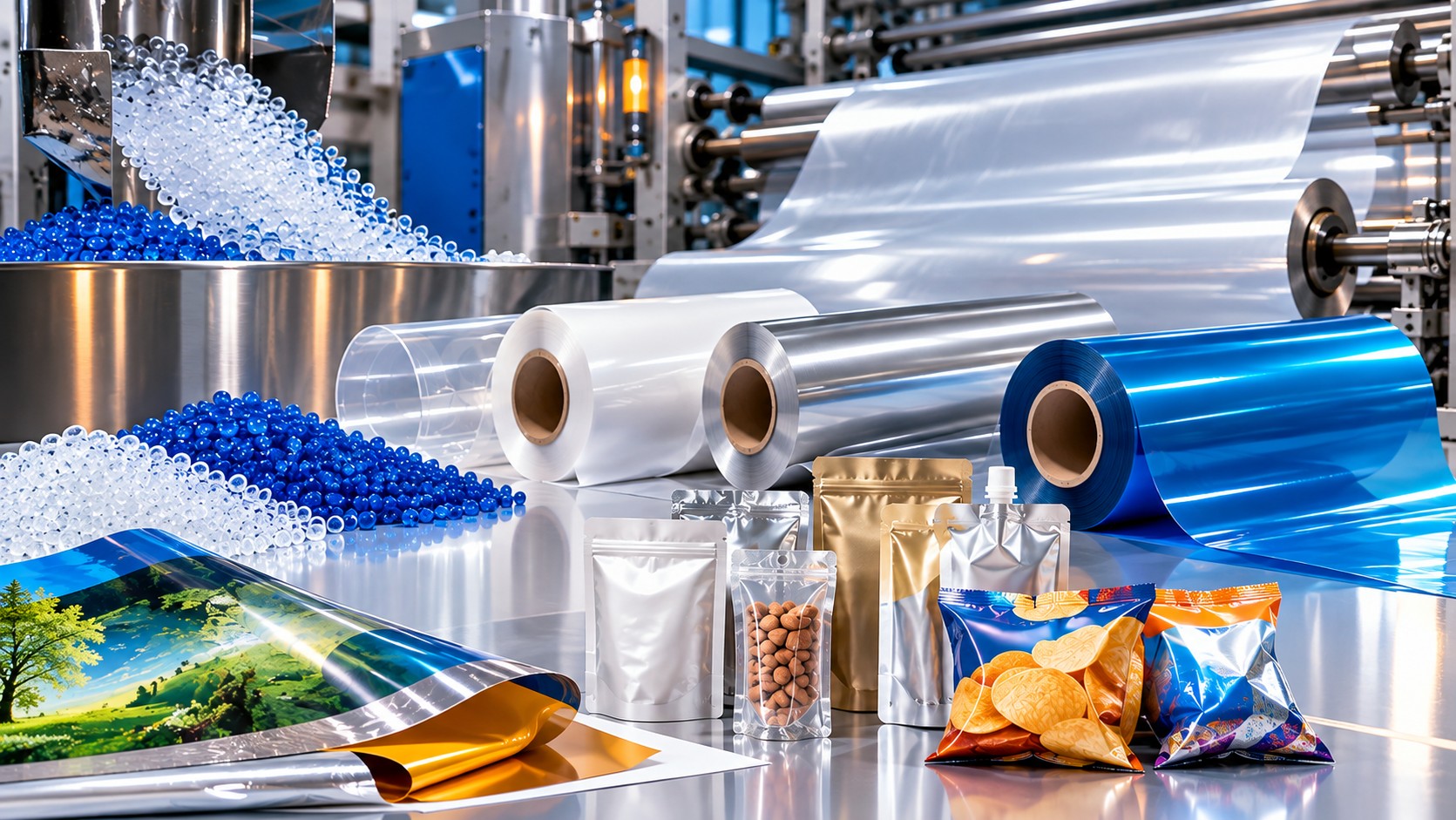
From Polymer to Performance
Engineering Synthetic Substrates for Printing, Flexible Packaging, Folding Cartons, and Commercial Applications
By Ronen Dolev | 2026
Introduction — Why Polymers Changed Printing and Packaging
Synthetic substrates have become central to printing and packaging because they can deliver combinations of properties that cellulose-based materials cannot always provide: flexibility, moisture resistance, transparency, puncture resistance, tensile strength, sealability, and engineered barrier performance.
The word plastic, however, describes an exceptionally broad family of materials. A polyethylene sealing film, a biaxially oriented polyester print web, a polypropylene label stock, and a rigid clear sheet for a folding carton differ in molecular architecture, manufacturing history, mechanical response, and end use. Even two films sharing the same polymer name can behave very differently when their grades, additives, processing temperatures, or orientation processes differ.
Substrate selection is therefore not a choice between interchangeable abbreviations. It is a systems decision involving polymer chemistry, film formation, surface modification, ink and primer compatibility, converting, final package design, and the operating environment. This article explores those relationships across flexible packaging, plastic folding cartons, synthetic papers, book covers, albums, calendars, and durable commercial products.
1. Polymer Structure: The Basis of Performance
A polymer consists of long molecular chains assembled from repeating units. Chemistry, molecular weight, chain branching, crystallinity, orientation, and formulation determine how the material behaves during melting, drawing, folding, sealing, and use. Most mainstream packaging films are made from thermoplastics: polymers that can be heated and processed within an appropriate temperature range, subject to thermal stability and degradation limits.
Crystallinity describes the degree to which chain segments pack into ordered regions. It influences stiffness, transparency, barrier behavior, chemical resistance, shrinkage, and processing. A greater crystalline fraction is not always preferable; it may improve certain properties while reducing flexibility or optical clarity.
Glass-transition temperature (Tg) describes a transition in the mobility and mechanical behavior of amorphous polymer regions. Melting temperature (Tm) applies to crystalline regions of semicrystalline polymers. Neither value should be mistaken for the actual sealing-jaw temperature needed in a packaging line: sealing depends on layer composition, heat transfer, pressure, dwell time, and the required seal performance.
Molecular-weight distribution, comonomers, impact modifiers, slip agents, antiblock particles, pigments, and other additives can materially change performance. A datasheet that identifies a film simply as "PE" or "PP" is rarely enough to qualify it for a demanding print-and-converting application.
2. From Resin to Film: How Synthetic Substrates Are Manufactured
Film manufacture generally starts with resin supplied as pellets or other suitable feedstock. In an extruder, material is conveyed by a rotating screw through a temperature-controlled barrel to form a homogeneous melt, then shaped through a die. Hygroscopic polymers, including many polyester and polyamide grades, may require carefully controlled drying before melt processing to avoid degradation.
Blown-film extrusion
In blown-film extrusion, molten polymer exits an annular die as a tube. Air inflates the tube into a bubble, while haul-off rolls draw it upward or along the line. Cooling and the relationship between blow-up ratio, draw-down, and throughput influence gauge distribution and directional properties. The tube may be slit to create flat web or processed as tubular material.
The method is widely used for PE-based shopping bags, protective packaging, sealant webs, shrink films, and multilayer flexible structures. It provides extensive formulation flexibility, though precise control of bubble stability, thickness profile, and optical properties is essential.
Cast-film extrusion
In cast-film extrusion, molten polymer emerges from a flat die onto a controlled chill roll. The process commonly provides good gauge control and a consistent visual surface. It is used for CPP and various PE films, as well as other sheet and film constructions. Quench conditions influence crystallization, appearance, and downstream mechanical behavior.
Biaxial orientation
Biaxial orientation stretches a suitable film in both the machine and transverse directions. Drawing and subsequent heat-setting reorganize polymer chains and morphology, often improving stiffness, tensile properties, dimensional stability, and selected optical or barrier characteristics. BOPP and BOPET are two major examples.
Orientation does not improve every characteristic equally. Depending on the formulation and draw ratios, it can reduce elongation at break, change tear propagation, or create sensitivity to heat shrinkage. A film's usable temperature and tension window must therefore be understood before selecting it for printing or converting.
Coextrusion
Coextrusion combines several compatible melt streams into a single multilayer film. One layer can provide sealability, another mechanical support, and another barrier performance. Where adjacent polymers bond poorly, specialized tie layers may be required. Coextrusion is particularly useful for building a structure with multiple functions without first manufacturing each layer as an independent reel.
Coating, metallization, and lamination
After film formation, a web may be coated, surface-treated, metalized, stretched further, or laminated to another substrate. Lamination joins separately formed layers, often by an adhesive or extrusion-bonding process; it is not synonymous with coextrusion. Both approaches can create functional multilayer constructions, but their mechanical behavior, curing requirements, and failure interfaces differ.
3. Polyethylene (PE): Flexibility, Moisture Resistance, and Sealing
Polyethylene is a leading flexible-packaging material because it offers a wide choice of grades and excellent opportunities to engineer a heat-sealable structure. PE is generally a good moisture-vapor barrier relative to many other uncoated common films, but it is not inherently a high oxygen-barrier material. Its principal forms should not be treated as interchangeable.
LDPE — Low-density polyethylene
LDPE has substantial chain branching and is commonly selected for flexibility and sealing applications. It is used for bags, sealant layers, extrusion coatings, and packaging webs that must deform without brittle failure. Its limitations can include lower stiffness and a narrower thermal-performance window than some alternative polymers.
LLDPE — Linear low-density polyethylene
LLDPE offers a useful combination of flexibility, tensile performance, puncture resistance, and tear behavior, depending on the comonomer system and resin grade. It is frequently used as a sealant or toughness component in packs that must withstand sharp or uneven products. Blending LLDPE with other PE grades is a common way to adjust sealing, processing, and mechanical properties.
HDPE — High-density polyethylene
HDPE generally has higher crystallinity and stiffness than LDPE and can provide very useful moisture resistance. It is employed in bags, sheets, and rigid or semi-rigid products. Depending on film processing and orientation, its tear behavior and flexibility may differ markedly from low-density grades.
MDO-PE — Machine-direction-oriented polyethylene
MDO-PE is polyethylene film stretched in the machine direction. The controlled orientation can improve stiffness, processability, and selected dimensional attributes, making appropriate grades valuable as outer webs in PE-focused flexible packaging structures. Its contribution to designs intended for PE recycling streams is increasingly important.
However, oriented PE can show directional tearing and thermal shrinkage behavior that must be investigated. Film tension, dimensional stability during print and lamination, and finished-pack seal integrity remain engineering gates, not assumptions.
4. Polypropylene (PP): Stiffness, Clarity, and Packaging Efficiency
PP offers a different balance of mechanical and thermal properties from PE. It is commonly processed as oriented print film, cast sealant film, or sheet material for particular commercial and packaging applications.
BOPP — Biaxially oriented polypropylene
BOPP is widely used for snack packaging, confectionery, bakery products, labels, overwraps, and lamination films. Its characteristic strengths include good stiffness, clarity, gloss, and efficient processing in high-speed reel applications. Typical uncoated BOPP provides useful resistance to moisture-vapor transmission but relatively limited oxygen barrier performance.
A plain BOPP film is not automatically a suitable heat-sealing surface. Heat-sealable BOPP grades may employ a specially formulated coextruded or coated sealing layer. Orientation and heat-setting conditions also influence shrinkage and directional tear properties.
CPP — Cast polypropylene
CPP is made by cast-film processing and is often used as a functional sealant film, including in suitable retort-capable structures. Compared with BOPP, it offers a different balance of orientation, flexibility, heat-seal response, and impact behavior. Retort suitability cannot be inferred from the letters CPP alone; the selected grade and full laminate must be validated under the actual thermal and mechanical cycle.
5. Polyester (PET): Dimensional Stability and Mechanical Strength
Polyester, especially PET, is a major family for printed packaging where mechanical stability, optical appearance, and resistance to processing stresses are essential.
BOPET — Biaxially oriented polyester
BOPET offers high tensile strength, stiffness, excellent print-film dimensional behavior in suitable grades, clarity, and gloss. It is widely used as an external print web, often in reverse-print structures. In such a construction, ink is printed on the inner face of the outer web and then enclosed within a laminate.
BOPET is valuable where registration stability and mechanical durability matter. Conventional BOPET alone is not usually used for internal heat-seal function, so a compatible PE, CPP, or special sealant/coating layer is commonly added when the finished package requires thermal sealing.
APET — Amorphous polyester sheet
APET is widely used for clear thermoformable sheets for trays, displays, and semi-rigid packaging. It provides a useful combination of clarity and formed-product rigidity. Its forming window and final thermal performance depend on grade, thickness, and process history.
PETG — Glycol-modified polyester
PETG is a modified polyester family that offers different forming and processing behavior than standard PET. It is used in transparent sheets, certain commercial applications, and specific shrink-sleeve structures. Select its heat response, dimensional stability, forming characteristics, and post-print performance for the application rather than assuming them from its name.
6. Polyamide (PA/Nylon): Puncture and Mechanical Resistance
Polyamides play an important role in mechanically demanding packs. BOPA, biaxially oriented polyamide, is used where resistance to puncture, mechanical abuse, and product edges matters. Typical applications include vacuum packs, meat and cheese packaging, frozen foods, and selected liquid or formable structures.
PA can absorb moisture, affecting its mechanical and barrier response. Its oxygen-barrier performance can therefore vary with conditioning, so it should not be represented by a single universal number. Films intended for long shelf life must be tested at relevant temperature and relative humidity, especially after lamination and converting.
7. Functional Barrier Polymers: EVOH and PVDC
EVOH — Ethylene vinyl alcohol
EVOH is a widely used oxygen-barrier polymer under suitable conditions. It is often included as a relatively thin internal layer within a multilayer coextruded structure. Other layers protect the EVOH, contribute mechanical strength, provide print compatibility, or form the sealant.
Its chief limitation is humidity sensitivity. Water uptake can substantially reduce oxygen-barrier efficiency. The correct EVOH grade, layer thickness, protection by adjacent materials, and storage/use conditions must all be considered when selecting a package structure.
PVDC — Polyvinylidene chloride
PVDC can provide useful gas and moisture-barrier properties in suitable coatings and multilayer systems. Its application requires attention to processing behavior, formulation, regulatory suitability, and compatibility with the intended recycling route. Alternative barrier systems may be considered when they better satisfy performance and end-of-life requirements.
8. Other Polymer Families: PVC, PS, PLA, and PHA
PVC — Polyvinyl chloride: used in some rigid clear sheets, shrink structures, and specialty products. Plasticizers, stabilizers, and the grade chosen materially affect flexibility and performance. Regulatory, environmental, and end-of-life considerations are important.
PS and HIPS — Polystyrene and high-impact polystyrene: used primarily for rigid or thermoformable sheets and packaging. Standard PS can be comparatively brittle; HIPS modifies impact behavior at some cost to other properties such as clarity.
PLA — Polylactic acid: a polyester family that can be produced from bio-based feedstocks. It is used in selected films and formed packaging, but thermal resistance and service conditions can limit use. Claims of compostability must be linked to specific grades, certified constructions, and end-of-life conditions.
PHA — Polyhydroxyalkanoates: a group of bio-produced polyesters with properties that vary considerably by composition and grade. Processing, strength, degradation behavior, and suitability for a particular package all require verification.
Bio-based, biodegradable, compostable, and recyclable are distinct terms. A material's origin does not automatically establish how it behaves in industrial composting, the natural environment, or a mechanical recycling stream.
9. Synthetic Paper: A Polymer Designed to Behave Like Paper
Synthetic paper is a group of polymer-based substrates engineered to offer selected paper-like visual or print characteristics along with functional advantages such as moisture resistance, tear toughness, and cleanability. Some grades use PP, PE, PET, fillers, microporous structures, or a specially coated surface.
They can be useful for menus, maps, reference manuals, calendars, cards, labels, weather-exposed information, and repeatedly handled commercial pieces. They may also support durable publications where ordinary cellulose-based paper would wear or soften quickly.
Yet synthetic paper is not a direct drop-in replacement. It behaves differently under folding, drilling, binding, heat, adhesive application, and static charging. A grade that prints cleanly may still crack during scoring or fail to bond to a bookbinding adhesive. The full process, including finishing, must be qualified.
10. Comparing Polymer Families
The descriptions below represent broad trends, not guaranteed datasheet values. A specific film should be chosen from its measured grade properties and service conditions.
Material | Typical strength/advantage | Important limitation | Common function |
|---|---|---|---|
LDPE | Flexibility and sealing | Limited stiffness and high-temperature use | Bags, sealant layers |
LLDPE | Puncture toughness and flexibility | Grade-dependent process behavior | Tough sealants, flexible packs |
HDPE | Stiffness and moisture protection | Lower flexibility than many LDPE films | Bags, films, sheets |
BOPP | Stiffness, gloss, clarity | Modest oxygen barrier unless modified | Snacks, overwrap, labels |
CPP | Heat sealability in suitable grades | Thermal window is grade-specific | Sealant layers, some retort packs |
BOPET | Strength and dimensional stability | Usually needs separate sealant layer | External print web |
BOPA | Puncture and abuse resistance | Moisture-sensitive properties | Vacuum, meat, frozen-food packs |
EVOH | Strong oxygen-barrier potential | Barrier declines at high humidity | Internal barrier layer |
PVDC | Functional barrier options | Processing and recycling challenges | Barrier coatings/layers |
Synthetic paper | Durable paper-like printed surface | Printing, binding, and heat qualification needed | Durable commercial products |
11. Barrier Engineering: OTR, WVTR, and Their Limitations
In flexible packaging, a film's tensile strength is only one part of its suitability. Barrier performance can determine whether a packed food, pharmaceutical product, cosmetic, or moisture-sensitive material meets shelf-life requirements.
Oxygen Transmission Rate (OTR) measures oxygen passing through a film or construction under specified conditions. Water Vapor Transmission Rate (WVTR) measures water-vapor passage. For comparable test conditions and reporting units, a lower value generally indicates less transmission of the respective substance.
The two barrier mechanisms are different. Many PE grades provide useful moisture-vapor resistance but do not function as high-performance oxygen barriers. EVOH may provide excellent oxygen protection under suitable humidity but lose much of that advantage when exposed to high relative humidity. Metalized films and functional inorganic coatings offer further alternatives, with their own mechanical limitations.
Thickness, temperature, relative humidity, pressure conditions, and film orientation all influence the reported result. Values from two suppliers are not directly comparable unless the test conditions and measurement basis agree.
Most importantly, a flat-film barrier value is not a finished-package approval. Creases, flex-cracking, pinholes, damaged coating, seal defects, and lamination faults can create transmission or leakage paths. The pouch or pack should be evaluated in the configuration and use conditions that matter for the product.
12. Why Flexible Packs Often Need Multiple Layers
A single film rarely offers the ideal combination of printable outer surface, mechanical strength, barrier, opacity, puncture resistance, and sealability. Multilayer design assigns a function to each layer and selects materials that work together.
Example: PET / Ink / Adhesive / PE
PET acts as a dimensionally stable outer print web. Printing may be applied in reverse on the face that will be laminated. The adhesive joins the structure, and PE supplies the internal sealing function. The structure is useful for selected pouches and sachets where its barrier and mechanical performance meet product requirements.
Example: PET / Ink / Adhesive / metalized PET / Adhesive / PE
The metalized layer adds barrier and light-protection functionality, while the outer PET and inner PE retain their print-web and sealant roles. The barrier level depends on metallization integrity and the completed laminate, not merely the layer description.
Example: PE-oriented mono-family construction
An MDO-PE outer web can be paired with other PE grades to provide print handling and sealing functions within a design focused primarily on polyethylene. Such structures are increasingly relevant to specific recycling-stream requirements, but coating, adhesives, barrier content, and actual sortability must still be assessed.
The best construction is not automatically the one with the most layers. Added layers may improve one property while increasing stiffness, cost, conversion complexity, and end-of-life difficulty.
13. Aluminum Foil, Metallization, and Thin Barrier Coatings
Aluminum is not a polymer, but it plays an important role in flexible synthetic laminates. Aluminum foil, when intact, can provide extremely strong barriers against oxygen, water vapor, and light. In use, it is vulnerable to defects such as pinholes, mechanical damage, and flex-cracking; barrier integrity must be verified after conversion.
A metalized film has a very thin layer of deposited metal on a polymer web. It can combine useful barrier and light-shielding performance with the handling characteristics of the underlying film, but usually does not behave exactly like a solid aluminum foil.
Transparent AlOx and SiOx coatings are another approach to improving barrier performance. These thin layers may be vulnerable to cracking under repeated flexing or demanding conversion. Testing must consider the combined structure, its bending history, and its final use conditions.
14. Surface Energy and Why Polymers Can Be Hard to Print
PE and PP surfaces commonly have relatively low surface energy, which can limit an ink, primer, or coating's ability to wet the substrate. Insufficient wetting may cause uneven coverage, poor anchorage, or failure of a later adhesive interface.
Corona treatment is widely used to modify the outermost surface chemistry through a controlled electrical discharge. Other methods include plasma treatment, flame treatment, and chemically compatible primers or topcoats. The correct approach depends on polymer family, additives, surface history, printing method, and subsequent lamination or coating.
Dyne-test values are useful indicators of wettability, but a dyne reading is not an ink-adhesion test. A sufficiently high value does not guarantee durable adhesion; weak boundary layers, migratory slip agents, contamination, unsuitable primers, and incompatible inks may still cause failure.
Conversely, excessive treatment is not harmless. In some systems, it can create weak oxidized layers or reduce downstream durability. Surface treatment can also decay during storage or change through contamination and additive migration. Production qualification should identify the correct treated side and check the actual incoming surface condition before print or lamination.
15. Polymer Substrates Across Printing Technologies
In flexography and gravure, ink wetting, viscosity, drying capacity, and the film's treated surface must match press speed and ink-transfer settings. Flexible webs also require suitable tension control and temperature management.
In inkjet, coatings and curing/drying mechanisms determine drop spreading, image sharpness, ink fixation, and post-conversion resistance. A film that accepts one inkjet technology may be unsuitable for another.
In electrophotographic printing, the transfer and fixation mechanisms interact with surface chemistry, thermal tolerance, and mechanical handling. A qualified primer or pretreated film may be required. Process settings should follow the material specification and the relevant press platform.
Across all technologies, thermal shrinkage, elastic stretch, web tension, coefficient of friction, static charge, and gauge uniformity may affect registration, wrinkles, winding, and surface quality. A defect seen at the print station can originate in film production, storage, slitting, or an inappropriate tension/temperature window rather than in the ink itself.
16. Finishing and Converting: Testing the Full Construction
Lamination and bond integrity
Lamination performance depends on adhesive chemistry, wetting, dry or applied coat weight, print/primer interface, conversion conditions, and sufficient cure where relevant. When a laminate separates, the failure may be cohesive within the adhesive, adhesive at the film interface, between ink and primer, between primer and film, or within a weak topcoat.
The peeled surfaces should be inspected to locate the actual interface. Replacing an adhesive without identifying that interface can leave the root cause unresolved.
Heat sealing and hot tack
Heat sealing requires appropriate sealant chemistry and a compatible combination of temperature, pressure, dwell time, heat transfer, and contamination control. Seal strength commonly describes the cooled seal's resistance under a defined peel test. Hot tack describes a freshly created seal's ability to withstand load while still hot, before it has fully developed its cooled strength.
This distinction matters most in fast form-fill-seal systems, where the filled package can stress the seam almost immediately. A film with acceptable laboratory cooled-seal strength can still perform poorly in a high-speed line if hot tack or the seal window is inadequate.
Slitting, folding, and pouch formation
Orientation may make tear propagation directional; controlled easy-open tearing and maximum puncture resistance are different objectives. Web tension, slit-edge quality, folds, corners, perforations, and seal positioning should be designed around the material. Final pack verification should include representative filling, transportation, and post-filling conditions where applicable.
17. Selecting Synthetic Substrates by End Application
Flexible food and consumer packaging
Snacks, coffee, dairy products, frozen foods, cosmetics, wet wipes, and household products place different demands on barrier, odor, chemical resistance, puncture, sealability, and shelf life. BOPP may be selected for stiffness and moisture protection; PET for a dimensionally stable outer print web; PE and CPP for sealing; PA for puncture-critical designs; and EVOH or coated/metallized structures when improved oxygen barrier is required.
Each decision must be based on the packaged product and the complete structure. For example, wet-wipes packaging must preserve liquid content and maintain closure functionality, not simply achieve excellent image reproduction.
Synthetic folding cartons, Plastic cards, and transparent boxes
Rigid or semi-rigid PET, PP, Plastic card PVC, and other engineered sheets may be used in transparent packages, display boxes, sleeves, cards, and specialized folded constructions. Designers need to balance stiffness, scoring/folding behavior, clarity, adhesive compatibility, cracking resistance, and edge quality.
A thermoforming-grade sheet is not automatically well suited to a sharp folding carton crease, and the reverse is equally true. Select resin formulation, thickness, and conversion route for the specific geometry.
Book covers and protective laminates
Polymer films protect commercial book covers against scuffing, handling, and moisture. Flexible laminates must survive repeated bending around spines. Adhesion, scuff resistance, finish, and local stress near scores all require consideration.
Photo albums and premium print products
Protective film can improve scratch resistance and handling life, but it also modifies gloss, tactile feel, and color appearance. The composite may curl if the laminate is unbalanced. Photo albums and lay-flat products should be tested after their final mounting and binding steps.
Calendars, maps, menus, and durable reference products
Synthetic paper may help in humid environments, repeat-use publications, display graphics, menus, maps, and calendars where washability or tear resistance is valuable. It should still be checked for stiffness, punchability, electrostatic behavior, thermal compatibility, and suitability for wire, spiral, or adhesive binding.
18. Quality Tests: Match the Method to the Real Failure Mode
A useful polymer specification should document film construction, total and layer thickness, orientation, treatment side, aging limits, surface characteristics, applicable mechanical properties, barrier conditions, and conversion requirements.
Reference | Property/test purpose | Why it matters |
|---|---|---|
ASTM D882 | Tensile properties of thin plastic sheeting | Strength and elongation, including directional behavior |
ASTM D3985 | Oxygen gas transmission through plastic film/sheet | Oxygen-barrier assessment under stated conditions |
ASTM F1249 | Water-vapor transmission through plastic film/sheet | Moisture-barrier assessment under stated conditions |
ASTM F88/F88M | Seal strength of flexible barrier materials | Performance of cooled seals |
ASTM F1921/F1921M | Hot-tack seal strength | Seal load capacity shortly after sealing |
Additional evaluations may include puncture, tear, dimensional change under heat, shrinkage, dynamic and static coefficient of friction, laminate bond strength, chemical resistance, optical properties, aging, flex-crack resistance, and package leak integrity.
A test result is meaningful only with its conditions: temperature, relative humidity, specimen preparation, thickness, orientation, applied load, and equipment method. A single-layer film result must not silently be treated as equivalent to data for the printed, laminated, sealed, and filled package.
19. Root-Cause Analysis of Common Failures
Ink peeling or poor rub resistance: identify the film and print side, surface treatment history, contamination, primer application, curing or drying, and the precise interface at which the image releases. Surface wetting alone does not establish final adhesion.
Web wrinkles and registration instability: review web-tension distribution, thickness profile, roll hardness, coefficient of friction, elastic stretch, heat shrinkage, and film history. The visible failure may originate before the press.
Color change in heat-seal zones: distinguish an optical change in film morphology from thermal damage to ink, coating, or laminate interfaces. Evaluate the sealing time-temperature-pressure window and inspect the complete layer stack.
Delamination: examine the peeled surfaces and determine whether the failure is adhesive, cohesive, within the ink, within the primer, or in the topcoat. Do not automatically attribute every peel failure to the laminating adhesive.
Barrier or shelf-life failure: investigate flex-cracking, pinholes, damaged coatings, seals, fitments, closures, and distribution abuse in addition to incoming film barrier properties.
Passes in the lab, fails at the customer: compare the laboratory environment with true conditions of filling, heat processing, humidity, storage, exposure to the packed substance, and mechanical handling. A material only passes the test that was performed—not every possible use condition.
A disciplined investigation identifies the failing layer and condition, documents the evidence, and changes one variable at a time. This is more reliable than adjusting unrelated press settings until the visible symptom disappears.
20. Sustainability, Recycling, and Mono-Family Design
High-performing multilayer packs can be difficult to recycle when PET, PE, PA, aluminum, adhesives, and complex coatings are joined in one structure. The industry is therefore developing designs based predominantly on a single polymer family, especially PE or PP, while using orientation and tailored grades to replace some functions previously supplied by dissimilar materials.
Mono-material or mono-family should not be taken as a universal guarantee of recyclability. Sortability, collection stream, ink and adhesive content, barrier layers, pigments, closures, and the recycling process determine compatibility. An MDO-PE/PE laminate may be a promising design for an identified PE stream, yet the exact construction must still meet applicable recycling-design criteria.
For bio-based or compostable polymers, verified certification and access to a suitable end-of-life system matter just as much. A claim of industrial compostability does not establish degradation in natural environments or acceptance in a local collection program.
Sustainability also depends on product protection: an apparently simpler material solution that increases food waste or causes package failure may have an unfavorable overall outcome. Effective designs assess material use, manufacturing energy, product shelf life, logistics, and realistic recovery options together.
Conclusion — Engineer the Structure, Not Just the Resin
No single polymer is universally strongest or best. PE provides a broad range of flexibility and sealing functions; PP enables clear, stiff, and efficient film structures; PET supports dimensionally stable printed laminates; PA adds toughness where puncture is critical; and EVOH or other functional barriers protect oxygen-sensitive contents under suitable conditions. Each strength depends on grade, thickness, orientation, processing history, and use environment.
The most successful package is not a collection of the individually strongest materials. It is a carefully designed structure in which each layer has a defined purpose, and all interfaces survive printing, surface treatment, lamination, slitting, folding, filling, sealing, storage, and distribution.
Substrate engineering starts with the finished product's requirements, proceeds through material and structural selection, and ends with validation of the actual converted product. Tensile strength of an isolated film and seal strength of a single test strip matter, but the decisive measure is whether the whole package—or durable printed article—protects its contents and performs reliably for its intended service life.
Source and standards framework
The technical framework was developed from the supplied flexible-packaging guide, folding-carton guide, and materials/application training presentations, supplemented by established polymer-processing and packaging principles. Standard identifiers mentioned in the text include ASTM D882, ASTM D3985, ASTM F1249, ASTM F88/F88M, and ASTM F1921/F1921M. Verify the current edition, required reporting conditions, and application-specific regulatory requirements before using these references in a purchase or acceptance specification.