Ronen Dolev | Industrial Color Engineering Series | 2026
A carton that passed every print test — until the code was touched
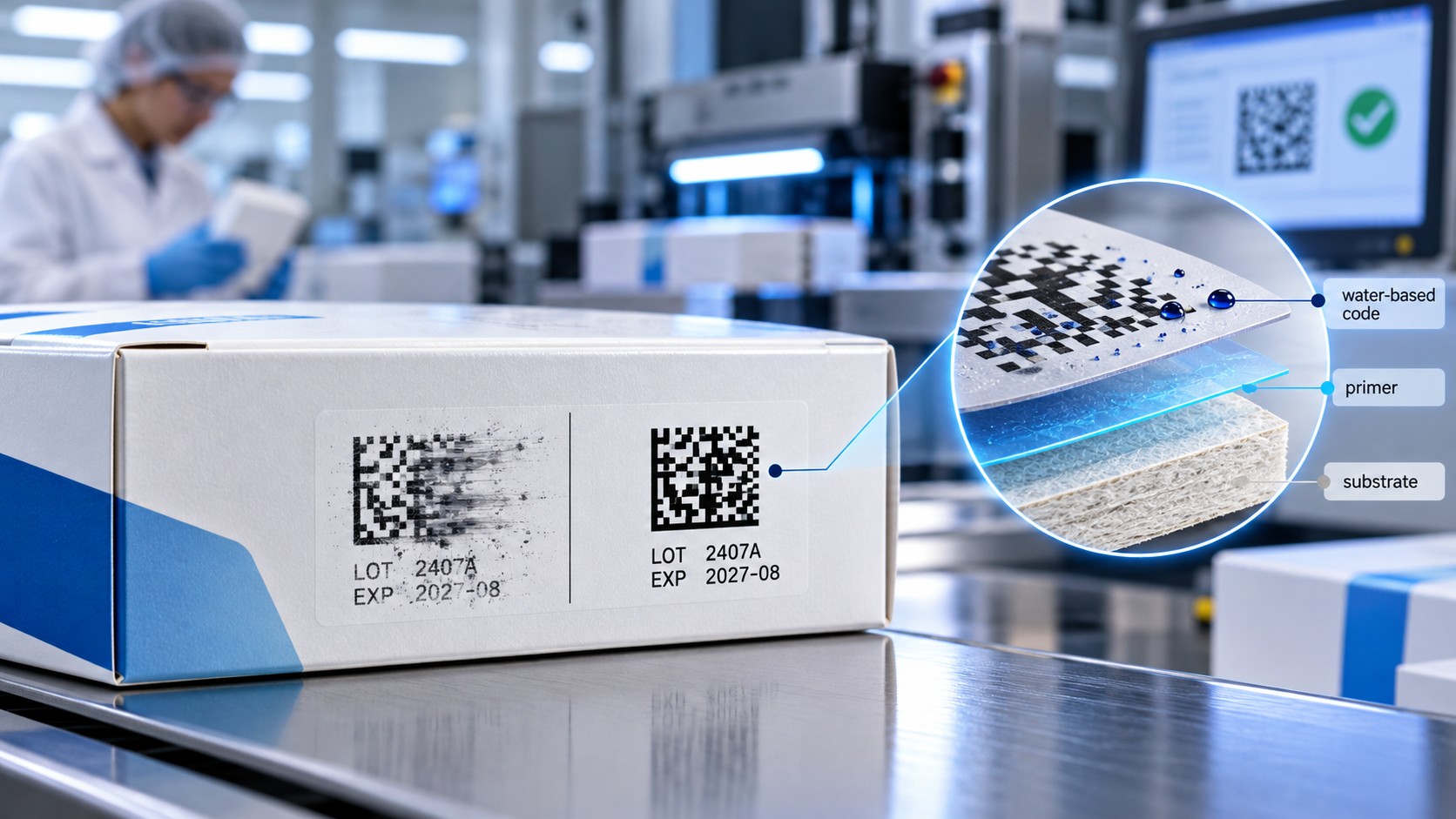
The folding carton was printed, inspected, die-cut, folded, and glued. Its graphics met the agreed print-quality criteria, and its printed areas demonstrated adequate adhesion. At the pharmaceutical filling facility, however, variable batch and expiry information was applied in an unprinted window. The characters initially looked sharp; after a short handling interval, they smeared. A mark that had been readable became vulnerable precisely where the product required durable identification.
The coding window contained no process image and no protective overprint varnish. It nevertheless contained a functional layer: primer deposited during preparation of the paperboard for digital liquid-electrophotographic (LEP) printing. In this adapted case, that layer provided a suitable interface for the original digital ink but proved insufficiently compatible with the subsequent water-based coding ink. The practical solution was not to change the product identifier or repeatedly recalibrate the press. Instead, requalify the surface on which the second ink had to work. [1, 2]
An unprinted coding window is not an empty surface. Its chemistry must be qualified for the ink that arrives later.
The regulatory purpose of post-print coding — in brief
Post-print coding is more than a visual addition to a package. The code can connect a physical carton to its product identity, batch history, expiration information, and serialization record. Precise requirements depend on the medicinal product and market; not every carton or drug is subject to the same serialization rules. Yet wherever identification is required, a code must be correct in content, machine-readable in form, and durable enough for the actual distribution and use conditions.
GS1 is an international not-for-profit standards organization, not a pharmaceutical regulator. It maintains common rules for identification keys, data attributes, and carriers. The Global Trade Item Number (GTIN) identifies a trade-item class and relevant package configuration; it does not, on its own, distinguish one physical carton from another. When a unique serial identifier is associated with a GTIN, individual packages can be distinguished. Batch and expiry data provide other dimensions of traceability. The 2026 GS1 General Specifications establish the underlying identification and data-carrier conventions. [3, 4]
GS1 data element | Function in a typical serialized identification string |
|---|---|
(01) GTIN | Identifies the trade item/package configuration, not a single serialized physical pack. |
(21) Serial number | Distinguishes a particular physical package when combined with the relevant product identity. |
(10) Batch/lot | Links the package to a defined manufacturing batch. |
(17) Expiration date | Carries a standardized expiration-date data element; formatting follows GS1 rules. |
A GS1 DataMatrix carries these elements using standardized syntax and encoding rules. It is not the same as a consumer QR code. EU Delegated Regulation 2016/161 specifies a Data Matrix for the unique identifier on medicinal products within its scope; in the United States, the DSCSA requires a two-dimensional Data Matrix for the product identifier at package level for products within its scope. Market applicability, human-readable information, and database responsibilities must be confirmed separately. [5, 6]
Three independent questions must then be answered: Is the encoded information correct? Is the printed symbol geometrically and optically verifiable? Will the mark remain usable after contact, handling, storage, and downstream processing? A successful scan addresses none of these questions completely.
The Standards Measure Different Things: Coding, Serialization, and Pharmaceutical Traceability
Pharmaceutical post-print coding is not simply a matter of adding readable text or a barcode to a finished carton. It is part of a regulated identification and traceability system that supports product authentication, batch identification, expiration control, and patient safety throughout the pharmaceutical supply chain.
Although the underlying objectives are similar worldwide, regulatory requirements differ by country and market. These differences affect the information that must be encoded, the barcode symbology, the serialization structure, the human-readable information, and the verification procedures required before a product can be released.
GS1, GTIN, and the Global Identification Framework
GS1 is an international, neutral, not-for-profit standards organization that develops and maintains recognized systems for product identification, data capture, and information exchange across supply chains.
One of its most important identification standards is the Global Trade Item Number (GTIN), which identifies a specific commercial product or packaging configuration. The GTIN does not, by itself, identify an individual physical package.
For pharmaceutical serialization, a unique serial number is associated with the product identifier, allowing individual packages to be distinguished and traced.
The GS1 system uses Application Identifiers (AIs) to define the meaning and structure of encoded information. Common pharmaceutical data elements include:
- AI (01) — GTIN: Identifies the pharmaceutical product and its defined packaging configuration.
- AI (17) — Expiration Date (EXP): Identifies the product's expiry date, encoded in YYMMDD format.
- AI (10) — Batch/Lot Number: Identifies the manufacturing batch to support quality investigations, recalls, and traceability.
- AI (21) — Serial Number: Identifies an individual package when combined with the relevant product identifier.
The GTIN identifies the product, while serialization identifies the individual package. The batch number connects packages to a specific manufacturing lot, and the expiration date defines the approved period of product use.
These data elements support traceability, but printing them correctly is only one part of compliance. Their accuracy, uniqueness, association with the correct product, and integration with the applicable national or regional traceability system must also be verified.
Data Matrix, QR Codes, and Linear Barcodes Are Not Interchangeable
Pharmaceutical packaging may contain several types of machine-readable symbols, each designed for a different purpose.
GS1 DataMatrix is a two-dimensional barcode that can encode multiple data elements in a relatively small area. It incorporates error-detection and correction mechanisms and is widely used for pharmaceutical serialization and traceability.
QR Codes are also two-dimensional symbols, but they are commonly associated with website access, electronic product information, and other digital services. Although QR Codes can carry structured identification information, they are not automatically interchangeable with GS1 DataMatrix in regulated pharmaceutical applications. GS1 Healthcare identifies GS1 DataMatrix as the preferred data carrier for healthcare product identification and traceability, while QR Codes may be used for supplementary digital information where permitted.
Linear barcodes, including EAN/UPC and GS1-128, represent information through a sequence of bars and spaces. They remain important for product identification, logistics, and supply-chain operations. However, a conventional linear barcode does not necessarily provide the data capacity or satisfy the symbology requirements of pharmaceutical package-level serialization.
Barcode selection therefore depends on its intended function and the regulatory framework governing the product.
A barcode that scans successfully is not automatically compliant. The encoded information, symbol type, printing quality, and data-processing workflow must all satisfy the applicable requirements.
Regional Differences in Pharmaceutical Coding Regulations
In the European Union, Commission Delegated Regulation (EU) 2016/161 establishes requirements for safety features on medicinal products within its scope. The unique identifier includes a product code, serial number, batch number, expiration date, and, where required, a national reimbursement or identification number.
The unique identifier must be encoded in a two-dimensional Data Matrix symbol. A conventional QR Code is not an equivalent replacement for this regulatory requirement.
In the United States, the Drug Supply Chain Security Act (DSCSA) establishes product identification and traceability requirements for covered prescription medicines. The package-level product identifier includes the National Drug Code (NDC), a unique serial number, batch or lot number, and expiration date. It must be represented in human-readable and machine-readable formats, with a two-dimensional Data Matrix required at package level. Certain linear barcode requirements continue to apply separately.
Turkey operates its pharmaceutical Track and Trace System (İTS), which uses serialized Data Matrix identification and electronic transaction reporting to follow individual medicine packages through the supply chain.
Other markets, including countries in Asia, the Middle East, and Latin America, may impose their own requirements concerning national product codes, reporting systems, serialization data, aggregation, and verification procedures.
Consequently, a pharmaceutical carton designed for distribution in multiple countries may require different data structures, labeling arrangements, and regulatory validation workflows even when the same physical printing and coding technologies are used.
Verify applicable requirements for the specific destination market and product category rather than assuming one global coding configuration satisfies every jurisdiction.
Barcode Quality Standards and Verification
International standards define different aspects of symbol generation, measurement, and verification.
ISO/IEC 16022:2024 specifies the Data Matrix symbology, including its structural characteristics, data encoding, symbol dimensions, error correction, and decoding requirements.
ISO/IEC 15415:2024 defines methods for measuring and grading the print quality of two-dimensional symbols, including Data Matrix and QR Code applications. ISO/IEC 15416:2025 addresses the print quality of linear barcodes, while ISO/IEC 15426-2:2023 specifies conformity requirements for two-dimensional barcode verification equipment.
Barcode verification evaluates characteristics such as symbol contrast, modulation, geometric consistency, fixed-pattern damage, and decoding performance under defined conditions.
For the European medicines framework, Article 6 of Regulation (EU) 2016/161 requires manufacturers to establish sufficient Data Matrix print quality to maintain readability over the specified period. The regulation recognizes a grade of at least 1.5 according to ISO/IEC 15415:2011 as a deemed-compliance route.
The reference to the 2011 edition is significant because the regulation explicitly identifies that edition, even though the ISO standard has since been updated. Project specifications must therefore identify the applicable standard edition and verification requirements.
Importantly, barcode verification assesses the measurable quality of the symbol. It does not establish that the coding ink has developed sufficient adhesion, fixation, or resistance to mechanical contact.
Expiration Date, Serialization, and Coding Durability
In pharmaceutical production, variable information is often applied after the folding carton has been printed, die-cut, folded, and glued. Depending on the manufacturing arrangement, coding may occur at the converter or later at the pharmaceutical filling and packaging line.
This information may include the batch number, expiration date, serial number, and a machine-readable identification code.
For regulatory compliance, the information must not only be correct when printed. It must remain sufficiently legible and machine-readable throughout the required handling, storage, and distribution conditions.
This requirement introduces an additional engineering challenge.
A freshly printed Data Matrix may achieve an acceptable verification grade, while the same code becomes unreadable after mechanical contact because the coding ink has not developed sufficient resistance to smearing.
Abrasion resistance must therefore be evaluated separately. ASTM D5264-98(2019) provides a controlled method for assessing the abrasion resistance of printed materials. A pharmaceutical production line may additionally require a qualified short-dwell rubbing test that reflects the actual interval between code application and subsequent handling.
Such a test should define the waiting time, contact material, force, rubbing movement, and acceptance criteria.
Neither a valid GS1 identifier nor a passing barcode verification grade guarantees that a water-based coding ink has developed sufficient resistance to smearing.
This distinction matters most when post-print coding is applied over a primer-coated surface.
A pharmaceutical code must satisfy three independent requirements: the encoded information must be correct, the printed symbol must meet the applicable quality criteria, and the marking must remain durable under its intended production and use conditions.
When the code fails the third requirement, the problem may not originate in the barcode design or coding equipment. It may originate in the physical and chemical interaction between the coding ink and the surface onto which it is deposited.
That interface becomes the central engineering question when investigating water-based post-print coding failures on primer-coated folding cartons.
Coding technologies: what each process must deliver
The choice of marking head must be separated from the choice of ink chemistry. Thermal inkjet (TIJ), continuous inkjet (CIJ) and piezoelectric drop-on-demand describe different droplet-generation approaches; water-based, solvent-based and UV-curable describe different liquid-ink systems. Performance depends on the actual pairing of equipment, formulation, and surface. Laser marking does not deposit liquid ink, but it depends equally on the construction it marks. [2]
Process family | Expected output and critical qualification checks |
|---|---|
TIJ / water-based | Fine human-readable characters or 2D symbols; confirm wetting, drying/fixing time, edge definition, and immediate rub resistance on the actual coding surface. |
CIJ / suitable liquid ink | Variable codes on moving products; confirm solvent or water compatibility, character placement, transfer resistance, and line-speed reliability. |
Piezo DOD / UV-curable | Variable text or codes formed from deposited droplets; verify complete curing, adhesion, readable modules, and downstream durability. |
CO₂ laser | Material-dependent visible marks formed by interaction with the outer surface; test coating sensitivity, contrast, potential thermal damage, and code grading. |
Fiber laser | Marking on a deliberately designed laser-responsive layer; verify pigment/surface response, contrast, and integrity rather than assuming an open white window will work. |
Thermal transfer | Ribbon-derived variable marks; qualify ribbon–surface adhesion, printhead contact, heat setting, durability and verification. |
In the adapted investigation, solvent-based and UV-curable coding systems did not reproduce the same smearing as the selected aqueous system under the practical comparison conditions. That result demonstrates selective failure, not the universal superiority of one chemistry or a waiver of code qualification. [1]
Conventional offset versus digital LEP: what does the second ink actually touch?
On a typical conventional offset folding-carton job, the ink is deposited on the coated paperboard without the additional all-over digital-print primer used in the LEP construction studied here. When graphics and varnish are excluded from the coding zone, the later coding ink commonly meets the board's own coating. This is a useful engineering contrast, not a universal rule: conventional jobs can also use surface treatments, primers, functional coatings, or specialty board finishes, each requiring compatibility verification.
In the LEP route described in the case, an all-over primer was applied to help the primary digital ink transfer and adhere. Removing the image and varnish from a rectangular coding window did not remove the primer. Consequently, the ink used later at the pharmaceutical plant was deposited on a primer-defined surface rather than directly onto the nominal board coating. Both surfaces may appear equally white to an operator yet possess very different wetting and liquid-reception characteristics. [1, 2]
Conventional offset — typical path | LEP — primed path in this case |
|---|---|
Coding ink → board coating → paperboard | Coding ink → primer → board coating → paperboard |
No additional digital-print primer in the coding window in the common construction. | Primer remains throughout the sheet even where artwork and varnish are absent. |
Qualify coding against the board coating, any surface treatment, and finishing history. | Qualify coding against primer chemistry, deposited solids, substrate, and ink system as a complete construction. |
This is why a material can be fully qualified for the first printing step but not yet qualified for coding after filling. Functional acceptance at one interface does not prove compatibility at the next.
Why water-based coding can smear on a primed window
A water-based coding droplet must spread enough to form the intended stroke or Data Matrix module without uncontrolled feathering; its liquid phase must then leave or be immobilized rapidly enough for the colorant and binder to resist contact. Depending on formulation and substrate, liquid removal can involve absorption into a porous surface, evaporation and/or other film-formation processes. Strong initial visual definition alone does not demonstrate that the dry mark has developed mechanical integrity.
A primer designed to support the primary digital ink may modify surface energy, pore access, absorption rate, and the nature of the binder interface presented to a later aqueous ink. A comparatively closed or insufficiently receptive primer surface is one plausible mechanism for delayed fixing and weak rub resistance. But the adapted case did not include a complete microscopic or chemical proof of its pore structure. The narrower, well-supported finding was that changing the primer application state changed the aqueous code's performance while the principal materials and print conditions were held constant. [1, 2]
An unstable code can fail in several ways: liquid smearing before fixation, abrasion of a partially formed film, detachment from an incompatible surface, or damage from contact pressure in downstream conveying. Their remedies differ. Before changing primer or ink, the engineer must determine whether the mark moves like wet material, flakes after drying, rubs off as a dry coating, or distorts only after a particular mechanical contact.
The controlled solution: lowering effective primer solids
The adapted case began with a useful comparison. The same finished carton construction was coded with the specified water-based system and with solvent-based and UV-curable alternatives. The aqueous code repeatedly failed the agreed rub challenge; the two comparison routes performed markedly better. This directed the investigation toward aqueous-ink compatibility with the primed window, rather than a general fault in print registration, data generation, or the board grade itself. [1]
Next, the team evaluated ordinary priming-process adjustments, including application and drying conditions. Some changes moved the result slightly, but none established the required operating margin. A controlled trial then used the same primer formulation diluted, for example, by 50%, with the board, artwork, unvarnished coding window, and core digital-print conditions otherwise kept fixed. The resulting effective solids deposited onto the board were reduced under that trial setup. After printing and converting, the water-based ink was reapplied and challenged at a fixed short interval of approximately 10–15 seconds. The code resisted the handling/rub test while the original digital image areas continued to meet the required adhesion checks. Repeated samples across sheet positions and a later evaluation strengthened the conclusion. [1]
The correction was not "remove primer." It was "restore a qualified interface for aqueous coating without sacrificing the original LEP ink-to-substrate performance."
A critical distinction: diluting a primer solution, for example by 50%, does not, by arithmetic alone, prove that the dry coating weight on the substrate will fall by exactly 50%. Viscosity, wet film delivery, anilox behavior, drying, and substrate interactions can change simultaneously. The qualification process must measure or control primer concentration, actual deposition, and resulting surface behavior. Nor does 50% dilution constitute a recommended setting for other chemistries, substrates, or platforms.
The underlying engineering hypothesis is that an overly restrictive primer layer was limiting the aqueous ink's practical fixing and anchorage within the available dwell time. The evidence directly demonstrates a process-dependent compatibility improvement; a precise molecular mechanism would require additional surface and materials characterization. [1]
A qualification protocol for the coding window
An effective development protocol works backward from the final code. It starts with the actual pharmaceutical coding line, not with an isolated press sample, and tests both the newly deposited code and the existing digitally printed image. The following sequence is an engineering framework, not a substitute for a site-approved validation protocol.
- Define the intended market, product identifiers, GS1 encoding specification, data source, required readable fields, and applicable verification grade before producing the test sheet.
- Freeze the material lot, surface state, primer formulation, application method, printing settings, artwork exclusions, varnish exclusions, and conditioning history. Retain an original-construction control.
- Document the coding equipment and aqueous formulation, production speed, placement distance, drying environment, and the actual time available before carton contact or inspection.
- Build a small, controlled primer-solids series; measure solution concentration and monitor the deposited layer rather than using dilution percentage as the only process record.
- Print, finish, fold, and code representative cartons. Test character definition and immediate rub resistance at a fixed interval chosen for the real line; then repeat after relevant conditioning or aging.
- Verify the Data Matrix with a compliant verifier under the specified methodology. Independently verify the decoded content, serialization record, human-readable data, and code persistence after handling.
- Confirm the primary printed image retains acceptable transfer, adhesion, visual quality, and converting performance. A coding solution that damages the main print is not qualified.
- Lock the validated combination of board, primer preparation, application window, code chemistry, dwell time, and acceptance methods under change control; requalify when any relevant component changes.
Troubleshooting matrix: start from the symptom, not the last successful fix
Observed failure | Priority diagnostic evidence | Directed corrective route |
|---|---|---|
Aqueous code smears at short dwell; alternatives resist | Controlled coding comparison; identical surface and contact interval; primer-present window | Assess ink–primer reception; challenge primer solids and laydown in a controlled trial. |
Code remains intact, but verifier grade is poor. | Module dimensions, contrast, quiet zone, print growth and verification setup | Correct code geometry, optical performance, or measurement setup; not primer by default. |
Code passes initially, then rubs off when dry. | Film detachment, handling contact, binder/surface adhesion, cure or fixing history | Determine failure plane and contact condition; qualify ink or surface change. |
Printed image loses adhesion when primer is reduced | Tape or defined adhesion test in original LEP print areas | Reject the reduced-primer setting or redesign selective surface preparation. |
Only certain paperboard lots fail. | Coating variation, storage/conditioning, actual primer deposition, incoming lot history | Compare approved and failing lots; tighten incoming qualification and process controls. |
Laser text or Data Matrix loses contrast after varnish | Before/after-varnish trials, wavelength, responsive layer, verifier results | Requalify laser–pigment–coating construction; do not assume inkjet window equals laser window. |
Code reads on one scanner, fails on production verification | Grade, verifier compliance, scanner optics, distance, symbology and data structure | Use the specified verification method, then separately confirm end-line read capability. |
What must be released — and what must remain under change control
A robust release decision needs three gates. The data gate confirms that the product identity, GTIN or market-specific product identifier, serial, batch, and expiration information are correct and associated with the intended package. The symbol gate confirms that the printed machine-readable carrier meets its specified quality and can be decoded reliably. The materials gate confirms that the mark remains legible and verifiable after the actual short-dwell contact, production handling, finishing history, and relevant storage conditions.
Passing one gate does not overrule failure of another. The print converter and the downstream pharmaceutical packaging operation must also agree who owns each verification, who maintains reference samples, and when an altered primer preparation or new board grade triggers requalification. Production decisions should be based on the tested construction rather than a general reputation of the primer, inkjet technology, or substrate family.
Conclusion: engineer the surface that the next process will see
In the adapted pharmaceutical-carton investigation, an apparently blank coding window was covered by a primer that supported the original LEP print. The selected aqueous coding ink could create sharp variable data but lacked adequate short-dwell rub resistance on that surface. A carefully controlled reduction in primer solids improved the code's stability without sacrificing the qualified digital-print adhesion in the tested construction. The result was not a universal dilution instruction; it was evidence that the second ink must be treated as a new material-to-surface interface requiring its own qualification. [1]
GS1 rules and pharmaceutical regulations define what information must travel with the product. ISO methods help verify how well the symbols are rendered. Neither can compensate for a coding surface that fails mechanically after the code is printed. The engineering task is to make the entire chain work: data, mark, material, measurement and downstream handling.
Technical references and source basis
- [1] R. Dolev, The Personal Journey of an Industrial Printing Expert (2026), Chapter 6, "The Window That Wasn't Empty," pp. 112–130. Adapted technical narrative; details are not represented as an independently published field trial.
- [2] Pharmaceutical Folding Carton Packaging — How-to Guide, author-supplied technical material, revision April 2024, chapters on substrates, post-print coding, and pharma standards. Used for engineering context; manufacturer-specific settings intentionally omitted.
- [3] GS1, “What is GS1?” — https://support.gs1.org/support/solutions/articles/43000734145-what-is-gs1-
- [4] GS1 General Specifications, Release 26 (January 2026) — https://www.gs1ie.org/standards/resources/general-specifications/ ; GS1 Global Traceability Standard — https://www.gs1.org/standards/gs1-global-traceability-standard/current-standard
- [5] Commission Delegated Regulation (EU) 2016/161, Articles 5–7 — https://eur-lex.europa.eu/legal-content/EN/TXT/?uri=CELEX:32016R0161
- [6] U.S. FDA, Product Identifiers under the Drug Supply Chain Security Act: Questions and Answers (2021) — https://www.fda.gov/regulatory-information/search-fda-guidance-documents/product-identifiers-under-drug-supply-chain-security-act-questions-and-answers
- [7] ISO/IEC 16022:2024, Data Matrix bar code symbology specification — https://www.iso.org/standard/80926.html
- [8] ISO/IEC 15415:2024, Two-dimensional barcode print quality — https://committee.iso.org/standard/76876.html
- [9] ISO/IEC 15416:2025, Linear barcode print quality — https://www.iso.org/standard/83390.html
- [10] ISO/IEC 15426-2:2023, Two-dimensional barcode verifier conformity — https://committee.iso.org/standard/82440.html
- [11] ASTM D5264-98(2019), Abrasion resistance of printed materials — https://store.astm.org/d5264-98r19.html